 Search
 English
 中文简体
中文简体 Deutsch
 Español
Content
- 1 Product Overview
- 2 Why Pressure-Feed Spraying Matters
- 3 Advantages Over Common Competing Spray Guns
- 4 Spray Performance and Finish Quality
- 5 Designed for Furniture Primer and Medium Paint
- 6 Manufacturing Strength Behind the Product
- 7 Research, Development, and Process Improvement
- 8 Quality Control from Raw Material to Finished Spray Gun
- 9 Operator Benefits in Daily Use
- 10 Recommended Setup Considerations
- 11 Application Technique for Consistent Results
- 12 Maintenance and Service Life
- 13 Value for Distributors and Industrial Buyers
- 14 How the W71P Supports Lower Total Finishing Cost
- 15 Comparison with Alternative Feeding Methods
- 16 Suitable Users and Working Environments
- 17 Safety and Responsible Use
- 18 Frequently Asked Questions
- 18.1 What is the W71P mainly used for?
- 18.2 What feed type does the W71P use?
- 18.3 What nozzle sizes are available?
- 18.4 What is the recommended air pressure?
- 18.5 How wide is the spray pattern?
- 18.6 Why is pressure feed useful for furniture primer?
- 18.7 Can the W71P be used with a diaphragm pump?
- 18.8 How does the W71P compare with basic cup spray guns?
- 18.9 What makes the W71P competitive?
- 18.10 How should the W71P be maintained?
- 19 Conclusion
- 20 References
- 21 Product: W71P
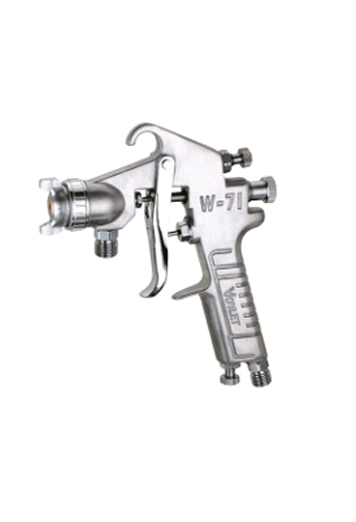
In professional finishing, a spray gun is more than a handheld tool; it is the final link between coating preparation and surface quality. The W71P is designed for pressure-feed spraying where consistency, transfer control, and stable atomization are essential. With 1.3 mm and 1.5 mm nozzle options, 43 PSI air pressure, pressure-feed operation, and a spray pattern of approximately 200 mm, the W71P is positioned as a practical solution for furniture primer, medium-viscosity paint, and production environments using diaphragm pumps.
For workshops, furniture factories, coating contractors, and distributors, the value of a spray gun is measured by daily reliability. A good gun must atomize evenly, work comfortably with the coating system, reduce rework, and support repeatable finishing. The W71P is built around these needs. Its pressure-feed configuration allows it to work effectively in continuous spraying processes, especially where gravity or suction feeding may be insufficient for production efficiency.
Product Overview
The W71P is a pressure-feed air spray gun designed for industrial and professional painting applications. Its listed nozzle sizes are 1.3 mm and 1.5 mm, giving users flexibility for different primer and medium-paint requirements. The recommended air pressure is 43 PSI, and the spray pattern reaches approximately 200 mm, making it suitable for covering flat panels, furniture parts, wooden components, and medium-sized surfaces.
The product is especially suitable for furniture primer and medium paint, and it is mainly intended to be used with a diaphragm pump. This makes it useful in coating systems where paint is supplied from a remote pressure source instead of a small cup mounted on the gun. In production, pressure feeding can reduce downtime because the operator does not need to refill a cup frequently. It can also help maintain stable material flow, which is important when applying primer across repeated workpieces.
Unlike small touch-up guns designed mainly for minor repair work, the W71P is built for a more continuous workflow. It has enough spray width for efficient coverage while still allowing control on furniture components, edges, frame structures, and assembled wood products. The 1.3 mm nozzle is useful when a finer finish or lower material output is needed, while the 1.5 mm nozzle provides more flow for primers and medium coatings that require stronger build.
| Feature | W71P Specification | Practical Benefit |
|---|---|---|
| Nozzle Options | 1.3 mm and 1.5 mm | Supports fine to medium coating flow for primer and medium paint |
| Air Pressure | 43 PSI | Provides stable atomization for pressure-feed spraying |
| Feed Type | Pressure feed | Suitable for diaphragm pump systems and continuous production |
| Spray Pattern | Approximately 200 mm | Efficient coverage for furniture panels and medium-sized surfaces |
| Main Application | Furniture primer and medium paint | Designed for professional wood finishing and coating preparation |
Why Pressure-Feed Spraying Matters
Pressure-feed spray guns are selected when users need controlled material delivery from a separate paint supply system. In a gravity-feed gun, coating material depends partly on gravity and cup position. In a suction-feed gun, airflow creates a vacuum to pull material from a cup. Both systems are useful, but they may become limiting in production environments where the coating volume is higher and the operator needs fewer interruptions.
The W71P pressure-feed design solves this problem by receiving coating material under pressure, commonly from a diaphragm pump. This method allows a more continuous supply and helps the operator keep a steady spraying rhythm. For furniture production, this is especially important because panels, cabinets, chairs, doors, frames, and decorative parts often require consistent primer build across many repeated pieces.
A pressure-feed gun can also support better material control when coatings are heavier than fine clear finishes. Primer often has more solids, and medium paint may require dependable flow to avoid dry spray, weak coverage, or uneven film thickness. By combining pressure-fed material delivery with appropriate air atomization, the W71P helps users obtain a consistent finish foundation before sanding, topcoating, or final finishing.
Advantages Over Common Competing Spray Guns
The W71P offers several advantages when compared with basic conventional guns, low-cost cup guns, and general-purpose spray guns that are not optimized for pump-fed production. Its main strength is the combination of pressure-feed compatibility, practical nozzle sizing, a wide working spray pattern, and suitability for furniture primer.
Many economical spray guns can perform occasional painting, but they may struggle in production where coating must be applied evenly throughout the day. Cup-based systems may require repeated refilling, creating pauses and possible coating variation. If the operator refills at different times or mixes smaller batches inconsistently, the finish can vary from part to part. The W71P, when connected with a suitable diaphragm pump, helps reduce such interruptions.
Compared with smaller touch-up guns, the W71P provides broader coverage. A 200 mm spray pattern is efficient for furniture panels and similar surfaces. This can reduce the number of passes required and improve productivity. At the same time, it remains controllable enough for furniture components where overly large industrial spray patterns may be wasteful or difficult to manage.
Compared with spray guns intended only for thin clear coats, the W71P is better aligned with primer and medium paint. The 1.5 mm nozzle option supports coatings requiring greater material flow, while the 1.3 mm option allows more controlled application when a finer atomization target is preferred. This flexibility gives workshops one gun platform that can be adapted to different coating steps.
In many finishing operations, low price alone does not create value. A spray gun that causes orange peel, inconsistent film build, dry edges, excessive overspray, or frequent clogging can cost much more in sanding time, rework, coating waste, and delayed delivery. The W71P is positioned as a dependable production-oriented option that supports stable application and lower process disruption.
Spray Performance and Finish Quality
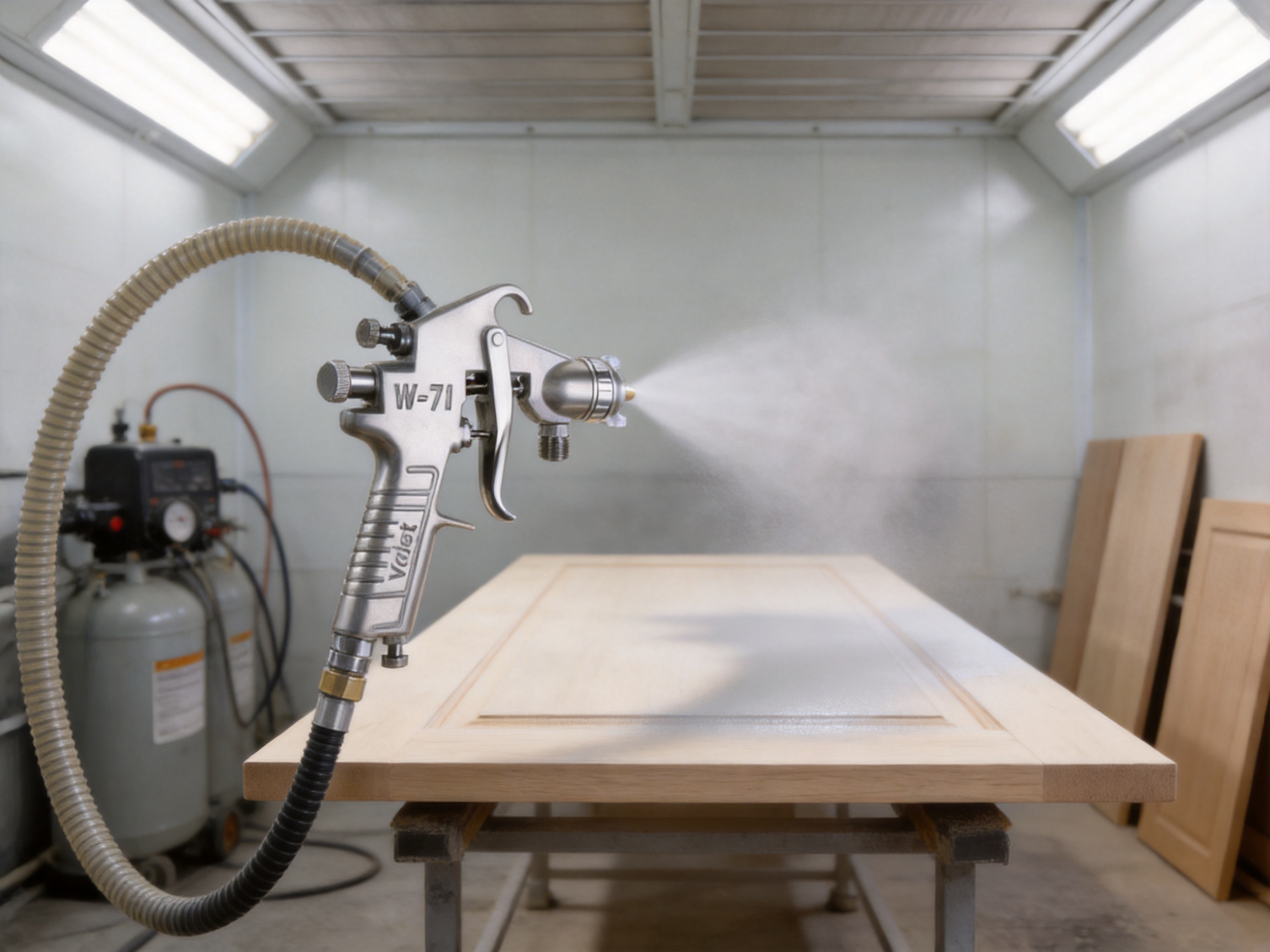
The quality of a sprayed surface depends on several linked factors: atomization, material flow, air pressure, gun distance, overlap, coating viscosity, and operator technique. The W71P supports these factors through a balanced specification set. Its 43 PSI air pressure recommendation provides the energy needed to break primer and medium paint into a consistent spray pattern, while the pressure-feed system supplies coating material steadily.
For furniture primer, the goal is usually not only visual smoothness but also proper surface preparation. Primer must cover the substrate, fill minor surface irregularities, and provide an even base for sanding and topcoat adhesion. If primer is too dry, it may create roughness and weak film formation. If it is too wet, it may sag, run, or require excessive drying time. A stable spray gun helps the operator keep the coating within the correct application window.
The W71P’s approximate 200 mm spray pattern supports uniform pass overlap. In furniture finishing, operators commonly use controlled parallel passes, overlapping each pass to build even film thickness. A pattern that is too narrow can require too many passes and increase labor time. A pattern that is too wide can waste material and make edge control difficult. The W71P sits in a practical middle range for many furniture and woodworking surfaces.
The 1.3 mm nozzle can be selected for more controlled atomization, lower output, or smoother medium coating work. The 1.5 mm nozzle can be used when primer requires more material delivery or when productivity requires faster coverage. Because coating viscosity varies by supplier, temperature, reducer ratio, and process standard, having two nozzle sizes is a meaningful advantage for process tuning.
Designed for Furniture Primer and Medium Paint
Furniture finishing is demanding because wood and engineered wood substrates are sensitive to surface preparation. Primer must be applied evenly, but the workpieces may include large flat surfaces, carved areas, frames, corners, edges, and assembled structures. The W71P is suitable for this environment because it combines production efficiency with control.
On flat panels, the broad pattern helps operators cover the surface quickly. On edges and profiles, controlled air and material adjustment can help prevent excessive build-up. For furniture primer, this balance matters because too much primer on edges can cause sanding problems, while too little primer may expose the substrate after finishing. With proper setup, the W71P helps establish a repeatable priming layer.
Medium paint applications also benefit from steady material flow. When painting furniture components, color consistency and film thickness are important. Uneven paint can lead to visible shade differences, texture variation, and customer rejection. A pressure-feed system helps ensure that material reaches the gun consistently, while the operator focuses on gun speed, distance, and overlap.
The W71P is also appropriate for production lines or batch finishing areas where a diaphragm pump is already used. Diaphragm pumps are common in finishing because they can supply coating material from a tank or container to the spray gun with controlled pressure. This arrangement makes the W71P a strong choice for workshops upgrading from cup guns to a more productive spray process.
Manufacturing Strength Behind the Product
A spray gun’s performance depends not only on its design but also on manufacturing discipline. Ningbo Lis Industrial Co., Ltd. is engaged in the research, development, manufacturing, and marketing of air painting spray gun series, mini air compressors, and relevant air tools. The company has decades of industry experience and has developed into one of the significant enterprises in the painting spray gun industry in China.
The company’s manufacturing capability is supported by a large production base, a skilled workforce, and an annual output reaching a substantial international scale. For customers, this means the W71P is not an isolated product from a small workshop but part of a broader manufacturing system that includes engineering, quality control, production planning, and export experience.
Advanced manufacturing is especially important for spray guns because small variations can influence atomization. Nozzle geometry, needle alignment, air cap precision, trigger movement, sealing performance, and material passage finishing all affect spray quality. Consistent machining and assembly help maintain predictable performance from one unit to another.
The company follows quality management practices based on ISO9000 requirements, covering raw material inspection, incoming inspection, in-process quality control, functional testing, and final product inspection. Such process control is essential for spray tools because users need stable performance when purchasing repeat orders or equipping multiple operators in the same factory.
In addition, the company has passed international product certifications such as CE and GS for relevant products, and has experience with ISO9001 quality management, OHSAS18001 occupational health and safety management, and ISO14001 environmental management systems. These systems demonstrate an organized approach to product safety, worker health, environmental responsibility, and quality assurance.
Research, Development, and Process Improvement
The W71P benefits from a manufacturing environment that values technical development. The company has invested in technology improvement and established a spraying machinery engineering technology center. This focus on engineering supports product development, process refinement, and application-based solutions for customers.
For spray gun users, research and development are not abstract ideas. They influence how comfortable the tool feels, how stable the spray pattern remains, how easy the gun is to clean, and how reliably it performs after repeated use. R&D also supports adaptation to different markets, coating systems, and user preferences.
The company provides OEM services based on customer drawings or samples and ODM services according to customer needs. This capability is important for distributors and industrial buyers who require tailored specifications, private-label programs, or customized product packages. It also shows that the manufacturing team can interpret application requirements and convert them into production-ready solutions.
Production capacity is another practical strength. The company states that production capacity can be increased by 30% within two months, which helps meet customers’ different purchase quantity needs. For importers, distributors, and project buyers, this flexibility can reduce supply risk during seasonal demand peaks or large procurement cycles.
Quality Control from Raw Material to Finished Spray Gun
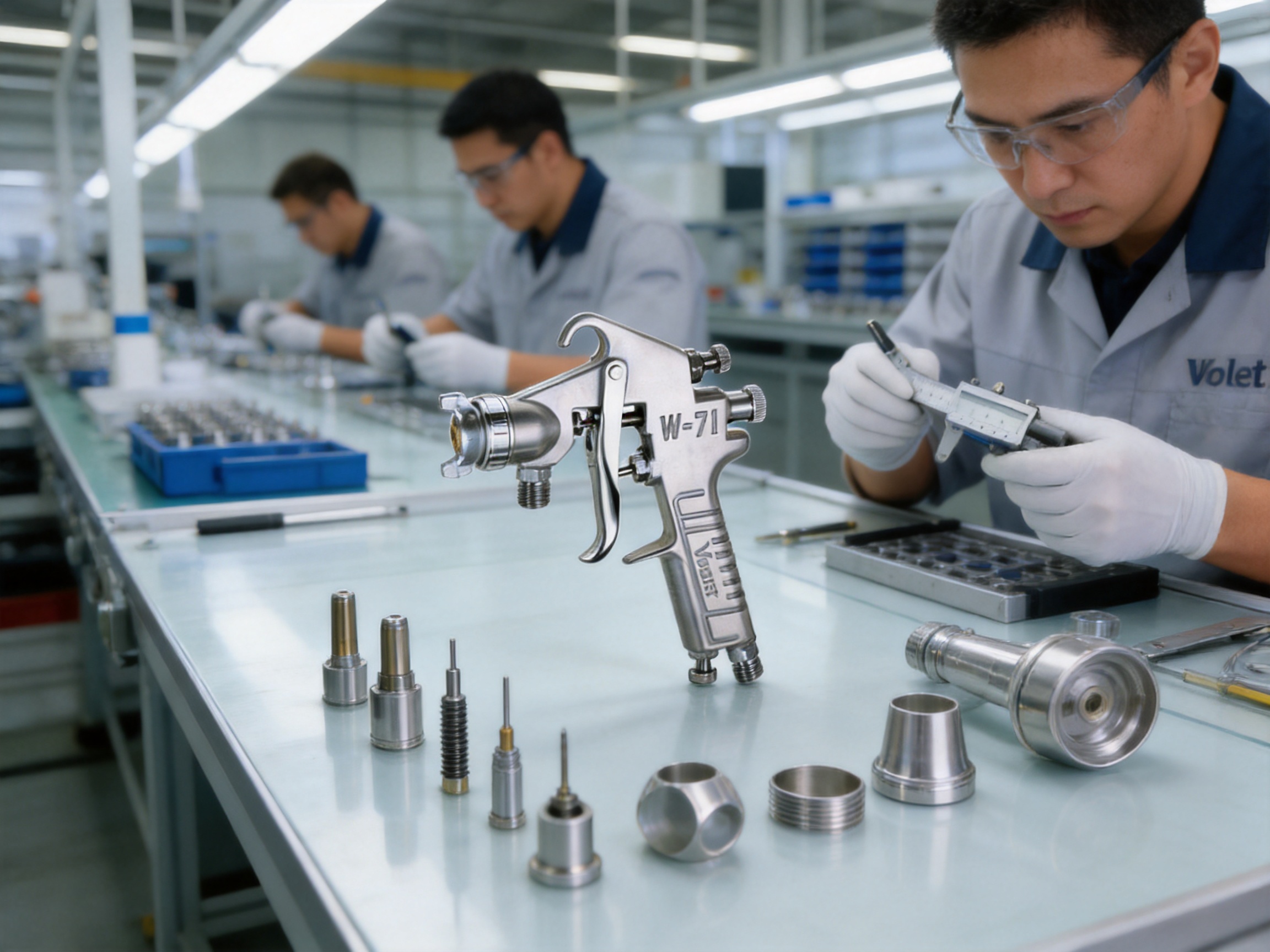
Quality control for a pressure-feed spray gun begins before assembly. Raw materials must be checked for suitability, stability, and durability. Components that interact with paint and air must be shaped accurately and finished properly. If a nozzle, needle, or air cap is inconsistent, the spray pattern may become uneven or unstable.
Incoming inspection helps prevent unsuitable materials or components from entering production. In-process quality control helps detect issues during machining, finishing, assembly, and adjustment. Functional testing verifies that the assembled product performs as expected. Final inspection confirms that the finished spray gun meets requirements before shipment.
This structured approach is one of the main differences between a serious manufacturing operation and a low-end supplier focused only on short-term price. A cheaper spray gun may look similar at first glance, but inconsistent production can lead to poor sealing, uneven spray, rough trigger action, shorter service life, and higher defect rates. The W71P gains competitive strength from being produced within a quality-oriented system.
The company’s long-term customer relationships also reflect its manufacturing credibility. Customers from Europe, North America, the Middle East, South Africa, and East Asia have developed business relationships with the company. International markets often require stable documentation, consistent quality, packaging standards, and dependable after-sales communication. These requirements encourage continuous process control and product improvement.
Operator Benefits in Daily Use
For the operator, a spray gun must feel predictable. When the trigger is pulled, the material and air should respond smoothly. The spray fan should remain stable. The coating should land evenly. The W71P’s pressure-feed design helps support that predictability because material supply is not dependent on cup angle or frequent refilling.
In a furniture workshop, operators may spray for many hours. Even small inefficiencies become costly over time. A gun that covers with a practical 200 mm pattern can reduce unnecessary passes. A gun that works with a diaphragm pump can reduce refill interruptions. A gun with suitable nozzle choices can help match the coating rather than forcing the operator to compensate with poor technique.
For supervisors, repeatability is equally important. Training is easier when tools behave consistently. If multiple operators use similar equipment and settings, process control improves. The W71P supports this by offering a clear application profile: pressure-feed operation, 43 PSI air pressure, 1.3 mm or 1.5 mm nozzle, and suitability for primer and medium paint.
For maintenance staff, a production spray gun should be straightforward to clean and inspect. Although all spray equipment must be maintained carefully, pressure-feed guns used with primers must be cleaned especially well to prevent material build-up in passages, nozzles, and air caps. A disciplined cleaning routine helps protect spray quality and extend service life.
Recommended Setup Considerations
To get the best results from the W71P, users should treat it as part of a complete spraying system. The gun, diaphragm pump, air supply, air hose, material hose, filter, regulator, coating viscosity, and operator technique all influence the final result. A good spray gun cannot overcome poor coating preparation or unstable air supply, so setup discipline is essential.
The air supply should be clean and dry. Moisture or oil in compressed air can contaminate coatings, causing defects such as fisheyes, craters, poor adhesion, or surface irregularities. An air filter and regulator should be used to help maintain stable pressure near the required operating level. The recommended 43 PSI should be interpreted as part of the system setting process, with final adjustment based on coating behavior and desired finish.
The material supply from the diaphragm pump should be stable and appropriate for the nozzle selected. Excessive material pressure may create too much output, leading to runs or excessive film build. Insufficient pressure may cause weak coverage, poor atomization, or an uneven pattern. Operators should adjust material pressure, air pressure, and gun controls together.
Coating viscosity should be checked according to the paint supplier’s guidance. Primer that is too thick may not atomize properly, while primer that is too thin may reduce film build and increase the chance of sagging. The 1.5 mm nozzle is generally more suitable for heavier primer flow, while the 1.3 mm nozzle may be selected for finer control or thinner medium coatings.
Application Technique for Consistent Results
Good technique helps the W71P deliver its full value. The operator should keep the gun at a consistent distance from the surface, move at a steady speed, and maintain the gun perpendicular to the workpiece whenever possible. Arcing the wrist can create uneven film thickness because the gun distance changes across the pass.
Overlap should be consistent. For many spray processes, operators use a regular overlap pattern to avoid stripes or dry areas. The W71P’s 200 mm pattern provides enough width for efficient overlap on furniture panels. On edges and corners, the operator may need to reduce output or adjust technique to prevent excessive build.
Trigger control is also important. Starting the spray before reaching the workpiece edge and releasing it after passing the opposite edge can help avoid heavy spots at the beginning and end of each pass. When spraying smaller components, operators should coordinate movement and trigger timing to avoid waste and uneven coating.
Environmental conditions should be considered. Temperature, humidity, airflow, and booth ventilation can affect drying and overspray behavior. Primer may dry too quickly in hot or highly ventilated conditions, creating dry spray. In cooler or humid conditions, drying may slow, increasing the risk of runs or contamination. The W71P provides stable tool performance, but environmental control remains part of professional finishing.
Maintenance and Service Life
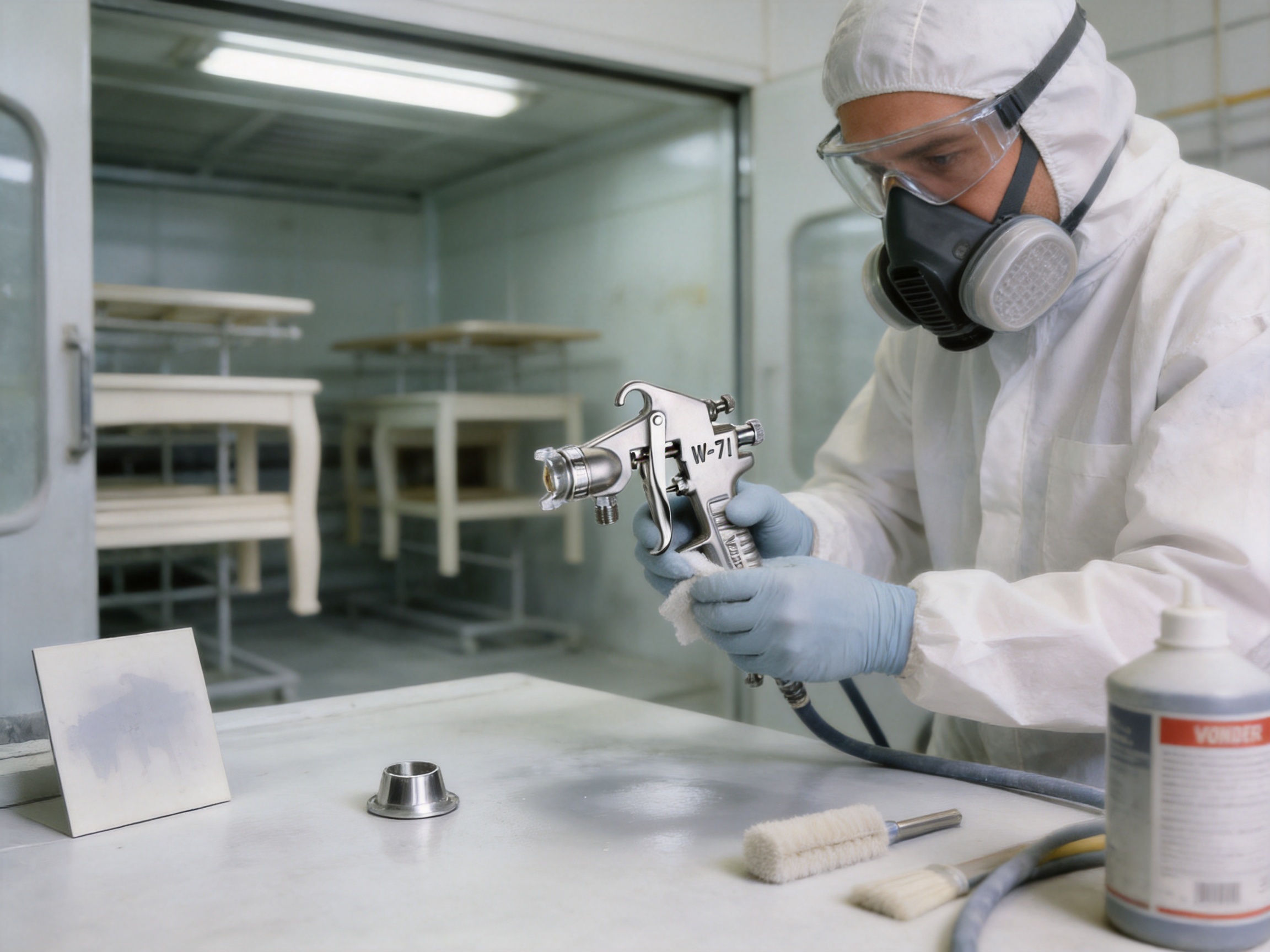
Maintenance is essential for any spray gun, especially one used with primer and medium paint. After use, the W71P should be flushed with the appropriate cleaning solvent or water-based cleaner, depending on the coating system. Material passages should be cleaned before coating dries inside the gun. The air cap and nozzle should be removed and cleaned carefully according to standard spray gun maintenance practices.
Operators should avoid using hard metal tools that can damage precision openings in the air cap or nozzle. Even small scratches or enlarged holes can distort the spray pattern. Soft brushes, proper cleaning needles, and compatible cleaning solutions are better choices. Seals and moving parts should be inspected regularly for wear.
Before each shift, the operator should check that the gun is clean, the nozzle is properly installed, the air cap is clear, and the trigger movement is smooth. The material and air hoses should be checked for leaks or restrictions. A short test spray can reveal pattern issues before production parts are coated.
Good maintenance reduces downtime and protects finish quality. It also lowers the total cost of ownership. A spray gun that is cleaned properly and used within its intended range can deliver stable performance over an extended service period, while neglected equipment can quickly produce defects even if it was well manufactured.
Value for Distributors and Industrial Buyers
The W71P is not only a tool for end users; it is also a practical product for distributors, importers, and industrial procurement teams. Its application focus is easy to communicate: a pressure-feed spray gun for furniture primer, medium paint, and diaphragm pump systems. This clear positioning helps sales teams match the product to appropriate customers.
Because the manufacturer has broad experience in air painting spray guns, mini air compressors, and relevant air tools, buyers can source within a wider product ecosystem. This can simplify procurement for distributors that need spray guns, accessories, fittings, paint tanks, and related tools. A supplier with multiple categories can support more complete spraying solutions.
The company’s OEM and ODM capability gives business customers room for customization. Packaging, market positioning, accessory combinations, and product specifications can be discussed according to project needs. The company’s production capacity flexibility also supports larger orders and changing demand.
For international buyers, supplier stability is a major consideration. A manufacturer with long operating history, quality system experience, certifications, engineering resources, and global customer relationships offers stronger supply confidence than a small unknown source. The W71P gains value from this manufacturing background.
How the W71P Supports Lower Total Finishing Cost
The purchase price of a spray gun is only one part of finishing cost. Coating waste, labor, rework, sanding time, downtime, cleaning time, and rejected parts all affect profitability. A stable spray gun can reduce these hidden costs by helping operators apply the right amount of material consistently.
In furniture priming, uneven application can lead to extra sanding or additional primer coats. Thin areas may require rework, while heavy areas may dry slowly or clog sandpaper. The W71P’s pressure-feed system and practical pattern size support more uniform primer coverage, reducing the likelihood of avoidable correction work.
Material savings can also result from better pattern control. Excessive overspray wastes paint and increases booth maintenance. A gun that atomizes properly and delivers material consistently can help operators keep the coating on the workpiece rather than in the air or on booth filters. While transfer efficiency depends on many factors, stable equipment is a necessary foundation.
Production time can be improved because the pressure-feed system reduces cup refilling interruptions. In batch furniture production, even short pauses accumulate over the day. When material is supplied from a pump system, the operator can continue spraying longer with fewer workflow breaks.
Comparison with Alternative Feeding Methods
Gravity-feed spray guns are popular because they are simple, compact, and efficient for many finishing jobs. However, their cup capacity can be limiting in continuous production. Cup weight and position may also affect operator comfort during long spraying sessions. For smaller jobs, gravity feed is convenient; for larger primer operations, pressure feed may be more productive.
Suction-feed spray guns can be useful for certain conventional applications, but they depend on air movement to draw coating material upward from a cup. This can be less ideal for higher viscosity materials or steady industrial primer application. Pressure feed provides more direct material delivery.
Airless spray equipment can deliver high production speed and high material output, but it may not provide the same type of atomization control needed for some furniture finishing processes. Air-assisted and air spray methods are often chosen when finish appearance and controlled film build are important. The W71P fits into this controlled air spray category, especially for primer and medium paint.
Electric spray guns can be convenient for DIY or light-duty work, but professional furniture production often requires compressed air systems, pump feeding, and more durable industrial equipment. The W71P is better aligned with workshops that already use compressed air and professional coating supply systems.
Suitable Users and Working Environments
The W71P is suitable for furniture manufacturers, woodworking finishing shops, cabinet producers, door and panel coating operations, industrial paint rooms, and professional coating service providers. It is especially relevant where primer is sprayed repeatedly and where a diaphragm pump is used for material supply.
It can also serve distributors targeting professional users who need a reliable pressure-feed gun without moving into overly complex equipment. Its specifications are straightforward, which makes product training and customer support easier. Users can understand its purpose quickly: 1.3 mm and 1.5 mm nozzle options, 43 PSI air pressure, pressure feed, and 200 mm spray pattern.
The product is also appropriate for workshops transitioning from manual cup spraying to more organized production spraying. By pairing the W71P with a diaphragm pump and properly regulated air supply, a workshop can improve workflow and reduce refilling interruptions. This makes it a practical upgrade step for growing businesses.
Safety and Responsible Use
Spraying operations require attention to safety. Users should follow coating supplier instructions, wear appropriate personal protective equipment, and operate in a properly ventilated spray area. Respiratory protection, eye protection, gloves, and protective clothing may be necessary depending on the coating material and local regulations.
Compressed air equipment should be used within recommended pressure limits. Hoses, fittings, regulators, and pumps should be inspected to prevent leaks or failures. Operators should never point a spray gun at people or use compressed air carelessly. Cleaning solvents and coating materials should be handled according to safety data sheets.
Environmental responsibility is also important. Overspray, solvent waste, used filters, and leftover coatings should be managed according to applicable rules. A well-controlled spray process can reduce waste and support cleaner production. The manufacturer’s attention to environmental management systems reflects the growing importance of responsible manufacturing and use.
Frequently Asked Questions
What is the W71P mainly used for?
The W71P is mainly used for furniture primer and medium paint applications. It is especially suitable for professional woodworking and furniture finishing operations where consistent coating coverage is required.
What feed type does the W71P use?
The W71P uses a pressure-feed system. This means coating material is supplied under pressure, commonly from a diaphragm pump, instead of relying on a cup mounted directly on the gun.
What nozzle sizes are available?
The W71P is specified with 1.3 mm and 1.5 mm nozzle options. The 1.3 mm option is useful for more controlled or finer applications, while the 1.5 mm option supports stronger material flow for primer and medium paint.
What is the recommended air pressure?
The listed air pressure is 43 PSI. Actual setup should also consider coating viscosity, hose length, regulator accuracy, and production requirements.
How wide is the spray pattern?
The spray pattern is approximately 200 mm. This width is practical for furniture panels, wooden components, and medium-sized surfaces.
Why is pressure feed useful for furniture primer?
Pressure feed is useful because it provides steady material supply and reduces the need for frequent cup refilling. This helps maintain production rhythm and supports consistent primer application across repeated workpieces.
Can the W71P be used with a diaphragm pump?
Yes. The W71P is mainly intended for use with a diaphragm pump, making it suitable for workshops and production lines that already use pump-fed coating systems.
How does the W71P compare with basic cup spray guns?
Basic cup spray guns are convenient for small jobs, but they may interrupt production due to limited cup capacity. The W71P offers better suitability for continuous spraying because it works with pressure-fed material supply.
What makes the W71P competitive?
The W71P is competitive because it combines pressure-feed operation, practical nozzle choices, a 200 mm spray pattern, and suitability for furniture primer. It is also supported by a manufacturer with strong production capacity, quality control systems, R&D capability, and international market experience.
How should the W71P be maintained?
It should be cleaned after use with the proper cleaning material for the coating system. The nozzle, air cap, and material passages should be kept clear. Operators should avoid damaging precision openings and should inspect seals, hoses, and fittings regularly.
Conclusion
The W71P pressure-feed spray gun is a practical and production-ready tool for furniture primer and medium paint applications. Its 1.3 mm and 1.5 mm nozzle options, 43 PSI operating pressure, pressure-feed configuration, and 200 mm spray pattern make it well suited for professional woodworking and furniture finishing environments.
Its main advantage over many competing spray guns is its suitability for pump-fed continuous spraying. By working with a diaphragm pump, it reduces refilling interruptions, supports stable material delivery, and helps operators maintain consistent application. For furniture manufacturers and finishing workshops, this can translate into better workflow, more uniform primer build, and lower rework risk.
The product is also strengthened by the manufacturing background of Ningbo Lis Industrial Co., Ltd. The company’s experience in spray gun production, quality management systems, engineering resources, OEM and ODM services, certifications, and global market presence all support the W71P’s value. In a market where many spray guns may appear similar, manufacturing discipline and process control make a significant difference.
For users seeking a reliable pressure-feed spray gun for furniture primer, medium paint, and diaphragm pump systems, the W71P offers a balanced combination of performance, productivity, and manufacturing credibility.
References
1. Product specification material for W71P pressure-feed spray gun, including nozzle size, air pressure, feed type, spray pattern, and application information.
2. Company manufacturing and quality information provided by Ningbo Lis Industrial Co., Ltd., including production capability, quality control process, certification background, and R&D capability.
3. General industrial finishing practice references on compressed-air spray application, pressure-feed spraying, coating viscosity control, and furniture primer application.
4. Standard spray finishing maintenance principles for air caps, nozzles, needles, material passages, compressed air preparation, and coating system cleanliness.