 Search
 English
 中文简体
中文简体 Deutsch
 Español
Content
- 1 Product Overview
- 2 Why an Air Blowing Gun Matters in Production
- 3 Advantages Over Ordinary Competing Blow Guns
- 4 Applications of the BG-2
- 5 Design Priorities for Daily Use
- 6 Manufacturing Strength Behind the Product
- 7 Quality Control from Raw Material to Final Inspection
- 8 Certifications and Management Systems
- 9 Comparison Table
- 10 Role in a Complete Air Tool System
- 11 Support for Surface Preparation and Finishing Quality
- 12 Value for Distributors and Industrial Buyers
- 13 Practical Use Guidelines
- 14 Maintenance Considerations
- 15 How the BG-2 Supports Productivity
- 16 Manufacturing Culture and Continuous Improvement
- 17 Environmental and Energy Considerations
- 18 Safety in Air Blowing Operations
- 19 Ideal Customers for the BG-2
- 20 Why Manufacturing Scale Benefits the End User
- 21 Frequently Asked Questions
- 21.1 What is the BG-2 used for?
- 21.2 Why choose this air blowing gun instead of a generic low-cost model?
- 21.3 Can the BG-2 be used before painting?
- 21.4 Is the BG-2 suitable for woodworking?
- 21.5 Does the tool require special maintenance?
- 21.6 Can distributors order customized versions or packaging?
- 21.7 What makes the manufacturer strong in pneumatic products?
- 21.8 Is compressed air blowing safe?
- 22 Conclusion
- 23 References
- 24 Product: BG-2
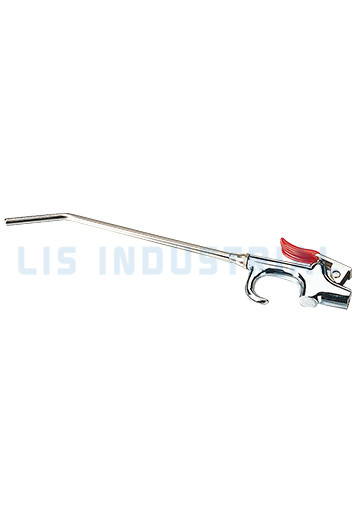
In modern workshops, finishing lines, assembly stations, maintenance areas, and paint preparation rooms, compressed air is one of the most practical utilities available. The BG-2 air blowing gun is designed for the everyday task of directing controlled air where it is needed: removing dust, clearing chips, drying surfaces, cleaning workpieces, and supporting general shop maintenance. As part of the air blowing gun category, the BG-2 serves a simple but essential purpose, yet its value depends on how well it is manufactured, how consistently it performs, and how comfortably it supports daily operation.
The BG-2 is not merely an accessory attached to an air line. It is a working tool used repeatedly throughout the day by technicians, painters, assemblers, maintenance workers, and machine operators. For that reason, users look for a blow gun that feels stable in the hand, responds predictably to trigger input, connects easily with standard air fittings, and maintains reliable airflow over long service periods. In industrial environments, even small tools can influence productivity, safety, finishing quality, and cleaning efficiency. A dependable air blowing gun helps prevent rework, reduces manual cleaning time, and improves preparation before coating, assembly, packaging, or inspection.
The BG-2 is supplied by Ningbo Lis Industrial Co., Ltd., a manufacturer engaged in the research, development, manufacturing, and marketing of air painting spray guns, mini air compressors, and relevant air tools. The company’s long history in air tools and spray-related equipment gives the product a broader technical foundation than ordinary low-cost blow guns made without deep experience in air handling. Since its establishment in 1984, the company has developed extensive production capability, quality control systems, and international market experience. This background is important because a reliable blow gun requires not only a simple structure but also stable machining, material control, assembly discipline, air tightness verification, and consistent final inspection.
Product Overview
The BG-2 is categorized as an air blowing gun. Its primary function is to deliver compressed air through a hand-operated tool, allowing the user to blow away unwanted particles, moisture, dust, or debris from surfaces and work areas. In a woodworking shop, it can help remove sawdust from equipment, jigs, and workpieces. In an automotive refinishing environment, it can support surface preparation by clearing sanding dust before painting. In a metalworking or maintenance area, it can clear chips from machine tables, fixtures, and parts. In general assembly, it can dry components or remove loose contaminants before packaging.
Although air blowing guns may appear simple, the difference between a basic tool and a professionally manufactured tool becomes clear during repeated use. A poorly made blow gun may leak air, deliver inconsistent flow, feel uncomfortable, wear quickly at the trigger, or fail to seal properly at connection points. It may also be difficult to control, especially when a user needs a gentle stream for delicate parts or a stronger burst for debris removal. A better-designed tool provides a more predictable response, giving the operator confidence in daily tasks.
The BG-2 is positioned as a practical air tool for users who need dependable compressed-air cleaning without unnecessary complexity. It belongs to a wider product ecosystem that includes spray guns, air brushes, air fittings, paint tanks, air pipeline accessories, air compressors, and related pneumatic products. This ecosystem matters because air tool performance is influenced by more than the tool itself. It also depends on the quality of air supply, fittings, hoses, regulators, filters, and workflow design. A manufacturer experienced in complete spraying and pneumatic systems is better able to understand how a blow gun should function in real working conditions.
Why an Air Blowing Gun Matters in Production
Air blowing guns are among the most frequently used tools in many industrial spaces. They are often kept near workbenches, paint booths, assembly lines, CNC equipment, woodworking machines, inspection benches, and maintenance carts. Their role is immediate and practical: remove what should not be there. That may be dust on a panel, chips in a drilled hole, sanding powder on a primer surface, droplets of water after washing, or loose fibers before packaging.
Contamination control is especially important in surface finishing. A fine layer of dust can ruin a coating job, create fisheyes, cause adhesion problems, or require sanding and repainting. Before using a spray gun, a clean surface is essential. A blow gun can help remove particles from seams, corners, holes, grooves, and textured surfaces where wiping alone may not be sufficient. In woodworking, dust left on a surface can interfere with staining, coating, gluing, and finishing. In metal fabrication, chips left in threaded holes or fixtures can damage tools or create assembly issues.
Drying is another important use. After washing, rinsing, degreasing, or air-line moisture exposure, parts may need to be dried before the next process. Compressed air can accelerate drying in complex shapes, holes, edges, channels, and recesses. A tool like the BG-2 allows the operator to direct air only where required, reducing wasted time and improving process control.
Workplace organization also benefits. Keeping machines, benches, and fixtures free from debris helps operators work faster and reduces the chance of quality issues. When cleaning is convenient, workers are more likely to do it frequently. A comfortable and reliable blow gun encourages routine cleaning rather than delayed cleaning, which can lead to accumulated debris and process interruptions.
Advantages Over Ordinary Competing Blow Guns
The BG-2 offers advantages that come from professional manufacturing experience, consistent quality management, and a broader understanding of pneumatic tools. Many low-end blow guns in the market are treated as disposable accessories. They may perform acceptably at first but often show problems after repeated trigger operation, rough handling, or long periods connected to compressed air. By contrast, a tool produced within a controlled manufacturing environment is more likely to deliver stable performance across batches and over time.
One advantage is consistency. A user purchasing multiple units for different workstations needs each tool to behave similarly. If one blow gun has a stiff trigger, another leaks, and another delivers weak airflow, operators lose confidence and maintenance staff spend unnecessary time replacing parts. The BG-2 benefits from a quality system that includes raw material inspection, in-process quality control, functional testing, and final inspection. This disciplined approach helps reduce variation and provides a stronger basis for repeatable performance.
A second advantage is compatibility with professional pneumatic environments. The manufacturer supplies a wide range of air tools and air pipeline accessories, including fittings, spray gun kits, paint tanks, air compressors, and related accessories. This experience supports practical product design because connection reliability, air passage design, sealing behavior, and user handling are part of the company’s daily technical field. A blow gun must work smoothly with compressed air systems, and a producer with broad pneumatic expertise can better understand those requirements.
A third advantage is manufacturing maturity. The company has operated for decades and has grown into a large enterprise in the painting spray gun industry in China. Large-scale production requires stable processes, trained workers, systematic inspection, supplier management, and continuous improvement. These strengths are not always visible in the product photo, but they affect the product received by the customer. For distributors, wholesalers, industrial buyers, and workshop managers, manufacturing stability is often as important as initial price.
A fourth advantage is international market experience. Products from the company are sold into Europe, North America, the Middle East, South Africa, and East Asia. Different markets have different expectations for packaging, documentation, certification, durability, consistency, and after-sales communication. Experience with global buyers helps shape products that can meet practical professional needs rather than only local or short-term market standards.
A fifth advantage is the company’s ability to support OEM and ODM requirements. For customers who need customized packaging, fitting preferences, product configuration, or private-label supply, the manufacturer’s R&D and engineering capabilities are valuable. Many competing suppliers can only offer existing stock designs. A manufacturer with established development capability can adapt to customer needs more effectively, making the BG-2 and related air tool offerings suitable for distributors and industrial supply channels.
Applications of the BG-2
The BG-2 is suitable for many common compressed-air cleaning tasks. Its usefulness extends across different industries because most production environments need fast, directed, non-contact cleaning. The tool can support operations before, during, and after production.
In woodworking, the BG-2 can help clear sawdust from panels, joints, cabinets, molds, machine beds, guide rails, and sanding areas. Wood dust can settle into pores, corners, and grooves. If not removed before coating or assembly, it can affect appearance and bonding. A controlled air stream helps remove loose material quickly, especially from irregular shapes where cloth wiping is inefficient.
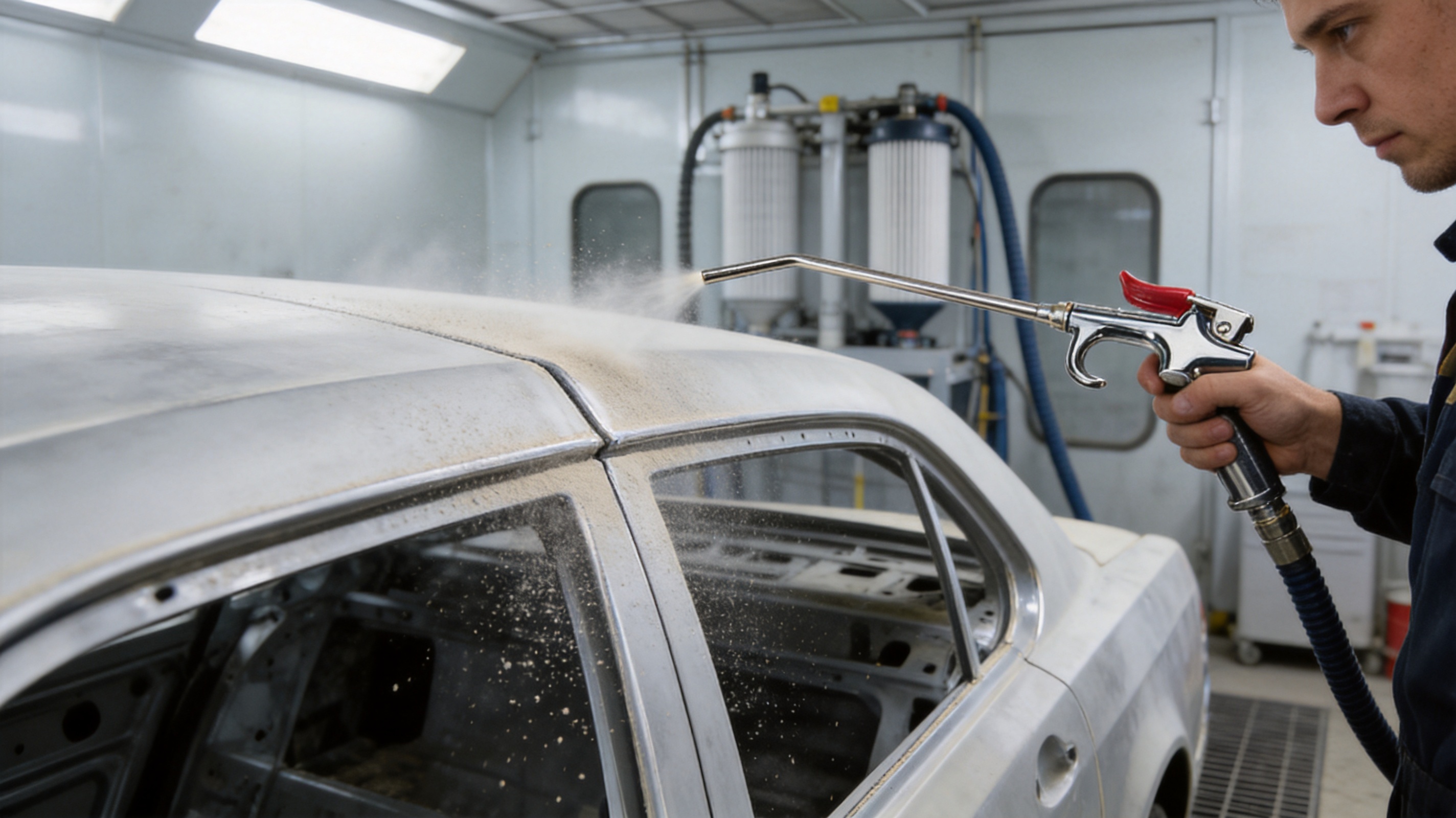
In automotive repair and refinishing, the tool can help clean surfaces after sanding, remove dust from gaps, clear debris near trim, and dry specific areas after washing. Before paint application, surface cleanliness is crucial. A blow gun helps prepare panels and components for the next stage, particularly when used together with proper filtration, dry compressed air, and other surface preparation methods.
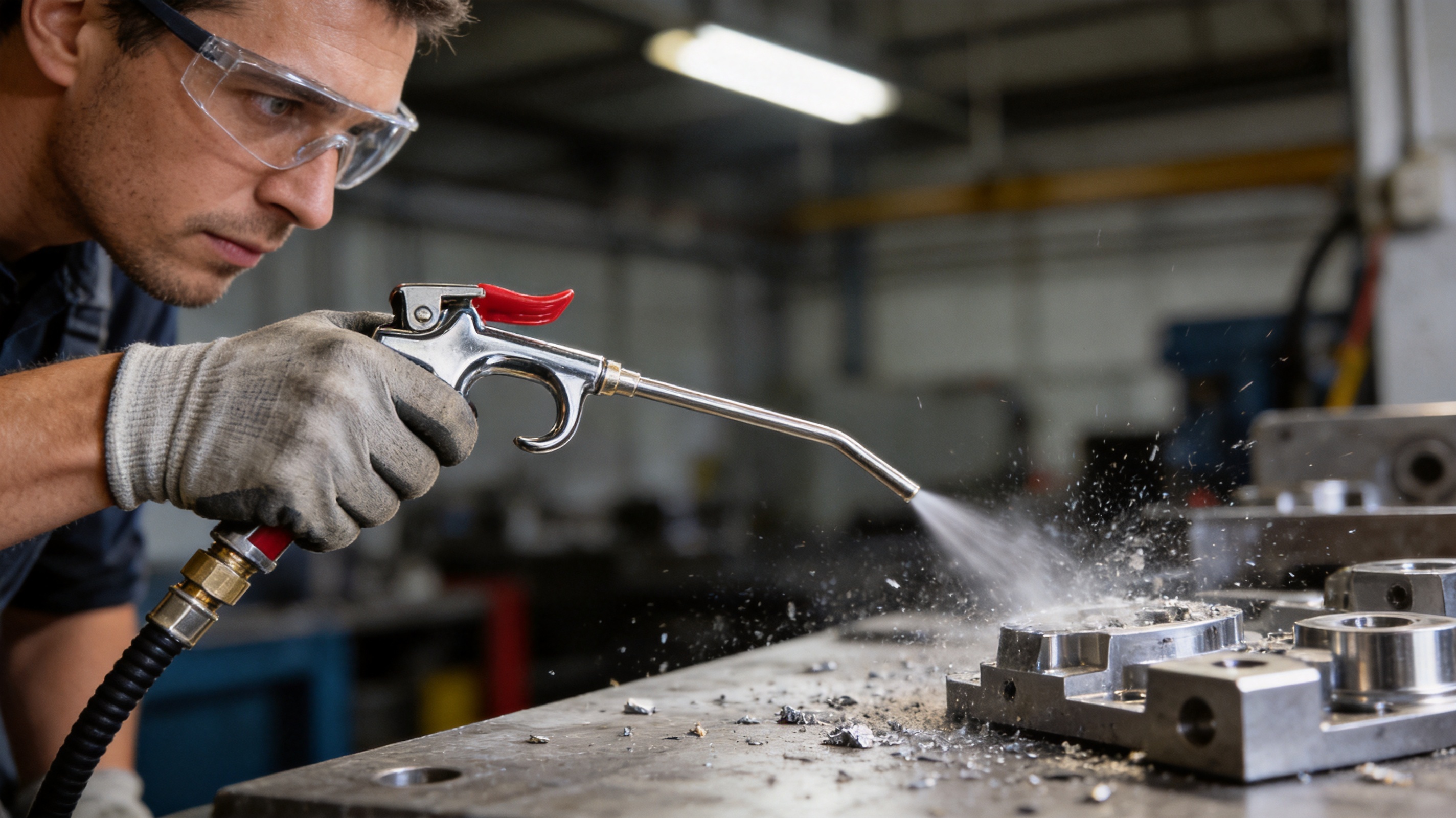
In metalworking, the BG-2 can remove chips from drilled holes, machined parts, fixture plates, tool holders, and work tables. Metal chips can scratch parts, interfere with measurement, block holes, or create hazards. A directed airflow tool gives operators a quick way to clear debris from localized areas.
In maintenance departments, the BG-2 can clean equipment housings, workbenches, motors, tools, filters, and general workshop surfaces. Maintenance technicians often need a rugged and ready-to-use blow gun that can be attached to air lines throughout the facility. Reliable trigger response and air sealing help reduce wasted air and improve efficiency.
In assembly and packaging, the BG-2 can remove dust or particles before parts are joined, inspected, or packed. Clean parts create a better impression for end users and reduce customer complaints. The blow gun can be used for small components, larger assemblies, and packaging stations where dust removal is part of quality control.
In paint preparation rooms and finishing departments, the tool can support cleaning before coating, drying between process stages, and general booth maintenance. It should be used responsibly with properly conditioned compressed air, because moisture or oil in the air line can create defects. When combined with quality air preparation equipment, a blow gun becomes a useful part of the finishing workflow.
Design Priorities for Daily Use
A good air blowing gun should be easy to hold, simple to control, and dependable under repeated use. Operators may use it dozens or hundreds of times in a day. If the grip is uncomfortable or the trigger is difficult to operate, fatigue increases. If the air flow is unpredictable, the operator may use too much air or fail to clean effectively. If the tool leaks, compressed air is wasted and the workplace becomes noisier.
The BG-2 is designed around the practical expectations of an industrial air blowing tool. Its purpose is direct and clear: provide a controlled stream of compressed air through a hand-held gun. In a production environment, simplicity can be a strength. Fewer unnecessary features mean less confusion, easier training, and faster operation. Workers can pick up the tool, aim it, press the trigger, and complete the task.
Durability is also a key design priority. Blow guns are often placed on benches, hung from hoses, moved between stations, or used near machinery. They may experience impacts, dust, oil mist, and constant connection to air lines. A dependable product must withstand routine workshop conditions. The company’s experience in manufacturing spray guns and air tools supports attention to material selection, machining, sealing, and assembly quality.
Another design priority is air efficiency. Compressed air is valuable and can be expensive to generate. A leaking or poorly controlled blow gun wastes energy continuously. While the exact consumption depends on air pressure, nozzle configuration, and usage habits, a well-made gun with good sealing and trigger response helps operators use air only when needed. Good air management reduces operating costs and supports more sustainable production.
Manufacturing Strength Behind the Product
The strength of the BG-2 is closely connected to the manufacturing foundation behind it. Ningbo Lis Industrial Co., Ltd. has been engaged in air painting spray guns, mini air compressors, and related air tools for many years. The company is located in Ningbo, a harbor city known for developed industry, convenient transportation, and access to supply chain resources. This location supports efficient procurement, production, export logistics, and communication with international customers.
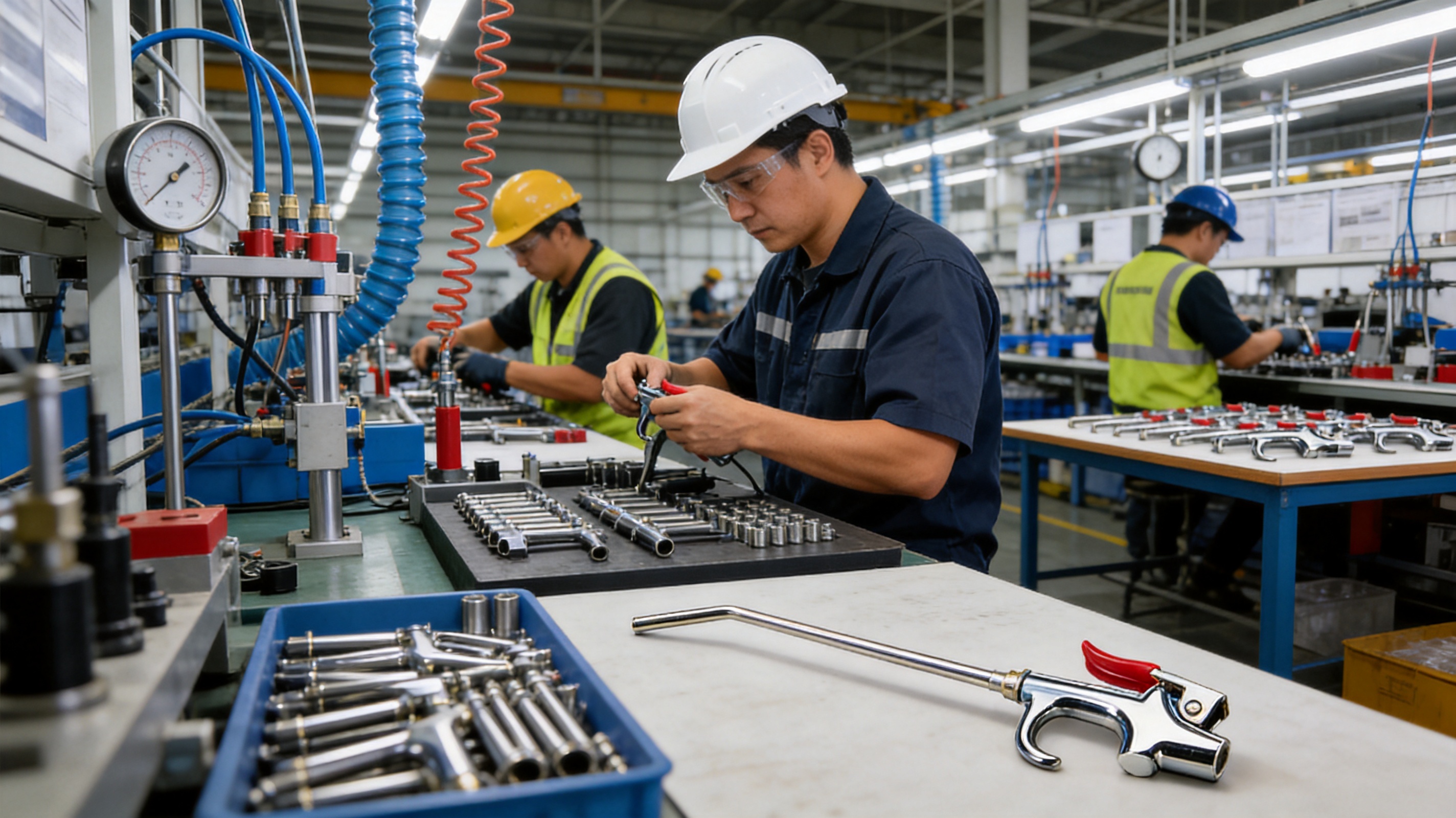
The company has developed into one of the largest enterprises in China’s painting spray gun industry, with more than 400 employees and annual output reported at over 40 million US dollars. Its production base covers more than 400,000 square feet. These figures indicate scale, but scale alone is not the main point. The real value of scale is the ability to maintain specialized departments, trained production teams, engineering resources, inspection systems, and flexible capacity for different order quantities.
The company has received recognition such as national high-tech enterprise status, customs advanced certification, individual item champion of Ningbo City, and provincial engineering and technology center. These recognitions support the idea that the company is not simply assembling low-value tools but is actively involved in technical development, process improvement, and industrial upgrading.
For the BG-2, advanced manufacturing does not necessarily mean complicated electronics or excessive features. It means stable processes for parts production, reliable finishing, accurate assembly, effective sealing, and consistent inspection. A blow gun must be ready for immediate use, and its quality is measured by thousands of small actions: the trigger press, the release, the airflow, the connection seal, and the ability to remain dependable after repeated use.
Quality Control from Raw Material to Final Inspection
Quality begins before assembly. The company follows the requirements of the ISO9000 quality system and applies control throughout production. Raw material and incoming inspection help ensure that components meet necessary standards before they enter the manufacturing process. This step is important because weak raw materials or inconsistent parts can cause leakage, poor fit, premature wear, or finish problems.
In-process quality control is the next critical stage. During manufacturing, inspection points help identify issues before they become finished goods. This may include dimensional checks, surface checks, process verification, assembly control, and functional assessment depending on the part and production procedure. For a blow gun, dimensional consistency affects sealing, trigger movement, connection reliability, and air path performance.
The company also conducts 100% functional testing. This is especially meaningful for pneumatic tools because the customer expects each unit to work when connected to compressed air. Functional testing helps verify basic operation before shipment. A product that has not been functionally checked may look acceptable but still leak, fail to trigger properly, or deliver poor airflow. A complete functional testing policy helps reduce these risks.
Final quality inspection completes the control cycle. Finished products are checked before release, helping ensure that packaging, appearance, function, and overall quality meet requirements. For distributors and industrial buyers, final inspection reduces the chance of receiving defective goods and supports stable supply relationships.
This approach gives the BG-2 a stronger competitive position against low-cost tools produced with limited inspection. The lowest-priced blow gun may save a small amount at purchase but can cost more through air leakage, replacement frequency, user frustration, quality defects, and downtime. A tool supported by systematic quality control offers better long-term value.
Certifications and Management Systems
The company has passed ISO9001 international quality system certification, OHSAS18001 occupational health and safety system certification, and ISO14001 environmental management system certification. It has also passed European CE and German GS international product certification for relevant products. These certifications indicate a structured approach to product quality, workplace safety, environmental responsibility, and international compliance.
For buyers, certifications provide reassurance that the manufacturer operates under recognized management frameworks. While a certificate does not replace product evaluation, it helps demonstrate that production is not uncontrolled or informal. In global sourcing, this matters because buyers often need suppliers that can support audits, documentation, repeat orders, and consistent quality expectations.
ISO9001 is particularly relevant to the BG-2 because quality consistency depends on documented processes, corrective action, internal control, and continuous improvement. ISO14001 reflects environmental management, which is increasingly important to international customers and industrial distributors. OHSAS18001 shows concern for occupational health and safety, supporting responsible production practices.
Comparison Table
| Buyer Requirement | BG-2 Product and Manufacturing Support | Advantage Over Ordinary Alternatives |
|---|---|---|
| Reliable daily cleaning performance | Designed as a practical air blowing gun for directed compressed-air cleaning and drying. | More dependable for repeated workshop use than low-grade tools with inconsistent airflow. |
| Reduced air leakage | Supported by controlled production, assembly discipline, functional testing, and final inspection. | Helps reduce wasted compressed air and avoids the inconvenience of leaking tools. |
| Consistent product batches | Manufactured under a quality management system with raw material inspection and in-process control. | Better suited for distributors and multi-station industrial users requiring repeatable quality. |
| Supplier experience | Produced by a company with decades of experience in spray guns, air tools, compressors, and air accessories. | Benefits from broader pneumatic knowledge rather than isolated accessory production. |
| International sourcing confidence | Backed by global market experience, recognized certifications, and export capability. | More suitable for professional procurement than suppliers with limited documentation or support. |
| Customization potential | OEM and ODM services are available according to drawings, samples, or customer needs. | Offers flexibility for brand owners, wholesalers, and project-based supply requirements. |
Role in a Complete Air Tool System
The BG-2 works best when it is part of a well-designed compressed air system. Air pressure, hose size, fittings, filtration, moisture control, and operator habits all affect performance. A high-quality blow gun connected to poor air supply may not deliver the best results. Likewise, a strong air system is wasted if the hand tool leaks or fails. The manufacturer’s product range includes air pipeline accessories, air fittings and accessories, mini oil-free compressors, spray gun kits, paint tanks, and other pneumatic products, making it possible to support complete solutions rather than isolated items.
For professional shops, this system perspective is important. A paint shop may require clean, dry air for spraying and surface preparation. A woodworking factory may need multiple air stations for cleaning and equipment maintenance. An assembly workshop may require consistent air delivery across many benches. The BG-2 fits into these environments as a simple but frequently used terminal tool.
When selecting an air blowing gun, buyers should consider the full air pathway. The air compressor must provide adequate pressure and flow. The air line should be appropriately sized and maintained. Filters and dryers may be necessary when surface cleanliness or coating quality matters. Couplers and fittings should seal properly. Operators should be trained to use compressed air safely and efficiently. A reliable blow gun completes the system by providing controlled final delivery.
Support for Surface Preparation and Finishing Quality
Because the manufacturer has deep experience in paint spray guns and spraying solutions, the BG-2 can be understood as a companion tool in finishing workflows. Surface preparation is a major factor in coating results. Even the best paint spray gun cannot compensate for a surface contaminated by dust, chips, lint, or moisture. Before spraying, operators often use a sequence of sanding, cleaning, wiping, air blowing, and inspection. The blow gun plays an important role in removing loose particles from edges, holes, seams, and uneven surfaces.
In refinishing and industrial coating, compressed air must be clean and dry. If the air supply contains oil or water, blowing the surface may create more problems than it solves. Therefore, the BG-2 should be used with properly maintained air preparation equipment. When applied correctly, it helps improve the cleanliness of the substrate and supports better coating adhesion and appearance.
In woodworking finishing, dust management is especially difficult because fine particles can settle quickly after sanding. A directed air stream helps remove particles from profiles, carved details, grooves, joints, and corners. After blowing, operators may still use tack cloths or other cleaning methods as needed, but the blow gun reduces the amount of loose material and speeds preparation.
In metal finishing, holes and recessed areas can trap abrasive dust or chips. These contaminants may later emerge during coating or assembly. Using the BG-2 before the next process helps reduce hidden contamination and contributes to more consistent results.
Value for Distributors and Industrial Buyers
Distributors and industrial buyers evaluate products differently from occasional end users. They need stable supply, consistent quality, clear communication, practical packaging options, and dependable manufacturer support. The BG-2 is supplied by a company with large production capacity and international experience, making it suitable for wholesale channels, tool dealers, pneumatic product distributors, and industrial procurement programs.
The company’s production capacity can be increased by 30% in two months, according to the provided company information. This is valuable when market demand rises, when a distributor wins a new account, or when seasonal projects require larger quantities. A supplier that can adjust capacity quickly helps buyers avoid missed sales and delivery delays.
OEM and ODM capability is another important advantage. Some customers may require specific branding, packaging, fittings, instruction materials, or product combinations. Others may need the blow gun included in air tool kits or sold together with air hose and fittings. A manufacturer with engineering and production flexibility can support these requests better than a trading-only supplier.
Long-term partnerships are built on trust. The company emphasizes customer satisfaction, high-quality products, professional services, and mutual success. Its customers are located across multiple global regions, and many have built strong long-term strategic partnerships. For distributors, this suggests that the company understands international business expectations and can support repeat cooperation.
Practical Use Guidelines
To obtain the best results from the BG-2, users should follow good compressed air practices. First, connect the tool to a suitable air line with compatible fittings. The connection should be secure, and the air line should be checked for damage, leakage, or contamination. If the tool is used in a finishing environment, the air supply should be filtered and dried to avoid introducing oil, water, or dirt onto the workpiece.
Second, use the blow gun at a controlled pressure appropriate for the task. Excessive pressure can waste energy, increase noise, scatter debris unnecessarily, and create safety risks. Lower pressure may be sufficient for delicate cleaning, while stronger airflow may be needed for chips or heavy dust. Operators should follow workplace safety procedures and local regulations regarding compressed air use.
Third, aim the airflow carefully. Compressed air can move particles at high speed. Operators should avoid blowing debris toward themselves, other workers, sensitive equipment, open containers, or freshly coated surfaces. In production spaces, safe direction of airflow is essential.
Fourth, wear appropriate personal protective equipment. Eye protection is especially important because dust, chips, or other particles can become airborne. Hearing protection may be required in high-noise areas. Respiratory protection may be necessary where fine dust or hazardous particles are present. The blow gun is a cleaning tool, but it should be used as part of a safe work system.
Fifth, store the tool properly. Keeping the BG-2 in a designated location helps prevent damage, contamination, and loss. Hanging it near the workstation or placing it in a tool holder can improve workflow and reduce accidental drops. Regular checks of fittings and hoses help maintain safe and efficient operation.
Maintenance Considerations
Air blowing guns generally require limited maintenance, but simple habits can extend service life. Users should inspect the tool regularly for visible damage, air leakage, loose fittings, or trigger problems. If the tool is dropped or exposed to heavy contamination, it should be checked before further use. A damaged blow gun may leak or behave unpredictably.
The air line should be kept clean and dry. Moisture, rust particles, and oil contamination can affect pneumatic tools and the workpiece. Draining compressor tanks, maintaining filters, and replacing worn couplers are important steps in overall air system maintenance. A reliable blow gun performs best when the air supply is well maintained.
Operators should avoid using the blow gun for unsuitable purposes. It should not be used to clean clothing or skin, because compressed air can be dangerous. It should not be used to move hazardous dust without proper extraction and protection. It should not be modified in ways that compromise safety, sealing, or airflow control.
If replacement is required after long use, choosing the same model can help maintain consistency across workstations. For factories with multiple air points, standardizing on a dependable blow gun simplifies purchasing, training, and maintenance.
How the BG-2 Supports Productivity
Productivity gains from an air blowing gun may seem minor at first, but they accumulate quickly. If a worker saves a few seconds each time a part is cleaned, the daily time savings can be significant. If better cleaning reduces coating defects, the savings from avoided rework can be much larger. If a tool reduces air leakage, energy savings occur continuously. If the product lasts longer and requires fewer replacements, purchasing and maintenance costs decline.
The BG-2 supports productivity through readiness, simplicity, and reliability. A worker can use it immediately without complicated adjustment. The tool’s function is intuitive, reducing training time. When the trigger response and airflow are dependable, the operator can focus on the work rather than the tool. When the product is manufactured under consistent quality control, buyers can equip multiple stations with confidence.
In high-output production, small interruptions can disrupt workflow. A leaking blow gun may need to be replaced. A weak tool may require repeated cleaning passes. An uncomfortable trigger may slow the operator. A poor connection may cause air loss or hose problems. By selecting a professionally manufactured tool, users reduce these small but persistent sources of inefficiency.
Manufacturing Culture and Continuous Improvement
The company’s long development history demonstrates a culture of continuous improvement. Since 1984, the organization has expanded from its early foundation into a major producer with broad product categories and international reach. Its mission emphasizes continuous innovative design, high-quality products and services, and creating value for global customers. Its vision focuses on the painting industry and providing professional, high-quality products, services, and solutions for worldwide and domestic needs.
This culture matters for a product like the BG-2 because even mature tools can be improved through better materials, better process control, more reliable assembly, more efficient production, and improved customer support. An experienced manufacturer receives feedback from many markets and applications. That feedback can guide refinements in production and quality control.
The company has a strong R&D team and can provide OEM services according to drawings or samples, as well as ODM services according to customer needs. It has established a spraying machinery engineering technology center and has carried out technical cooperation with American Wagner Spraying Technology Co., Ltd. in the development and research of spraying machinery. This background shows technical depth that goes beyond ordinary trading activity.
For the BG-2, such technical depth supports a better understanding of airflow, ergonomics, manufacturing repeatability, and user expectations. Even if the tool is simple, the best simple tools are the result of careful engineering and disciplined production.
Environmental and Energy Considerations
Compressed air is convenient but energy-intensive. Generating compressed air consumes electricity, and leaks in air systems can be costly. A blow gun that leaks when not in use contributes to unnecessary energy consumption. A tool that requires excessive pressure or repeated passes also wastes energy. Therefore, selecting a reliable, well-sealed air blowing gun is part of responsible energy management.
The BG-2 should be used with proper pressure control and good operator habits. Workers should use only the airflow required for the task and release the trigger when blowing is complete. Air lines should be inspected for leaks, and fittings should be maintained. In facilities with many air tools, these practices can produce meaningful savings.
The manufacturer’s ISO14001 environmental management certification supports a broader commitment to environmental responsibility. For industrial buyers with sustainability goals, sourcing from suppliers with environmental management systems can be an important part of procurement policy.
Safety in Air Blowing Operations
Safety is essential when using compressed air. Air blowing guns should be used only by trained personnel who understand the risks of airborne particles, noise, and improper use. Operators should never point the tool at people or use compressed air on skin or clothing. Even a common shop tool can be dangerous if misused.
Eye protection should be worn when using the BG-2, especially around chips, dust, wood particles, metal shavings, or dried coating debris. In dusty environments, respiratory protection and dust extraction may be needed. In noisy environments, hearing protection may be required. Workplaces should follow applicable occupational safety regulations and internal procedures.
Safe use also means controlling the direction of debris. Blowing dust from one area into another may create additional cleaning problems or contaminate finished work. Operators should blow toward collection areas, extraction systems, or safe open spaces. When cleaning delicate parts, airflow should be controlled to avoid moving or damaging components.
The company’s occupational health and safety management certification reflects an understanding that responsible manufacturing and responsible use are connected. A good tool should be produced safely and used safely.
Ideal Customers for the BG-2
The BG-2 is suitable for a wide range of customers. Industrial workshops can use it at machine stations, assembly benches, maintenance areas, and finishing lines. Automotive repair shops can use it for surface preparation, drying, and general cleaning. Woodworking shops can use it for dust removal before finishing and assembly. Metalworking operations can use it for chip removal and fixture cleaning. Distributors can include it in pneumatic tool offerings for professional and general workshop customers.
The product is also suitable for buyers who want a dependable supplier with a broad product range. Because the manufacturer offers spray guns, air brushes, compressors, air fittings, air accessories, paint tanks, air polishers, spray gun kits, electric spray guns, airless spray guns, and other products, customers can source multiple related items from one experienced supplier. This can simplify procurement and improve product compatibility across categories.
For brand owners, the company’s OEM and ODM services are valuable. A blow gun may be sold as a standalone tool or as part of a kit with hoses, couplers, compressors, or spray equipment. Customization can help match market preferences and brand positioning.
Why Manufacturing Scale Benefits the End User
Manufacturing scale benefits the end user when it is combined with quality discipline. A large facility can invest in better production equipment, specialized departments, training, testing procedures, and inventory control. It can also respond to large orders and support stable long-term supply. The company’s large production area, workforce, and output indicate strong capacity to serve both domestic and international markets.
For the end user, this scale translates into availability and consistency. When a shop needs replacement tools or additional units for new workstations, supply continuity matters. When a distributor promotes a product, it needs confidence that future orders will match previous quality. When a large industrial customer standardizes tools across facilities, stable production becomes essential.
Compared with small, inconsistent suppliers, a mature manufacturer can provide better documentation, more reliable communication, and stronger quality traceability. These benefits may not be visible at the moment of purchase, but they become important throughout the product lifecycle.
Frequently Asked Questions
What is the BG-2 used for?
The BG-2 is an air blowing gun used to direct compressed air for cleaning, dust removal, chip removal, drying, and general workshop maintenance. It is suitable for woodworking, automotive refinishing, metalworking, assembly, maintenance, and paint preparation environments.
Why choose this air blowing gun instead of a generic low-cost model?
The BG-2 is backed by professional air tool manufacturing experience, quality system control, functional testing, and final inspection. Compared with generic low-cost models, it offers stronger confidence in consistency, sealing, daily reliability, and supplier support.
Can the BG-2 be used before painting?
Yes. It can help remove loose dust and particles before painting or coating. However, the compressed air must be clean and dry. Proper filtration and moisture control are important to avoid contaminating the surface.
Is the BG-2 suitable for woodworking?
Yes. It can help remove sawdust from workpieces, joints, grooves, machines, and benches. It is especially useful before finishing, gluing, assembly, or inspection.
Does the tool require special maintenance?
Maintenance is generally simple. Users should check for air leakage, trigger problems, fitting condition, and visible damage. The compressed air system should also be maintained by draining moisture, checking filters, and replacing worn couplers or hoses.
Can distributors order customized versions or packaging?
The manufacturer can provide OEM services according to drawings or samples and ODM services according to customer needs. This makes the product suitable for distributors, brand owners, and project-based procurement.
What makes the manufacturer strong in pneumatic products?
The company has decades of experience, a large production base, more than 400 employees, global market reach, strong R&D capability, recognized certifications, and a complete quality control process from raw material inspection to final product inspection.
Is compressed air blowing safe?
Compressed air must be used carefully. Operators should wear eye protection, avoid pointing the tool at people, avoid cleaning skin or clothing, control debris direction, and follow workplace safety rules. Dust extraction or respiratory protection may be needed in dusty environments.
Conclusion
The BG-2 air blowing gun is a practical and dependable tool for industrial cleaning, drying, and surface preparation. Its value lies not only in its everyday function but also in the manufacturing strength behind it. A blow gun is used repeatedly, often in demanding environments, and its reliability affects productivity, cleanliness, energy use, and operator confidence.
Compared with ordinary low-cost alternatives, the BG-2 benefits from professional pneumatic tool experience, systematic quality control, 100% functional testing, and the support of a manufacturer with broad air tool and spray equipment expertise. The company’s long history, large-scale production capacity, R&D capability, international certifications, and global market experience provide a strong foundation for consistent product quality and long-term cooperation.
For workshops, factories, distributors, and industrial buyers seeking a reliable air blowing gun, the BG-2 offers a balanced solution: simple operation, practical performance, professional manufacturing support, and compatibility with broader compressed air systems. Whether used in woodworking, automotive refinishing, metalworking, maintenance, assembly, or finishing preparation, it helps keep work areas cleaner, processes smoother, and production more efficient.
References
Ningbo Lis Industrial Co., Ltd. Company Profile and Product Category Materials.
ISO 9001 Quality Management Systems: Requirements and Industrial Application Principles.
ISO 14001 Environmental Management Systems: Framework and Manufacturing Relevance.
Occupational Health and Safety Management Guidance for Compressed Air Tool Use.
Industrial Pneumatic Tool Maintenance and Compressed Air Efficiency Best Practices.
Surface Preparation and Contamination Control Practices in Painting and Finishing Operations.