 Search
 English
 中文简体
中文简体 Deutsch
 Español
Content
- 1 Understanding the Function of a Pneumatic Quick Coupler Plug
- 2 Why the BSM20 Matters in a Compressed-Air System
- 3 Key Product Advantages
- 4 Application Areas
- 5 Comparison with Conventional Threaded Connections
- 6 Manufacturing Strengths Behind the Product
- 7 Production Process Considerations
- 8 Advantages for Distributors and OEM Customers
- 9 Correct Selection and Installation
- 10 Maintenance and Service Life
- 11 Safety Practices
- 12 Why Manufacturer Support Adds Value
- 13 Purchasing Checklist
- 14 Frequently Asked Questions
- 14.1 What is the BSM20 used for?
- 14.2 What does G.B. Standard mean in this product category?
- 14.3 Can the BSM20 be used with spray guns?
- 14.4 Does a quick coupler plug replace a regulator or filter?
- 14.5 How can users confirm compatibility?
- 14.6 Is the BSM20 suitable for frequent tool changes?
- 14.7 What should be checked during maintenance?
- 14.8 Can the manufacturer provide customized products?
- 14.9 Can the fitting be purchased with other pneumatic products?
- 14.10 What information should be included in a quotation request?
- 15 Conclusion
- 16 References
- 17 Product: BSM20 Pneumatic fittings Air Compressor Hose Quick Coupler Plug+

The BSM20 pneumatic fittings air compressor hose quick coupler plug is designed for workshops, production lines, maintenance areas, automotive service centers, woodworking facilities, painting operations, and other applications that depend on clean and dependable compressed-air connections. As a G.B. Standard fitting, it is intended for systems that use British-standard connection requirements and compatible pneumatic hose assemblies.
A quick coupler plug may be a small component within a complete air system, but its influence on daily productivity is substantial. A poorly matched plug can cause leakage, difficult connection, premature wear, pressure loss, and unnecessary downtime. A well-designed plug provides a repeatable connection between an air hose and a pneumatic tool, allowing operators to change equipment quickly while helping the system preserve working pressure.
The BSM20 is part of a broader range of air tools, spray equipment, air fittings, compressors, and accessories manufactured by Ningbo Lis Industrial Co., Ltd. The manufacturer has developed long-term expertise in compressed-air technology, spray application equipment, and supporting pneumatic products. This experience allows the fitting to be considered not as an isolated accessory, but as part of a complete air-management solution.
Understanding the Function of a Pneumatic Quick Coupler Plug
A pneumatic quick coupler plug is the male portion of a quick-connect air fitting. It is inserted into a compatible female coupler, where an internal locking mechanism holds the plug in position. Once connected, the fitting creates an air passage between the compressor hose and the attached tool or equipment. When the operator needs to change tools, the connection can be released without using a wrench for every exchange.
This arrangement is particularly valuable in environments where several air tools share one compressor or distribution line. A spray gun, blow gun, pneumatic polisher, air drill, inflating gun, or other air-powered device may need to be connected during the same working shift. Quick couplers and plugs reduce the time required for these changes and help keep the work area organized.
The plug must be correctly matched with the coupler standard, thread type, hose connection, pressure requirements, and intended application. The BSM20 belongs to the G.B. Standard category, so users should confirm that the receiving coupler is compatible with the applicable British-standard profile. Compatibility is determined by more than the apparent outside shape. Locking geometry, sealing surfaces, insertion depth, thread configuration, and nominal passage dimensions all influence safe operation.
Why the BSM20 Matters in a Compressed-Air System
Compressed air is an energy source that travels through multiple components before reaching a tool. The compressor produces air, the receiver stores it, regulators control pressure, filters remove contaminants, hoses carry the air, and fittings create the connection points. Every connection is a possible source of restriction or leakage. The BSM20 supports the final connection between the hose assembly and the coupler, making its design important to the complete system.
When the connection is secure and properly sealed, the operator can work with greater confidence. The tool is less likely to disconnect unexpectedly, the hose is easier to manage, and the compressor does not need to compensate unnecessarily for avoidable leakage. In a production environment, even small improvements at repeated connection points can contribute to smoother workflow and more consistent equipment performance.
For spray equipment, stable air delivery is especially important. Spray guns require an appropriate combination of air pressure, air volume, material viscosity, and technique. A leaking or poorly fitted connector can disturb the pressure available at the gun and make atomization less predictable. The BSM20 can therefore contribute to the reliability of a spray system when it is selected and installed with the correct compatible coupler and hose assembly.
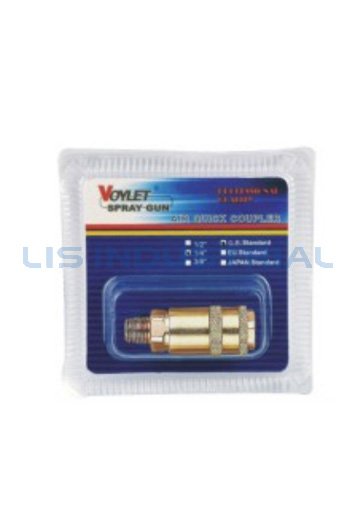
BSM20 Pneumatic fittings Air Compressor Hose Quick Coupler Plug+
Key Product Advantages
G.B. Standard Compatibility
The most important identifying feature of the BSM20 is its classification as a G.B. Standard fitting. Standardization helps users select compatible components for an existing air network rather than replacing an entire system. For distributors and industrial buyers, a clearly defined standard also simplifies product classification, stock management, and customer support.
Users should always verify the exact profile required by their equipment because different regional and manufacturer-specific coupler standards may appear similar while remaining mechanically incompatible. Selecting the correct standard is the first step toward obtaining the expected sealing performance and safe locking action.
Fast Tool Changes
The quick-connect format allows an operator to attach or remove a compatible air tool efficiently. This is useful in repair shops, assembly stations, paint preparation areas, and maintenance departments where time is lost when tools must be disconnected with conventional threaded fittings.
Faster changes do not only improve convenience. They can also reduce interruptions between work stages. An operator may use an air blow gun to clean a surface, connect a spray gun for coating, and then attach an inflating gun or pneumatic polisher. A quick coupler plug supports this sequence without requiring a separate permanent hose for every tool.
Support for Organized Air-Hose Management
A fitting that is easy to connect encourages users to arrange hoses according to task rather than leaving multiple tools permanently attached. Better hose organization can reduce tangling, limit accidental pulling, and make it easier to identify which line is connected to which tool.
In a professional workshop, organized air connections also support maintenance routines. Operators can inspect the plug, coupler, and hose end more easily when the connection is not hidden among improvised adapters. This can help identify damaged seals, worn locking components, contamination, or mechanical distortion before a problem becomes serious.
Practical Design for Repeated Use
Pneumatic fittings are often connected and disconnected many times during their service life. The BSM20 is intended for this type of practical workshop use. A suitable plug should enter the mating coupler smoothly, lock positively, and release in a controlled manner when the sleeve or release mechanism is operated.
Repeated use places demands on the plug surface, connection geometry, and sealing area. The fitting must also tolerate normal handling in an industrial environment. These requirements make production accuracy important. Small dimensional differences can affect insertion force, locking reliability, and air tightness.
Useful Across Multiple Applications
The BSM20 can support a wide range of compressed-air applications when used with the correct compatible components. Typical uses include pneumatic spray equipment, air blowing guns, tire-inflating guns, workshop air tools, pneumatic polishers, cleaning stations, and general air-compressor hose assemblies.
Its application flexibility is useful for wholesalers and equipment integrators. A distributor can include the plug in compressed-air accessory packages, spray-gun kits, maintenance sets, or workshop hose assemblies. This can make the product suitable for both original equipment supply and replacement-parts distribution.
Application Areas
Automotive Repair and Refinishing
Automotive workshops frequently move between cleaning, sanding, polishing, inflating, and refinishing tasks. Pneumatic tools are valued for their compact size, operating speed, and suitability for repetitive work. A quick coupler plug makes it easier to share a compressor between these tools.
In a paint preparation area, the connection must be kept clean. Dust, moisture, oil, and paint residue can interfere with sealing surfaces. The BSM20 should be installed in a location where the fitting can be protected from overspray and cleaned as part of routine maintenance. When used with a suitable filter and regulator, it can contribute to a more dependable air supply for spray operations.
Industrial Painting
Air spray systems depend on controlled air delivery. The hose fitting is one element in the path between the compressor and spray gun. A quick coupler plug can simplify gun changes, color changes, cleaning procedures, and maintenance activities.
For finishing work, the fitting should be selected according to the air demand of the spray gun and the capacity of the hose system. The plug itself should not be treated as a substitute for correct hose sizing, filtration, pressure regulation, or moisture control. Instead, it works as part of an integrated preparation and application system.
Woodworking and Furniture Production
Woodworking shops often use air blow guns, pneumatic sanders, nailers, staplers, and spray guns. Dust management and rapid tool access are important in these environments. A quick-connect fitting helps workers move from surface preparation to coating or assembly without repeatedly rebuilding the air connection.
Because wood dust can accumulate around fittings, the connection should be kept free from contamination. A fitting cap or protected storage location may be appropriate when the plug is not connected. Regular inspection is particularly useful where the air hose is dragged across floors or workbenches.
General Maintenance and Assembly
Maintenance teams may need to use the same compressor for cleaning, fastening, inflating, and testing. A G.B. Standard quick coupler plug provides a practical connection option for compatible pneumatic systems. It can be integrated into portable hose reels, bench-mounted lines, mobile service carts, or fixed factory distribution networks.
The fitting is also relevant to equipment manufacturers that build air-powered machinery. By selecting a consistent fitting standard, manufacturers can simplify tool changes and provide replacement accessories that are easier for service technicians to identify.
Small Workshops and Professional Garages
Small workshops often have limited space and one central compressor. A quick coupler system enables several tools to share the available air source. The BSM20 can be used in a modular arrangement in which hoses, plugs, couplers, and tools are selected according to the operator’s needs.
For these users, value is measured not only by initial purchase price but also by ease of use, availability of compatible replacements, durability in normal service, and the reduction of lost working time. A standardized plug can make future additions to the air system more straightforward.
Comparison with Conventional Threaded Connections
Conventional threaded connections remain useful in permanent installations and applications where a tool is rarely removed. However, they generally require more time to change and may need thread sealant, adjustable tools, or careful tightening procedures. Repeated assembly and disassembly can also place stress on threads and increase the opportunity for cross-threading.
A quick coupler plug such as the BSM20 is intended for a different operating pattern. It is most beneficial where tools are exchanged frequently, mobility is important, or the user wants to create a flexible hose system. The main advantage is not that quick couplers replace every threaded fitting, but that they offer a more efficient connection method for dynamic workshop use.
| Evaluation Area | BSM20 Quick Coupler Plug | Conventional Threaded Connection |
|---|---|---|
| Tool replacement | Designed for rapid connection and release with a compatible coupler | Usually requires manual threading and unthreading |
| System flexibility | Suitable for shared hoses and interchangeable pneumatic tools | Better suited to fixed or infrequently changed connections |
| Standard selection | Identified within a G.B. Standard fitting range | Depends on thread specification and sealing method |
| Workflow efficiency | Helps reduce time spent changing tools | May require more handling between operations |
| Maintenance focus | Inspect locking action, sealing surfaces, and plug condition | Inspect threads, sealant, tightening, and joint condition |
The correct choice depends on the system design. A professional installation may use threaded adapters at fixed points and quick coupler plugs at tool connections. This mixed approach can provide both permanent stability and practical flexibility.
Manufacturing Strengths Behind the Product
The performance of a pneumatic fitting begins with production control. Ningbo Lis Industrial Co., Ltd. has operated in the air painting spray gun and air-tool industry since 1984. The company has developed manufacturing experience across spray guns, mini oil-free compressors, air fittings, air pipeline accessories, paint tanks, and related pneumatic products.
This broad product background is relevant to the BSM20 because fittings are used in the same working environments as spray guns and air tools. Manufacturing teams that understand the requirements of complete compressed-air systems are better positioned to consider connection reliability, application conditions, tool compatibility, and service requirements during product development.
Established Industrial Experience
The company operates from Ningbo, a major harbor city with developed industrial infrastructure and convenient transportation. Its facilities cover more than 400,000 square feet and support a workforce of more than 400 employees. The company reports annual output exceeding 40 million U.S. dollars and maintains production capabilities for international customers across multiple markets.
For buyers, this scale can provide several practical benefits. It can support stable production scheduling, coordinated quality-control procedures, product development, packaging operations, and export logistics. It also gives distributors a partner capable of supplying more than one type of pneumatic product.
Research and Development Capability
The manufacturer maintains a dedicated research and development team and a spraying machinery engineering technology center. This technical foundation supports product improvement, application research, and the development of spraying and pneumatic equipment.
Customers may require products with particular dimensions, packaging, connection arrangements, or performance objectives. The company provides OEM services based on customer drawings or samples and ODM services based on customer requirements. This capability is valuable for importers, equipment manufacturers, private-label distributors, and system integrators that need more than a standard catalog item.
Integrated Product Knowledge
The company’s product portfolio includes new HVLP spray guns, heavy-duty spray guns, woodworking low-pressure spray guns, economical conventional spray guns, texture paint spray guns, paraffin guns, air blowing guns, sandblast guns, foam guns, tire-inflating guns, water and grease guns, automatic spray guns, air brushes, mini oil-free compressors, air pipeline accessories, paint tanks, air fittings, and other air tools.
This range creates a useful connection between the BSM20 and actual end-user applications. A fitting supplier that also manufactures spray guns and compressors can evaluate how accessories function within real equipment combinations. It can also support customers that want a complete spraying solution rather than a single replacement component.
Quality-System Controls
According to the supplied company information, production quality is controlled through procedures based on the ISO9000 quality model. The reported process includes raw-material control, incoming inspection, in-process quality control, 100 percent functional testing, and final inspection of finished products.
For a pneumatic plug, these stages may involve checking material condition, verifying dimensions, inspecting surface quality, confirming connection geometry, and testing the finished part according to applicable internal procedures. Functional testing is especially important because a fitting can appear acceptable while still failing to lock correctly or seal reliably.
Quality control is most effective when it is applied throughout production rather than only at the final packing stage. Incoming materials must be consistent, machining or forming operations must be stable, assembly processes must be controlled, and inspection results must be traceable. This approach helps reduce variation between production batches.
Certification and International Market Readiness
The company reports that its products have passed CE and GS certifications and that its management systems include ISO9001 quality certification, ISO14001 environmental management certification, and OHSAS18001 occupational health and safety certification. Buyers should request the documentation applicable to the specific product, market, and shipment before placing an order.
International compliance is important because pneumatic fittings may be incorporated into equipment sold in different regions. Documentation, labeling, packaging, and technical information should be aligned with the destination market. An experienced export manufacturer can assist buyers with these requirements and help reduce avoidable communication problems.

Production Process Considerations
Material Preparation
The first stage of reliable fitting production is material preparation. The selected material must be appropriate for the intended mechanical and environmental conditions. It should support the required strength, dimensional stability, corrosion resistance, and surface quality for the fitting design.
Incoming materials should be checked against purchasing and production requirements. Consistent material quality helps maintain stable machining, forming, plating, or finishing results. It also reduces the likelihood of defects that may appear only after the fitting is placed under repeated connection loads.
Precision Forming and Machining
The plug’s external profile must match the geometry of the compatible coupler. Connection areas, locking grooves, sealing surfaces, and threaded sections require controlled dimensions. Manufacturing equipment and inspection tools must work together to maintain these dimensions throughout a production run.
Precision is not limited to a single measurement. The relationship between several surfaces determines whether the plug inserts smoothly, reaches the correct position, activates the locking mechanism, and maintains an effective seal. A robust process therefore checks critical dimensions and uses suitable gauges or measurement equipment.
Surface Treatment and Finishing
Surface quality affects both appearance and function. Roughness, burrs, sharp edges, contamination, or damage in the sealing and insertion areas can interfere with connection performance. Finishing operations should remove unwanted irregularities while preserving the dimensions required by the fitting standard.
Where a surface treatment is used, the treatment must be applied consistently. Excessive coating thickness can affect fit, while inadequate treatment may reduce resistance to normal handling or environmental exposure. The exact finish should be confirmed through the product specification and purchase documentation.
Assembly and Functional Testing
After forming, machining, and finishing, the fitting may be assembled or prepared for final inspection. Functional checks can verify whether the product interacts correctly with its mating coupler, whether the locking action is positive, and whether the connection remains stable during normal use.
Air-tightness testing is another important control for pneumatic components. The appropriate test method depends on the design, pressure range, and quality requirements. Testing helps identify leakage paths caused by dimensional variation, surface defects, contamination, or assembly problems.
Final Inspection and Packaging
Final inspection should confirm that the product is correctly identified, free from visible damage, and packaged in a way that protects the connection surfaces. Packaging is especially important for small fittings because loose parts can be scratched, contaminated, or mixed with similar-looking standards during transportation.
Clear product identification helps distributors and users distinguish the G.B. Standard BSM20 from fittings intended for other regional standards. Labels, cartons, technical sheets, and order documents should use consistent product descriptions and codes.
Advantages for Distributors and OEM Customers
The BSM20 offers commercial value beyond its use as a workshop component. Distributors need products that are easy to classify, explain, stock, and replace. A fitting with a defined standard and clear application can be more straightforward to add to a pneumatic accessory range.
Because the manufacturer supplies a wide variety of spray equipment and air tools, customers can consolidate purchasing. An importer may source quick coupler plugs together with spray guns, compressors, air hoses, regulators, filters, and other accessories. Consolidated sourcing can simplify quality communication, packaging coordination, and shipment planning.
The company also reports that its production capacity can be increased by 30 percent within two months. This may support customers whose demand changes with seasonal sales, project schedules, or new distribution agreements. Actual capacity planning remains dependent on product mix, order quantities, specifications, and production scheduling, so buyers should discuss forecasts with the supplier in advance.
OEM and ODM support can be valuable where a buyer wants a private-label accessory, a special packaging format, or a fitting integrated into a larger equipment kit. Drawings, samples, application conditions, required standards, and inspection expectations should be supplied at the beginning of the development process.
Correct Selection and Installation
Before ordering the BSM20, users should confirm the required standard and mating coupler. The fitting should not be selected only by appearance or general product name. The following information should be checked:
First, confirm that the receiving coupler uses the compatible G.B. Standard profile. A plug from another standard may insert partially but fail to lock, seal, or release correctly.
Second, confirm the hose-end or equipment-side connection. Thread dimensions, connection orientation, and adapter requirements should match the hose assembly and the connected tool.
Third, review the working pressure and air-flow requirements of the complete system. The compressor, regulator, hose, coupler, and plug should all be suitable for the application. The lowest-rated component can limit the safe operating range of the system.
Fourth, consider the environment. Applications involving paint mist, dust, moisture, oil, outdoor exposure, or frequent dragging may require additional protection and more frequent inspection.
Fifth, determine whether the fitting will be used for a portable tool, a fixed hose, a mobile cart, or a high-frequency production line. The physical arrangement influences hose length, strain relief, fitting orientation, and maintenance access.
Installation Recommendations
Depressurize the air line before installing or removing a fitting. Check that the hose and coupler are clean and that no foreign material is present on the plug surface. If a threaded adapter is required, use the correct sealing method for the thread type and follow the installation guidance provided by the equipment manufacturer.
Do not force the plug into the coupler. A connection that requires unusual force may indicate contamination, incorrect standard selection, damage, or misalignment. After connection, verify that the locking mechanism has engaged fully before operating the tool.
Route the hose so that the fitting is not subjected to continuous bending, twisting, impact, or pulling. Where a hose is frequently moved, appropriate strain relief can reduce stress at the connection. Avoid placing the fitting directly in areas where vehicles, sharp edges, or heavy objects may strike it.
Maintenance and Service Life
Routine inspection is one of the simplest ways to preserve the performance of a quick coupler plug. Operators should look for visible deformation, corrosion, damaged sealing areas, excessive wear, contamination, or difficulty during connection and release.
The plug should be cleaned with a method appropriate for its material and application. Aggressive chemicals or unsuitable tools may damage the surface. When the fitting is disconnected, it should be protected from dirt and moisture rather than placed directly on a contaminated floor or workbench.
Leaks should be investigated promptly. A leak may result from a worn seal in the coupler, a damaged plug, an incorrect connection, a loose threaded adapter, or a hose problem. Replacing only the visible component without checking the mating parts may fail to solve the issue.
When a plug no longer locks securely, releases unexpectedly, or shows significant mechanical damage, it should be removed from service. Pneumatic systems store energy, and a connection failure can create a safety hazard. Replacement decisions should be based on the condition of the component and the requirements of the complete system.
Safety Practices
Compressed air should be treated as a powerful energy source. Never direct pressurized air toward the body, eyes, or another person. Wear suitable eye protection and follow workplace rules for noise, air pressure, hose handling, and tool operation.
Before disconnecting a pneumatic fitting, close the air supply and release trapped pressure when the system design requires it. Do not disconnect a hose while the tool is operating. Confirm that the coupler release mechanism is functioning correctly and keep hands away from areas where the hose may move suddenly.
Use the fitting only within the limits specified for the relevant system. Do not modify the plug, remove critical locking features, grind the connection profile, or combine standards through improvised adapters. Any modification may affect compatibility and safety.
For paint applications, compressed air must also be managed with appropriate filtration and moisture separation. Contaminated air can affect coating quality and may damage pneumatic equipment. The plug is one part of the system and should be supported by correct compressor maintenance, hose selection, filtration, regulation, and cleaning procedures.
Why Manufacturer Support Adds Value
Buying from an experienced manufacturer can reduce uncertainty during product selection. Ningbo Lis Industrial Co., Ltd. has focused on spray guns, compressors, fittings, and air tools for decades. Its customer base extends across Europe, North America, the Middle East, South Africa, East Asia, and other international markets.
This international experience can support communication about regional standards, packaging, product documentation, export requirements, and application conditions. Long-term technical cooperation in spraying machinery has also contributed to the company’s ability to develop products for professional painting and pneumatic applications.
The company’s stated mission is to create value for global customers through innovative design, quality products, and professional services. For buyers of the BSM20, this means that product supply can be considered together with technical consultation, OEM development, quality coordination, and after-sales support.
A supplier relationship is especially important for pneumatic accessories because compatibility questions often arise after the initial purchase. Buyers may need additional couplers, hose assemblies, spray-gun fittings, replacement parts, or private-label packaging. A manufacturer with a broad product range can help create a consistent accessory platform.
Purchasing Checklist
Before placing an order, buyers should prepare a clear product and application brief. The brief should identify the BSM20 model, the G.B. Standard requirement, the intended use, the mating coupler, the hose or thread arrangement, and the destination market.
It is also useful to request technical drawings, dimensional information, material details, available surface finishes, packaging specifications, inspection standards, and applicable certificates. If the fitting will be incorporated into a machine or kit, provide drawings or samples so the supplier can confirm the interface.
For larger orders, buyers should discuss minimum order quantities, production lead time, sample approval, batch inspection, carton quantities, labeling, and shipment schedules. Forecasts are helpful when demand may rise quickly or when the product will be launched in a new market.
Distributors should also consider whether they need the BSM20 as a standalone item or as part of a complete product family. Matching plugs, couplers, hoses, regulators, filters, spray guns, and air compressors can make the final offering easier for customers to understand.
Frequently Asked Questions
What is the BSM20 used for?
The BSM20 is a pneumatic air-compressor hose quick coupler plug. It is used as the plug side of a compatible quick-connect fitting system, allowing an air hose or pneumatic tool to be connected and disconnected efficiently.
What does G.B. Standard mean in this product category?
G.B. Standard identifies the fitting standard and connection profile associated with the product category. Users should match the BSM20 with a compatible female coupler rather than assuming that plugs from different standards are interchangeable.
Can the BSM20 be used with spray guns?
It can be used in a spray-gun air system when the spray gun, hose, coupler, and plug are compatible and the complete system meets the required air-pressure and air-flow conditions. The fitting should be protected from paint residue and cleaned as part of normal equipment maintenance.
Does a quick coupler plug replace a regulator or filter?
No. The BSM20 provides a connection function. A regulator is used to control pressure, while a filter or water separator helps manage contamination and moisture. These components perform different roles and may all be required in a properly prepared compressed-air system.
How can users confirm compatibility?
Users should compare the fitting standard, profile, dimensions, thread information, hose arrangement, and pressure requirements with the specifications of the female coupler and connected equipment. When there is uncertainty, the supplier should be asked to review drawings, samples, or photographs before purchase.
Is the BSM20 suitable for frequent tool changes?
Yes. Its quick-connect format is intended to support efficient connection and release in workshops, maintenance areas, automotive facilities, and other locations where multiple pneumatic tools share an air source.
What should be checked during maintenance?
Inspect the plug for damage, wear, corrosion, contamination, and deformation. Check whether it enters and locks into the coupler correctly. Investigate air leaks promptly and replace the plug or mating coupler if the connection is no longer secure or airtight.
Can the manufacturer provide customized products?
Ningbo Lis Industrial Co., Ltd. reports that it provides OEM services based on customer drawings or samples and ODM services according to customer requirements. Buyers should discuss customized dimensions, packaging, labeling, materials, standards, and testing before development begins.
Can the fitting be purchased with other pneumatic products?
The manufacturer produces a broad range of spray guns, air compressors, air fittings, air pipeline accessories, paint tanks, and air tools. This makes it possible for buyers to explore coordinated product sourcing, subject to availability, specifications, and order requirements.
What information should be included in a quotation request?
A quotation request should include the product code, required quantity, G.B. Standard confirmation, intended application, mating component, packaging needs, destination country, target delivery schedule, and any OEM or private-label requirements.
Conclusion
The BSM20 pneumatic fittings air compressor hose quick coupler plug is a practical component for compressed-air systems that require fast, repeatable, and organized connections. Its G.B. Standard classification helps buyers identify the intended compatibility range, while its quick-connect format supports efficient tool changes in workshops, automotive service, painting operations, woodworking facilities, and industrial maintenance environments.
Its value is strongest when the plug is selected as part of a complete pneumatic system. Correct standard matching, suitable hose and coupler selection, pressure management, filtration, careful installation, and routine inspection all contribute to reliable service. A quick coupler plug cannot compensate for an unsuitable compressor or damaged hose, but it can provide an efficient connection point within a properly designed system.
The manufacturing capabilities of Ningbo Lis Industrial Co., Ltd. add further value for professional buyers. Decades of experience in spray equipment and air tools, a broad product portfolio, research and development resources, OEM and ODM support, international certifications, and structured quality-control procedures provide a foundation for consistent supply and technical cooperation.
For distributors, OEM customers, and end users seeking a compatible G.B. Standard connection, the BSM20 can serve as a useful building block for flexible air-hose assemblies and complete pneumatic equipment packages. Its combination of practical usability, standardized application, and support from an experienced air-tool manufacturer makes it suitable for both replacement use and new system development.
References
1. Ningbo Lis Industrial Co., Ltd. Product information for BSM20 pneumatic fittings air compressor hose quick coupler plug.
2. Ningbo Lis Industrial Co., Ltd. Corporate information concerning air painting spray guns, air tools, compressors, fittings, research and development, and manufacturing capabilities.
3. ISO 9001, Quality Management Systems — Requirements.
4. ISO 14001, Environmental Management Systems — Requirements with Guidance for Use.
5. Occupational health and safety management system principles based on OHSAS 18001.
6. General pneumatic-system practices for compressed-air distribution, hose assemblies, fittings, filtration, pressure regulation, and equipment maintenance.