 Search
 English
 中文简体
中文简体 Deutsch
 Español
Content
- 1 Product Overview: A Compact Air Blow Gun for Everyday Cleaning Tasks
- 2 Key Advantages in Practical Use
- 3 Why a Dedicated Air Blow Gun Performs Better Than Improvised Cleaning Methods
- 4 Applications Across Industries
- 5 Product Value for Painting and Surface Preparation
- 6 Manufacturing Strength Behind the DG10-1
- 7 Advanced Quality Control and Process Discipline
- 8 Comparison With Common Competing Products
- 9 Ergonomics and Ease of Use
- 10 Integration With Compressed-Air Systems
- 11 Durability and Long-Term Value
- 12 Safety Considerations for Responsible Operation
- 13 Company Strengths Supporting Global Buyers
- 14 How the DG10-1 Supports Distributors and OEM Customers
- 15 Maintenance Tips for Longer Service Life
- 16 Buying Considerations
- 17 Q&A Section
- 17.1 What is the DG10-1 Air Blow Gun used for?
- 17.2 Why is an air blow gun important before painting?
- 17.3 How does the DG10-1 compare with low-cost alternatives?
- 17.4 Can the DG10-1 be used in woodworking?
- 17.5 Is compressed air cleaning safe?
- 17.6 What kind of air system is needed?
- 17.7 Can distributors order the DG10-1 for large-volume sales?
- 17.8 Does the manufacturer provide OEM or ODM support?
- 17.9 How should the DG10-1 be maintained?
- 17.10 What makes the company behind the DG10-1 reliable?
- 18 Conclusion
- 19 References
- 20 Product: DG10-1 Air Blow Gun Cleaner Compressor Dust Blower
In modern workshops, factories, repair stations, woodworking rooms, paint preparation areas, and general maintenance environments, clean compressed-air tools are essential for productivity and safety. The DG10-1 Air Blow Gun Cleaner Compressor Dust Blower is designed for users who need a dependable air blowing gun for removing dust, chips, powder, moisture, and loose debris from surfaces, equipment, workpieces, and hard-to-reach spaces. As a product in the Air Blowing Guns category, it supports fast cleaning with compressed air while offering practical handling, durable construction, and stable performance for daily industrial and commercial use.
The value of an air blow gun is often underestimated until production slows down because of dust contamination, clogged machinery, or inefficient manual cleaning. In painting, woodworking, automotive maintenance, assembly, and tool cleaning, even small particles can cause quality problems. Dust on a surface before coating may lead to paint defects. Wood chips left in a joint may affect fit and finish. Fine particles on pneumatic equipment can increase wear. The DG10-1 helps operators address these issues quickly by delivering focused compressed-air cleaning in a compact and easy-to-control tool.
Unlike ordinary dust blowers that may feel fragile, waste air, or become uncomfortable during long use, the DG10-1 is positioned as a practical heavy-use accessory for workshops that value repeatable performance. Its design reflects the manufacturing experience of Ningbo Lis Industrial Co., Ltd., a company engaged in the research, development, production, and marketing of air painting spray guns, mini air compressors, and related air tools. The same manufacturing discipline applied to spray equipment, air fittings, paint tanks, compressors, and pneumatic accessories also supports the development of reliable air blowing guns such as the DG10-1.
DG10-1 Air Blow Gun Cleaner Compressor Dust Blower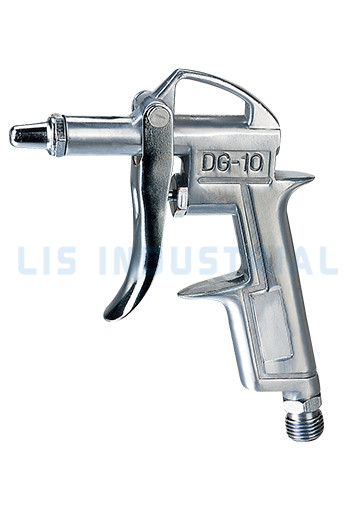
Product Overview: A Compact Air Blow Gun for Everyday Cleaning Tasks
The DG10-1 Air Blow Gun Cleaner Compressor Dust Blower is a compressed-air cleaning tool intended for blowing away dust and loose particles. It connects to an air compressor system through suitable air fittings and uses controlled airflow to clean parts, benches, machinery, and surfaces. In many facilities, the tool can be used at the end of a compressed-air hose beside a workbench, inside a maintenance bay, in a paint preparation room, or near a CNC woodworking or metalworking area.
Its main function is simple: convert compressed air into a directed cleaning stream. However, a good air blow gun must do more than release air. It should feel comfortable in the hand, respond smoothly to operator control, withstand frequent use, connect securely with air pipeline accessories, and maintain consistent airflow. The DG10-1 is built around these practical expectations. Its compact size supports quick movement around complex workpieces, while its air-blowing function helps reduce cleaning time compared with brushes, cloths, or vacuuming in certain applications.
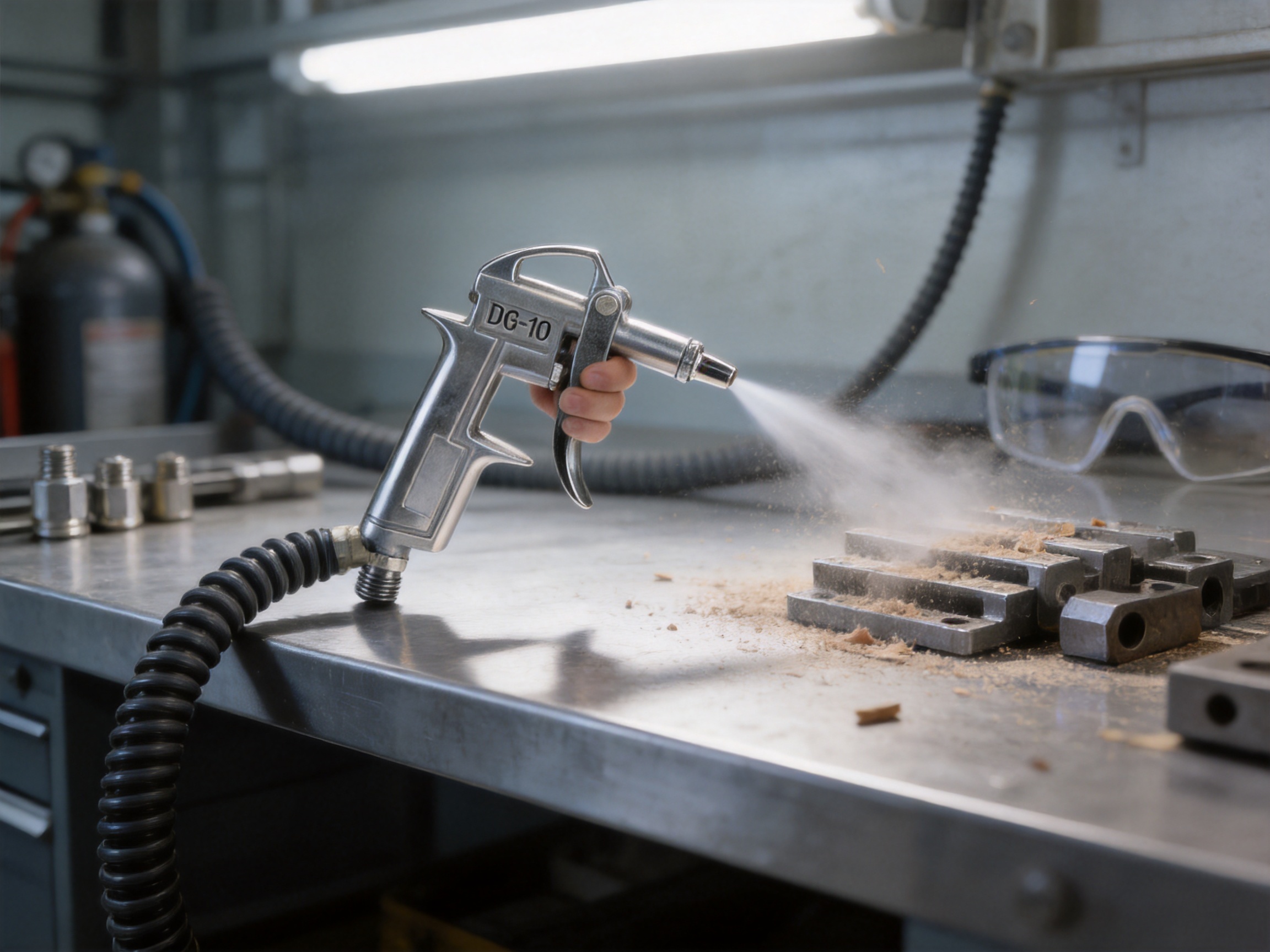
In workshops using spray guns or paint sprayers, an air blow gun is often used before the painting stage. Operators can remove loose dust from panels, body parts, furniture pieces, metal components, jigs, masking areas, and spray booths. In woodworking, compressed air can clear sawdust from grooves, edges, sanding marks, hinges, guide rails, and assemblies. In automotive and mechanical service, the DG10-1 can be used to clean filters, tools, fixtures, engine bay areas, wheels, worktops, and equipment housings when appropriate safety procedures are followed.
The product title identifies it as a cleaner, compressor dust blower, and air blow gun, which accurately describes its role. It is not a complicated machine; instead, it is a vital supporting tool that makes larger processes cleaner and more efficient. For many professionals, the best tools are the ones that work every day without attracting attention. A reliable blow gun becomes part of the workflow, saving minutes on every task and reducing the risk of contamination in quality-sensitive operations.
Key Advantages in Practical Use
The first advantage of the DG10-1 is operational speed. Compressed air cleaning is fast because it can reach corners, gaps, holes, and irregular surfaces that are difficult to wipe manually. A worker can clear dust from a bench, blow chips from a drilled part, or remove powder from a fixture in seconds. In environments where repeated cleaning is required throughout a shift, this time saving becomes significant.
The second advantage is versatility. The DG10-1 is suitable for a wide range of tasks, including general workshop cleaning, pre-paint surface preparation, dust removal from tools, cleaning of machine areas, and maintenance support. Because it belongs to the air blowing gun category, it can be integrated into many compressed-air systems where suitable pressure regulation and fittings are available. Users working with air paint sprayers, air polishers, woodworking equipment, and pneumatic tools can benefit from having a dedicated dust blower nearby.
The third advantage is operator control. An air blow gun must allow the worker to release air when needed and stop quickly when the task is complete. Controlled airflow reduces unnecessary air consumption and makes cleaning more accurate. Compared with improvised air hoses or low-grade blowers, a purpose-built blow gun offers more convenient handling and a more professional approach to shop cleanliness.
The fourth advantage is reduced physical effort. Brushing, wiping, and disassembling parts for cleaning can consume labor and increase fatigue. The DG10-1 allows many loose-particle cleaning tasks to be completed with a simple hand motion. This does not eliminate the need for proper deep cleaning, but it greatly improves daily housekeeping and intermediate cleaning between work steps.
The fifth advantage is compatibility with professional manufacturing environments. Ningbo Lis Industrial Co., Ltd. has long experience in the air tool and spraying equipment field, including air painting spray guns, mini air compressors, air pipeline accessories, air fittings, and related pneumatic products. This background matters because air tools depend on accurate machining, dependable seals, proper material selection, and consistent quality inspection. The DG10-1 benefits from a broader manufacturing ecosystem focused on compressed-air performance.
Why a Dedicated Air Blow Gun Performs Better Than Improvised Cleaning Methods
Some workshops attempt to use open hoses, damaged nozzles, or makeshift fittings to blow dust away. Although these methods may seem convenient, they often create problems. Uncontrolled airflow can waste compressed air, increase noise, scatter debris unpredictably, and reduce operator precision. An open hose can whip, leak, or become difficult to manage. A damaged fitting can create safety risks. A dedicated tool like the DG10-1 is a better solution because it is designed specifically for hand-controlled air blowing.
Compared with manual cleaning using cloths or brushes, a compressed-air blow gun can reach narrow crevices and uneven surfaces more effectively. Brushes may push dust deeper into holes or scratch delicate surfaces. Cloths may leave fibers behind, especially before painting or coating. Vacuum tools are useful in many settings, but they may not be as quick for clearing small parts or irregular shapes. The DG10-1 fills the gap by offering immediate, directed airflow exactly where the operator needs it.
Compared with lower-quality blow guns, the DG10-1 stands out through the manufacturing strength behind it. A competitor product may look similar from a distance, but small differences in trigger feel, internal sealing, body durability, connection stability, and airflow consistency affect everyday performance. A tool that leaks air increases compressor load. A poorly balanced handle causes fatigue. A weak body can fail after repeated drops. A rough trigger can make fine cleaning harder. Professional production standards help reduce these weaknesses.
For buyers, the cost of an air blow gun should not be judged only by the purchase price. The real cost includes air consumption, downtime, replacement frequency, worker comfort, and cleaning effectiveness. A more reliable tool can reduce interruptions and support better process quality. In paint and finishing work, preventing a single dust-related defect may save far more than the cost of the tool. In production lines, keeping fixtures and parts clean can prevent rework and improve consistency.
Applications Across Industries
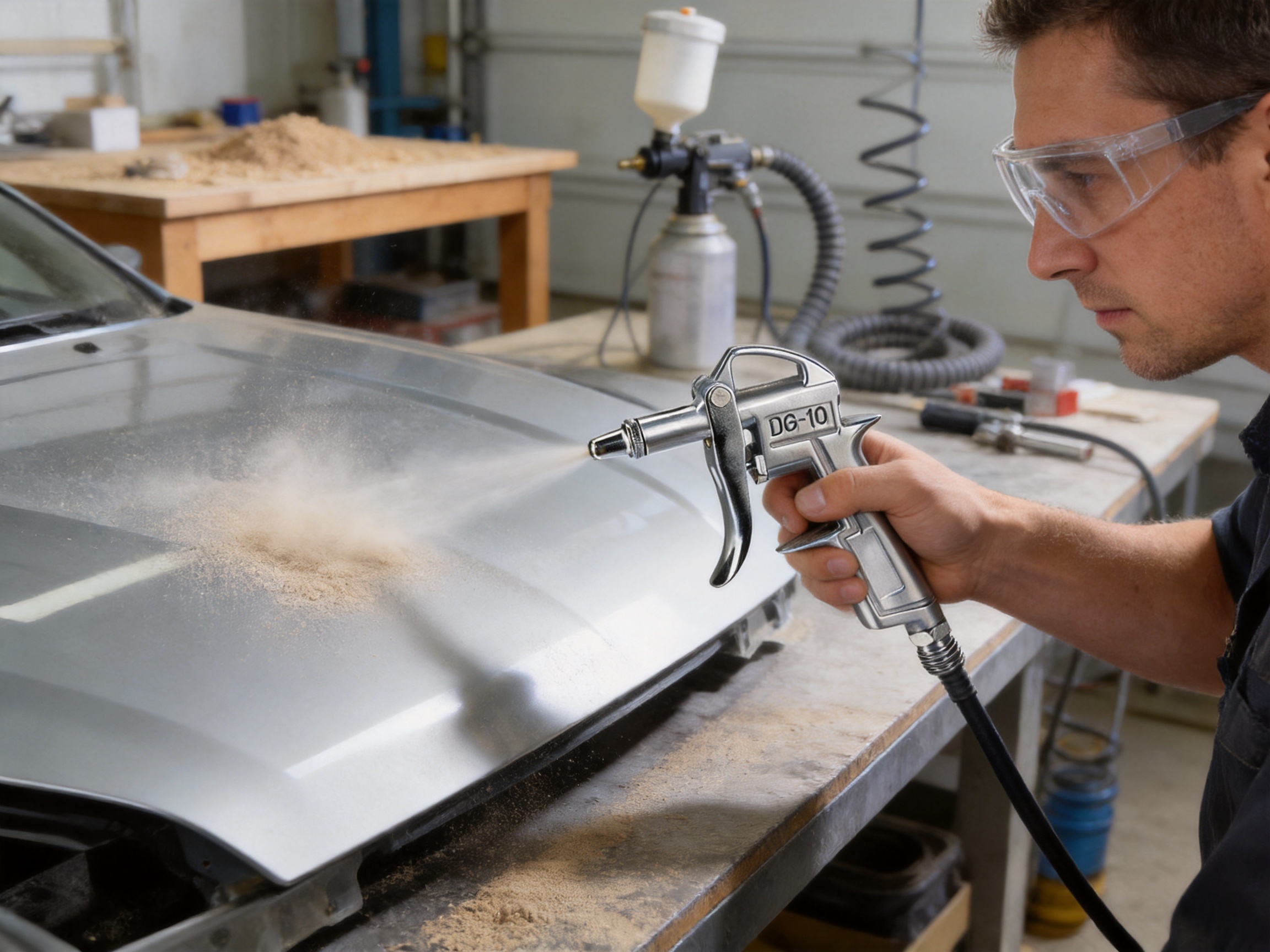
The DG10-1 can be applied in many industries because dust and debris are universal problems. In automotive repair, technicians may use an air blow gun to clean work areas, remove dust from body panels before sanding or painting, clear particles from tools, or blow moisture from certain surfaces. In body shops, air cleaning often takes place before applying primer, basecoat, or clearcoat, although users must always follow paint shop safety rules and filtration requirements.
In woodworking, sawdust and sanding dust can accumulate rapidly. The DG10-1 can help clean joinery areas, drilled holes, router paths, sanding stations, clamps, jigs, and assembly benches. Woodworking low-pressure spray guns and finishing systems require clean surfaces for good results. Before applying stain, lacquer, varnish, or paint, operators can use the blow gun to remove loose dust from corners and textured grain. This supports a smoother finish and reduces defects.
In metalworking and machining environments, chips and shavings can interfere with measurement, assembly, and tool life. A directed air blow gun can clear loose chips from fixtures, vises, machines, parts, and inspection areas. Users must apply proper safety measures, including eye protection and chip control, because metal particles can be hazardous when blown into the air. When used responsibly, the DG10-1 is a useful tool for keeping work areas ready for the next operation.
In electronics repair, compressed air is often used carefully to remove dust from housings, vents, and non-sensitive mechanical areas. The DG10-1 may support general cleaning tasks around benches and equipment, provided pressure levels are appropriate and components are protected from static, moisture, and excessive force. In general maintenance departments, it can clean filters, fan covers, toolboxes, compressor areas, and floor-level equipment surfaces.
In manufacturing plants, air blowing guns are often placed at multiple stations. Operators use them during assembly, inspection, packaging, and equipment maintenance. A dependable model supports standardization. When a facility chooses consistent tools, training becomes easier, spare parts and fittings are more predictable, and maintenance teams can manage the compressed-air network more effectively.
Product Value for Painting and Surface Preparation
Because Ningbo Lis Industrial Co., Ltd. is strongly associated with spraying equipment and air painting tools, it is important to consider how the DG10-1 contributes to the painting process. A paint spray gun or paint sprayer can only produce a high-quality coating when the surface is properly prepared. Dust, sanding residue, fibers, water droplets, and loose contaminants may cause pinholes, fisheyes, rough texture, poor adhesion, and visible defects. The air blow gun is not a replacement for full surface preparation, but it is a key supporting tool.
Before painting, an operator may sand the surface, wipe it with appropriate cleaning material, inspect it, and then use compressed air to clear remaining loose particles from edges and seams. The DG10-1 helps reach areas where cloth cannot easily reach. In furniture finishing, this may include carved details, frame joints, panel edges, and hardware recesses. In automotive work, it may include door gaps, trim lines, wheel arches, and masked areas. In industrial coating, it may include brackets, weld seams, bolt holes, and assembly features.
Cleanliness is also important for spray gun maintenance. Paint spray guns, touch-up spray guns, automatic spray guns, airbrushes, and electric spray systems all require surrounding work areas to be clean. Dust on a bench can transfer to components during cleaning or assembly. The DG10-1 can help keep the maintenance area clear of dry particles before gun servicing. While it should not be used to blow liquid solvents in an unsafe way, it can support general dry cleanup and tool area maintenance.
When paired with proper filtration, dry compressed air, suitable pressure regulation, and good workshop habits, a blow gun becomes part of a complete finishing quality system. It helps reduce the hidden causes of coating defects and makes the operator’s work more predictable. This is one of the reasons why professional spray equipment suppliers also offer air blowing guns and accessories: the best finish depends on the entire air and surface preparation process, not only the spray gun itself.
Manufacturing Strength Behind the DG10-1
Ningbo Lis Industrial Co., Ltd. has developed from its establishment in 1984 into one of the significant enterprises in China’s painting spray gun and air tool industry. The company is located in Ningbo, a harbor city with strong industrial infrastructure, convenient transportation, and a developed economic environment. These advantages support efficient sourcing, manufacturing, export logistics, and customer service for global markets.
The company’s production scope includes air painting spray gun series, mini oil-free compressors, relevant air tools, air pipeline accessories, air fittings, paint tanks, polishing tools, spray gun kits, touch-up spray guns, airless spray guns, electric spray guns, and related equipment. This broad product system is an advantage for the DG10-1 because air blowing guns are not produced in isolation. They are part of an integrated pneumatic manufacturing environment where engineers understand airflow, sealing, ergonomics, pressure behavior, and user requirements.
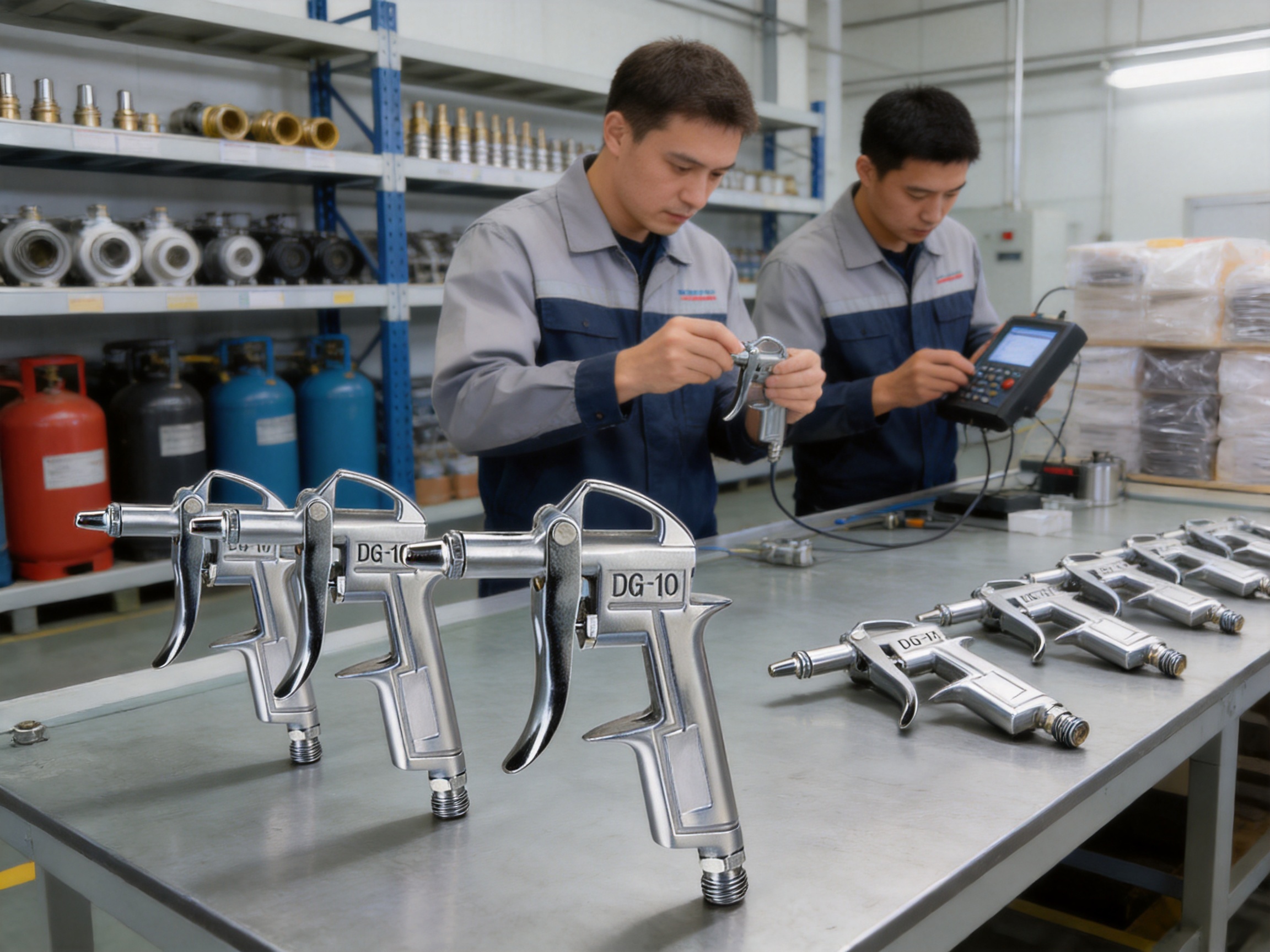
Lis Industrial operates with a quality-focused approach based on ISO9000 quality system principles. The company emphasizes control from raw material and incoming inspection through in-process quality control, functional testing, and final product inspection. For an air blow gun, this approach can affect body integrity, fitting accuracy, trigger response, surface finish, and leak resistance. Even a small air tool benefits from disciplined inspection because compressed-air products must work safely and consistently under repeated pressure cycles.
The company has also been recognized as a national high-tech enterprise and has developed engineering and technology capabilities. Its R&D team supports both OEM production according to customer drawings or samples and ODM services based on customer needs. This means the manufacturing organization is not limited to copying existing designs; it can improve, customize, and develop products for different markets and usage standards. For buyers seeking stable supply and technical support, this capability is a meaningful advantage.
Production capacity is another strength. The company has reported the ability to increase production capacity significantly within a short time to meet different purchase quantities. This matters to distributors, wholesalers, and industrial buyers who need dependable delivery. A tool like the DG10-1 may be purchased in large quantities for workshops, retail channels, or bundled air tool programs. A manufacturer with flexible capacity can support both routine orders and demand surges.
Advanced Quality Control and Process Discipline
Manufacturing an air blow gun requires attention to materials, machining, assembly, testing, and packaging. The body and internal components must be suitable for compressed-air use. Threads and connection points must be accurate. Seals must prevent leakage. The trigger or valve mechanism must respond repeatedly without sticking. The tool must be comfortable enough for frequent handling. These requirements sound straightforward, but they depend on process discipline.
Incoming material inspection helps ensure that the raw materials and purchased components meet specifications before production begins. If poor-quality material enters the process, later inspection may not fully solve the problem. By controlling incoming quality, the manufacturer reduces variation and supports more consistent final products. This is especially important for pneumatic tools, where dimensional accuracy and material strength affect performance.
In-process quality control monitors production stages before final assembly. This may include dimensional checks, surface checks, thread verification, component fitting, and process stability review. In-process control helps identify issues early, reducing waste and preventing defective batches from moving forward. For a high-volume tool such as an air blow gun, early detection is essential to maintain efficiency and protect customer confidence.
Functional testing is one of the most important steps for air tools. A blow gun should be checked for air release, trigger operation, leakage, and basic performance. The company’s emphasis on complete quality control and functional testing supports user confidence. A product that passes functional checks is more likely to perform properly when connected to a compressor in the field.
Final inspection before shipment helps confirm that the finished tool meets appearance, assembly, packaging, and performance expectations. This stage is important for distributors and end users because it reduces the chance of receiving damaged, incomplete, or inconsistent products. When a manufacturer exports to Europe, North America, the Middle East, South Africa, East Asia, and other regions, consistent final inspection becomes central to international reputation.
Comparison With Common Competing Products
| Evaluation Area | DG10-1 Air Blow Gun | Typical Low-Cost Alternative | User Benefit |
|---|---|---|---|
| Manufacturing Background | Produced within a professional air tool and spray equipment manufacturing system | Often produced with limited specialization or unclear quality systems | Greater confidence in consistency and air tool know-how |
| Quality Control | Supported by incoming inspection, in-process control, functional testing, and final inspection | May rely mainly on basic visual checks | Reduced risk of leakage, poor fit, or early failure |
| Application Range | Suitable for workshop cleaning, surface preparation, maintenance, and dust removal | May be acceptable only for light or occasional use | Better value for professional environments |
| Supply Capability | Backed by a manufacturer with scalable production and export experience | Supply may be inconsistent for larger orders | Useful for distributors and industrial purchasers |
| Product Ecosystem | Part of a broader line of air tools, compressors, fittings, and spraying accessories | Often sold as a single isolated item | Easier sourcing of related pneumatic products |
The table shows that the DG10-1 competes not only as a physical tool but also as part of a stronger manufacturing and supply system. Many air blow guns look similar, but professional buyers know that consistency, inspection, and delivery reliability are just as important as appearance. A low-cost alternative may work for occasional home use, but it may not provide the same assurance for daily workshop or distribution needs.
The DG10-1 also has an advantage because it comes from a company with experience in international markets and product certifications for related product lines, including CE and GS certifications. While certifications vary by product and market, the presence of a certification culture indicates familiarity with global requirements, documentation, testing expectations, and quality management. This is valuable for importers and business customers who need suppliers capable of meeting professional standards.
Another advantage over competitors is the company’s ability to provide OEM and ODM services. If a buyer needs customized packaging, product adjustments, fitting compatibility, branding arrangements, or specific market requirements, a manufacturer with R&D and production flexibility can respond more effectively. This makes the DG10-1 not only an off-the-shelf air blow gun but also a potential component in broader customer-specific air tool programs.
Ergonomics and Ease of Use
A frequently used tool must be comfortable. Even a simple air blow gun can cause fatigue if the grip is awkward, the trigger is stiff, or the balance is poor. The DG10-1 is intended for convenient handheld operation, allowing workers to direct air with accuracy and complete cleaning tasks without unnecessary strain. Its compact nature supports movement around tight spaces and reduces the effort required to position the tool.
Ease of use also improves training. New employees can quickly understand how to connect the tool, aim it, activate airflow, and clean the target area. This makes the DG10-1 suitable for busy workshops where tools need to be practical and intuitive. Supervisors can establish clear procedures for safe pressure levels, eye protection, chip direction, and cleanup routines.
Control is especially important when cleaning sensitive surfaces. Too much air, or air directed at the wrong angle, may scatter debris into finished surfaces, bearings, electronic areas, or other sensitive zones. A handheld blow gun gives the operator a better chance to manage airflow direction compared with uncontrolled hoses. In quality-sensitive industries, the ability to apply air precisely helps reduce secondary contamination.
For distributors and retail customers, simple usability also reduces after-sales questions. A product that connects easily to standard air systems, feels familiar, and performs expected cleaning tasks is more likely to satisfy end users. When combined with clear instructions and appropriate safety guidance, the DG10-1 can serve professional and serious DIY users alike.
Integration With Compressed-Air Systems
The performance of any air blow gun depends partly on the compressed-air system that supplies it. Users should connect the DG10-1 to a suitable air compressor with proper hoses, fittings, regulators, and filters. Clean, dry air improves the performance of pneumatic tools and reduces the risk of blowing moisture or oil onto work surfaces. In painting and finishing environments, air quality is particularly important because contamination can damage coating results.
Air pipeline accessories and air fittings play a major role in stable operation. Loose or poor-quality fittings may leak, reduce pressure, or create safety hazards. Because Ningbo Lis Industrial Co., Ltd. also offers air fittings and accessories, customers can source related components from a supplier familiar with pneumatic systems. This integrated product range supports compatibility and simplifies procurement for buyers who need more than one item.
Pressure regulation should be handled responsibly. Excessive air pressure can increase noise, waste energy, and create unsafe particle movement. Appropriate pressure depends on the task, the workpiece, and local safety rules. Users should follow workplace requirements and never direct compressed air at people, skin, eyes, or clothing. Proper personal protective equipment, including safety glasses or face protection, should be used when blowing dust or chips.
Energy efficiency is another reason to use a proper blow gun. Compressed air is expensive to generate. A leaking or uncontrolled tool forces the compressor to run more often, increasing energy cost and wear. A controlled air blow gun helps release air only when needed. While the DG10-1 is primarily a cleaning tool, its proper use can support better compressed-air management in a facility.
Durability and Long-Term Value
Durability is one of the most important purchase factors for industrial users. A blow gun may be dropped, handled with gloves, used repeatedly throughout a shift, and exposed to dust, overspray, oil, or shop grime. A product intended for professional settings must tolerate these conditions better than a light-duty accessory. The DG10-1 is backed by a manufacturing organization with decades of experience in air tools and spraying equipment, which supports attention to product robustness.
Long-term value comes from dependable service, not just initial cost. If a low-priced blow gun leaks after a short period, breaks at the connection, or becomes uncomfortable, the user loses time and must replace it. In a busy workshop, tool failure can interrupt work and reduce confidence in the supplier. The DG10-1 is positioned as a practical, economical, and dependable tool for users who need repeatable performance.
The company’s production scale and quality control also support consistent replacement supply. For businesses operating multiple workstations, standardizing on a model like the DG10-1 can make purchasing and maintenance easier. When a tool is familiar to operators, they use it more correctly. When the supplier can provide stable quality over time, the business avoids the problems caused by constantly changing tool styles and fittings.
Durability should also be supported by proper care. Users should keep the tool clean, avoid dropping it unnecessarily, check fittings for tightness, and store it in a dry place. Air systems should be maintained to prevent excessive moisture and contamination. These simple practices extend service life and maintain performance.
Safety Considerations for Responsible Operation
Compressed air must be treated with respect. Although an air blow gun is simple, improper use can cause injury. Operators should never point the DG10-1 at themselves or others. Compressed air can drive particles into eyes or skin, and flying debris can injure nearby workers. Eye protection is essential. In noisy environments or high-airflow applications, hearing protection may also be required.
Users should avoid blowing hazardous dust into the air without proper extraction or ventilation. Certain materials, such as fine wood dust, metal dust, paint residue, and chemical powders, may present respiratory or fire hazards. In such cases, compressed air should be used according to workplace safety procedures, and dust collection or vacuum systems may be required. The DG10-1 is a tool for cleaning, but the cleaning method must match the material and environment.
Pressure should be controlled. More pressure is not always better. Excessive pressure may damage delicate components, scatter debris too widely, or increase risk. A regulator allows the user to adjust airflow for the job. In paint preparation areas, clean and dry air is important to avoid adding moisture or oil to surfaces. If the compressed-air system is contaminated, an air blow gun can spread that contamination.
Safe storage is also important. A blow gun attached to a hose should not be left where it can be stepped on, caught in machinery, or accidentally activated. Hoses should be routed to reduce trip hazards. Fittings should be inspected regularly. These precautions help the DG10-1 remain a productive and safe part of the workshop.
Company Strengths Supporting Global Buyers
Ningbo Lis Industrial Co., Ltd. has built a worldwide marketing and service network, with products sold into Europe, North America, the Middle East, South Africa, East Asia, and other regions. For global buyers, this export experience is valuable. International trade requires stable production, documentation, packaging, quality consistency, communication, and delivery coordination. A supplier experienced in these areas can reduce procurement risk.
The company’s customer base includes long-term strategic partnerships, and its development has been guided by customer satisfaction. This customer-oriented approach is important because air tool buyers often need more than a single transaction. They may require technical communication, packaging support, product development, production scheduling, and after-sales assistance. A manufacturer with a strong service mindset can become a long-term partner rather than only a vendor.
Research and development strength is another major advantage. The company has invested in technology improvement and established engineering technology capabilities in spraying machinery. Technical cooperation and product development experience in the spraying field contribute to a culture of innovation. While the DG10-1 is a straightforward air blow gun, it benefits from a company environment that understands air movement, tool design, product testing, and market requirements.
The company’s mission emphasizes innovative design, high-quality products and services, and value creation for global customers. Its vision focuses on painting industry needs and professional solutions. These principles align with the DG10-1 because a clean, efficient air blowing gun supports the broader goal of better painting, finishing, maintenance, and pneumatic work. The product is a small but meaningful part of a complete air tool solution.
How the DG10-1 Supports Distributors and OEM Customers
Distributors need products that are easy to explain, easy to sell, and reliable after sale. The DG10-1 has a clear function and a broad customer base, which makes it suitable for catalog sales, retail display, workshop supply programs, and pneumatic accessory packages. Because air blow guns are common consumable or semi-consumable tools, distributors can benefit from steady repeat demand.
OEM customers may need air blowing guns as part of compressor kits, spray gun kits, workshop tool sets, or maintenance packages. A manufacturer capable of OEM and ODM service can support custom requirements based on drawings, samples, packaging designs, market standards, or branding plans. This flexibility helps customers differentiate their product offerings while relying on experienced production support.
The company’s ability to increase production capacity within a short period is also important for seasonal or project-based orders. If a distributor receives a large request from a chain store, industrial group, or regional wholesaler, supply flexibility can determine whether the opportunity is captured. A stable manufacturer with scalable capacity gives buyers more confidence when planning promotions or expanding market coverage.
For professional procurement teams, supplier evaluation includes more than unit price. They consider factory scale, quality systems, export experience, communication, product range, customization capacity, and long-term reliability. The DG10-1 is supported by strengths in these areas, giving it an advantage over products from smaller or less specialized suppliers.
Maintenance Tips for Longer Service Life
To keep the DG10-1 performing well, users should inspect it regularly. Before use, check that the air connection is secure and that the hose is in good condition. Listen for unusual leakage and confirm that the trigger or valve operates smoothly. If the tool has been stored in a dusty environment, wipe the exterior before connecting it to the air line.
After use, disconnect the tool from the air supply when appropriate and store it in a clean, dry location. Avoid leaving it on the floor where it can be stepped on or damaged by vehicles, carts, or falling objects. If used in a paint shop, prevent heavy overspray buildup around the moving parts. If used in woodworking, keep fine dust from packing into the mechanism.
Maintain the compressed-air system as well. Drain compressor tanks according to maintenance instructions, use filters where necessary, and replace damaged hoses or fittings. A clean air supply protects not only the blow gun but also spray guns, polishers, inflating guns, sandblast guns, foam guns, and other pneumatic tools connected to the same system.
Use the correct fittings and avoid forcing mismatched threads. Damaged threads can cause leaks and unsafe connections. If a fitting becomes worn, replace it promptly. Good maintenance habits reduce air waste, improve safety, and extend the working life of the DG10-1.
Buying Considerations
When selecting an air blow gun, buyers should consider the work environment, air system, cleaning tasks, expected usage frequency, and supplier reliability. A small workshop may need only a few tools, while a large plant may require dozens or hundreds. The DG10-1 is suitable for buyers who want a practical product supported by a professional air tool manufacturer.
Buyers should also evaluate compatibility with existing hoses and fittings. If a facility uses regional standards such as Japan standard, European standard, U.S. standard, or G.B. standard fittings, the purchasing team should confirm the correct configuration. A manufacturer with broad experience in air fittings and accessories can help support market-specific requirements.
Packaging and logistics may matter for distributors. Clear labeling, stable packaging, and consistent product appearance help retail and wholesale operations. For industrial buyers, bulk packaging and predictable supply may be more important. Because Ningbo Lis Industrial Co., Ltd. serves international markets, it understands the importance of export-ready supply arrangements.
Finally, buyers should consider the total solution. If they also need spray guns, air brushes, mini oil-free compressors, paint tanks, air polishers, air pipeline accessories, or spray gun kits, sourcing from a broad manufacturer can reduce supplier complexity. The DG10-1 fits naturally into a larger pneumatic and painting product portfolio.
Q&A Section
What is the DG10-1 Air Blow Gun used for?
The DG10-1 is used for blowing away dust, chips, loose particles, and debris with compressed air. It is suitable for workshops, woodworking areas, automotive repair stations, painting preparation zones, maintenance departments, and general industrial cleaning tasks.
Why is an air blow gun important before painting?
Before painting, loose dust and sanding residue can cause coating defects such as roughness, pinholes, and poor finish quality. The DG10-1 helps remove particles from seams, edges, holes, and surface details, supporting cleaner preparation before spraying.
How does the DG10-1 compare with low-cost alternatives?
The DG10-1 is supported by a professional manufacturing system with experience in air tools and spraying equipment. Compared with many low-cost alternatives, it benefits from stronger quality control, broader supplier capability, export experience, and integration with related pneumatic accessories.
Can the DG10-1 be used in woodworking?
Yes. It can help remove sawdust and sanding dust from joints, grooves, benches, tools, and workpieces. Users should follow dust safety procedures, especially when working with fine wood dust or enclosed spaces.
Is compressed air cleaning safe?
Compressed air cleaning is safe when used correctly. Operators should wear eye protection, avoid pointing the tool at people, control air pressure, and prevent hazardous dust from becoming airborne. Workplace safety rules should always be followed.
What kind of air system is needed?
The DG10-1 should be connected to a suitable air compressor system with proper hoses, fittings, and pressure regulation. Clean and dry air is recommended, especially in painting and finishing environments.
Can distributors order the DG10-1 for large-volume sales?
Yes. The product is supported by a manufacturer with scalable production capacity and international supply experience. It is suitable for distributors, wholesalers, retail channels, industrial suppliers, and OEM tool programs.
Does the manufacturer provide OEM or ODM support?
Ningbo Lis Industrial Co., Ltd. provides OEM services according to customer drawings or samples and ODM services according to customer needs. This is useful for customers requiring customized products, packaging, or market-specific configurations.
How should the DG10-1 be maintained?
Users should keep it clean, check fittings and hoses regularly, avoid dropping it, store it in a dry place, and maintain the compressed-air system. Proper care helps reduce leaks and extends tool life.
What makes the company behind the DG10-1 reliable?
The company has decades of industry experience, a broad pneumatic and spraying product range, quality management practices, R&D capability, export experience, and a focus on customer satisfaction. These strengths support consistent product supply and long-term buyer confidence.
Conclusion
The DG10-1 Air Blow Gun Cleaner Compressor Dust Blower is a practical and valuable tool for workshops that depend on clean surfaces, efficient maintenance, and reliable compressed-air accessories. It offers fast dust removal, convenient handling, broad application potential, and strong compatibility with professional work environments. Whether used in painting preparation, woodworking, automotive repair, general maintenance, or manufacturing, it helps operators save time and improve cleanliness.
Its competitive advantage is strengthened by the manufacturing background of Ningbo Lis Industrial Co., Ltd. The company’s experience in air painting spray guns, compressors, air tools, fittings, and spraying solutions gives the DG10-1 a strong foundation. Quality control from material inspection to final testing, R&D capability, OEM and ODM support, scalable production, and international market experience all contribute to product value.
For end users, the DG10-1 is a dependable daily cleaning tool. For distributors, it is a marketable pneumatic accessory with wide demand. For OEM customers, it can be part of a customized air tool or compressor solution. In all cases, it demonstrates how a simple product can deliver meaningful benefits when supported by professional design, disciplined manufacturing, and a complete understanding of compressed-air applications.
References
Compressed Air and Gas Institute. Compressed Air Safety and Energy Efficiency Guidelines.
International Organization for Standardization. ISO 9001 Quality Management Systems: Requirements and Application Guidance.
Occupational Safety and Health Administration. General Safety Principles for Compressed Air Use in Industrial Workplaces.
Society of Manufacturing Engineers. Workshop Cleaning, Surface Preparation, and Production Maintenance Practices.
Finishing and Coating Industry Handbook. Surface Cleanliness and Defect Prevention in Spray Finishing.