 Search
 English
 中文简体
中文简体 Deutsch
 Español
Content
- 1 Product Overview
- 2 Key Specifications
- 3 Why Air Siphon Sandblasting Matters
- 4 Competitive Advantages of the PS3 Sandblaster Feed Blast Gun
- 5 Manufacturing Strength Behind the Product
- 6 Application Scenarios
- 7 How the PS3 Compares with Common Alternatives
- 8 Operational Guidance for Better Results
- 9 Safety Considerations
- 10 Procurement Value for Distributors and Industrial Buyers
- 11 Brand and OEM/ODM Support
- 12 Why Manufacturing Experience Matters in Air Tools
- 13 Long-Term Value Compared with Low-Cost Alternatives
- 14 Q&A Section
- 14.1 Q1: What is the PS3 sandblaster feed blast gun used for?
- 14.2 Q2: What is the rated pressure of the product?
- 14.3 Q3: What is the maximum pressure?
- 14.4 Q4: How does an air siphon sandblasting gun work?
- 14.5 Q5: Is the PS3 suitable for large industrial blasting jobs?
- 14.6 Q6: What compressor should be used?
- 14.7 Q7: Can it be used for automotive restoration?
- 14.8 Q8: What safety equipment is needed?
- 14.9 Q9: Why is this product a good choice for distributors?
- 14.10 Q10: Does the manufacturer support OEM or ODM cooperation?
- 15 Conclusion
- 16 References
- 17 Product: PS3 Sandblaster Feed Blast Gun Air Siphon Sand Blasting Gun
The PS3 Sandblaster Feed Blast Gun Air Siphon Sand Blasting Gun is designed for workshops, maintenance teams, fabrication users, refinishing professionals, and industrial buyers who need a practical, reliable, and economical tool for abrasive surface preparation. As a product in the sandblast gun and foam gun category, it offers a focused solution for removing rust, old paint, scale, carbon deposits, oxidation, and other surface contamination before coating, repainting, repairing, or restoring a workpiece.
Unlike complex blasting systems that require large cabinets, heavy pressure vessels, or highly specialized operation, an air siphon sandblasting gun is valued for its convenient structure and straightforward working principle. Compressed air passes through the gun and creates suction that draws abrasive media into the airflow. The mixed air and abrasive stream then impacts the surface, helping the user clean, roughen, or prepare the material. This makes the PS3 a practical tool for users who want flexible blasting performance without investing in oversized equipment.
The product is rated at 70 PSI and supports a maximum pressure of no more than 150 PSI. This pressure range allows the gun to serve many common cleaning and preparation tasks while giving users room to adjust operating conditions according to material hardness, abrasive type, surface condition, and compressor capability. The carton size is 45 by 45 by 37 cm, with 10 pieces packed per carton, making it suitable for distributors, wholesalers, tool retailers, and OEM supply programs that require manageable logistics.
PS3 Sandblaster Feed Blast Gun Air Siphon Sand Blasting Gun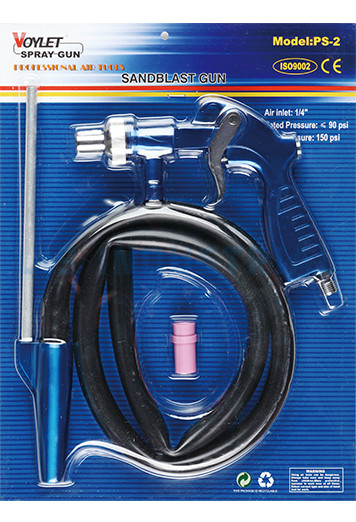
Product Overview
The PS3 sandblaster feed blast gun is a pneumatic tool built around the air siphon principle. In a typical use scenario, the operator connects the gun to a compressed air source and places the pickup tube or feed supply into suitable blasting media. When the trigger is activated, high-speed air creates a negative pressure zone that pulls abrasive into the airstream. The resulting blasting jet can be directed at the work surface for cleaning, etching, or coating preparation.
This simple operating concept is one of the product’s major advantages. It reduces the need for complicated setup, makes the tool easier to understand, and supports quick movement between jobs. For a maintenance shop or body repair facility, time spent setting up tools is often just as important as the tool’s blasting ability. A feed blast gun that can be prepared quickly helps improve workflow efficiency.
The PS3 is especially relevant for users who need targeted abrasive action. Large blasting rooms and automated systems may be efficient for mass production, but they are not always convenient for localized rust removal, small parts restoration, weld cleaning, bracket cleaning, wheel rim touch-up preparation, or metal edge treatment. A hand-operated siphon blasting gun gives users direct control over the spray position and angle, making it ideal for spot work.
The product also fits naturally into the broader air tool environment. Many workshops already use compressors for spray guns, air blowing guns, tyre inflating guns, air polishers, and other pneumatic tools. The PS3 extends the usefulness of that existing compressed air system by adding abrasive cleaning capability. This means users can gain additional surface preparation capacity without building an entirely new equipment infrastructure.
Key Specifications
| Item | Specification | Practical Meaning |
|---|---|---|
| Product Name | PS3 Sandblaster Feed Blast Gun Air Siphon Sand Blasting Gun | A hand-operated pneumatic blasting gun for abrasive surface preparation. |
| Product Category | Sandblast Guns/Foam Guns | Suitable for users sourcing air tools for cleaning, preparation, and finishing work. |
| Rated Pressure | 70 PSI | Appropriate for many standard blasting and cleaning applications when matched with a suitable compressor and media. |
| Maximum Pressure | ≤ 150 PSI | Provides an upper pressure limit for safe and controlled operation. |
| Carton Size | 45 × 45 × 37 cm | Convenient for storage, shipping, distribution, and warehouse planning. |
| Packing Quantity | 10 pcs/ctn | Suitable for wholesale, retail replenishment, and project procurement. |
| Operating Principle | Air siphon feed | Uses compressed air to draw abrasive media into the blasting stream. |
Why Air Siphon Sandblasting Matters
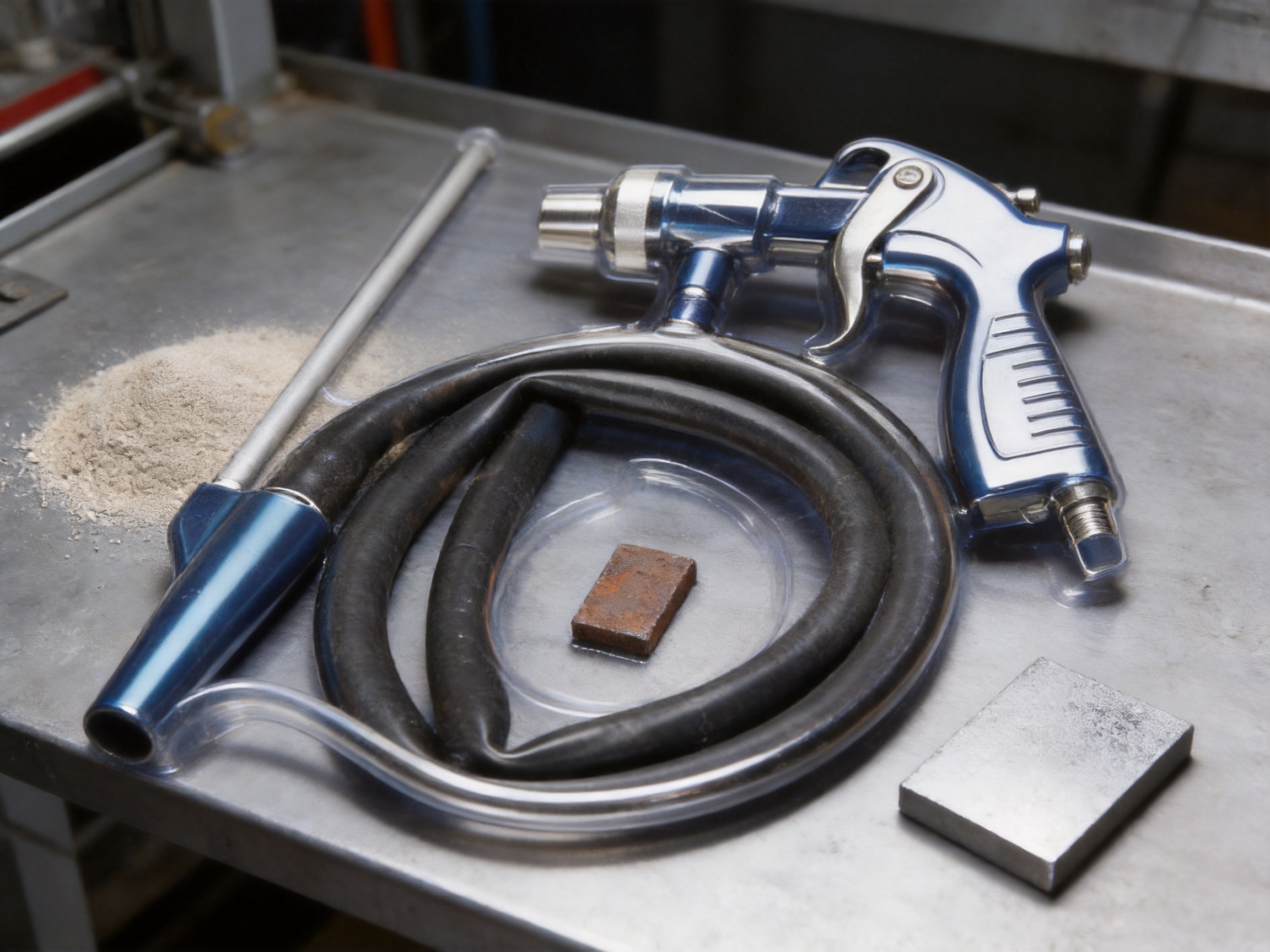
Surface preparation is one of the most important stages in coating quality, repair durability, and restoration results. Paint, powder coating, primer, adhesive, sealant, and protective coatings often fail when applied over rust, grease, loose paint, scale, or poorly prepared surfaces. A sandblasting gun helps solve this problem by mechanically cleaning the surface and creating a profile that can improve coating adhesion.
Air siphon sandblasting is especially useful because it balances performance with accessibility. Pressure pot systems can deliver strong blasting force, but they require more equipment, more preparation, and more careful management. Cabinet blasters are excellent for small parts but limit the operator to workpieces that fit inside the cabinet. A siphon feed blast gun is more flexible, allowing the operator to bring the tool to the workpiece and treat only the area that needs attention.
For automotive repair, it can support removal of rust from panels, frames, brackets, suspension components, and wheels. For machinery maintenance, it can help clean corroded metal parts, tool surfaces, and fixtures. For woodworking or decorative work, suitable media and careful pressure control may be used for texture effects or surface treatment, subject to testing and operator experience. For general fabrication, it assists in cleaning weld zones and preparing metal before painting.
The PS3’s rated pressure of 70 PSI is suitable for many routine operations. Users can select pressure based on the sensitivity of the material and the aggressiveness of the abrasive media. Higher pressure may clean faster, but it can also increase media consumption, surface roughness, dust, and risk of damage on delicate surfaces. The maximum pressure of no more than 150 PSI gives a clear boundary for safe setup and helps protect the tool from misuse.
Competitive Advantages of the PS3 Sandblaster Feed Blast Gun
Practical Pressure Range
One advantage of the PS3 is its practical pressure specification. A rated pressure of 70 PSI gives users a useful operating point for common blasting tasks. Some low-cost tools offer vague pressure information, which can lead to inconsistent results or improper compressor matching. By stating both rated pressure and maximum pressure, this product gives buyers and users clearer expectations.
In real workshop use, clarity matters. A distributor can explain the tool more confidently. A technician can set up the compressor more accurately. A safety manager can define operating limits more easily. The maximum pressure limit of no more than 150 PSI is also valuable because it supports disciplined use and helps prevent the common mistake of applying excessive pressure simply to increase speed.
Simple Siphon Feed Operation
The siphon feed design is convenient for users who want a direct and easy blasting method. It does not require a pressurized abrasive vessel and can be easier to maintain than more complicated blasting systems. The operator can place the feed into suitable media, connect the air supply, and begin work after proper safety checks.
Compared with many entry-level blasting tools, the PS3 benefits from being supported by a manufacturer with long-term experience in pneumatic spraying equipment and air tools. Product consistency, pressure awareness, packing control, and quality inspection are important factors that separate a dependable tool from a generic commodity product.
Efficient for Localized Surface Preparation
Many blasting jobs do not require full-scale industrial blasting equipment. A small rust patch, a welded bracket, a metal corner, a hinge, a wheel detail, or a machine part can often be treated more efficiently with a hand-held blasting gun. The PS3 allows users to target the exact area requiring cleaning, reducing unnecessary abrasion on surrounding surfaces.
This targeted approach can save time and reduce media consumption. It also gives the operator better visual control. In repair and restoration work, excessive blasting can damage thin metal, remove details, or create uneven texture. A hand-operated gun gives the user a more flexible way to work gradually.
Distributor-Friendly Packing
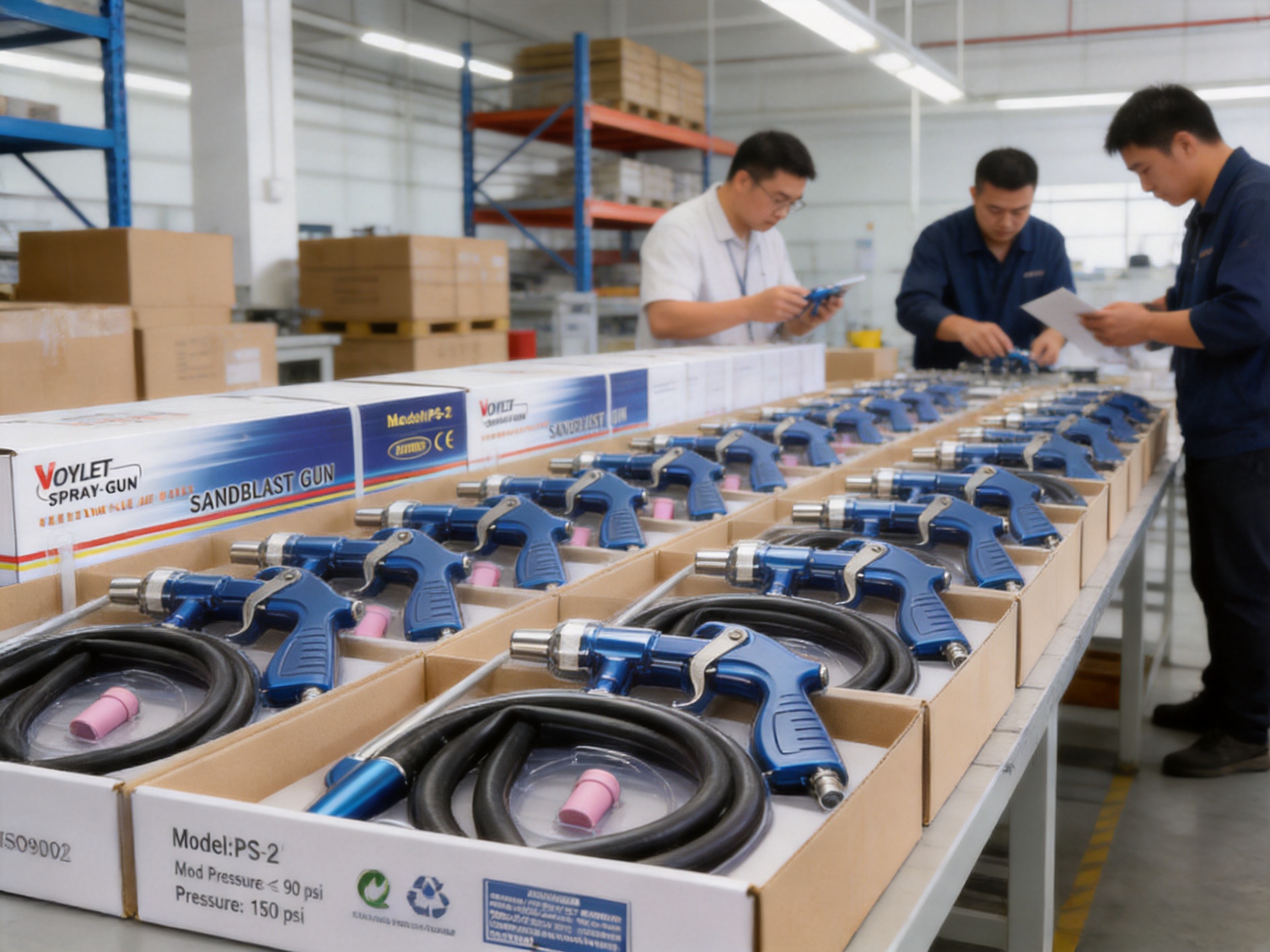
The carton size of 45 × 45 × 37 cm with 10 pieces per carton is practical for commercial supply. Wholesalers and tool distributors need products that are easy to stock, count, ship, and replenish. A 10-piece carton supports both bulk handling and smaller order planning.
For international buyers, packaging efficiency affects freight costs, warehouse layout, and delivery scheduling. Products with clear carton information are easier to integrate into procurement systems. This is particularly useful for companies that handle mixed air tool orders, including spray guns, blowing guns, air fittings, compressors, and accessories.
Backed by Manufacturing Scale
The PS3 is supplied by Ningbo Lis Industrial Co., Ltd., a manufacturer engaged in research, development, manufacturing, and marketing of air painting spray gun series, mini air compressors, and related air tools. The company has grown over decades into one of the significant enterprises in China’s painting spray gun and air tool industry, with extensive production experience and a broad product category system.
Manufacturing scale matters because a sandblasting gun is not merely a simple shell and trigger. It must withstand air pressure, maintain controlled airflow, resist wear from abrasive media, and provide repeatable performance. A factory with mature processes, quality control systems, and engineering support is better positioned to deliver consistent product batches than a small workshop without formal control.
Manufacturing Strength Behind the Product
A tool’s real quality is determined not only by its design but also by the manufacturing system behind it. Ningbo Lis Industrial Co., Ltd. has developed an integrated approach that includes research and development, production management, quality inspection, and international market service. This background is a major advantage for buyers seeking stable supply and long-term cooperation.
The company has been operating since 1984 and has accumulated extensive experience in air painting spray guns, air tools, and spraying-related solutions. Its production base covers more than 400,000 square feet, with more than 400 employees and significant annual output. This scale supports stable production capacity and gives the company the ability to meet different purchasing quantities, from routine replenishment orders to larger procurement programs.
The company emphasizes customer satisfaction and total solutions for spraying products. Although the PS3 is a sandblasting gun rather than a paint spray gun, it belongs to the wider surface preparation and air tool family. Surface preparation and spray finishing are closely connected. A manufacturer that understands coating application also understands why cleaning and preparation tools must be reliable.
Quality System and Process Control
The company follows quality management principles based on the ISO9000 quality system. Its process includes raw material control, incoming inspection, in-process quality control, functional testing, and final inspection. This complete quality chain helps reduce variation and improves reliability across production batches.
For an air siphon sandblasting gun, process control is especially important in the air passage, trigger mechanism, sealing areas, pressure-bearing sections, and media flow path. Even small differences in manufacturing accuracy can affect suction stability, air consumption, blasting pattern, and durability. A structured quality system helps ensure that each production stage contributes to the final performance.
The company has also passed ISO9001 international quality system certification, OHSAS18001 occupational health and safety system certification, and ISO14001 environmental management system certification. These certifications reflect attention not only to product quality but also to workplace safety and environmental responsibility. For international buyers, such management systems are often important when evaluating a supplier’s reliability.
Functional Testing and Final Inspection
One of the important strengths described by the company is 100% functional testing. For pneumatic tools, functional testing is crucial. A product may look correct from the outside but still fail to perform if air passages are blocked, sealing is poor, or the trigger response is inconsistent. Functional testing helps identify issues before shipment.
Final inspection also protects buyers from receiving tools with obvious defects, assembly problems, or packaging errors. In wholesale and distribution, quality problems can be expensive because they lead to returns, warranty claims, customer dissatisfaction, and lost sales opportunities. A supplier that invests in inspection reduces these risks for its customers.
Engineering and Research Capability
The company has established a spraying machinery engineering technology center and has carried out technical cooperation with American Wagner Spraying Technology Co., Ltd. This demonstrates a commitment to product development and engineering improvement. A strong research and development team supports both OEM and ODM cooperation, allowing the company to manufacture according to customer drawings or samples and to develop products according to customer needs.
This engineering background is valuable for a product such as the PS3 because buyers may require different packaging, market positioning, accessory combinations, labeling, or specification adjustments. A supplier with ODM capability can help customers adapt products for different regions and user groups, provided that safety and performance requirements are maintained.
Certifications and International Market Experience
The company’s products have passed certifications such as CE and GS for relevant product lines. It has also built a global marketing and service network, with products sold into Europe, North America, the Middle East, South Africa, and East Asia. International market experience matters because different regions have different expectations for quality, documentation, packaging, product labeling, and after-sales communication.
A buyer choosing a sandblasting gun supplier often looks beyond the product itself. The buyer wants predictable communication, stable shipment, responsive service, and the ability to support long-term market development. A manufacturer with an established export history can better understand these requirements.
Application Scenarios
Automotive Repair and Restoration
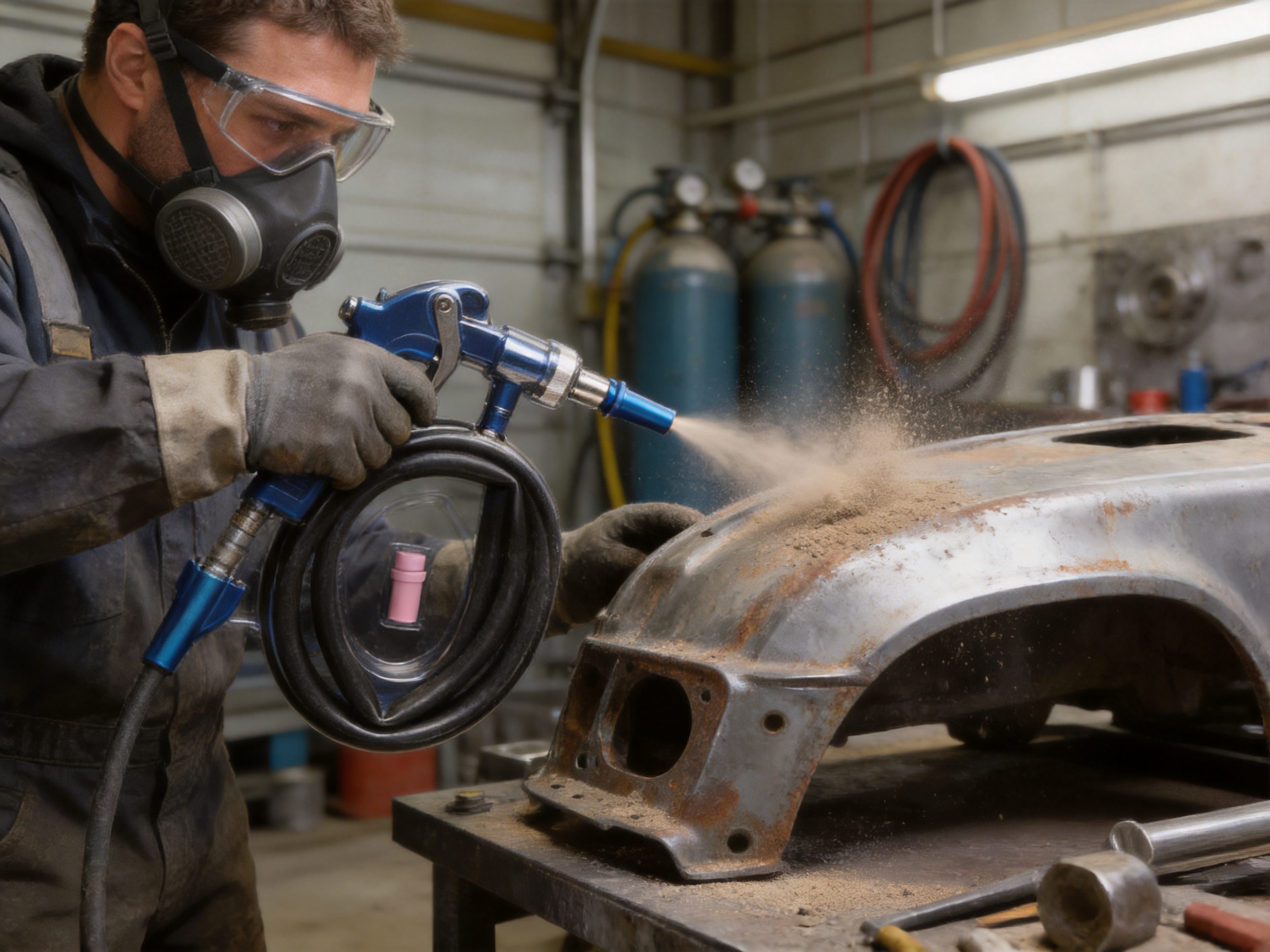
The PS3 sandblaster feed blast gun can be used in automotive repair environments for localized rust and paint removal. When restoring older vehicles, corrosion often appears around seams, brackets, underbody areas, wheels, and small metal components. A hand-operated blasting gun allows technicians to clean these areas before applying primer, filler, paint, or anti-corrosion treatment.
Compared with grinding alone, abrasive blasting can reach uneven surfaces, corners, and textured areas more effectively. It can remove rust from pits and recesses where a sanding disc may not fully contact the surface. This makes it useful for preparation before refinishing work.
Operators should select abrasive media carefully and adjust pressure according to the material. Thin automotive sheet metal can warp or become damaged if blasting is too aggressive. The PS3’s pressure information helps users approach the work with appropriate control.
Metal Fabrication and Welding Preparation
In fabrication shops, metal surfaces often require cleaning before coating or after welding. Weld spatter, scale, oxidation, and surface contamination can reduce coating quality. A siphon blasting gun is useful for localized cleanup, especially on brackets, frames, fixtures, and assemblies that are inconvenient to place in a cabinet blaster.
The ability to direct the blasting stream by hand gives the fabricator precise control. Instead of treating an entire component, the operator can focus on the weld zone or affected area. This reduces unnecessary labor and can improve finishing efficiency.
Machinery Maintenance
Maintenance departments often face corroded bolts, metal covers, guards, housings, and machine parts. Replacing every corroded part is not always economical. Cleaning and refinishing can extend service life and improve equipment appearance. The PS3 provides a convenient method for preparing these parts for repainting or protective coating.
Because the tool operates with compressed air, it fits well into maintenance workshops that already use air compressors and pneumatic accessories. This compatibility helps maintenance teams add blasting capability without creating a separate infrastructure.
Decorative and Surface Texturing Work
With suitable media and careful technique, abrasive blasting can be used for decorative effects, light etching, or surface texturing. Users working with metal, glass, stone, or wood must test the process first because different materials respond differently to abrasive impact. Pressure, media size, distance, and movement speed all affect the final appearance.
The PS3’s hand-held format gives creative users flexibility. It can be directed at specific patterns or zones, making it useful for custom projects where full automation is unnecessary. However, safety and material testing should always come first.
How the PS3 Compares with Common Alternatives
Compared with Manual Sanding
Manual sanding is inexpensive and familiar, but it can be slow and inconsistent on rusted or irregular surfaces. Sandpaper works well on flat areas but struggles with pits, seams, corners, and complex shapes. A sandblasting gun can reach these areas more effectively because abrasive particles follow the air stream into surface irregularities.
The PS3 offers better efficiency for many cleaning tasks, especially where corrosion is uneven. It can also reduce operator fatigue compared with extended hand sanding. Manual sanding remains useful for finishing and smoothing, but blasting provides a stronger first-stage cleaning method.
Compared with Angle Grinding
Angle grinders remove material quickly, but they can be too aggressive for delicate work. Grinding may leave marks, reduce material thickness, or fail to reach recessed areas. A blasting gun offers a more distributed abrasive action. It can clean rather than cut, which is beneficial when the goal is to remove rust or coating while preserving the shape of the workpiece.
The PS3 is not intended to replace grinders in heavy material removal. Instead, it complements them. A grinder may remove thick welds or heavy scale, while the blasting gun can finish the surface and clean remaining contamination.
Compared with Cabinet Blasters
Cabinet blasters are excellent for small parts because they contain dust and recycle media. However, they are limited by cabinet size and require the workpiece to be brought to the machine. Large assemblies, installed components, vehicle parts, and fixed structures may not fit inside a cabinet.
The PS3 provides portability and direct access. The operator can bring the tool to the workpiece. This is a major advantage for maintenance, repair, and on-site preparation tasks. Users should still apply dust control and personal protective equipment because open blasting creates airborne particles.
Compared with Pressure Pot Blasters
Pressure pot blasters deliver strong, continuous abrasive flow and are suitable for larger jobs. They are often preferred for heavy-duty industrial blasting. However, they are more complex, more expensive, and require more setup. For small to medium localized jobs, a siphon blasting gun may be more convenient.
The PS3 is advantageous when flexibility, simplicity, and lower equipment burden matter. It gives users a practical alternative for tasks where a pressure pot would be excessive. For distributors, offering the PS3 allows them to serve customers who need blasting ability but do not want to purchase a larger system.
Operational Guidance for Better Results
Match the Compressor to the Task
A sandblasting gun depends on stable compressed air. Users should ensure their compressor can maintain the required pressure and airflow during operation. If the compressor is too small, pressure will drop, suction may weaken, and blasting performance will become inconsistent. A stable air supply helps the PS3 perform more predictably.
Moisture control is also important. Compressed air can carry water, especially in humid environments. Moisture can cause abrasive media to clump and reduce flow. A suitable air filter or moisture separator can improve performance and reduce interruptions.
Select Suitable Abrasive Media
Different blasting media produce different results. Some media are aggressive and remove rust quickly, while others are gentler and better for delicate surfaces. The user should select media according to the workpiece material, desired surface profile, coating requirements, and safety considerations.
Operators should follow local regulations and safety recommendations regarding abrasive media. Some materials can generate hazardous dust. Proper respiratory protection, eye protection, gloves, and protective clothing are essential. The work area should be ventilated and controlled to prevent dust exposure to other people.
Control Distance and Angle
Blasting performance is affected by the distance between the nozzle and the surface. Holding the gun too far away reduces impact energy and may waste media. Holding it too close may create excessive surface roughness or localized damage. A moderate distance, adjusted through testing, usually gives the best balance.
The angle of attack also matters. A direct 90-degree angle delivers stronger impact, while a shallower angle can help peel coatings or reduce aggression. Operators can vary angle and movement speed to achieve the desired result.
Use Progressive Testing
Before blasting a visible or valuable part, users should test on a small hidden area or scrap material. This allows them to confirm pressure, media, distance, and surface effect. Progressive testing is especially important for automotive panels, decorative surfaces, aluminum, wood, and any material that may be sensitive to abrasion.
Safety Considerations
Abrasive blasting involves high-speed particles, dust, noise, and compressed air. Operators must treat the process seriously. Eye protection is essential because rebounding abrasive can cause serious injury. Respiratory protection is also important because dust may contain paint particles, rust, metal oxides, silica, or other harmful substances depending on the workpiece and media.
Protective gloves and clothing reduce skin exposure. Hearing protection may be needed in enclosed or high-noise environments. The work area should be arranged so that bystanders are not exposed to flying abrasive or dust. Users should never aim the gun at people or animals and should never exceed the maximum pressure limit of the tool.
Compressed air connections should be checked before use. Damaged hoses, loose fittings, or improper couplers can create hazards. Operators should release pressure before servicing, changing accessories, or clearing blockages. Proper safety habits not only protect people but also extend tool life.
Procurement Value for Distributors and Industrial Buyers
The PS3 sandblaster feed blast gun is attractive to distributors because it belongs to a practical product category with broad demand. Surface preparation is needed in automotive repair, machinery maintenance, metalworking, construction equipment service, restoration, and general workshops. A reliable siphon blasting gun can be sold as a standalone tool or as part of an air tool range.
The supplier’s broad product categories also help buyers consolidate sourcing. Ningbo Lis Industrial Co., Ltd. offers products including HVLP spray guns, heavy duty spray guns, woodworking low pressure spray guns, economical conventional spray guns, texture paint spray guns, paraffin and washing guns, air blowing guns, sandblast and foam guns, tyre inflating guns, water guns, grease guns, automatic spray guns, air brushes, mini oil-free compressors, air pipeline accessories, paint tanks, air fittings and accessories, air polishers, spray gun kits, touch-up spray guns, car polishing machines, airless spray guns, electric spray guns, and paint sprayers.
This wide range benefits importers and wholesalers because they can build a complete catalog from one manufacturing source. Combining the PS3 with spray guns, compressors, fittings, and accessories creates a more complete offering for end users. It also simplifies communication, quality tracking, and shipping coordination.
The company’s ability to increase production capacity by approximately 30 percent within two months provides additional procurement flexibility. Seasonal demand, promotional programs, and unexpected market growth can require rapid supply response. A manufacturer with scalable production is better prepared to support these situations.
Brand and OEM/ODM Support
The company has developed internationally recognized brands and also supports OEM and ODM services. For buyers, this means there are multiple cooperation paths. A distributor may purchase standard products, request private-label packaging, provide drawings or samples, or work with the manufacturer to develop a product adapted to local market needs.
OEM and ODM capability is especially important in competitive tool markets. Different regions may prefer different packaging styles, instruction formats, accessory sets, or product positioning. A manufacturer with engineering and production experience can help buyers create a more market-ready product while maintaining quality control.
For the PS3, potential customization discussions may include packaging, labeling, instruction sheets, carton markings, accessory combinations, or market-specific documentation. Any technical changes should be validated carefully to ensure safe operation and consistent performance.
Why Manufacturing Experience Matters in Air Tools
Air tools must perform under pressure. Even simple-looking products require careful attention to airflow, sealing, ergonomics, wear resistance, and assembly accuracy. A sandblasting gun faces additional challenges because abrasive media can accelerate wear and create flow instability if the internal path is not properly managed.
Experienced manufacturers understand that quality comes from repeatable processes, not only final inspection. Raw materials must be checked. Components must be produced within acceptable tolerances. Assembly must be controlled. Functional testing must verify performance. Packaging must protect the product during transport. Documentation must support correct use.
Ningbo Lis Industrial Co., Ltd. emphasizes an elaborate production process and stringent control throughout the quality system. This approach is a strong advantage over competitors that rely on inconsistent subcontracting, limited inspection, or low-cost assembly without engineering support. For industrial buyers, supplier reliability is often as important as unit price.
Long-Term Value Compared with Low-Cost Alternatives
Many buyers are tempted by the lowest-priced blasting tools. However, the lowest initial price may not produce the lowest total cost. If a tool fails early, performs inconsistently, or creates customer complaints, the distributor or end user pays more in returns, downtime, and replacement effort. A product supported by mature manufacturing and inspection can offer better long-term value.
The PS3’s advantage is not based only on its pressure rating or packing information. Its value is also connected to the production culture behind it: quality systems, functional testing, engineering resources, export experience, and a broad air tool background. These factors help create confidence for buyers who want stable supply rather than one-time transactions.
For workshops, dependable operation means fewer interruptions. For wholesalers, consistent batches mean fewer complaints. For OEM customers, manufacturing discipline means better brand protection. For end users, a practical tool means smoother surface preparation and better final finishing results.
Q&A Section
Q1: What is the PS3 sandblaster feed blast gun used for?
It is used for abrasive surface preparation, including rust removal, old paint removal, scale cleaning, oxidation removal, and preparation before repainting or coating. It is suitable for automotive repair, metal fabrication, machinery maintenance, restoration, and general workshop use.
Q2: What is the rated pressure of the product?
The rated pressure is 70 PSI. This is a practical operating point for many common blasting tasks when the tool is matched with a suitable air compressor and abrasive media.
Q3: What is the maximum pressure?
The maximum pressure is no more than 150 PSI. Users should not exceed this limit. Operating within the specified pressure range supports safety and tool reliability.
Q4: How does an air siphon sandblasting gun work?
Compressed air passes through the gun and creates suction that draws abrasive media into the airflow. The air and media mixture exits the gun at speed and strikes the work surface, removing contamination or creating a prepared surface profile.
Q5: Is the PS3 suitable for large industrial blasting jobs?
It is best suited for localized, small, and medium surface preparation tasks. Large-scale continuous blasting may require a pressure pot system or dedicated blasting equipment. The PS3 is valuable when portability, simplicity, and targeted operation are important.
Q6: What compressor should be used?
The compressor should be capable of maintaining the required pressure and airflow for the selected abrasive media and working conditions. Users should also consider moisture control, because wet air can cause media clumping and unstable flow.
Q7: Can it be used for automotive restoration?
Yes, it can be used for localized rust and coating removal in automotive restoration. However, users should test carefully on thin sheet metal and adjust pressure, distance, and media to avoid warping or surface damage.
Q8: What safety equipment is needed?
Operators should use eye protection, respiratory protection, gloves, protective clothing, and hearing protection when needed. The work area should be ventilated and isolated from bystanders. Users should also follow all local safety rules and abrasive media recommendations.
Q9: Why is this product a good choice for distributors?
It has broad market demand, practical pressure specifications, distributor-friendly packing of 10 pieces per carton, and support from an experienced manufacturer with quality systems, functional testing, export experience, and broad air tool production capability.
Q10: Does the manufacturer support OEM or ODM cooperation?
Yes. The manufacturer can support OEM production according to customer drawings or samples and can provide ODM services according to customer needs. This is useful for buyers who need private-label packaging, market-specific documentation, or product development support.
Conclusion
The PS3 Sandblaster Feed Blast Gun Air Siphon Sand Blasting Gun is a practical pneumatic tool for users who need efficient, targeted abrasive surface preparation. With a rated pressure of 70 PSI, a maximum pressure of no more than 150 PSI, and convenient carton packing of 10 pieces per carton, it is suitable for workshops, distributors, maintenance teams, and industrial buyers.
Its air siphon feed design offers simplicity, flexibility, and ease of use. It is especially valuable for localized rust removal, paint stripping, weld cleaning, metal preparation, restoration, and maintenance work. Compared with manual sanding, grinding, cabinet blasting, and pressure pot blasting, the PS3 occupies a useful middle position: more effective than hand methods in many irregular areas, more portable than cabinets, and simpler than large blasting systems.
The product’s competitive strength is reinforced by the manufacturing background of Ningbo Lis Industrial Co., Ltd. The company’s long operating history, large production scale, quality management systems, functional testing, R&D capability, international certifications, and global market experience give buyers confidence in consistency and supply reliability. In a market where many low-cost air tools look similar, the manufacturing process behind the product becomes a decisive advantage.
For end users, the PS3 helps improve surface preparation efficiency. For distributors, it is a practical product that fits naturally into an air tool catalog. For OEM and ODM customers, it is supported by a manufacturer capable of customization, production scaling, and quality control. As surface preparation remains essential to coating durability and repair quality, a dependable air siphon sandblasting gun such as the PS3 continues to be a valuable tool for professional and general workshop use.
References
1. ISO 9001 Quality Management Systems, International Organization for Standardization.
2. ISO 14001 Environmental Management Systems, International Organization for Standardization.
3. Occupational Health and Safety Management System Principles, OHSAS 18001 Framework.
4. Surface Preparation and Coating Adhesion Guidelines, Industrial Coating Practice Literature.
5. Compressed Air Safety and Pneumatic Tool Operation Manuals, General Industrial Safety References.
6. Abrasive Blasting Methods and Media Selection, Surface Finishing Technical Publications.