 Search

 English
 中文简体
 Deutsch
 Español
Content
- 1 Product Overview
- 2 Why Automatic Spraying Matters
- 3 Flexible Nozzle Selection
- 4 Controlled Atomization at 50 PSI
- 5 G1/4-Inch Air Inlet Compatibility
- 6 Advantages in Production Applications
- 7 Suitable Application Areas
- 8 Process Parameters That Influence Results
- 9 Manufacturing Strengths Behind the Product
- 10 How the ST5 Compares with Alternative Spray-Gun Approaches
- 11 Installation Recommendations
- 12 Maintenance and Cleaning
- 13 Safety Considerations
- 14 Purchasing and Project Evaluation
- 15 Recommended Setup Procedure
- 16 Common Problems and Corrective Actions
- 17 Value for Distributors and OEM Customers
- 18 Environmental and Workplace Benefits
- 19 Long-Term Reliability Considerations
- 20 Frequently Asked Questions
- 20.1 What type of product is the ST5?
- 20.2 What nozzle sizes are available?
- 20.3 What is the specified air pressure?
- 20.4 What air connection does the gun use?
- 20.5 Can the ST5 be used for manual spraying?
- 20.6 What coatings can be sprayed with the ST5?
- 20.7 How should users choose between the nozzle sizes?
- 20.8 Is a filter required in the air line?
- 20.9 Can the product be customized?
- 20.10 What industries may benefit from this product?
- 20.11 How can users improve spray consistency?
- 20.12 What should be done after spraying?
- 21 Conclusion
- 22 References
- 23 Product: ST5
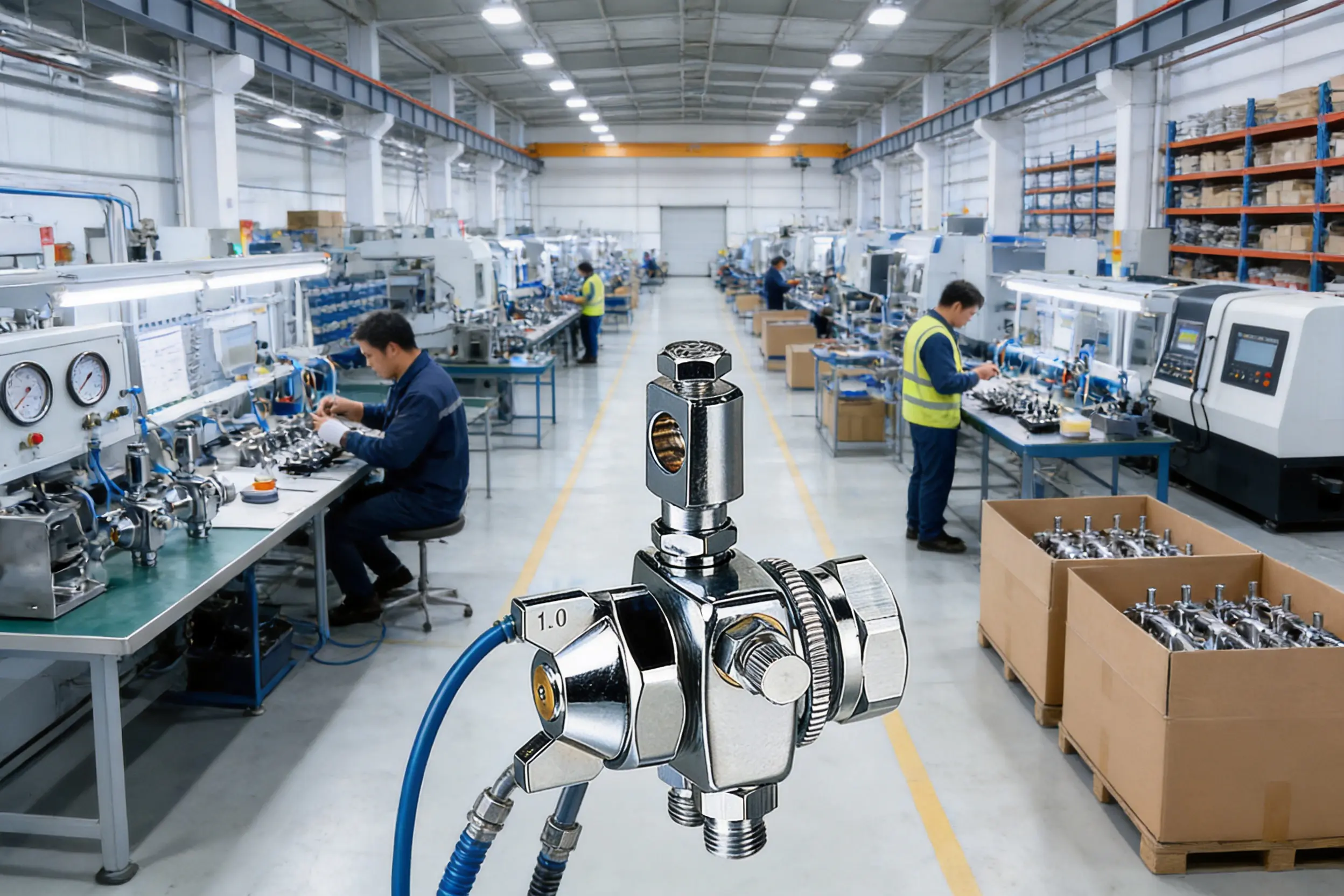
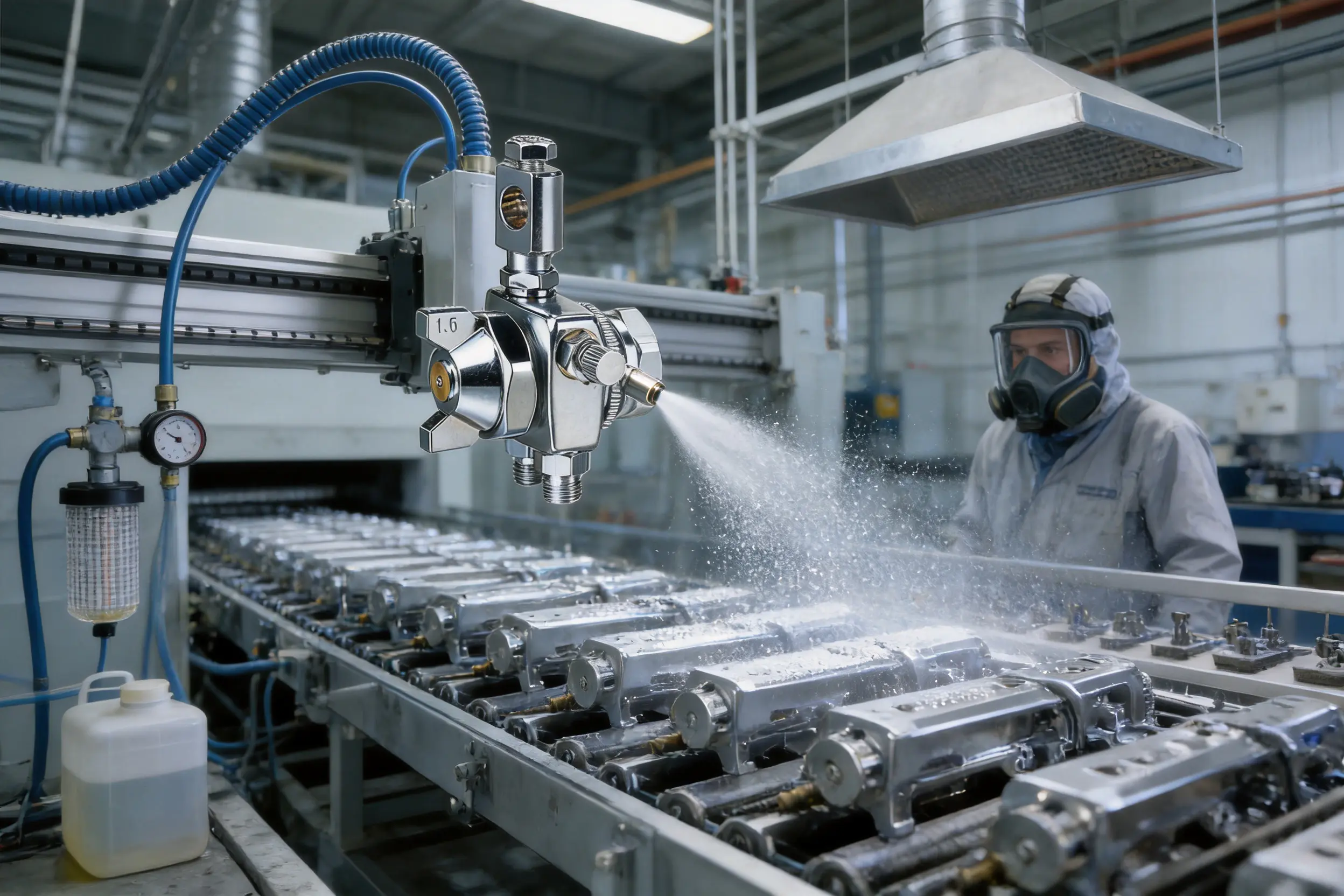
Automatic spray equipment plays an important role in modern manufacturing because it improves coating consistency, reduces material waste, and supports repeatable production. The ST5 automatic spray gun is designed for users who need dependable atomization, flexible fluid-nozzle options, and straightforward integration with compressed-air systems. With a compact configuration, a 50 PSI air-pressure specification, and a G1/4-inch air inlet, it is suitable for many industrial and professional spraying applications.
Automatic spray guns are widely used in woodworking, metal finishing, vehicle-component production, machinery manufacturing, furniture coating, general industrial painting, and other processes where a stable spray pattern is essential. Compared with purely manual application, an automatic gun can be incorporated into a production line, a reciprocating machine, a robotic system, or a fixed spray station. This makes it possible to achieve a more uniform finish while reducing the effect of operator fatigue and variations in hand movement.
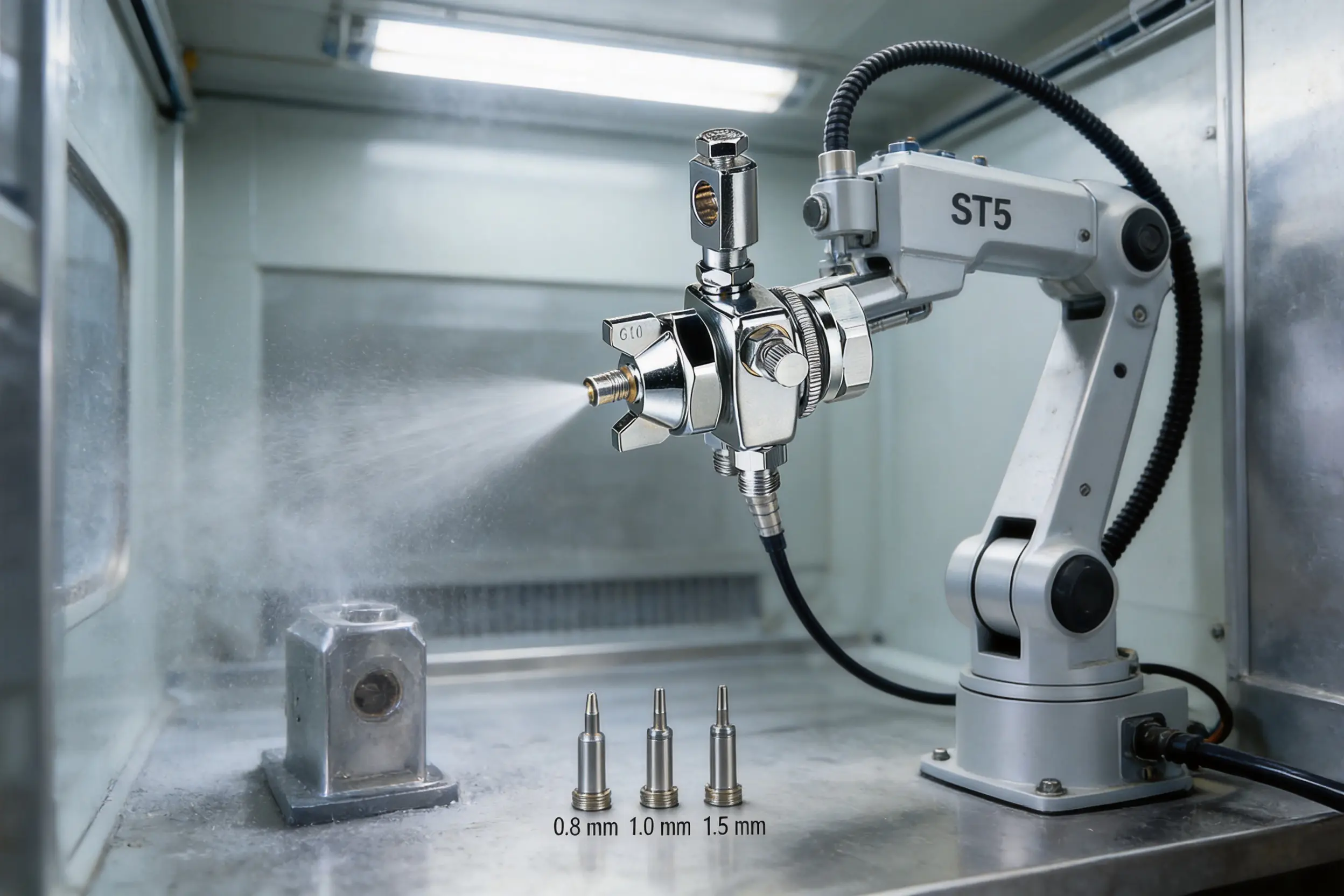
The ST5 is available with fluid nozzles measuring 0.8 mm, 1.0 mm, and 1.5 mm, with other configurations available according to application requirements. These nozzle choices allow users to adapt the gun to different coating viscosities, flow-rate targets, and surface-finishing expectations. The result is a versatile automatic spraying solution for businesses that need both production efficiency and process flexibility.
Product Overview
The ST5 automatic spray gun is a compressed-air coating device that combines a controlled fluid supply with atomizing air. When the gun is activated, coating material is delivered through the fluid nozzle while compressed air breaks the liquid into fine droplets. The droplets are then directed toward the workpiece in a controlled spray pattern.
Its operating principle is suitable for applications requiring repeated spraying cycles. The gun can be positioned in a fixed location or mounted to a suitable automated mechanism. Depending on the production system, triggering may be controlled through pneumatic valves, electrical signals, robotic controls, or other compatible automation equipment.
The principal specifications of the ST5 include a 50 PSI air-pressure rating, a G1/4-inch air inlet, and a selection of small and medium fluid nozzles. The compact carton arrangement of 50 units per carton, with a carton size of 44 × 34 × 22 cm, also supports organized transport and distribution for professional buyers, project contractors, and equipment suppliers.
| Specification | ST5 Information | Application Significance |
|---|---|---|
| Product type | Automatic spray gun | Suitable for repeatable and production-oriented coating processes |
| Fluid nozzle options | 0.8 mm, 1.0 mm, 1.5 mm, and other options | Allows adaptation to different materials and flow requirements |
| Air pressure | 50 PSI | Provides the specified compressed-air operating condition |
| Air inlet | G1/4 inch | Supports connection with compatible air hoses and fittings |
| Packaging quantity | 50 pieces per carton | Convenient for wholesale supply and project procurement |
| Carton dimensions | 44 × 34 × 22 cm | Supports efficient storage and shipment planning |
Why Automatic Spraying Matters
Manual spray guns remain useful for repair work, small projects, and applications requiring frequent repositioning. However, production environments often demand greater repeatability than manual operation can provide. An automatic spray gun can maintain a consistent position, distance, trigger sequence, and spray duration. These factors are important when the same coating must be applied to a large number of identical parts.
Consistency is especially important when the coating is visible or when it performs a protective function. Uneven film thickness can affect appearance, corrosion resistance, adhesion, durability, and drying behavior. By supporting a controlled process, the ST5 helps manufacturers establish a repeatable spraying routine rather than relying entirely on individual operator technique.
Automatic equipment can also improve productivity. A fixed or machine-mounted spray gun may continue working through a programmed cycle while the operator prepares the next batch of parts, monitors material levels, or performs quality checks. This can reduce unnecessary handling and support a more organized workflow.
Another benefit is the potential reduction of coating waste. Waste depends on many factors, including spray distance, air pressure, fluid pressure, coating viscosity, nozzle selection, booth design, and operator skill. The automatic gun itself cannot eliminate waste, but a properly adjusted system can deliver material more consistently and reduce the excessive overlap or uneven application that often occurs during uncontrolled manual spraying.
Flexible Nozzle Selection
The availability of 0.8 mm, 1.0 mm, and 1.5 mm fluid nozzles gives the ST5 a useful range of application possibilities. Nozzle size influences the volume of material that can pass through the gun and also affects the type of coating process for which the gun is best suited.
A 0.8 mm nozzle is generally appropriate when a finer application and lower material flow are required. It may be considered for thin coatings, detailed components, smaller surfaces, and finishing work where control is more important than high output. The actual result depends on the coating formulation, viscosity, air adjustment, and spray distance.
A 1.0 mm nozzle provides a balanced option for many general-purpose applications. It can be suitable when the user needs a combination of controlled atomization and moderate fluid delivery. This size may be useful for a broad range of industrial parts, furniture components, and coating tasks where a fine but productive spray is required.
A 1.5 mm nozzle allows a higher material flow than the smaller options. It can be considered for coatings that are more viscous or for applications where coverage speed is a higher priority. Before using any coating, operators should confirm that its viscosity, solids content, and chemical composition are compatible with the gun and the selected nozzle.
Nozzle selection should not be based on size alone. The ideal configuration also depends on the coating material, desired film thickness, surface geometry, production speed, atomizing-air adjustment, and curing method. A professional setup normally begins with a test spray on a representative workpiece. Adjustments can then be made to the air supply, fluid delivery, spray distance, and gun movement or travel speed.
Controlled Atomization at 50 PSI
The ST5 is specified for an air pressure of 50 PSI. Compressed air performs two main functions in an air spray system: it helps atomize the coating and shapes the resulting spray pattern. Stable pressure is therefore an important factor in achieving a consistent finish.
Operating at the specified pressure can help the user establish a repeatable process. Excessive pressure may produce unnecessary overspray, accelerate solvent evaporation, or disturb the coating as it reaches the surface. Insufficient pressure may result in poor atomization, heavy droplets, an irregular pattern, or an uneven finish. For this reason, air pressure should be checked at the gun inlet rather than assumed from the compressor display alone.
The quality of the air supply is equally important. Moisture, oil, rust particles, and other contaminants can affect the coating surface and may obstruct internal passages. A suitable filter and regulator should be installed in the air line. In applications involving sensitive finishes, additional air treatment may be appropriate.
Pressure stability also depends on the capacity of the compressor, the length and internal diameter of the air hose, the number of tools operating at the same time, and the condition of the fittings. A system that cannot maintain the required airflow may cause pressure fluctuations even when the regulator is correctly adjusted.
G1/4-Inch Air Inlet Compatibility
The G1/4-inch air inlet is a widely used connection size for air tools and spray equipment. It allows the ST5 to be connected to compatible hoses, regulators, filters, quick couplers, and air pipeline accessories. Before installation, users should verify the thread standard, sealing method, and fitting quality used in their local air system.
A well-designed air connection should be secure without restricting airflow. Undersized fittings, damaged threads, excessive sealant, or poorly fitted couplers can reduce air delivery and create leakage. Any sealant should be applied carefully so that it does not enter the air passage.
The air hose should be selected according to the distance between the gun and the air-treatment equipment. Long or narrow hoses can cause pressure loss, particularly when several tools share the same pipeline. In a production installation, the compressed-air network should be evaluated as a complete system rather than considering the spray gun in isolation.
Before operation, the air line should be inspected for leaks. A leak not only wastes compressed air but may also cause unstable atomization. Regular inspection of hose connections, couplers, regulators, and filters can help maintain reliable performance.
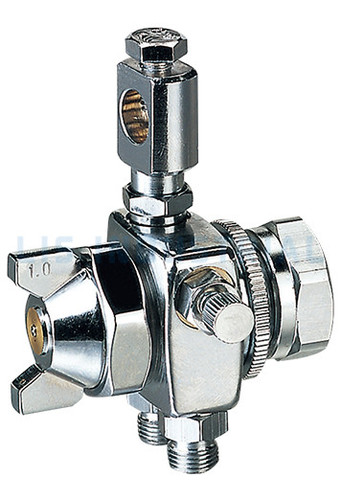
ST5
Advantages in Production Applications
Repeatable Spray Cycles
The primary advantage of an automatic spray gun is repeatability. Once the gun is correctly mounted and adjusted, it can perform the same trigger and spray sequence over many cycles. This is valuable for manufacturers producing identical or similar components in medium and high volumes.
Repeatability can improve visual uniformity. Surfaces are less likely to show random differences caused by variations in hand speed, wrist angle, or trigger pressure. Although the complete production system still requires proper adjustment, the automatic gun provides a stable foundation for process control.
Reduced Operator Fatigue
Continuous manual spraying can be physically demanding. Operators may need to hold the gun for long periods, repeatedly move across large surfaces, and maintain a consistent distance from the workpiece. Fatigue may eventually influence spray quality and productivity.
When the ST5 is integrated into a suitable automated station, the operator can focus on loading, inspection, material preparation, and process supervision. This can make the work environment more organized and reduce the need for repetitive manual movements.
Adaptability to Different Materials
The choice of fluid nozzles provides flexibility for different coating materials and production goals. Users can select a smaller nozzle for detailed finishing or a larger nozzle for increased material delivery. This adaptability is useful for businesses that handle more than one type of workpiece or coating.
Changing the nozzle does not remove the need for proper material preparation. Coatings should be mixed, filtered, and adjusted according to the coating manufacturer’s instructions. The gun should then be tested before production begins.
Integration with Automated Equipment
The ST5 can be considered for use with fixed spray stands, reciprocating units, rotary tables, linear systems, and other compatible automation platforms. The actual integration method depends on the machine design and the control system used by the customer.
Integration planning should consider gun mounting, trigger control, fluid supply, air supply, workpiece positioning, overspray collection, ventilation, and maintenance access. A well-planned installation helps ensure that the spray gun is easy to adjust and service.
Suitable Application Areas
The ST5 can be used in a variety of coating environments where compressed-air atomization and automatic operation are required. Potential application areas include furniture finishing, cabinet production, metal components, agricultural equipment parts, machinery housings, general fabrication, decorative items, and industrial maintenance.
In woodworking, an automatic spray gun may be used for primers, stains, lacquers, sealers, and selected topcoats, provided that the material is compatible with the gun. Wood surfaces often require careful control because differences in grain, porosity, edges, and end sections can affect absorption and appearance.
In metal finishing, the gun may support the application of primers, protective coatings, color coats, and clear finishes. Surface preparation is essential. Oil, dust, rust, and inadequate cleaning can reduce adhesion regardless of the spray equipment used.
For machinery and equipment components, automatic spraying can help apply a uniform coating over repeated parts. The gun may be positioned at a fixed angle or moved along a programmed path. The best arrangement depends on the shape of the component and the required film thickness.
In small-batch production, the ST5 may offer a practical middle ground between hand spraying and a large, complex automated line. A compact automatic station can provide process control without requiring a highly complicated installation.
Process Parameters That Influence Results
Coating Viscosity
Viscosity affects how easily the coating passes through the fluid nozzle and how the material atomizes. A coating that is too thick may produce large droplets, poor leveling, or an irregular spray pattern. A coating that is too thin may lead to runs, low film build, or insufficient coverage.
Users should follow the coating supplier’s recommendations for thinning, mixing, and filtration. Any adjustment should be recorded so that a successful formulation can be repeated. Because different materials react differently to solvents and environmental conditions, there is no single viscosity setting suitable for every product.
Spray Distance
The distance between the nozzle and the workpiece influences transfer efficiency, pattern width, and surface appearance. Spraying too close may cause excessive wetness, runs, or uneven film build. Spraying too far away may cause dry spray, roughness, and material loss before the coating reaches the surface.
For an automatic installation, the spray distance should be kept consistent throughout the programmed path. The gun should not move closer at one end of the workpiece and farther away at the other unless the process has been intentionally designed that way.
Travel Speed
Gun travel speed affects the amount of material deposited in a given area. Slow movement generally increases film thickness, while fast movement reduces coverage. A consistent speed is especially important when the same finish must be achieved on multiple parts.
Overlap between adjacent passes should also be controlled. Excessive overlap can create heavy areas, while insufficient overlap can leave visible stripes or gaps. Automated motion can help maintain a repeatable pattern when the equipment is properly calibrated.
Fluid and Air Adjustments
Air and fluid settings should be balanced. Too much fluid with insufficient atomizing air may create a wet, coarse spray. Too much air with too little fluid may increase overspray and produce a dry finish. Adjustments should be made gradually while observing the spray pattern and the coating result on a test panel.
The correct setting depends on the nozzle size, coating characteristics, workpiece shape, and production speed. A written setup record can help operators reproduce the same conditions after cleaning, maintenance, or a material change.
Manufacturing Strengths Behind the Product
The performance of an automatic spray gun depends not only on its external design but also on the manufacturing discipline used to produce it. Precision in machining, assembly, sealing, surface treatment, inspection, and testing all influence service reliability.
The manufacturer of the ST5 has been engaged in the development and production of air spray guns, mini air compressors, and related air tools since 1984. Its long operating history provides experience in product engineering, production organization, customer support, and international distribution.
The company operates a substantial manufacturing facility with more than 400 employees and a production area covering over 400,000 square feet. This scale supports dedicated functions for research and development, component production, assembly, quality control, packaging, and logistics.
A large production base can also help a manufacturer maintain supply continuity. For distributors and industrial customers, production capacity is important because delayed deliveries may interrupt a project or create difficulties in maintaining inventory. The manufacturer reports that production capacity can be increased by 30 percent within two months to respond to changes in customer demand.
Engineering and Product Development
Research and development is an important part of spray-equipment manufacturing. The manufacturer has established a spraying machinery engineering technology center and has participated in technical cooperation relating to spraying machinery. This type of technical foundation supports the development of improved spray-gun structures, air passages, fluid systems, and production methods.
Engineering work may include evaluating atomization behavior, improving component compatibility, simplifying maintenance, testing sealing performance, and adapting products for different regional requirements. It may also involve developing customized products for customers that need a particular nozzle arrangement, connection configuration, mounting method, or packaging solution.
The manufacturer provides both OEM and ODM services. OEM production can be based on customer drawings or samples, while ODM support can assist customers that require a product developed around specific application needs. These capabilities are useful for importers, distributors, equipment integrators, and established brands.
Quality-System Management
Consistent production requires more than final inspection. A robust quality system covers raw-material approval, incoming inspection, process control, assembly verification, functional testing, and finished-product inspection.
The manufacturer follows the requirements of the ISO9000 quality system and uses a controlled production process. The reported inspection sequence includes raw-material and incoming inspection, in-process quality control, 100 percent functional testing, and final quality inspection.
In-process control is particularly important for spray guns because small deviations can affect air delivery, fluid flow, trigger action, sealing, and spray performance. Checking components during production allows potential problems to be identified before the final assembly stage.
Functional testing of every finished unit provides an additional level of assurance. While the exact test procedures may vary according to the product and production batch, functional inspection can include checking air passages, fluid passages, trigger operation, sealing, and overall spray behavior.
International Certifications
The manufacturer reports certifications and compliance credentials including ISO9001, ISO14001, OHSAS18001, CE, and GS-related certifications. These certifications and approvals reflect attention to quality management, environmental management, occupational health and safety, and product safety requirements.
Certification does not replace correct installation or safe operation, but it can provide confidence for professional buyers evaluating a supplier. Customers should confirm the specific certification documents, product scope, and applicable version before using them for a particular project or market requirement.
How the ST5 Compares with Alternative Spray-Gun Approaches
Product comparison should be based on application requirements rather than on a single specification. Different spray-gun categories are designed for different jobs. The ST5’s main advantage is its automatic configuration, which makes it more appropriate for repeatable production than a standard hand-operated gun.
| Equipment Approach | Typical Strength | Possible Limitation | Where the ST5 May Offer Value |
|---|---|---|---|
| Manual conventional spray gun | Flexible for repair work and changing surfaces | Results may vary with operator technique | Automatic operation can improve repeatability in production |
| High-volume manual gun | Fast coverage for large surfaces | May use more material and require greater operator control | Selected nozzle options support controlled material delivery |
| Large automated spray system | High throughput and extensive process control | Higher investment and more complex installation | Compact automatic-gun integration may suit smaller or medium systems |
| Airless spray equipment | High-pressure application and rapid coverage | Different atomization behavior and maintenance requirements | Air atomization can be preferred for controlled finishing work |
| Electrostatic equipment | Potential transfer-efficiency advantages in suitable applications | Requires compatible materials, grounding, and specialized controls | Conventional compressed-air operation may be simpler for many users |
The ST5 should not be considered a universal replacement for every spray technology. Airless systems may be better suited to certain high-build coatings, while electrostatic systems may provide advantages under specific production conditions. The ST5 is most valuable when users need automatic compressed-air atomization, adaptable nozzle choices, and a practical connection to a standard air system.
Compared with a manually operated gun, the ST5 can reduce variation caused by human movement when installed in a properly configured automated setup. Compared with a large integrated painting line, it may provide a more accessible solution for manufacturers that need automation without the complexity of a complete turnkey system.
Installation Recommendations
The ST5 should be installed by personnel familiar with compressed-air systems and industrial coating equipment. The mounting structure must hold the gun securely and maintain the intended spray angle and distance. Vibration or movement during operation can negatively affect coating quality.
The air supply should include suitable filtration and pressure regulation. The line should be clean, dry, and free from contaminants. If the coating system uses a separate fluid tank, pump, or pressure vessel, all connections should be rated for the operating conditions and compatible with the coating material.
The gun should be positioned so that operators can inspect, clean, and remove it safely. Maintenance access is important because a difficult-to-reach gun may not be cleaned properly after each production cycle.
Before spraying production parts, the system should be tested with the intended material or a suitable test fluid. The operator should inspect the fan pattern, droplet quality, fluid delivery, and trigger response. Any leakage or abnormal operation should be corrected before production begins.
Maintenance and Cleaning
Regular cleaning is essential for maintaining spray quality. Dried coating can obstruct the fluid nozzle, air cap, or internal passages. Even a small amount of contamination may alter the spray pattern and cause uneven coverage.
After use, the remaining coating should be removed according to the coating supplier’s cleaning instructions. A compatible cleaning fluid can then be circulated or used to clean the fluid path. The air cap and nozzle should be handled carefully to avoid damage.
Sharp metal tools should not be used to clear small holes in the air cap because they may change the opening shape. A soft brush and approved cleaning tools are generally safer. Components should not be immersed in a cleaning solution unless the manufacturer’s instructions permit it.
Seals and moving parts should be inspected periodically. Worn seals may cause air or fluid leakage, while damaged threads can make connections unreliable. Replacement parts should match the correct model and specification.
Maintenance records can help identify recurring issues. If the spray pattern gradually changes, the operator should check the nozzle, air cap, fluid filter, coating condition, pressure stability, and hose connections before changing several settings at once.
Safety Considerations
Spray coating involves compressed air, chemicals, airborne particles, and potentially flammable materials. The ST5 should be used only in a suitable, properly ventilated working area. Operators must follow the safety data sheet for the coating and cleaning products.
Personal protective equipment may include suitable eye protection, gloves, protective clothing, and respiratory protection appropriate for the material being sprayed. The correct level of protection depends on the coating formulation and workplace risk assessment.
Compressed air must never be directed at the body or used to clean clothing. The air supply should be shut off and pressure released before disconnecting hoses or servicing the gun.
Ventilation and overspray control are important for both safety and finish quality. A spray booth or suitable extraction system can help remove airborne coating particles and maintain a cleaner working environment. Electrical equipment and lighting must be appropriate for the conditions where flammable vapors may be present.
Grounding and bonding requirements should be evaluated when using conductive, flammable, or static-sensitive materials. The complete installation, including the workpiece, fluid container, hoses, and surrounding equipment, should be assessed according to applicable workplace regulations.
Purchasing and Project Evaluation
Before purchasing the ST5, buyers should define the intended coating material, production volume, workpiece geometry, desired finish, and automation method. This information helps determine the appropriate nozzle, fluid-delivery arrangement, mounting solution, and supporting air equipment.
Distributors should also consider packaging and inventory requirements. With 50 pieces per carton and carton dimensions of 44 × 34 × 22 cm, the product can be planned for wholesale storage and shipment. Importers should confirm the required documentation, labeling, spare parts, and market-specific compliance requirements.
Industrial users should evaluate the total system rather than the spray gun alone. The compressor, regulator, filter, hose, fluid supply, booth, control valve, workpiece fixture, and maintenance program all contribute to the final result.
Technical support is another important purchasing factor. A supplier with experience in spray guns and related air tools can help customers select configurations, review application conditions, and address questions about integration. Long-term support may be particularly valuable for OEM projects and automated production lines.
Recommended Setup Procedure
Step One: Prepare the Air System
Confirm that the compressor and air pipeline can deliver stable air at the specified pressure. Install a suitable filter and regulator, inspect the G1/4-inch connection, and check all fittings for leakage.
Step Two: Select the Nozzle
Choose the 0.8 mm, 1.0 mm, or 1.5 mm nozzle according to the coating viscosity and required flow. If the application is unfamiliar, begin with a test panel and compare the results of different nozzle settings.
Step Three: Prepare the Coating
Mix the coating thoroughly, adjust it only according to the material supplier’s guidance, and filter it before filling the fluid system. Contaminated or improperly prepared material can lead to blockages and surface defects.
Step Four: Align the Gun
Mount the gun securely and set the spray distance, angle, and travel path. Ensure that the gun can cover the target surface without striking the workpiece or nearby equipment.
Step Five: Test the Pattern
Activate the gun briefly and inspect the spray pattern. Check for symmetry, uniform atomization, and the absence of leakage. Adjust air and fluid settings gradually rather than making large changes.
Step Six: Confirm the Coating Result
Apply the coating to a representative test piece. Examine coverage, leveling, film thickness, edges, corners, and overspray. Record the successful settings for future production runs.
Common Problems and Corrective Actions
If the spray pattern is uneven, the air cap may be dirty, the nozzle may be partially blocked, or the air supply may be unstable. Cleaning the relevant components and confirming the pressure at the gun inlet are appropriate first steps.
If the finish is too dry, the gun may be too far from the workpiece, the travel speed may be too high, or the atomizing air may be excessive for the material. The coating viscosity should also be checked.
If the finish is too wet, the gun may be too close, the fluid delivery may be too high, or the travel speed may be too slow. Reducing fluid flow or increasing travel speed may help, but changes should be tested carefully.
If the gun leaks fluid when it should be closed, the fluid needle, nozzle, seal, or trigger mechanism may require inspection. Continued operation with a leak can waste material and create a safety concern.
If the gun does not trigger correctly in an automated system, the control signal, pneumatic valve, air pressure, mounting alignment, and trigger mechanism should all be checked. The gun should be isolated from the system before mechanical inspection.
Value for Distributors and OEM Customers
The ST5 is suitable for distributors seeking an automatic spray-gun product with clear specifications and multiple nozzle options. Its compressed-air design and G1/4-inch inlet are familiar to many professional users, which may simplify product positioning and system integration.
OEM customers can benefit from the manufacturer’s ability to produce according to drawings or samples. Custom development may be considered for customers requiring special packaging, branding, component arrangements, mounting features, or application-specific adaptations.
The manufacturer’s broad product range also supports customers that need more than one type of air tool. Its portfolio includes manual and automatic spray guns, mini oil-free compressors, air fittings, paint tanks, air brushes, air polishers, airless spray guns, electric spray guns, and other related products. A wider product portfolio can simplify sourcing for customers building a complete air-spray offering.
International distribution experience is another consideration. The manufacturer reports sales into Europe, North America, the Middle East, South Africa, and East Asia, as well as established relationships with customers in multiple markets. This international experience can help support documentation, packaging, export coordination, and regional product requirements.
Environmental and Workplace Benefits
Efficient spraying can contribute to a cleaner and more economical workplace when the system is correctly designed. Controlled application may reduce unnecessary overspray, shorten cleanup time, and improve the use of coating materials. However, environmental performance depends on the complete process, including coating chemistry, ventilation, filtration, curing, and waste handling.
The manufacturer reports an ISO14001 environmental management certification. An environmental management system can help an organization establish procedures for resource use, waste control, legal compliance, and continual improvement. Customers should still evaluate the environmental performance of their own coating operations.
Workplace organization also benefits from a repeatable spray process. Clearly documented settings, maintenance schedules, and inspection procedures can reduce errors and make training easier. When a new operator joins the team, written instructions can provide a reliable starting point instead of requiring the operator to learn entirely through trial and error.
Long-Term Reliability Considerations
Reliability is influenced by product construction, material compatibility, maintenance, air quality, operating frequency, and user practices. A well-manufactured spray gun can perform effectively for a long period, but it must still be cleaned, inspected, and operated within its intended conditions.
Customers should store the gun in a clean and dry location when it is not in use. Nozzle and air-cap components should be protected from impact. Coating residue should not be allowed to remain in the fluid passages for extended periods.
Production managers should keep basic spare parts available if downtime would be costly. Nozzles, needles, seals, air caps, and compatible cleaning tools may be useful depending on the operating schedule and coating materials.
A preventive-maintenance plan can include daily cleaning, weekly connection checks, periodic seal inspection, air-filter service, and scheduled functional testing. The exact interval should be based on operating hours, coating type, and the manufacturer’s recommendations.
Frequently Asked Questions
What type of product is the ST5?
The ST5 is an automatic compressed-air spray gun intended for repeatable coating applications. It can be used in fixed or automated spraying systems when correctly mounted and supplied with compatible air and fluid connections.
What nozzle sizes are available?
The listed fluid-nozzle options are 0.8 mm, 1.0 mm, and 1.5 mm, with other configurations available according to application requirements. The correct size depends on the coating material, desired flow rate, and finish requirements.
What is the specified air pressure?
The specified air pressure is 50 PSI. The actual setup should be confirmed at the gun inlet, and users should make sure that the compressor and air pipeline can maintain stable pressure during operation.
What air connection does the gun use?
The ST5 uses a G1/4-inch air inlet. Users should confirm that their hose, coupler, regulator, and other fittings use a compatible thread standard and provide sufficient airflow.
Can the ST5 be used for manual spraying?
The ST5 is designed as an automatic spray gun. Its most appropriate use is in a fixed, machine-mounted, or automated application. Customers should consult the supplier if they require a configuration for a specific manual or semi-automatic arrangement.
What coatings can be sprayed with the ST5?
The gun may be suitable for compatible primers, paints, lacquers, stains, sealers, and other liquid coatings. Compatibility depends on the coating formulation, viscosity, chemical content, and cleaning method. The coating supplier’s instructions should always be followed.
How should users choose between the nozzle sizes?
The 0.8 mm nozzle may suit finer, lower-flow applications; the 1.0 mm nozzle offers a general-purpose balance; and the 1.5 mm nozzle may support higher flow or somewhat more viscous materials. These are general guidelines, so a test spray is recommended.
Is a filter required in the air line?
A suitable air filter and regulator are strongly recommended. Clean, dry air helps protect the spray gun and supports more stable atomization. Moisture or oil contamination can damage the finish and obstruct internal passages.
Can the product be customized?
The manufacturer provides OEM services based on customer drawings or samples and ODM services according to customer needs. Customization should be discussed in advance so that technical, packaging, minimum-order, and certification requirements can be confirmed.
What industries may benefit from this product?
Potential industries include woodworking, furniture manufacturing, metal finishing, machinery production, equipment manufacturing, component coating, industrial maintenance, and other applications requiring repeatable compressed-air spraying.
How can users improve spray consistency?
Users should maintain stable air pressure, choose the correct nozzle, prepare and filter the coating, keep the spray distance consistent, control gun travel speed, clean the gun regularly, and record successful operating settings.
What should be done after spraying?
The coating path should be cleaned with a compatible cleaning material, and the nozzle, air cap, fluid passage, and seals should be inspected. The air supply should be isolated and pressure released before servicing or disconnecting the gun.
Conclusion
The ST5 automatic spray gun is a practical solution for users seeking controlled compressed-air coating in repeatable production processes. Its 0.8 mm, 1.0 mm, and 1.5 mm nozzle options provide application flexibility, while the 50 PSI specification and G1/4-inch air inlet support connection with common industrial air systems.
Its principal advantage over a standard manual approach is the ability to support automatic and repeatable spraying. When properly integrated, it can help reduce operator fatigue, improve finish consistency, organize production cycles, and potentially reduce unnecessary coating waste. It is especially suitable for manufacturers that need a compact automatic spray solution rather than a large, complex coating line.
The product is supported by a manufacturer with experience dating back to 1984, a substantial production facility, dedicated engineering resources, OEM and ODM capabilities, international market experience, and a quality system covering incoming inspection, process control, functional testing, and final inspection. Reported certifications and technical cooperation further demonstrate the company’s commitment to structured manufacturing and product development.
For the best results, buyers should evaluate the complete spraying system. Nozzle selection, coating preparation, air quality, pressure stability, mounting, automation controls, ventilation, cleaning, and operator training all influence final performance. With correct setup and regular maintenance, the ST5 can serve as a dependable component in professional painting and finishing operations.
References
1. ISO 9001 Quality Management Systems: Requirements.
2. ISO 14001 Environmental Management Systems: Requirements with Guidance for Use.
3. General principles of compressed-air system design and air-treatment practice.
4. Industrial spray-finishing process guidance covering atomization, coating viscosity, spray distance, and film-thickness control.
5. Occupational safety guidance for compressed-air tools, spray coating, ventilation, and personal protective equipment.
6. Manufacturer-provided ST5 product specifications and company information.
7. General maintenance practices for pneumatic spray guns and industrial coating equipment.