 Search
 English
 中文简体
中文简体 Deutsch
 Español
Content
- 1 Understanding the N71P Product Configuration
- 2 Why Pressure Feed Matters in Professional Finishing
- 3 Automotive Finishing Performance
- 4 Advantages for Medium-Finish Applications
- 5 Diaphragm Pump Availability and Service Life
- 6 Manufacturing Quality and Process Control
- 7 Quality Systems and Certification Support
- 8 Operator Technique for Better Results
- 9 Nozzle Selection and Material Compatibility
- 10 Cleaning and Preventive Maintenance
- 11 Economic Value and Total Cost of Ownership
- 12 Applications Beyond Automotive Work
- 13 How the Product Compares with Competing Spray Guns
- 14 Purchasing Considerations for Professional Users
- 15 Supplier Strength and International Support
- 16 Recommended Operating Workflow
- 17 Safety Responsibilities
- 18 Q&A
- 18.1 What type of spray gun is the N71P?
- 18.2 What nozzle sizes are available?
- 18.3 What is the recommended air pressure?
- 18.4 What does a 200 mm spray pattern mean?
- 18.5 Why use a diaphragm pump?
- 18.6 Is the N71P suitable for small touch-up work?
- 18.7 Can the gun be used with different coating materials?
- 18.8 What compressor is required?
- 18.9 How can overspray be reduced?
- 18.10 How often should the gun be cleaned?
- 18.11 What should be checked if the spray pattern is uneven?
- 18.12 Does the manufacturer provide customization?
- 18.13 Which industries can benefit from this product?
- 19 Conclusion
- 20 References
- 21 Product: N71P
Professional finishing depends on more than the quality of the coating. The spray gun, air supply, fluid delivery system, operator technique, and preparation process all influence the final appearance. When these elements work together, a coating can be applied smoothly, efficiently, and with a predictable level of coverage. When they do not, the result may include dry spray, uneven color, excessive overspray, runs, poor atomization, or unnecessary material waste.
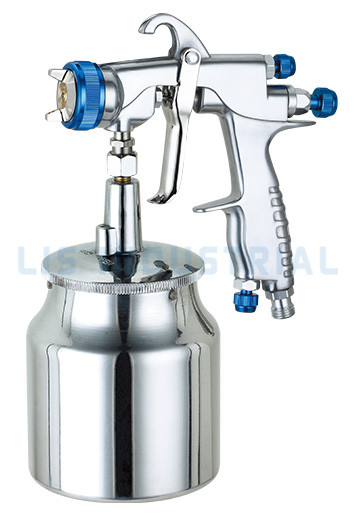
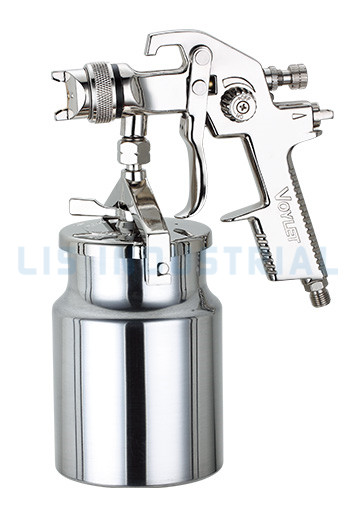
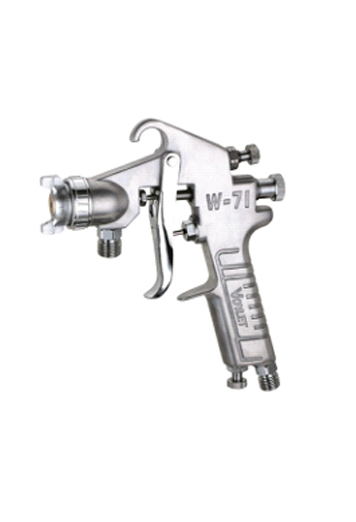
The N71P is a pressure-feed spray gun designed for automotive finishing and other medium-finish applications. It uses a pressure-feed configuration, operates at an air pressure of 43 PSI, supports 1.3 mm and 1.5 mm nozzle options, and provides a spray pattern of approximately 200 mm. It is mainly available with a diaphragm pump, a configuration that can contribute to longer service life when the equipment is correctly maintained and used within its intended operating range.
This article examines the product’s working principles, practical advantages, application suitability, construction considerations, operating procedure, maintenance requirements, and the manufacturing capabilities behind it. It also compares the pressure-feed approach with common alternatives and explains why a carefully engineered spray gun can offer value beyond its initial purchase price.
N71P
Understanding the N71P Product Configuration
The N71P belongs to a professional spray gun category intended for controlled application of coatings. Its design is particularly relevant to users who need more consistent material delivery than a basic gravity-feed tool can provide. The gun is suitable for automotive finish work and medium-finish applications, making it useful in repair shops, production environments, equipment workshops, furniture operations, and general industrial coating areas.
Its key specification is the pressure-feed delivery system. In a pressure-feed arrangement, the coating is supplied to the spray gun under pressure from a separate tank, cup, or diaphragm pump. The spray gun does not need to rely primarily on gravity to draw material into the fluid passage. This arrangement can support a more stable material supply, especially when the operator is working at different angles or when a larger volume of coating must be applied.
The product is offered with 1.3 mm and 1.5 mm nozzle sizes. These two options allow users to match the gun more closely to the viscosity of the coating and the desired finish. A smaller nozzle can be suitable for thinner materials and finer control, while a larger nozzle can help accommodate somewhat heavier materials or higher material delivery requirements. The correct selection should always be based on the coating manufacturer’s recommendations, the required finish, and the available air and fluid pressure.
The specified air pressure is 43 PSI. This operating figure provides a useful reference for setting up the air supply, but actual performance also depends on the compressor’s delivery capacity, hose length, air cleanliness, regulator accuracy, coating viscosity, and trigger technique. A stable pressure at the gun is more important than simply setting a high pressure at the compressor. Excess pressure can increase overspray and material waste without necessarily improving atomization.
The stated spray pattern is 200 mm. A pattern of this size is appropriate for many automotive panels and medium-sized workpieces. It offers a practical balance between coverage speed and operator control. A pattern that is too narrow may require excessive overlapping passes, while an excessively wide pattern may be difficult to control on small parts. The 200 mm specification gives the operator a useful working range for doors, hoods, fenders, cabinets, machinery panels, and similar surfaces.
Specification Overview
| Item | N71P Configuration | Practical Significance |
|---|---|---|
| Product type | Pressure-feed spray gun | Supports continuous or higher-volume material delivery from an external source |
| Nozzle options | 1.3 mm and 1.5 mm | Allows adjustment for different coating viscosities and finish requirements |
| Air pressure | 43 PSI | Provides a reference setting for atomization and spray adjustment |
| Spray pattern | Approximately 200 mm | Provides efficient coverage for automotive and medium-sized surfaces |
| Feed system | Pressure feed | Reduces dependence on gravity and supports stable material supply |
| Pump configuration | Mainly available with diaphragm pump | Can provide durable material transfer and extended service life with suitable maintenance |
| Primary applications | Automotive finish and medium finish | Suitable for repair, refinishing, production, and general coating work |
Why Pressure Feed Matters in Professional Finishing
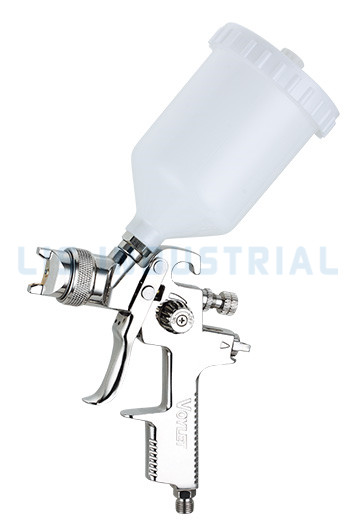
The feed system has a direct effect on how a spray gun behaves during operation. Gravity-feed guns place a material cup above the gun body, allowing coating to move toward the fluid nozzle through gravity and suction created by the air stream. This arrangement is convenient and compact, but the material flow can change as the cup empties. The gun’s balance may also change as the weight of the cup decreases.
A pressure-feed gun receives material from an external pressurized source. The operator can therefore use a larger material container and maintain a more consistent supply during a long spraying session. This is valuable when coating large panels, multiple parts, vehicle bodies, or production batches. The operator spends less time stopping to refill a small cup and can maintain a more continuous rhythm.
Pressure feed also offers flexibility when the spray gun is held in positions where gravity-feed performance may become less predictable. Although the operator should always maintain a suitable gun angle, the external material supply can make the system more adaptable for vertical, overhead, or difficult-to-reach surfaces. This flexibility is one of the main reasons pressure-feed equipment remains important in automotive and industrial finishing.
Another advantage is the potential to separate material capacity from gun size. A small gun body can be connected to a larger tank or pump, giving the user a longer operating period without adding a large cup directly to the hand-held tool. This can improve balance and reduce the frequency of interruptions. The final result depends on the complete system, but the pressure-feed principle provides a strong foundation for efficient work.
Comparison with Conventional Alternatives
Compared with a basic suction-feed spray gun, a pressure-feed configuration can provide more reliable material delivery for coatings that are less suitable for simple suction systems. A suction-feed gun must generate enough vacuum to lift material from a container, and this may limit its performance when the material is relatively viscous or when a larger volume is required. Pressure assistance reduces the burden placed on the atomizing air stream.
Compared with a small gravity-feed gun, the N71P configuration is better suited to longer spraying sessions and larger workpieces. A gravity gun may be easier to set up for small touch-up jobs, but its cup capacity can limit productivity. The pressure-feed design is more appropriate when the user needs steady coverage over several panels or repeated parts.
Compared with some high-volume systems, the N71P can offer a more manageable balance between professional output and equipment complexity. Very large industrial systems may provide high production rates, but they can require more space, more extensive air and fluid management, and more complicated cleaning procedures. A pressure-feed spray gun with a suitable diaphragm pump can occupy a useful middle position for workshops that need capacity without installing a fully automated coating line.
Automotive Finishing Performance
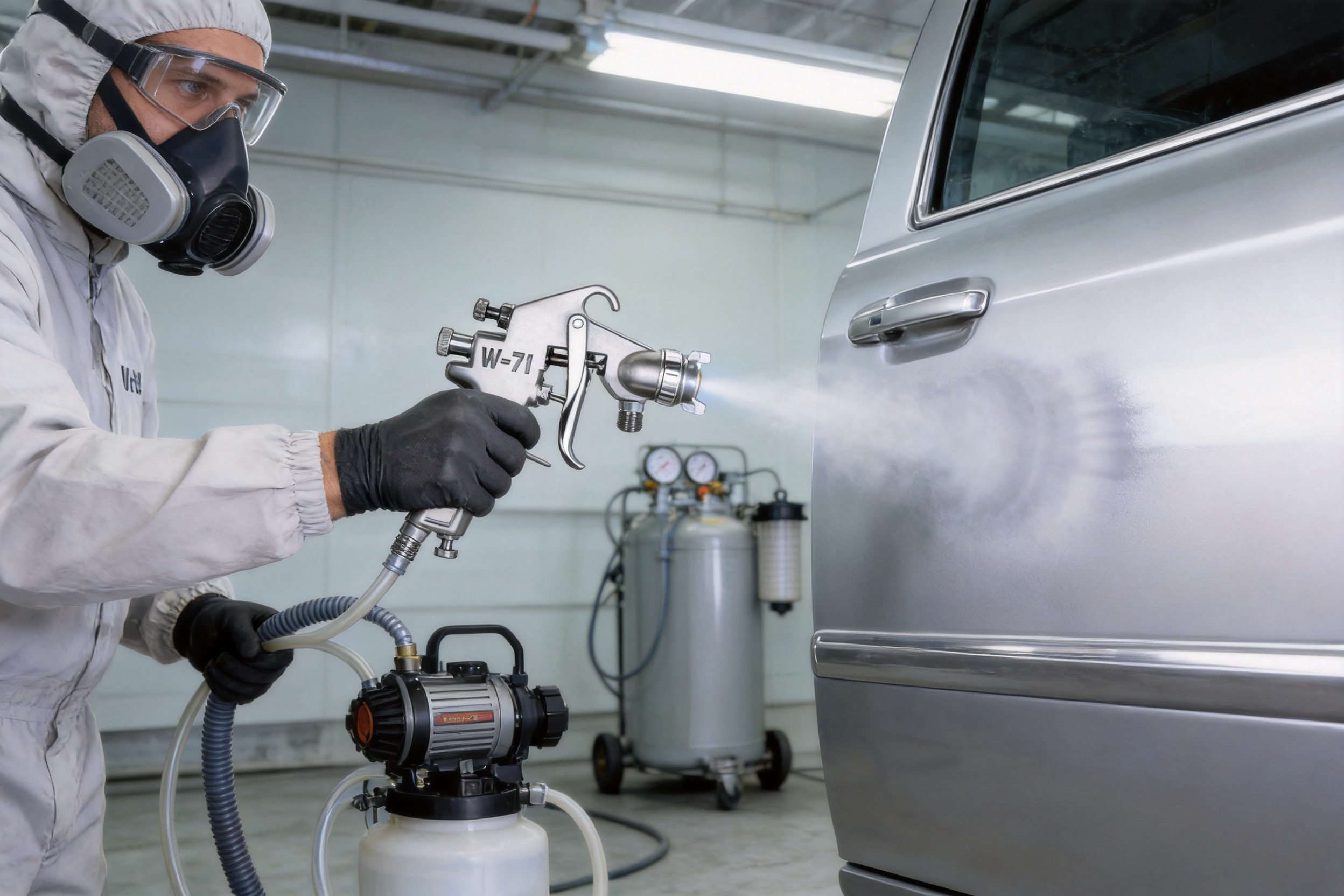
Automotive finishing requires control over coverage, color uniformity, texture, and film thickness. Panels often contain large flat areas, curved sections, edges, recessed features, and transitions between old and new coatings. A spray gun must atomize the material evenly while allowing the operator to control the overlap and speed of each pass.
The N71P’s 200 mm spray pattern can support efficient application across common vehicle panels. The operator can move across the panel using consistent, overlapping passes. A suitable overlap helps avoid striping and ensures that the center and outer portions of adjacent passes blend together. The exact overlap percentage depends on the coating, pressure, nozzle, and technician preference, but a controlled pattern is essential for a uniform result.
The 1.3 mm nozzle is generally associated with finer material control and can be considered when applying thinner automotive coatings or when a smoother finish is required. The 1.5 mm nozzle provides additional fluid capacity and may be more appropriate for materials that need a slightly larger passage. Nozzle selection should not be treated as a substitute for proper material reduction. The coating should be prepared according to its technical data sheet, and the spray gun should be adjusted only after the material has reached the recommended viscosity.
Automotive refinishing also benefits from stable pressure. At the specified 43 PSI reference point, the technician can establish a repeatable starting setup. The regulator should be positioned so that pressure is checked as close to the gun as practical, ideally while the trigger is pulled. Static pressure readings may not represent the actual pressure during spraying because the air demand changes when the gun is activated.
A well-adjusted pressure-feed system can help reduce the need for excessive passes. Fewer unnecessary passes can lower material consumption, shorten application time, and reduce the risk of excessive film build. However, the gun must be used with a suitable compressor and clean air system. A spray gun cannot compensate for insufficient air volume, moisture contamination, oil in the airline, or an incorrectly prepared coating.
Advantages for Medium-Finish Applications
Medium-finish work covers a broad range of applications between basic protective coating and highly specialized show-quality finishing. Examples include machinery panels, workshop equipment, agricultural components, furniture, cabinets, vehicle repair work, and general metal or composite parts. These applications typically require a good appearance, reliable coverage, and practical productivity rather than the extremely fine control of a dedicated detail airbrush.
The N71P is well matched to this category because its specifications provide a useful combination of coverage and adjustability. The 200 mm pattern reduces the time required to cover medium-sized surfaces, while the two nozzle choices allow the user to adapt the gun to different materials. Pressure feed further supports a consistent supply when several parts must be coated in sequence.
For workshops handling multiple coating types, operational flexibility is a major advantage. The gun may be used for primers, base materials, clear finishes, sealers, or other compatible coatings, provided the fluid passages, seals, nozzle, pressure, and cleaning process are appropriate for the material. The user should confirm chemical compatibility before applying aggressive solvents, waterborne products, textured materials, or specialty coatings.
Medium-finish applications also benefit from equipment that is easy to integrate into an existing air system. The N71P can be paired with a pressure tank or diaphragm pump and connected through appropriate air and fluid fittings. The complete installation should include a regulator and, where necessary, filtration and moisture separation. A clean, dry, stable air supply improves both finish quality and component life.
Diaphragm Pump Availability and Service Life
The product is mainly available with a diaphragm pump. A diaphragm pump transfers material through the controlled movement of a flexible diaphragm. Depending on the specific system design, the pump can provide a steady flow while isolating the material from certain mechanical components. This can be beneficial when the coating requires careful handling or when the equipment must operate for extended periods.
Longer service life is not determined by the pump alone. It depends on material compatibility, correct pressure, cleaning frequency, replacement of wear components, and the quality of the incoming air. A diaphragm pump can perform reliably when the user avoids operating it dry for unnecessary periods, prevents abrasive contamination from entering the system, and follows the recommended maintenance schedule.
The pressure-feed arrangement also allows the pump and gun to be selected as a coordinated system. Fluid pressure should be sufficient to provide consistent delivery but not so high that the gun becomes difficult to control or the finish receives excessive material. A balanced setup supports smoother trigger operation and helps the operator maintain a repeatable wet film.
For production users, the service-life benefit is especially important. Equipment downtime can interrupt schedules, delay deliveries, and increase labor costs. A durable pump and carefully manufactured gun reduce the likelihood of frequent replacement, provided that maintenance is treated as part of normal production rather than an emergency response.
Maintenance Practices That Protect the Pump
After each work session, the fluid path should be flushed with a compatible cleaning solution. The cleaning material must be suitable for the coating and the pump seals. Using an incorrect solvent can cause swelling, hardening, cracking, or loss of elasticity in seals and diaphragms. The equipment supplier’s cleaning recommendations should take priority over general assumptions.
Filters and strainers should be inspected regularly. Small particles can restrict the fluid nozzle, damage internal surfaces, or cause an uneven spray pattern. If the coating requires filtration, it should be filtered before entering the pressure tank or pump. The operator should avoid using contaminated containers, open storage vessels, or unclean mixing tools.
Air connections should be checked for leaks. A leaking connection can reduce pressure stability and increase compressor workload. Fluid connections should also be examined for signs of seepage, especially after the system has been pressurized. Any damaged hose, fitting, seal, or diaphragm should be replaced before continued operation.
Maintenance records can be useful in professional environments. Recording cleaning dates, nozzle changes, diaphragm replacements, and observed pressure settings helps identify wear patterns. It also gives supervisors a clearer basis for planning preventive service instead of waiting for a complete performance failure.
Manufacturing Quality and Process Control
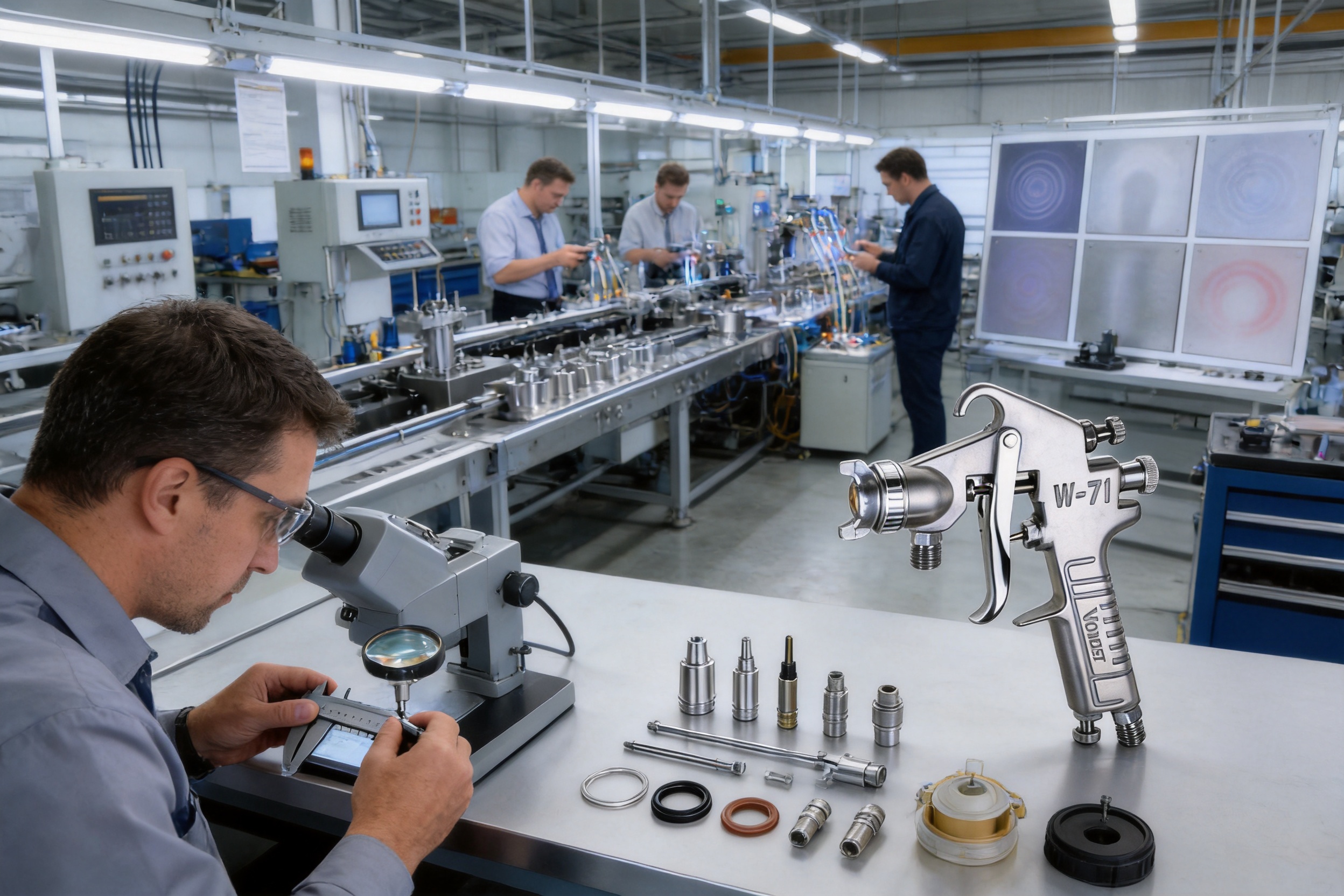
Spray gun performance is closely related to manufacturing consistency. A product may have attractive specifications, but those specifications are only meaningful when each unit is assembled accurately and tested correctly. Critical components include the air cap, fluid nozzle, needle, needle seat, trigger mechanism, adjustment controls, seals, body passages, and connection points.
Precision in the air cap and fluid nozzle affects atomization. Small differences in orifice geometry, surface finish, alignment, or concentricity can change the shape of the spray pattern. Consistent machining and inspection help ensure that the gun behaves predictably from one unit to another. This is particularly important for distributors and professional users who expect replacement units to perform like the original.
Material selection also influences durability. The gun body must resist the mechanical stresses of repeated use, while internal surfaces must tolerate contact with suitable coatings and cleaning agents. Components exposed to aggressive materials need compatible finishes and seals. A thoughtful material strategy can extend useful life and reduce the likelihood of premature corrosion or chemical damage.
Assembly control is equally important. Threads must engage correctly, seals must be positioned without damage, and moving components must operate smoothly. Excessive friction at the needle or trigger can make fine control difficult. Incorrect assembly can also cause leakage, inconsistent fluid flow, or poor adjustment response.
Quality assurance should cover incoming materials, in-process production, and finished products. Incoming inspection helps prevent defective raw materials from entering the manufacturing line. In-process controls identify errors before the product reaches final assembly. Finished-product inspection confirms that the completed gun meets functional and appearance requirements.
Functional testing is particularly valuable for spray equipment. A visual inspection alone cannot confirm that a gun atomizes correctly or maintains a suitable pattern. Testing may include checks for air passage performance, fluid delivery, trigger action, leakage, pattern shape, and general operation. A final functional test gives greater confidence that the product is ready for professional use.
Advanced Production Capabilities
The manufacturer behind the product has operated in the spray equipment field since 1984 and has developed a large production base in Ningbo, China. The company operates on more than 400,000 square feet of land and employs over 400 people. Its reported annual output exceeds 40 million US dollars, indicating the capacity to support both standard product demand and larger procurement programs.
The company’s manufacturing scope includes air painting spray guns, mini air compressors, and related air tools. This broader product capability is useful because a spray gun is rarely used in isolation. A supplier with experience in pumps, compressors, fittings, tanks, and air accessories can better understand the requirements of a complete spraying system.
The company reports dedicated research and development resources, an engineering technology center, and technical cooperation related to spraying machinery. These capabilities support continued improvement in fluid delivery, atomization, ergonomics, reliability, and compatibility with changing coating technologies.
Production capacity is also relevant to commercial customers. The company indicates that capacity can be increased by 30 percent within two months. This flexibility can help address seasonal demand, large customer orders, and private-label programs. Capacity expansion is most valuable when it is supported by stable quality controls, trained personnel, reliable sourcing, and documented production procedures.
For customers requiring customized products, the manufacturer provides OEM services based on drawings or samples and ODM services based on customer requirements. This can be useful for distributors seeking a specific nozzle configuration, packaging arrangement, handle design, color, accessory combination, or system integration. Any customized project should be supported by clear technical documents, approved samples, inspection criteria, and change-control procedures.
Quality Systems and Certification Support
The manufacturer reports operating according to the ISO9000 quality system and states that it was among the first companies in the Chinese industry to pass ISO9001 international quality system certification. It also reports ISO14001 environmental management system certification and OHSAS18001 occupational health and safety system certification. These systems address different areas of organizational performance.
ISO9001 focuses on the structure of quality management, including documented processes, customer requirements, corrective action, internal review, and continual improvement. For a spray gun buyer, this can translate into more consistent order handling, clearer production controls, and a more systematic response to quality issues.
ISO14001 relates to environmental management. Manufacturing processes may involve metalworking, surface treatment, cleaning chemicals, packaging, energy use, and waste management. An environmental management system encourages the organization to identify relevant impacts and establish procedures for managing them.
OHSAS18001 was an occupational health and safety management standard used before the broader ISO 45001 framework became common. The reported certification reflects an emphasis on workplace safety processes. Safe production is important not only for employees but also for supply continuity and responsible business operation.
The manufacturer also reports CE and German GS product certifications. Certification requirements depend on the exact product configuration and applicable regulations, so buyers should request current certificates and confirm that they correspond to the specific model, market, and accessory package being purchased. Certifications should complement, not replace, practical technical evaluation and incoming inspection.
Operator Technique for Better Results
Even a well-manufactured spray gun requires correct technique. Before spraying a vehicle panel or finished workpiece, the operator should test the gun on a suitable sample surface. The test should confirm the spray pattern, material delivery, atomization, and edge distribution. Adjustments should be made in small increments rather than changing several variables at the same time.
The gun should generally be held perpendicular to the surface. Tilting the gun can cause one side of the pattern to receive more material than the other. The operator should move the entire arm rather than pivoting only the wrist. A steady speed and consistent distance help maintain a uniform film thickness.
The trigger should be operated smoothly. On a conventional spray gun, the operator typically begins air flow before fluid flow and releases fluid before air when ending the pass. This sequence can reduce spitting and help keep the air cap cleaner. The exact technique may vary according to the gun and coating, but abrupt trigger movements should be avoided.
Overlap should be consistent from pass to pass. Too little overlap can produce stripes or visible differences in gloss and color. Too much overlap can create excessive film build and increase material consumption. The correct overlap depends on the pattern and coating, so a test panel is valuable before production work begins.
The operator should also consider the environment. Temperature, humidity, ventilation, and airflow can influence drying and overspray behavior. The work area must be adequately ventilated and compliant with all applicable safety requirements. Personal protective equipment, including suitable respiratory, eye, skin, and hearing protection, should be selected according to the coating and workplace risk assessment.
Setting Up the Air Supply
The compressor should be capable of delivering the required air volume at the gun while maintaining a stable working pressure. A compressor that is too small may cycle continuously, causing pressure fluctuations and heat buildup. A receiver tank can help smooth short-term demand, but it does not replace adequate compressor capacity.
Air lines should be sized and arranged to reduce unnecessary pressure loss. Long, narrow, damaged, or poorly connected hoses can restrict airflow. Quick-connect fittings should be compatible with the system and checked for internal restrictions. A regulator placed near the gun can make final pressure adjustment easier.
Moisture separation is essential in many finishing applications. Condensation from the compressor or airline can reach the gun and create defects in the coating. An air filter or moisture separator should be installed and drained regularly. For sensitive finishes, additional filtration may be needed.
The 43 PSI specification should be used as an operating reference, not as a reason to ignore the complete system. Pressure should be verified during spraying, because the dynamic pressure may differ from the static reading. If the pattern is unstable, the operator should inspect the airline, regulator, fittings, and compressor before assuming that the gun is defective.
Nozzle Selection and Material Compatibility
The 1.3 mm nozzle can be considered when the coating is relatively fluid and the objective is controlled atomization. It may be useful for automotive color coats, clear finishes, and other materials that are designed for a smaller passage. The 1.5 mm nozzle provides a little more fluid capacity and may be preferred for primers, heavier finishes, or applications where faster material delivery is necessary.
Nozzle size should be selected together with fluid pressure, air pressure, needle adjustment, and coating viscosity. A large nozzle combined with a thin material and high fluid pressure may produce excessive flow. A small nozzle used with a heavy material may require excessive pressure and still produce poor atomization. The best setup is the one that allows the material to atomize without unnecessary air or fluid pressure.
Material compatibility must also be considered. Coatings may contain solvents, pigments, resins, or additives that affect seals and internal surfaces. Waterborne and solvent-based products can have different cleaning and storage requirements. Abrasive materials may accelerate wear in nozzles, needles, and pump components. Users should consult the product data sheet and equipment recommendations before introducing a new material.
When changing from one coating to another, the system should be thoroughly cleaned. Small amounts of incompatible material can cause gelling, blockage, color contamination, or changes in viscosity. A clean test spray after flushing can help verify that the previous material has been removed before the next product is loaded.
Cleaning and Preventive Maintenance
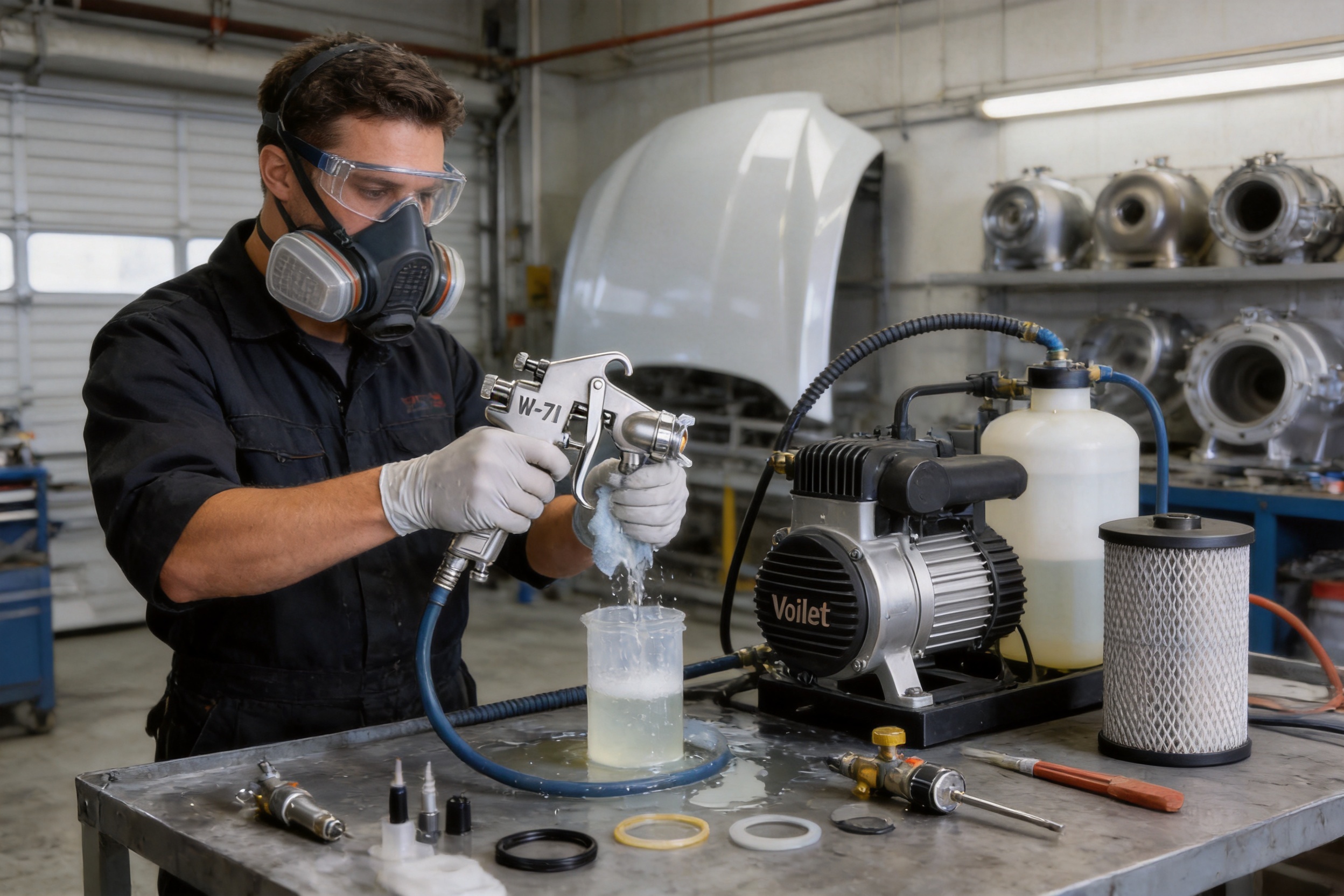
Cleaning should begin immediately after spraying. Dried coating is more difficult to remove and may require aggressive treatment that can damage seals or finishes. The fluid supply should be disconnected or depressurized according to the system procedure, and the remaining material should be returned or disposed of in compliance with local regulations.
The fluid path should then be flushed with an approved cleaning solution. The operator should avoid immersing the entire gun in solvent unless the manufacturer specifically permits it. Full immersion can remove lubricants, attack seals, and allow cleaning fluid to enter areas that do not need it.
The air cap and nozzle require careful attention because partial blockage can distort the pattern. Appropriate cleaning tools should be used to protect the orifices. Hard metal objects should not be forced into precision openings, since even minor damage can affect atomization.
The needle should be inspected for coating buildup and damage. The trigger and adjustment controls should move smoothly. Threads should be kept clean, and seals should be checked for flattening, swelling, cracking, or leakage. Replacement parts should match the correct product configuration.
Before storage, the gun should be clean and dry, with all components protected from contamination. If the equipment will not be used for an extended period, the pump and fluid system should be stored according to the recommended procedure. Good storage reduces startup problems and extends the useful life of the equipment.
Economic Value and Total Cost of Ownership
The purchase price is only one part of spray equipment value. A gun that provides consistent results can reduce material waste, rework, labor time, and production interruptions. These indirect savings may be more important than a small difference in initial cost.
The N71P pressure-feed design can support larger material containers and longer uninterrupted work periods. This may reduce refill time in automotive and medium-finish operations. The availability of two nozzle sizes can also reduce the need to purchase separate guns for every coating task, although each nozzle and fluid component must still be selected and maintained correctly.
Durability contributes to total cost of ownership. A longer-lasting diaphragm pump, robust gun body, consistent internal components, and accessible replacement parts can help reduce the frequency of equipment replacement. The actual service life depends on use, cleaning, coating chemistry, and maintenance discipline, but a product designed for professional operation offers a stronger basis for long-term value than a disposable or lightly constructed tool.
For distributors, supply reliability is another economic factor. A manufacturer with substantial production capacity, OEM and ODM capability, and an established international customer base may be better positioned to support repeat orders. Stable supply helps distributors maintain stock, meet customer commitments, and build a consistent product range.
Applications Beyond Automotive Work
Although automotive finishing is a primary application, the N71P configuration can also be considered for many medium-finish coating tasks. Furniture and woodworking operations may use a suitable nozzle and coating setup for cabinets, tables, panels, and fixtures. Industrial workshops may apply protective finishes to machine housings, brackets, frames, and fabricated components.
Agricultural and construction equipment can benefit from pressure-feed application when large metal surfaces must be coated efficiently. The external material supply is useful for repeated parts or long work sessions. In maintenance departments, the gun may be used for equipment refurbishment, general repair, and protective repainting.
Small manufacturing businesses may also use the product for batch work. A pressure tank or diaphragm pump can supply a sequence of parts while the operator maintains a repeatable spray method. This can provide a practical alternative to a fully automated line when production volume is moderate and product variety is high.
Users should evaluate each application carefully. Highly textured coatings, extremely abrasive materials, very high-solids products, and specialized industrial chemicals may require a different gun design or dedicated fluid equipment. The N71P should be used only with materials and pressures that are compatible with its construction and specifications.
How the Product Compares with Competing Spray Guns
Competition in the spray gun market includes gravity-feed, suction-feed, pressure-feed, HVLP, conventional, electric, airless, automatic, and specialized touch-up equipment. No single type is best for every application. The appropriate comparison depends on the required finish, production volume, material viscosity, available air supply, operator skill, and regulatory environment.
Against entry-level gravity guns, the N71P’s strongest distinction is its pressure-feed capability. It is designed for users who need an external material supply and longer operating periods. The trade-off is that a pressure-feed setup requires additional equipment, such as a pressure tank, diaphragm pump, fluid hose, or related fittings. For occasional small repairs, a gravity gun may be simpler. For repeated medium-sized work, the pressure-feed design can be more productive.
Against suction-feed guns, the N71P can offer stronger support for continuous material delivery and coatings that are not ideal for suction operation. The external pump reduces reliance on the air stream to lift material. This can improve flexibility, though the system must be correctly balanced to avoid excessive fluid pressure.
Against very high-output production guns, the N71P may be easier to manage in workshops that need professional performance without the full complexity of large industrial automation. Its 200 mm pattern and two nozzle choices are practical for general automotive and medium-finish tasks. The most suitable option depends on the required production speed and the number of parts being coated.
Against electric paint sprayers, an air-driven pressure-feed gun can provide a more familiar solution for facilities that already have compressed air. Electric systems may be attractive where compressors are unavailable, but the finish, maintenance, motor design, and material compatibility can differ significantly. A pneumatic gun offers direct control through air and fluid adjustments.
Against airless equipment, the N71P generally emphasizes atomization and finish control rather than maximum material output. Airless systems can be advantageous for large-area protective coatings, but the pressure-feed air spray approach may be preferable when appearance and controlled application are central requirements.
Purchasing Considerations for Professional Users
Before purchasing, users should identify the coatings they intend to apply, the expected daily workload, the size of the workpieces, and the available air infrastructure. The nozzle size should be selected based on the coating data sheet, not simply on the desired speed. Buyers should also confirm whether the package includes the pump, pressure tank, hoses, fittings, regulators, cleaning tools, and replacement components.
Distributor support is important. A professional spray gun is more valuable when users can obtain compatible needles, nozzles, air caps, seals, diaphragms, and repair guidance. Clear technical documentation helps operators set pressure, perform cleaning, and identify normal wear.
Buyers should ask for current certification documents when products are intended for regulated markets. They should also confirm packaging standards, inspection procedures, warranty terms, spare-parts availability, and production lead times. For large orders, a pre-shipment inspection or approved sample can help establish expectations for appearance and function.
Private-label buyers should define every critical requirement in writing. This may include model designation, nozzle configuration, logo placement, packaging language, accessories, color, materials, test procedures, and acceptable tolerances. OEM and ODM projects are more successful when technical communication is detailed from the beginning.
Supplier Strength and International Support
The manufacturer, Ningbo Lis Industrial Co., Ltd., has developed international experience in spray equipment and air tools. Its products are reported to be sold in Europe, North America, the Middle East, South Africa, and East Asia. An international customer base can indicate experience with different market requirements, shipping procedures, documentation expectations, and product configurations.
The company’s brands include Voylet, Muzi, and Wagem. It also reports long-term business relationships with international customers and technical cooperation in the spraying machinery field. These factors may be relevant to importers and distributors seeking a supplier rather than a one-time product source.
The company emphasizes total spraying solutions rather than a single isolated tool. Its product categories include spray guns, mini compressors, air pipeline accessories, paint tanks, air fittings, air polishers, spray gun kits, paint sprayers, airless spray guns, electric spray guns, and related equipment. This range can help customers coordinate components across a complete application system.
Research and development capacity adds another layer of value. Spray technology continues to evolve as coatings change, environmental requirements become stricter, and users seek better transfer efficiency and reduced waste. A supplier with an engineering team can respond more effectively to new requirements than a company that only resells standard products.
For customers evaluating long-term cooperation, the most important question is whether the supplier can combine innovation with reliable execution. Product design, manufacturing capacity, certification support, quality control, customization, logistics, and after-sales service must work together. A strong supplier relationship is built through documented specifications, consistent communication, transparent testing, and continuous improvement.
Recommended Operating Workflow
Step One: Prepare the Work Area
Ensure that the spraying area has adequate ventilation, suitable lighting, clean air movement, and appropriate fire and chemical safety controls. Remove dust-producing activities from the area. Confirm that the workpiece is properly supported and that the operator has enough space to move the gun smoothly.
Step Two: Prepare the Material
Mix the coating according to the material manufacturer’s instructions. Filter the material if recommended. Check viscosity, pot life, temperature, and compatibility with the pressure-feed system. Do not use material that contains lumps, skin, foreign particles, or signs of chemical instability.
Step Three: Inspect the Equipment
Check the gun, nozzle, needle, air cap, hoses, pump, pressure vessel, regulator, fittings, and filters. Make sure all connections are tight and that the fluid path is clean. Inspect seals and diaphragms for signs of wear. Confirm that the selected 1.3 mm or 1.5 mm nozzle is suitable for the material.
Step Four: Establish Pressure
Set the air system near the specified 43 PSI reference and verify the pressure while the gun is operating. Adjust fluid pressure gradually. The objective is a stable, controlled spray rather than the highest possible delivery rate.
Step Five: Test the Pattern
Spray onto a test panel or disposable surface. Observe the pattern for uniform distribution, correct atomization, and balanced edges. If the pattern is heavy on one side, inspect the air cap and nozzle for contamination or damage. Make one adjustment at a time.
Step Six: Apply the Coating
Hold the gun at a consistent distance and angle. Move at a steady speed with controlled overlap. Avoid stopping over the surface, swinging the gun in an arc, or changing speed abruptly. Monitor wetness, coverage, and film build throughout the application.
Step Seven: Clean Immediately
After the job, depressurize the system safely and flush the fluid path. Clean the air cap, nozzle, needle, and relevant fittings. Inspect the equipment before storage and record any parts that may require replacement.
Safety Responsibilities
Spray coatings can create inhalation, skin-contact, fire, explosion, and environmental hazards. Operators must read the coating safety data sheet and follow local workplace regulations. Suitable respiratory protection is essential when required by the coating and ventilation conditions. Gloves, eye protection, protective clothing, and hearing protection should be selected according to the risk assessment.
Compressed air must never be directed at the body or used to clean clothing. Pressurized fluid systems should be depressurized before disconnecting hoses or removing components. The operator should verify that all fittings and hoses are rated for the intended pressure and chemical exposure.
Ventilation equipment must be suitable for the materials being sprayed. Ignition sources should be controlled where flammable coatings or solvents are present. Waste solvent, contaminated filters, and leftover coating should be handled according to applicable environmental requirements.
Q&A
What type of spray gun is the N71P?
The N71P is a pressure-feed spray gun intended primarily for automotive finishing and medium-finish applications. It receives coating from an external pressurized source rather than relying only on a cup mounted above or below the gun.
What nozzle sizes are available?
The listed nozzle options are 1.3 mm and 1.5 mm. The 1.3 mm option may support finer control with thinner materials, while the 1.5 mm option can provide higher fluid delivery for suitable coatings. The coating manufacturer’s technical recommendations should guide final selection.
What is the recommended air pressure?
The specified air pressure is 43 PSI. The actual pressure should be checked during spraying and adjusted according to the coating, nozzle, air supply, and required finish. The operator should avoid increasing pressure unnecessarily because excessive pressure can increase overspray and waste.
What does a 200 mm spray pattern mean?
A 200 mm spray pattern indicates the approximate width of the fan under the specified testing or operating conditions. It is a practical size for many automotive panels and medium-sized workpieces. Actual pattern width can vary with pressure, distance, material viscosity, nozzle selection, and adjustment.
Why use a diaphragm pump?
A diaphragm pump can provide a controlled external material supply and may contribute to extended service life when correctly maintained. It is particularly useful for longer spraying sessions, larger material volumes, and applications where a stable feed is preferred.
Is the N71P suitable for small touch-up work?
It can be used for selected small or medium repair tasks, but a dedicated touch-up gun may be more convenient for very small areas. The N71P’s pressure-feed configuration is most valuable when the user needs stable delivery, a larger material supply, or repeated coverage rather than occasional spot repair.
Can the gun be used with different coating materials?
It may be used with compatible coatings when the material viscosity, chemical composition, nozzle, seals, pressure, and cleaning procedure are suitable. Users should consult both the coating technical data sheet and the equipment instructions before changing materials.
What compressor is required?
The compressor must provide sufficient air volume at the gun while maintaining stable pressure. The required capacity depends on the complete system and operating conditions. A small compressor that cannot sustain demand may cause pressure fluctuation, poor atomization, and inconsistent finish quality.
How can overspray be reduced?
Use the correct pressure, maintain the recommended gun distance, select a suitable nozzle, prepare the material correctly, and move the gun at a consistent speed. Excessive air pressure, an overly wide pattern, poor ventilation, and incorrect technique can all increase overspray.
How often should the gun be cleaned?
The gun should be cleaned after every work session and immediately when changing incompatible materials. Regular cleaning prevents dried coating from restricting the nozzle, air cap, needle, and fluid passages.
What should be checked if the spray pattern is uneven?
Inspect the air cap and nozzle for blockage, confirm that the nozzle and needle are correctly installed, check air and fluid pressure, examine the material for contamination, and verify that the regulator and hoses are functioning correctly. A damaged air cap or nozzle should be replaced.
Does the manufacturer provide customization?
The manufacturer reports OEM services based on customer drawings or samples and ODM services based on customer requirements. Custom projects should define technical specifications, approved samples, packaging, inspection standards, and delivery expectations in advance.
Which industries can benefit from this product?
Automotive refinishing, equipment repair, woodworking, furniture production, machinery coating, agricultural equipment maintenance, general fabrication, and moderate-volume manufacturing can all be potential applications when the coating and operating conditions are suitable.
Conclusion
The N71P pressure-feed spray gun is designed for users who require controlled automotive and medium-finish application with a stable external material supply. Its 1.3 mm and 1.5 mm nozzle options provide practical flexibility, while the 43 PSI operating reference and approximately 200 mm spray pattern support repeatable coverage across many common workpieces.
Its main advantage over simpler alternatives is the pressure-feed configuration. This design can support larger material capacity, longer uninterrupted work periods, and more consistent delivery when paired with a correctly adjusted diaphragm pump. Compared with highly specialized or very large systems, it offers a practical balance between professional performance, flexibility, and manageable equipment complexity.
The product’s value is strengthened by the manufacturing capabilities of Ningbo Lis Industrial Co., Ltd. The company reports decades of industry experience, substantial production capacity, research and development resources, OEM and ODM services, international distribution, and quality and product certification support. Its broader range of spray equipment and air tools also enables customers to source components for complete coating solutions.
Ultimately, spray quality depends on the complete system. Correct material preparation, clean and dry air, suitable pressure, proper nozzle selection, controlled operator movement, immediate cleaning, and preventive maintenance are all essential. When these practices are combined with a well-engineered pressure-feed gun, the result can be a more efficient, consistent, and economical finishing process.
References
1. Ningbo Lis Industrial Co., Ltd. Product specification information for the N71P pressure-feed spray gun.
2. Ningbo Lis Industrial Co., Ltd. Corporate information concerning spray gun manufacturing, research and development, quality systems, certifications, OEM, and ODM services.
3. ISO 9001, Quality Management Systems: Requirements.
4. ISO 14001, Environmental Management Systems: Requirements with Guidance for Use.
5. International standards and guidance concerning compressed-air equipment, pneumatic tools, and workplace safety.
6. Coating manufacturer technical data sheets and safety data sheets for material preparation, viscosity, application pressure, ventilation, and personal protective equipment.
7. General industry guidance on automotive refinishing, spray pattern adjustment, atomization, equipment cleaning, and preventive maintenance.