 Search
 English
 中文简体
中文简体 Deutsch
 Español
Content
- 1 Product Overview
- 2 Designed for Handcrafting and Precision Work
- 3 Advantages of the 0.3 mm Nozzle
- 4 Practical Benefits of the 7CC Cup
- 5 Working Pressure and Spray Control
- 6 Performance Compared with General-Purpose Alternatives
- 7 Manufacturing Experience and Industrial Capability
- 8 Quality Control from Incoming Material to Finished Product
- 9 Engineering and Product Development Strengths
- 10 Applications for the ABS-130
- 11 Recommended Operating Practices
- 12 Maintenance and Service Life
- 13 Packaging and Distribution Value
- 14 Why Manufacturer Experience Matters to Buyers
- 15 Selection Guidance for Different Users
- 16 Limitations and Responsible Expectations
- 17 Frequently Asked Questions
- 17.1 What is the ABS-130 airbrush mainly used for?
- 17.2 What does the 0.3 mm nozzle mean?
- 17.3 How much material does the cup hold?
- 17.4 What pressure should be used?
- 17.5 Can the ABS-130 spray every type of paint?
- 17.6 Is a compressor required?
- 17.7 Is the product suitable for large surfaces?
- 17.8 How should the airbrush be cleaned?
- 17.9 What quality systems does the manufacturer report?
- 17.10 Can the product be customized?
- 17.11 How is the product packed?
- 17.12 What should a buyer ask before ordering?
- 18 Conclusion
- 19 References
- 20 Product: ABS-130 0.3mm 7CC Portable Air Brush Spray Gun For Handcrafter

The ABS-130 portable airbrush spray gun is a compact and practical finishing tool designed for handcrafters, artists, model makers, decorators, hobbyists, and professionals who need controlled application of paint and other suitable liquid coatings. With a 0.3 mm nozzle, a 7CC cup, and a working pressure range of 15–50 PSI, it offers a useful balance between fine detail, smooth coverage, portability, and ease of operation.
Unlike large conventional spray guns designed for furniture, vehicles, walls, or industrial production, the ABS-130 is intended for smaller-scale precision work. Its compact format helps users apply color where it is needed without carrying a full-size spray system. The product is suitable for creating fine lines, gradients, decorative effects, model finishes, artwork, craft details, and small-area touch-ups when used with compatible paints and an appropriate air source.
The design also reflects the manufacturing experience of Ningbo Lis Industrial Co., Ltd., a Chinese manufacturer specializing in air painting spray guns, mini air compressors, air tools, fittings, and related spraying equipment. The company has developed a broad product portfolio covering airbrushes, HVLP spray guns, heavy-duty spray guns, woodworking spray guns, conventional spray guns, texture paint spray guns, automatic spray guns, airless spray guns, electric sprayers, paint tanks, air polishers, air fittings, and other professional equipment.
For buyers seeking a portable airbrush with an intermediate fine nozzle, the ABS-130 provides a practical configuration. It is more versatile than an ultra-fine detail tool while offering greater control than a basic broad-pattern sprayer. This makes it a useful choice for users who need one compact airbrush for both detailed application and modest-area coverage.
Product Overview
The ABS-130 is built around four primary specifications: a 0.3 mm nozzle diameter, a 7CC cup capacity, a working pressure range of 15–50 PSI, and a compact package suitable for portable use. Each specification affects the way the airbrush performs, and together they define the product’s main application range.
| Specification | ABS-130 Configuration | Practical Benefit |
|---|---|---|
| Product type | Portable airbrush spray gun | Convenient for craft, artwork, models, and small-area finishing |
| Nozzle diameter | 0.3 mm | Supports controlled detail work and relatively smooth small-area coverage |
| Cup capacity | 7CC | Provides a practical paint quantity without making the tool unnecessarily large |
| Working pressure | 15–50 PSI | Allows users to adjust atomization and spray intensity for different tasks |
| Carton packing | 10 pieces per carton | Suitable for distribution, retail packaging, and commercial purchasing |
| Carton size | 24.5 × 21 × 20 cm | Compact logistics profile for storage and transportation |
The 0.3 mm nozzle is one of the product’s most important characteristics. It is small enough to support controlled lines and precise application, but it is not so fine that the tool becomes limited to extremely delicate detailing. In practical terms, this configuration can serve a wide range of tasks, including model painting, miniature decoration, craft finishing, illustration, nail-art-related applications where suitable materials are used, small artwork, cake decoration with approved materials, and selected cosmetic or decorative work subject to material safety requirements.
The 7CC cup is sized for portability. A larger cup can reduce the need for refilling during broad work, but it also adds weight and can make a small airbrush less comfortable during extended use. A smaller cup may be ideal for very short detail sessions but can become inconvenient when the user needs to apply several colors or cover a larger area. The 7CC configuration occupies a useful middle position for handcrafting and hobby applications.
The 15–50 PSI working pressure range gives users room to adapt the spray to the material, surface, and desired finish. Lower pressure may be preferred for controlled detail work and reduced overspray, while higher pressure can assist with atomization and more consistent coverage when the material and nozzle condition permit. Actual operating pressure should always be selected according to the coating manufacturer’s recommendations, paint viscosity, ambient conditions, and the capabilities of the connected compressor.
Designed for Handcrafting and Precision Work
Handcrafting often requires more than simply applying color. The user may need to create a soft transition, shade a curved surface, highlight a raised detail, add a controlled border, or cover a small component without affecting surrounding areas. A portable airbrush is well suited to these tasks because it delivers a focused spray pattern and can be guided gradually across the workpiece.
The ABS-130 can support a variety of creative techniques. Users may apply base colors to models, create shadows on miniature figures, add gradients to decorative objects, finish small wooden pieces, customize hobby components, or produce layered artwork. By adjusting the distance from the surface, the speed of movement, the pressure, and the amount of material delivered, the operator can achieve different visual effects from the same tool.
A 0.3 mm nozzle is especially useful for users who want greater flexibility than a dedicated ultra-fine airbrush can provide. An extremely small nozzle may produce excellent detail but can be more sensitive to paint preparation and clogging. A larger nozzle may cover more quickly but can make narrow lines and controlled transitions more difficult. The ABS-130’s nozzle size provides a balanced solution for general-purpose creative work.
Portability is another important advantage. Handcrafters often work in studios, classrooms, workshops, garages, craft rooms, or temporary project spaces. A compact spray gun is easier to store and transport than a full-size spray system. When connected to a suitable mini compressor and air accessories, it can form a relatively compact workstation for projects that do not require high-volume production.
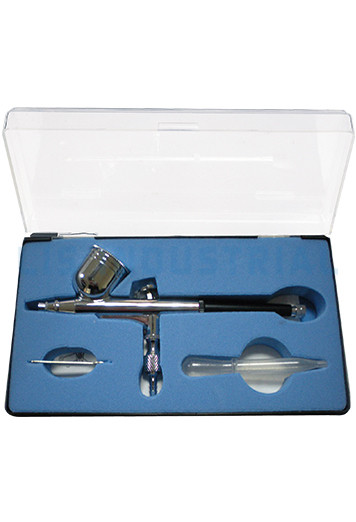
ABS-130 0.3mm 7CC Portable Air Brush Spray Gun For Handcrafter
Advantages of the 0.3 mm Nozzle
The nozzle is the point where the prepared coating and compressed air interact to form the spray. Its diameter influences the volume of material that can pass through, the achievable line width, the sensitivity to paint viscosity, and the overall character of the spray pattern.
A 0.3 mm nozzle offers several practical advantages. First, it provides a level of precision appropriate for small objects and detailed surfaces. Second, it can handle a broader range of craft applications than a nozzle intended exclusively for microscopic detail. Third, it gives experienced users room to vary their technique, from controlled lines to soft shading and small-area coverage.
For model makers, this balance can reduce the need to switch constantly between tools. A single 0.3 mm airbrush may be used for priming small components, applying base color, shading recessed areas, and adding selected highlights. Although specialized applications may still require different nozzle sizes, the ABS-130 is positioned as a versatile general-purpose solution.
The nozzle also works together with pressure control. At a lower pressure, the user can approach the surface carefully and build up color in thin layers. At a higher pressure, the spray may atomize more aggressively and cover a broader area. This does not mean that maximum pressure is always better. Successful results depend on balancing pressure, paint viscosity, distance, trigger control, and the absorbency or smoothness of the surface.
Compared with basic, poorly controlled spray tools, a purpose-designed 0.3 mm airbrush can help users achieve more predictable results. Consistent results are particularly important when a project includes repeated parts, matching colors, or layered finishes. A predictable tool reduces material waste and shortens the learning curve for new users.
Practical Benefits of the 7CC Cup
The 7CC cup capacity is appropriate for projects that require more than a few drops of material but do not justify the weight and bulk of a large reservoir. It allows the user to prepare a useful quantity of coating before spraying, which can be helpful when applying a continuous color layer or working on several small pieces in sequence.
A moderate cup size also supports color changes. Handcrafters frequently alternate between colors, shades, and transparent layers. A 7CC reservoir can hold enough material for a meaningful operation while remaining manageable when the cup needs to be emptied and cleaned. The user can prepare multiple colors separately and fill the airbrush as required, reducing the risk of mixing incompatible materials inside the tool.
Material economy is another benefit. Because the cup is not excessively large, users are less likely to prepare far more paint than the project requires. This can reduce leftover material, particularly when expensive specialty colors or custom-mixed shades are used. It also encourages a disciplined workflow in which the operator prepares only the quantity needed for the next stage.
Correct preparation remains essential. Paint should be mixed, filtered, and reduced according to the coating manufacturer’s instructions. Thick, poorly mixed, or contaminated materials can cause inconsistent spraying regardless of the quality of the airbrush. The operator should also avoid allowing material to dry in the cup or nozzle, as dried residue can affect atomization and increase cleaning time.
Working Pressure and Spray Control
The ABS-130 is specified for a working pressure range of 15–50 PSI. This range provides flexibility for different materials and techniques, but it should not be interpreted as a requirement to operate at the upper limit for every project. The correct pressure is the lowest setting that produces stable atomization and the desired finish under the current conditions.
Lower pressure can be useful when the operator wants to reduce overspray and maintain careful control. It may be appropriate for close-range detail work, thin layers, or sensitive surfaces. However, if the material is too thick or the pressure is too low, the spray may become uneven, sputter, or produce larger droplets.
Higher pressure can improve atomization for certain properly reduced coatings and may help the operator obtain more consistent coverage. Excessive pressure, however, can dry the material before it reaches the surface, increase overspray, disturb lightweight workpieces, or create an unwanted rough texture. Pressure should therefore be adjusted gradually rather than set automatically to the maximum value.
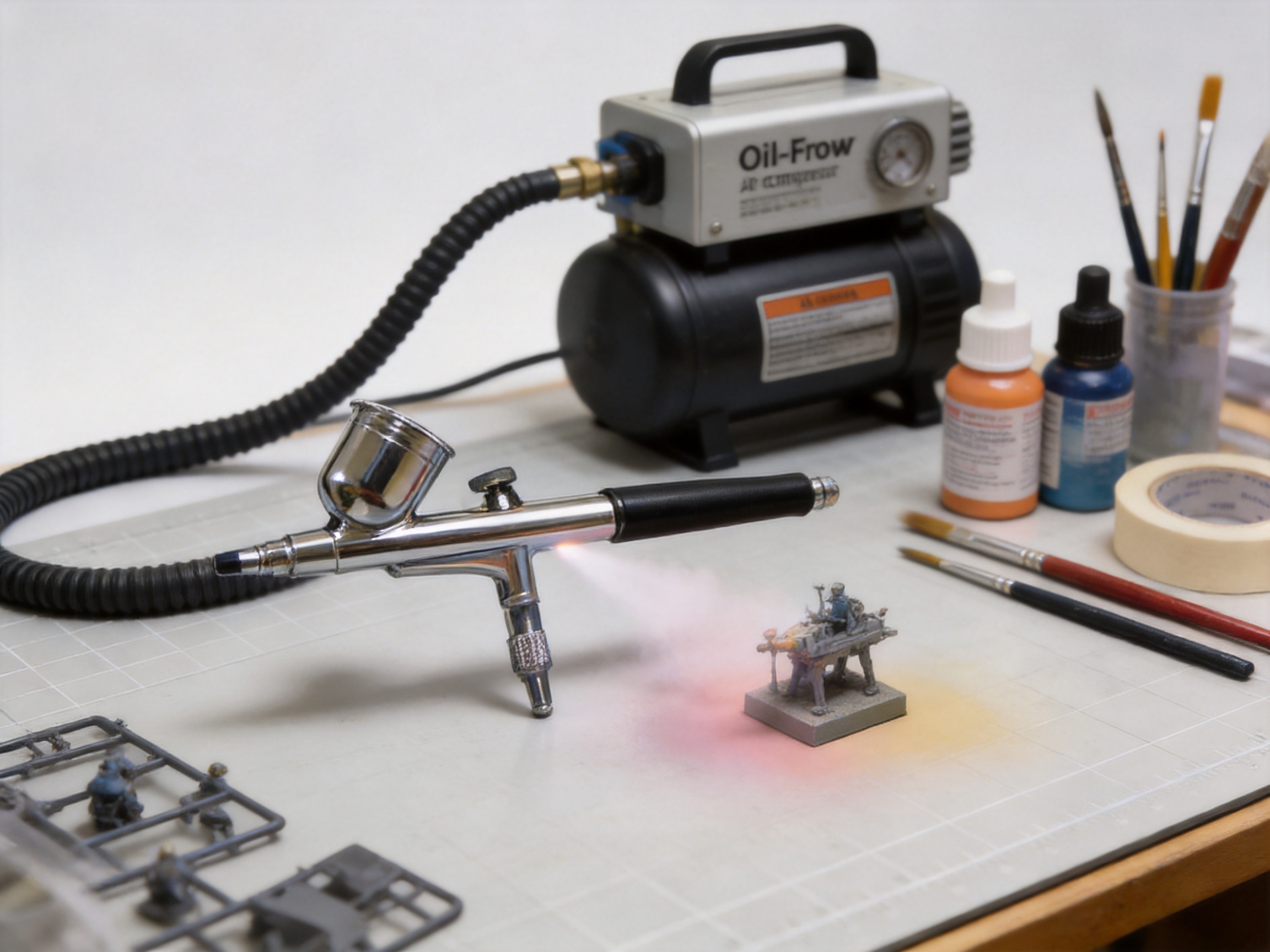
The air source is an important part of the complete system. A suitable mini oil-free compressor can provide convenient, clean air for airbrush work. A pressure regulator, moisture control, and compatible air hose or fittings can further improve consistency. The compressor should be selected to deliver stable airflow within the airbrush’s operating requirements. Fluctuating pressure can make it difficult to maintain consistent line width and color density.
Users should also work in a properly ventilated area and follow the safety instructions supplied with the coating. Respiratory protection, eye protection, gloves, and suitable extraction may be required depending on the material. The airbrush itself does not make an unsafe coating safe; responsible material handling remains essential.
Performance Compared with General-Purpose Alternatives
The ABS-130 occupies a different performance category from a full-size conventional spray gun. Conventional guns are designed for larger material volumes, wider spray patterns, and faster coverage. They are valuable for vehicles, furniture, doors, walls, and production work, but their size and output can be excessive for small handcrafting projects.
Compared with a larger spray gun, the ABS-130 offers better portability and finer control for small surfaces. It can reduce the risk of flooding a small component with too much material and can help the operator work closer to the desired detail. It also requires less workspace and is easier to store between projects.
Compared with a simple aerosol can, the airbrush offers greater control over color application and can use prepared coatings selected by the user. The operator can vary the pressure and technique rather than relying on a fixed spray pattern. This supports gradual layering, custom color mixing, and more controlled finishing.
Compared with an ultra-fine airbrush, the 0.3 mm configuration can be more adaptable for general craft use. It may be less specialized for the smallest possible lines, but it can offer a more practical compromise between detail and coverage. For many users, versatility is more valuable than extreme specialization.
Compared with low-cost, poorly manufactured tools, a product made through controlled industrial processes can provide more dependable dimensional accuracy, component compatibility, and functional consistency. These factors influence nozzle alignment, trigger response, air sealing, material delivery, and cleaning behavior. A reliable basic tool can be more economical over time than a cheaper product that produces inconsistent results or requires frequent replacement.
| Comparison Point | ABS-130 Portable Airbrush | Large Conventional Spray Gun | Ultra-Fine Detail Airbrush |
|---|---|---|---|
| Typical work scale | Small to medium craft projects | Medium to large surfaces | Very small and highly detailed work |
| Nozzle balance | Versatile 0.3 mm configuration | Higher material output | Usually optimized for extremely fine lines |
| Portability | High | Lower | High |
| Material use | Moderate and controllable | Higher volume | Low volume |
| Learning flexibility | Suitable for developing multiple techniques | Better for broad application methods | Best for specialized detail control |
Manufacturing Experience and Industrial Capability
The product is supported by the manufacturing background of Ningbo Lis Industrial Co., Ltd., which has been engaged in the development, production, and marketing of air painting spray guns, mini air compressors, and related air tools since 1984. Over time, the company has expanded into a large-scale production organization with more than 400 employees and a site covering more than 400,000 square feet.
This industrial scale matters because spray equipment requires coordination among design, material selection, machining, assembly, testing, packaging, and after-sales support. A company with experience across multiple categories can apply knowledge gained from professional spray guns, airbrushes, compressors, fittings, automatic spray equipment, and other tools to the development of compact products.
The company reports annual output exceeding 40 million United States dollars and an ability to increase production capacity by 30 percent within two months. For distributors and importers, this capacity can be important when demand changes or when a product must be supplied in different purchase quantities. Consistent production planning can also support more stable delivery schedules and reduce the risk associated with relying on a very small manufacturing source.
The company’s product range includes several international standards and product categories. This broad experience indicates familiarity with different market expectations, connection systems, packaging requirements, certification processes, and application environments. For buyers serving multiple regions, an established manufacturer may be able to provide related equipment and accessories through one supply relationship.
Research and development is another stated strength. The company maintains an R&D team and provides OEM services based on customer drawings or samples, as well as ODM services based on customer requirements. This capability can be useful for wholesalers, brands, distributors, and professional users who need changes to appearance, packaging, specifications, or product configuration.
Quality Control from Incoming Material to Finished Product
Spray gun performance depends heavily on small details. A slight dimensional variation in a nozzle, needle, air passage, seal, or threaded connection can affect the final result. For this reason, a complete quality system must address more than visual appearance. It must also verify fit, function, air behavior, material delivery, and finished-product reliability.
According to the supplied company information, the manufacturer applies quality control throughout the production process. This includes raw material and incoming inspection, in-process quality control, functional testing, and final quality inspection. Such a sequence is valuable because it can identify problems at the earliest practical stage rather than allowing defects to pass through assembly and packaging.
Incoming inspection helps confirm that purchased materials and components meet the required specifications before they enter production. In-process controls can monitor assembly accuracy, component installation, surface condition, and other manufacturing characteristics. Functional testing can verify whether the assembled airbrush operates as intended. Final inspection provides a last review before shipment.
The company also states that its products have passed CE and GS certifications. Certification requirements vary according to product type and destination market, and buyers should confirm the exact certification documentation applicable to the specific model and order. Nevertheless, experience with recognized certification systems demonstrates an established approach to compliance, documentation, and product evaluation.
The manufacturer further reports experience with ISO9001 quality management, ISO14001 environmental management, and OHSAS18001 occupational health and safety management systems. These systems address different aspects of organizational control. Quality management supports repeatable processes, environmental management addresses environmental responsibilities, and occupational health and safety management focuses on workplace risks and employee protection.
For an airbrush buyer, the practical value of these systems is consistency. A controlled process can reduce variation between production batches, support traceability, and make it easier to investigate problems. It can also provide distributors with greater confidence when developing long-term product programs rather than making one-time purchases.
Engineering and Product Development Strengths
The manufacturer’s engineering capability is relevant to the ABS-130 because a compact airbrush requires careful integration of multiple functions within a small body. The air path must support stable airflow, the material path must allow controlled delivery, and the nozzle assembly must be manufactured and fitted accurately. The trigger and operating mechanism must respond smoothly enough for users to regulate the spray during detailed work.
Product development also involves user considerations. A handcrafting tool should be comfortable to hold, simple enough to learn, and practical to clean. Its capacity should be appropriate for the intended work, and its connections should be compatible with the supporting air system. These needs are not solved by nozzle size alone. They require attention to the complete product architecture.
Experience in professional spray equipment can help a manufacturer understand atomization, pressure regulation, coating behavior, surface preparation, and production durability. Knowledge from larger spray guns can be adapted to smaller tools, while experience with mini compressors and air fittings can support the development of complete airbrush systems.
OEM and ODM support also indicates that the manufacturer can work with customers beyond standard catalog products. A distributor may require a private-label package, a specific color, a customized instruction manual, a modified accessory set, or a market-specific presentation. The feasibility of any requested change should be reviewed with the manufacturer, but the presence of dedicated development resources is a positive foundation.
Applications for the ABS-130
Model Making
Model makers can use a 0.3 mm airbrush for base coats, camouflage patterns, shading, weathering, panel effects, and selected detail work. The operator can build color gradually, which is useful when the surface includes small raised or recessed features. Thin layers may help preserve the appearance of fine details that could be hidden by heavy application.
Miniature Painting
Miniature figures and small decorative objects often contain complex shapes that are difficult to coat evenly with a brush or aerosol. The ABS-130 can help apply controlled color to curved surfaces and recessed areas. Brush finishing may still be needed for the smallest highlights, but the airbrush can efficiently establish foundations, shadows, and soft transitions.
Craft and Decorative Projects
Handmade boxes, ornaments, small panels, decorative components, and mixed-media projects can benefit from an adjustable spray tool. The airbrush can apply solid colors, translucent layers, and gradual effects when compatible materials are correctly prepared. Users can also mask portions of a surface to produce clean boundaries and patterns.
Artwork and Illustration
Artists may use the product for backgrounds, gradients, atmospheric effects, lettering support, and controlled color transitions. The 0.3 mm nozzle is suitable for users who want both detail and coverage in one compact tool. Paper, board, canvas, plastic, wood, and other surfaces may require different preparation and coatings, so testing on a sample is recommended.
Small-Area Touch-Up Work
The airbrush can be useful for selected small-area refinishing and touch-up tasks when the coating is compatible and the finish requirements are appropriate. It is not intended to replace a high-output professional spray gun for large surfaces, but it can help users address localized areas without setting up a full-size painting system.
Educational and Training Use
Because of its portable format and moderate specifications, the ABS-130 may also be suitable for training environments, craft schools, workshops, and demonstrations. Learners can practice pressure control, distance, movement, masking, color layering, and equipment cleaning. Proper ventilation and supervision remain necessary, especially when coatings contain solvents or other hazardous ingredients.
Recommended Operating Practices
Before spraying, inspect the airbrush, hose, air source, cup, nozzle area, and trigger mechanism. Confirm that connections are secure and that the air supply is clean and stable. Prepare the coating according to its technical instructions, then test the spray on a disposable surface or sample piece.
Start with a moderate pressure and make small adjustments. If the spray sputters, check material viscosity, paint filtration, nozzle cleanliness, air pressure, and the condition of the needle or nozzle assembly. If the result is too dry or rough, the pressure, material reduction, distance, or movement speed may need adjustment. If the surface becomes wet or uneven, reduce the amount of material and build the finish in thinner passes.
Keep the airbrush moving when the trigger is delivering material. Holding the spray in one place can create runs, heavy spots, or uneven color. For broad small-area coverage, use overlapping passes while maintaining a consistent distance from the surface. For detail work, practice on a test surface to understand how line width changes with distance and trigger control.
Masking can expand the product’s capabilities. Tape, film, paper, liquid masking products, and temporary shields can help define edges and protect surrounding surfaces. The masking method should be selected according to the substrate and coating. Delicate surfaces may require low-tack materials to prevent lifting or damage.
After use, remove remaining material promptly and clean the cup, nozzle area, and fluid path according to the coating manufacturer’s instructions. Different coatings may require different cleaning agents. Never assume that a solvent is safe for every seal, finish, or component. If the airbrush will be stored for an extended period, ensure that it is clean and dry before storage.
Maintenance and Service Life
Regular maintenance helps preserve spray quality. The most important maintenance task is preventing dried coating from accumulating in the nozzle and material passage. Even a small amount of residue can change the spray pattern or cause intermittent blockage. Cleaning should be performed after each use, with additional attention after using fast-drying or heavily pigmented materials.
Users should handle the nozzle and needle carefully. These components are precision parts, and bending, scratching, or cross-threading can affect operation. When disassembling the airbrush, work over a clean surface where small components cannot be lost. Follow the product instructions for the correct order of removal and reassembly.
Air connections should be checked periodically for leaks. A leak can reduce effective pressure and make the compressor work harder. It can also create unstable spraying. Inspect hoses and fittings for cracks, damaged threads, or loose connections, and replace unsuitable components with compatible parts.
Storage conditions also matter. Keep the airbrush in a clean, dry location protected from dust, impact, extreme temperatures, and unauthorized handling. If the product is used in a shared studio or classroom, establish a cleaning and storage routine so that the tool is ready for the next operator.
Correct use and maintenance can extend the practical service life of the airbrush. The manufacturer’s broader experience with air tools and spraying equipment supports the availability of related accessories and technical knowledge, although users should confirm the availability and compatibility of replacement parts for their specific order.
Packaging and Distribution Value
The ABS-130 is packed at 10 pieces per carton, with a carton size of 24.5 × 21 × 20 cm. This compact packing arrangement can support distributors, retailers, workshop suppliers, and online sellers that need a manageable stock unit. The carton quantity allows purchasers to test market demand, maintain inventory, or combine the product with mini compressors and airbrush accessories.
Compact logistics can reduce storage requirements compared with larger spray guns. Retailers can display the product in a tools, hobby, art, or craft section without dedicating the space required for industrial equipment. Distributors can also include it in a broader range of spraying products, creating opportunities for cross-selling hoses, fittings, compressors, cleaning accessories, paint containers, and protective equipment.
For business customers, packaging should be evaluated together with labeling, manuals, language requirements, product identification, and destination-market compliance. The manufacturer’s OEM and ODM capabilities may allow packaging or presentation adjustments, subject to technical review, order quantity, and commercial agreement.

Why Manufacturer Experience Matters to Buyers
Purchasing an airbrush is not only a decision about the product’s headline specifications. Buyers also need to consider manufacturing stability, quality systems, technical support, production capacity, certifications, customization capability, and long-term supply. A reliable specification is valuable, but a reliable supply relationship can be equally important for distributors and professional users.
Ningbo Lis Industrial Co., Ltd. has operated in the spraying equipment field since 1984 and has developed international brands including Voylet and Muzi. The company’s reported customer base extends across Europe, North America, the Middle East, South Africa, and East Asia. This international market experience can help the manufacturer understand the different expectations of importers, distributors, contractors, workshops, and end users.
The company also reports cooperation with Wagner Spray Tech Corp. and technical cooperation with American spraying technology specialists. Such cooperation, as described in the supplied information, reflects an emphasis on technical development and industry knowledge. Buyers should request current documentation and verify the exact scope of any cooperation, certification, or market authorization relevant to their transaction.
The manufacturer’s stated mission emphasizes continuous design innovation, high-quality products, professional service, and value creation for global customers. Its vision focuses on serving worldwide and domestic painting needs through professional products, services, and solutions. These goals align with the needs of buyers who are looking for more than a single shipment and want a supplier capable of supporting a complete spraying product program.
Selection Guidance for Different Users
For a beginner, the ABS-130 can be a useful entry point when the user wants more control than a brush or aerosol can provides. Beginners should start with simple, low-risk practice exercises, use properly reduced material, and learn to clean the airbrush after every session. A mini oil-free compressor with pressure regulation can make the system easier to manage.
For an experienced hobbyist, the 0.3 mm nozzle can serve as a versatile everyday tool. It may be used for base coating, shading, detail work, and small-area finishing. Experienced users may combine it with other nozzle sizes when a project demands very broad coverage or extremely fine lines.
For a retailer, the product can fill the space between basic craft sprayers and professional full-size spray guns. Its compact specifications are easy to communicate, and the product can be presented as part of a complete airbrush solution that includes an air source, hose, fittings, cleaning tools, and compatible coatings.
For a distributor or private-label customer, the manufacturer’s production scale, quality-control system, and OEM or ODM capability may be important advantages. Before placing an order, the buyer should confirm minimum order quantity, lead time, packaging, labeling, available accessories, inspection procedures, certification documents, and after-sales arrangements.
For an educational institution, the product’s moderate size and portable format may simplify storage and handling. However, the institution should establish clear rules for ventilation, coating selection, cleaning, compressor operation, personal protective equipment, and supervision.
Limitations and Responsible Expectations
The ABS-130 is a portable airbrush, not a replacement for every type of spray equipment. Its 7CC cup and 0.3 mm nozzle are optimized for small and moderate applications rather than large-area, high-speed production. Users who need to cover vehicles, furniture, walls, industrial components, or extensive panels should consider a suitable HVLP, conventional, airless, or electric spray system.
Performance also depends on the air source and coating. A high-quality airbrush cannot compensate for unstable compressor output, excessive moisture, unsuitable paint viscosity, contamination, or poor surface preparation. Buyers should consider the entire system rather than evaluating the spray gun in isolation.
The product should be used only with materials that are compatible with the airbrush and safe for the intended application. Coatings may contain solvents, pigments, resins, or additives that require specific ventilation and protective equipment. Users should consult the material safety information supplied by the coating manufacturer.
Finally, certification and market requirements should be confirmed for the exact model, configuration, and destination. Product documentation may change over time, and requirements can differ between countries. Professional buyers should request current technical files and compliance information before commercial distribution.
Frequently Asked Questions
What is the ABS-130 airbrush mainly used for?
The ABS-130 is mainly intended for handcrafting, model making, miniature painting, artwork, decorative finishing, and small-area touch-up work. Its portable format and 0.3 mm nozzle make it suitable for controlled application on small and moderately sized surfaces.
What does the 0.3 mm nozzle mean?
The 0.3 mm measurement refers to the nozzle diameter. This size provides a balance between fine control and practical coverage. It is more versatile than an extremely fine detail nozzle and more precise than a larger general-purpose spray nozzle.
How much material does the cup hold?
The cup capacity is 7CC. This provides a moderate quantity of material for craft projects and small-area finishing while keeping the airbrush compact and portable.
What pressure should be used?
The specified working pressure range is 15–50 PSI. The correct setting depends on the coating, viscosity, surface, spray distance, and desired result. Users should begin at a moderate pressure and adjust gradually while testing on a sample surface.
Can the ABS-130 spray every type of paint?
No. Coating compatibility depends on the material formulation, viscosity, solvent system, and the construction of the airbrush. Users should follow the coating manufacturer’s instructions, filter and reduce material when appropriate, and confirm that cleaning agents are compatible with the airbrush components.
Is a compressor required?
An air source is required for operation. A compatible mini oil-free compressor is a practical option for many airbrush applications. The compressor should provide stable pressure and airflow within the airbrush’s specified working range.
Is the product suitable for large surfaces?
The ABS-130 is better suited to small and moderate surfaces. It can be used for selected small-area finishing, but a larger HVLP, conventional, airless, or electric spray system is generally more efficient for extensive surfaces and high-volume work.
How should the airbrush be cleaned?
Clean the airbrush immediately after use according to the coating manufacturer’s instructions. Remove remaining material, flush the fluid path with a compatible cleaning solution, and pay particular attention to the nozzle and needle area. Do not use a cleaning chemical that may damage seals, finishes, or other components.
What quality systems does the manufacturer report?
The supplied company information states that the manufacturer follows ISO9000 quality-system requirements and has experience with ISO9001, ISO14001, and OHSAS18001 management systems. It also reports CE and GS product certifications. Buyers should request current documentation for the exact product and destination market.
Can the product be customized?
The manufacturer reports OEM services based on customer drawings or samples and ODM services based on customer requirements. Potential customization may include packaging, branding, appearance, or configuration, but details should be confirmed according to order quantity, technical feasibility, and commercial terms.
How is the product packed?
The stated carton packing is 10 pieces per carton. The carton size is 24.5 × 21 × 20 cm. Buyers should confirm final packing details, labeling, and shipping specifications before placing a production order.
What should a buyer ask before ordering?
A buyer should confirm the exact nozzle and cup configuration, working pressure, available accessories, material compatibility, product documentation, certifications, packaging, minimum order quantity, production lead time, inspection standards, warranty terms, replacement parts, and after-sales support.
Conclusion
The ABS-130 0.3 mm portable airbrush spray gun is designed as a flexible tool for handcrafting, model work, artwork, miniature finishing, and small-area spraying. Its 0.3 mm nozzle offers a useful balance between precision and coverage, while the 7CC cup supports practical project work without making the tool unnecessarily bulky. The 15–50 PSI operating range gives users the ability to adjust spray behavior for different techniques and materials.
Its principal advantage over larger spray equipment is portability and control. Its principal advantage over highly specialized ultra-fine tools is versatility. For users who need one compact airbrush for a broad range of creative and decorative tasks, the ABS-130 provides a sensible configuration.
The product is also supported by a manufacturer with decades of experience in spraying equipment, a broad industrial product portfolio, reported international certifications, structured quality control, engineering resources, OEM and ODM capabilities, and substantial production capacity. These strengths can benefit both individual users and commercial buyers seeking dependable supply, consistent manufacturing, and access to related air tools and accessories.
When paired with a suitable compressor, properly prepared coating, responsible operating practices, and regular cleaning, the ABS-130 can become an effective part of a compact finishing system. Its performance is ultimately determined by the interaction of product quality, material preparation, air regulation, operator technique, and maintenance. Used within its intended application range, it offers a practical solution for controlled, portable, and economical airbrush spraying.
References
1. Product specification sheet for the ABS-130 portable airbrush spray gun, including nozzle diameter, cup capacity, working pressure, and carton information.
2. Manufacturer-provided company profile for Ningbo Lis Industrial Co., Ltd., including product categories, production history, quality systems, certifications, and research and development capabilities.
3. General principles of airbrush atomization, nozzle sizing, pressure regulation, coating preparation, and spray technique.
4. ISO 9001 quality management system principles and process-control practices.
5. ISO 14001 environmental management system principles.
6. Occupational health and safety management principles associated with OHSAS 18001 and related modern management standards.
7. General coating manufacturer guidance concerning ventilation, personal protective equipment, material compatibility, cleaning procedures, and safe handling.