 Search
 English
 中文简体
中文简体 Deutsch
 Español
Content
- 1 Introduction
- 2 Understanding the BG-2 Air Blowing Gun
- 3 Product Advantages in Daily Use
- 4 Advantages Over Basic or Lower-Quality Alternatives
- 5 Manufacturing and Engineering Strengths
- 6 Applications Across Different Industries
- 7 Technical and Purchasing Considerations
- 8 Manufacturing Process and Quality Assurance
- 9 Safe and Responsible Use
- 10 Maintenance and Service Practices
- 11 Why Choose an Experienced Manufacturer
- 12 Commercial Value for Distributors and Industrial Buyers
- 13 Comparison with Alternative Cleaning Methods
- 14 Recommended Selection Checklist
- 15 Q&A
- 15.1 What is the main purpose of the BG-2?
- 15.2 Does the BG-2 require an electric motor?
- 15.3 Can it be used for woodworking?
- 15.4 Can it be used to clean electronic components?
- 15.5 Is the BG-2 suitable for hazardous dust?
- 15.6 What type of air supply is recommended?
- 15.7 Can customers request different fittings?
- 15.8 Does the manufacturer support OEM and ODM projects?
- 15.9 What quality systems does the manufacturer report?
- 15.10 Can the BG-2 be included in a larger air-tool program?
- 15.11 How should users maintain the gun?
- 15.12 What should operators wear when using an air blowing gun?
- 16 Conclusion
- 17 References
- 18 Product: BG-2
Introduction
Clean, controlled air is essential in workshops, factories, garages, woodworking areas, vehicle repair facilities, and maintenance departments. Dust, chips, loose particles, moisture, and residue can quickly reduce work quality when they are not removed before the next production or repair step. A reliable air blowing gun provides a simple and efficient way to clear surfaces, workpieces, machines, tools, and hard-to-reach areas. The BG-2 Air Blowing Gun is designed for this practical purpose, offering a convenient handheld solution for users who need fast and controlled air cleaning.
Unlike improvised cleaning methods, an air blowing gun is designed to direct compressed air through a purpose-built body and nozzle. This design gives the operator better control, improved access, and a more consistent cleaning process. The BG-2 belongs to the air blowing gun category and can be used wherever a compressed-air line or suitable compressor is available. Its role may appear straightforward, but the quality of the gun has a direct influence on comfort, operating efficiency, air control, service life, and overall workplace productivity.
The product is manufactured by Ningbo Lis Industrial Co., Ltd., an experienced Chinese producer of air painting spray guns, air tools, mini air compressors, and related spraying equipment. Since its establishment in 1984, the company has developed substantial experience in product engineering, manufacturing, quality management, and international supply. Its manufacturing capabilities support both branded products and customer-specific OEM and ODM programs.
This article examines the BG-2 Air Blowing Gun in detail. It explains its operating purpose, construction considerations, practical benefits, application areas, maintenance requirements, purchasing factors, and the manufacturing strengths behind the product. It also compares the advantages of a professionally developed air blowing gun with lower-quality alternatives and includes a question-and-answer section for buyers, distributors, maintenance teams, and industrial users.
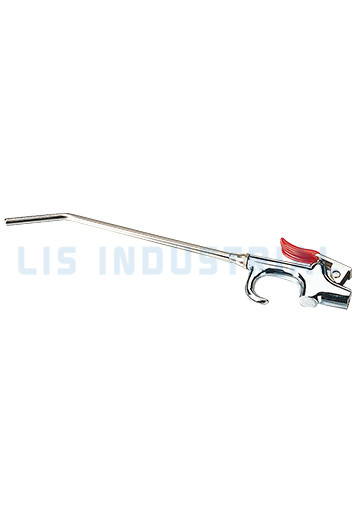
BG-2
Understanding the BG-2 Air Blowing Gun
The BG-2 is a handheld compressed-air cleaning tool. Its basic function is to transform air supplied by a compressor or air pipeline into a focused stream that can remove unwanted particles from a target surface. Depending on the application, the user may direct the air stream across a bench, blow dust from a machine, remove loose chips from a workpiece, or clean recesses that are difficult to reach with a cloth or brush.
The operating principle is simple. The tool is connected to an appropriate air source through an air fitting or hose. When the trigger is pressed, compressed air passes through the internal air path and exits through the outlet. Releasing the trigger stops or reduces the air flow, allowing the operator to control the cleaning action without repeatedly disconnecting the hose.
A well-designed blowing gun must balance several factors. The air passage should support effective delivery without unnecessary restriction. The trigger should be comfortable and responsive. The body should withstand regular workshop use. The connection should be compatible with the intended air system. The overall form should be easy to hold, especially when the operator must clean a large area or work in awkward positions.
The BG-2 is suitable for general air-blowing tasks where a compact manual tool is preferred. It is not intended to replace specialized extraction systems, dust collection systems, or hazardous-material removal equipment. Instead, it provides a practical method for routine cleaning and preparation when used with suitable compressed air and appropriate workplace controls.
Typical operating sequence
Before use, the operator should inspect the gun, hose, air fitting, and surrounding work area. The air source should be adjusted according to the requirements of the application and the instructions supplied with the equipment. The nozzle should be directed away from people, animals, sensitive components, and unprotected skin. The operator can then press the trigger gradually to apply the required air flow.
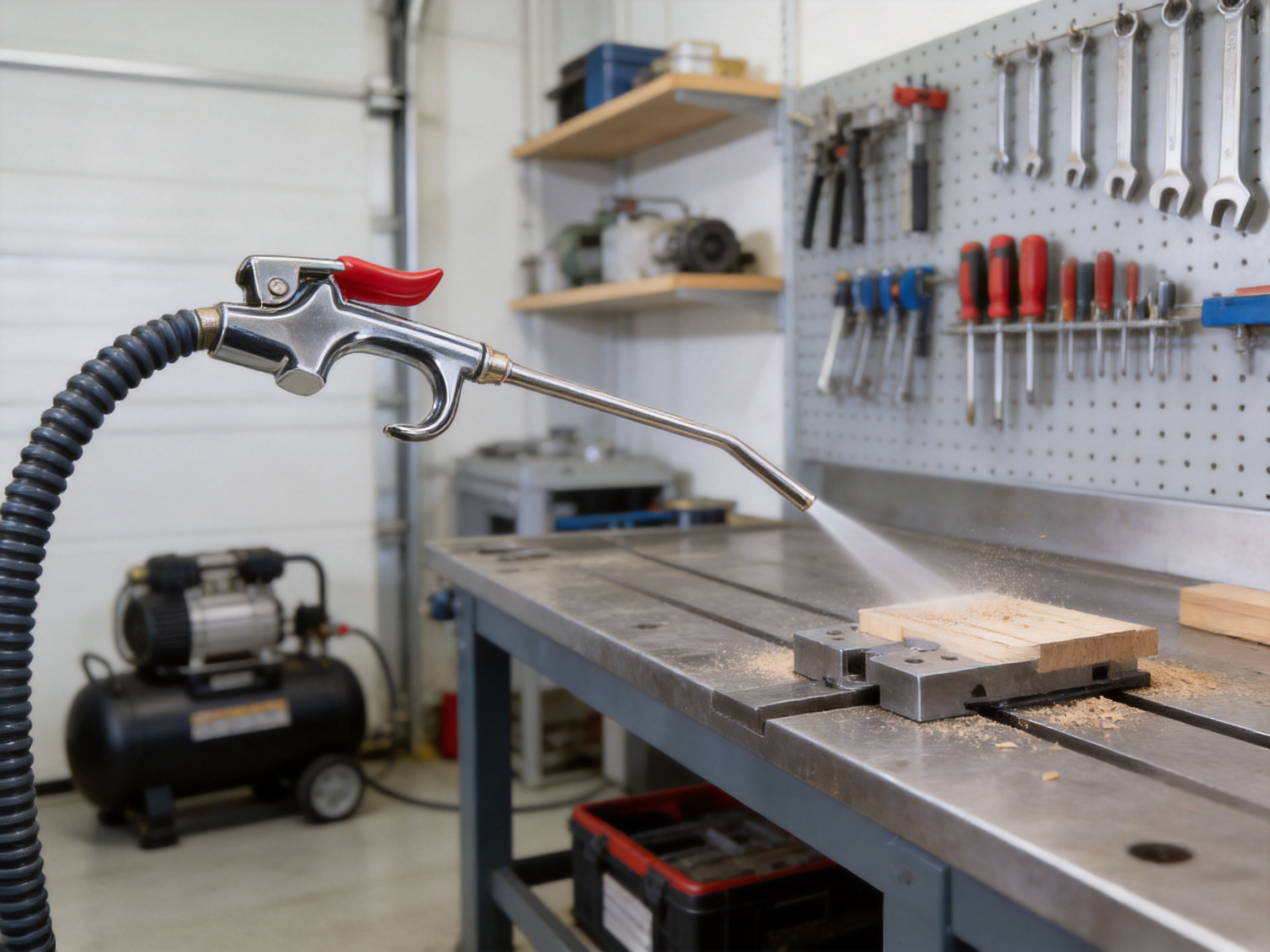
For light dust, a moderate air stream is generally sufficient. For heavier chips or debris, the operator may need to adjust the distance, angle, or duration of the air application rather than simply increasing pressure. Blowing from a shallow angle can help move particles across a surface, while direct application may be useful for clearing deep recesses. Good technique improves cleaning results and reduces unnecessary air consumption.
Common materials removed
The BG-2 can be used for ordinary non-hazardous debris such as sawdust, loose dust, metal chips, plastic particles, grinding residue, and dry surface contamination. It may also be useful after drilling, cutting, sanding, machining, assembly, or general workshop maintenance.
Users must evaluate the material before applying compressed air. Air blowing may spread harmful dust, combustible particles, chemical residue, asbestos-containing material, biological contaminants, or other dangerous substances. In such cases, a suitable extraction or containment method should be used instead of unrestricted air blowing.
Product Advantages in Daily Use
Fast surface cleaning
One of the main advantages of an air blowing gun is speed. A cloth or brush may require repeated contact with a surface, while compressed air can remove loose particles across a wider area in a short period. This is especially valuable in production environments where workpieces must be cleaned between operations.
The BG-2 allows an operator to move from one cleaning point to another without changing tools. Its handheld format is convenient for benches, machines, fixtures, assemblies, vehicle components, and general maintenance tasks. The ability to apply air only when the trigger is activated also supports more controlled operation than an open-ended hose.
Access to difficult areas
Dust and chips frequently collect in grooves, holes, corners, recesses, joints, and around mechanical components. These areas can be inconvenient to clean manually. The directed air stream from the BG-2 helps the user reach spaces where a cloth may not fit and where a brush may fail to remove loose particles.
For woodworking, the tool can help clear dust from work surfaces, tool tables, jigs, and components before inspection or finishing. In mechanical work, it can assist with removing loose debris from housings, fixtures, and non-sensitive assemblies. In general maintenance, it can support cleaning around fasteners, brackets, and equipment surfaces.
Improved workpiece preparation
Surface preparation affects the quality of many processes. Before painting, coating, bonding, assembly, inspection, or packaging, loose dust should be removed. The BG-2 can help create a cleaner starting surface when used as part of a complete preparation procedure.
For painting operations, compressed-air cleaning should be coordinated with the coating process. The operator should ensure that the air source is clean and properly maintained, because oil, water, and compressor contamination can damage a prepared surface. Air blowing alone cannot replace filtration, drying, degreasing, or other preparation steps, but it can be an efficient part of the overall workflow.
Operator control
A trigger-operated gun gives the user immediate control over air delivery. This allows the operator to start and stop the air stream as needed, which can reduce unnecessary noise and wasted compressed air. It also makes it easier to respond to changes in the workpiece or cleaning area.
Control is particularly important when working near delicate components. Rather than leaving a hose running continuously, the operator can apply short bursts and observe the result. The exact control available depends on the air supply, internal design, connection, and operator technique, but a purpose-built gun generally provides better handling than a loose hose end.
Compact and versatile format
The BG-2 can be stored easily and moved between workstations. It does not require a dedicated electrical motor at the point of use, which makes it suitable for environments that already have compressed-air infrastructure. It can support small workshops as well as larger facilities with multiple air points.
Its versatility also makes it useful as a supplementary tool. A workshop may use spray guns for coating, air polishers for finishing, tyre inflating guns for vehicle service, and air blowing guns for cleaning. A broad air-tool portfolio allows each task to be performed with an instrument designed for that specific function.
Advantages Over Basic or Lower-Quality Alternatives
Many low-cost air blowing tools may appear similar at first glance, but differences in materials, internal machining, assembly control, trigger design, air sealing, and inspection can become visible during repeated use. A professional product should be evaluated not only by its initial purchase price but also by its reliability, operating consistency, ease of use, and suitability for the intended environment.
Purpose-built air passage
A professionally developed blowing gun is engineered around the movement of compressed air. Internal passages, sealing points, connection areas, and outlet geometry all influence performance. Poorly finished passages or inconsistent components can create unnecessary restriction, irregular air delivery, leakage, or premature wear.
The BG-2 benefits from the experience of a manufacturer whose product range includes spray guns and other compressed-air tools. This background is relevant because spray equipment and air blowing tools share important engineering requirements, including controlled air paths, durable bodies, dependable trigger mechanisms, and accurate assembly.
More consistent production
Consistency is important when a product is purchased for a fleet of workstations or distributed through an international supply network. A buyer expects units from the same order to have similar fit, function, connection quality, and appearance. Standardized production and inspection help reduce variation between individual tools.
Ningbo Lis Industrial Co., Ltd. operates a large manufacturing facility covering more than 400,000 square feet and employs more than 400 people. Its scale supports dedicated production, engineering, quality, purchasing, and service functions. The company reports annual output exceeding 40 million United States dollars and has the capacity to increase production by approximately 30 percent within two months when customer demand requires additional supply.
Quality control beyond visual inspection
Visual inspection is useful, but it cannot identify every problem. Air tools require functional checks to confirm that the trigger, air path, connection, and sealing elements operate correctly. The company states that its quality system includes raw-material control, incoming inspection, process quality control, 100 percent functional testing, and final inspection of finished products.
Such a process is valuable for air blowing guns because small defects can affect daily usability. A minor leakage point, a poorly fitted component, or an inconsistent trigger can become a repeated source of lost time. Functional testing before shipment helps identify problems before products reach the customer.
Support for professional supply programs
Distributors, importers, equipment brands, and industrial buyers may require more than a standard product. Packaging, labeling, product configuration, fittings, documentation, and production quantities may need to match a specific market or sales channel. A manufacturer with OEM and ODM experience can provide a more complete supply solution.
Ningbo Lis Industrial Co., Ltd. offers OEM production based on customer drawings or samples and ODM services based on customer requirements. This capability can be useful for companies developing private-label air tools, assembling product kits, or expanding an existing catalog with a compatible air blowing gun.
Manufacturing and Engineering Strengths
Long-term industrial experience
The company was established in 1984 and has focused on air painting spray guns, mini air compressors, and related air tools. Long-term operation in this field provides practical knowledge of materials, production techniques, customer expectations, certification requirements, and international distribution.
Experience is especially important for tools that must perform repeatedly in demanding environments. A product may be used by a professional painter, a vehicle technician, a woodworking operator, a factory worker, or a maintenance engineer. Each user values dependable operation, but their working conditions and expectations may differ. A mature manufacturer is better positioned to identify these requirements during product development.
Research and development capability
The company maintains a strong research and development team and has established a spraying machinery engineering technology center. It has also conducted technical cooperation with American Wagner Spraying Technology Co., Ltd. This engineering background supports continued improvement in product design, manufacturing methods, and application solutions.
Although the BG-2 is a straightforward cleaning tool, its performance still depends on design details. The form of the body, trigger movement, air connection, sealing method, outlet, material selection, and production tolerances must work together. Research and development resources help transform basic functionality into a product that can be manufactured consistently and supported over time.
Integrated product portfolio
The manufacturer produces a broad range of equipment, including high-volume low-pressure spray guns, heavy-duty spray guns, woodworking low-pressure spray guns, conventional spray guns, texture paint spray guns, paraffin guns, air blowing guns, sandblast guns, foam guns, tyre inflating guns, water and grease guns, automatic spray guns, air brushes, mini oil-free compressors, air pipeline accessories, paint tanks, air fittings, air polishers, spray gun kits, touch-up spray guns, car polishing machines, airless spray guns, electric spray guns, and paint sprayers.
This portfolio creates useful synergies. Customers can source related products from one experienced supplier instead of coordinating multiple manufacturers for every air-tool category. It can also simplify compatibility planning, packaging, quality communication, technical support, and long-term purchasing.
International certification experience
The company reports that its products have passed CE and GS certifications. It also states that the factory has achieved ISO9001 quality management certification, ISO14001 environmental management certification, and OHSAS18001 occupational health and safety system certification. These certifications and recognitions demonstrate experience with formal management systems and international product requirements.
Certification does not eliminate the need for correct application, maintenance, or workplace safety. However, it gives buyers additional information when comparing suppliers. Businesses serving regulated or quality-sensitive markets may also value a supplier that understands technical documentation, product testing, traceability, and compliance procedures.
Applications Across Different Industries
Automotive repair and service
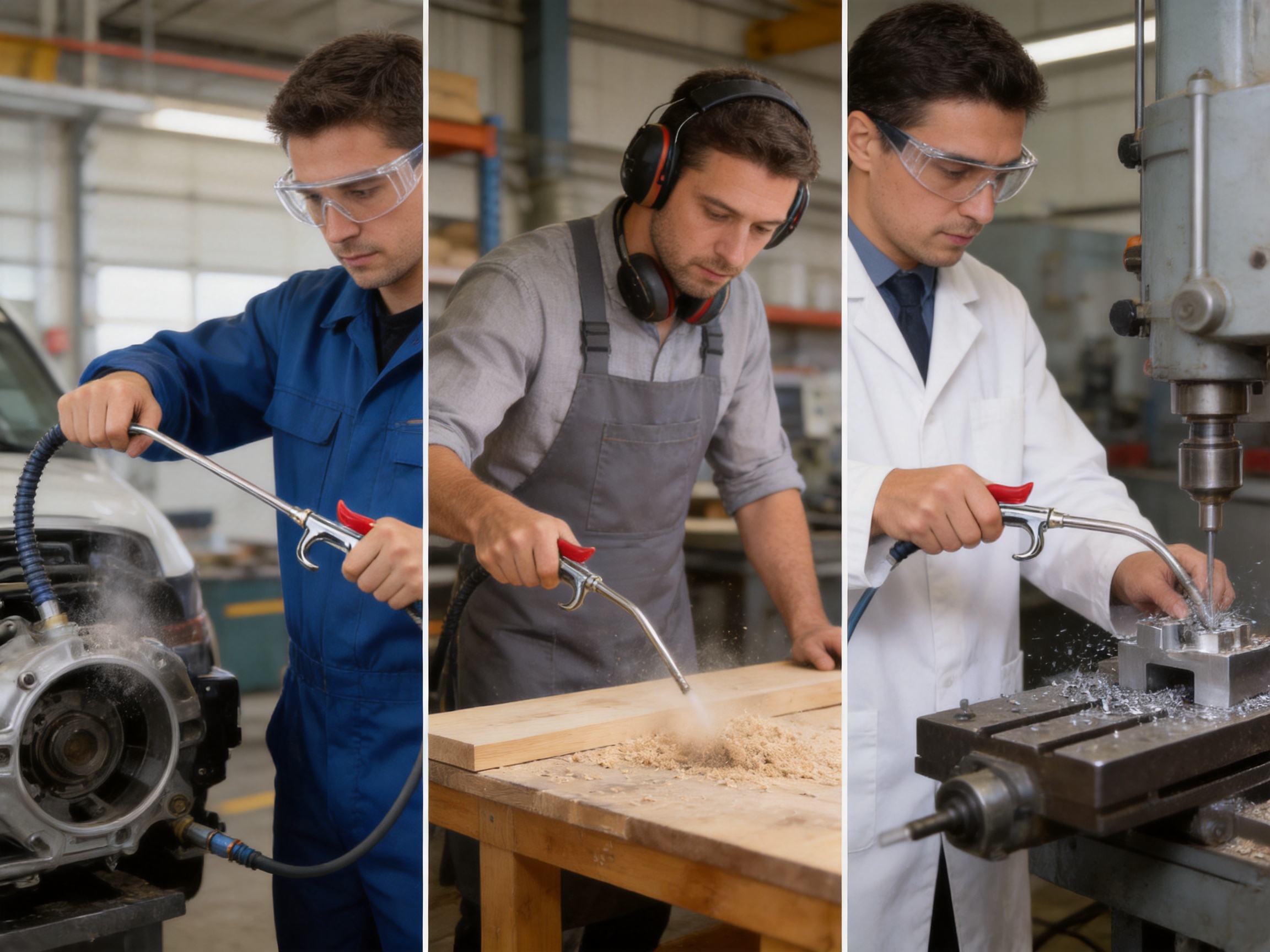
Vehicle workshops often need to remove dust, grinding particles, polishing residue, and loose debris from components and work areas. An air blowing gun can be used around non-sensitive surfaces, workbenches, engine-bay components, brake service areas, and general maintenance zones, provided the operator follows the vehicle manufacturer’s precautions.
When cleaning electronic control units, sensors, bearings, seals, or other sensitive parts, air pressure and contamination risks must be considered carefully. The air source should be clean and dry, and the operator should avoid forcing debris into sensitive assemblies.
Woodworking
Woodworking produces sawdust, shavings, and fine particles that can collect on benches, templates, tools, and finished pieces. The BG-2 can support final surface clearing, fixture cleaning, and removal of loose particles from areas that are difficult to reach with a vacuum nozzle.
Compressed air should not be treated as a replacement for local exhaust ventilation or an effective dust collection system. Fine wood dust can become airborne and may create respiratory, fire, or explosion hazards. The best practice is to use extraction at the source and reserve air blowing for controlled tasks where the risks have been assessed.
Metalworking and machining
Machining operations often leave chips and loose particles on workpieces, fixtures, tables, and machine surfaces. An air blowing gun can help clear a work area after cutting, drilling, tapping, or grinding. This can improve visibility and make inspection or measurement easier.
Operators should never direct compressed air at exposed skin or use it to clean clothing. Metal chips can travel at high speed and cause injury. Eye protection, suitable work clothing, guarding, and proper chip-management procedures remain essential.
Manufacturing and assembly
In assembly operations, the BG-2 can help remove loose particles before components are joined, inspected, packaged, or transferred to the next station. Clean surfaces can be important for adhesives, seals, coatings, electrical contacts, and precision fits.
The tool can also support line-side maintenance. A compact air blowing gun is easy to keep at a workstation, allowing operators to perform quick cleaning without taking the product to a separate maintenance area. Where several workstations use the same product, standardized tools can simplify training and replacement planning.
Painting and surface finishing
Before painting or finishing, dust removal is often necessary. The BG-2 can be used to clear a prepared surface, fixture, or surrounding work area. However, the air supply should be filtered and free of excess moisture and oil. A contaminated air stream may create defects such as fisheyes, adhesion problems, surface marks, or uneven coating results.
Users should also consider static electricity, paint-booth requirements, ventilation, and the properties of the material being removed. The gun is most effective when incorporated into a complete surface-preparation process rather than used as the only cleaning method.
General maintenance
Facilities teams can use air blowing guns for routine cleaning of non-sensitive equipment, storage areas, benches, fixtures, and tools. The portability of the BG-2 allows maintenance staff to carry it between locations. It may be connected to a fixed air line or a suitable portable compressor, depending on the environment and required air volume.
Technical and Purchasing Considerations
Buyers should evaluate the complete operating environment before selecting an air blowing gun. The product must be compatible with the available air source, hose, fitting system, pressure range, workplace rules, and cleaning requirements. A tool that is suitable for a small workshop may not be the best choice for a high-volume industrial line, while a heavy-duty industrial model may be unnecessary for occasional household maintenance.
| Evaluation area | Why it matters | Questions for buyers |
|---|---|---|
| Air source | The compressor or pipeline must provide suitable pressure and air volume. | What compressor capacity and working pressure are available? |
| Connection system | The fitting must match the hose and air-line accessories. | Is the required regional or customer-specific fitting available? |
| Cleaning material | Some dusts and residues require extraction or containment instead of open blowing. | Is the material non-hazardous and suitable for compressed-air cleaning? |
| Frequency of use | Frequent use places greater demands on durability and operator comfort. | Will the tool be used occasionally, daily, or continuously across multiple shifts? |
| Workplace safety | Air streams can propel particles and create excessive noise. | Are eye, hearing, respiratory, and machine-safety controls in place? |
| Supply requirements | Professional buyers may need documentation, packaging, and repeat production. | Can the supplier support volume, OEM labeling, and quality records? |
Air pressure and air volume
The actual cleaning effect depends on both pressure and air volume. Pressure influences the force available at the outlet, while volume affects how long and how broadly the air stream can operate. Users should follow the product instructions and avoid exceeding the rated limits of the tool, hose, fitting, or air system.
Higher pressure is not always the best solution. Excessive pressure can damage delicate parts, spread contaminants, increase noise, and waste energy. Correct nozzle distance and movement are often more effective than simply increasing pressure. A trained operator can achieve good results while using the minimum air required for the task.
Air quality
Compressed air may contain water, oil, rust particles, or residue from the compressor and pipeline. For ordinary cleaning, this may be inconvenient. For painting, electronics, precision assembly, and surface preparation, it can be unacceptable. Filters, separators, dryers, and regular drain procedures should be used when the application requires clean air.
Air quality also affects tool life. Moisture can contribute to corrosion, while contamination can interfere with valves, seals, and internal passages. A properly maintained air system supports both product performance and long-term reliability.
Fittings and regional standards
Air connections vary between markets and facilities. Buyers may work with Japan Standard, European Standard, United States Standard, or Great Britain Standard fittings. The company’s product range includes air fittings and accessories for different requirements, which can help customers plan a compatible system.
Before ordering, purchasers should confirm the fitting specification, thread type, hose size, and any adapter requirements. Correct matching reduces leakage and prevents delays during installation. For large orders, it is advisable to approve a sample connection before full production or shipment.
Packaging and documentation
Commercial users may require individual packaging, bulk packaging, instruction sheets, barcodes, warning labels, spare-part information, or private-label presentation. These requirements should be discussed before production. Clear documentation helps distributors and end users understand installation, safe use, maintenance, and limitations.
For OEM or ODM projects, buyers should also define product drawings, approved materials, inspection standards, sample approval procedures, logo placement, packaging artwork, and change-control requirements. Early communication reduces the risk of misunderstanding and supports more stable long-term supply.
Manufacturing Process and Quality Assurance
Material and component control
Product quality begins with material selection and component consistency. The body, trigger, seals, air fittings, internal passages, and other parts must be suitable for the intended application. Incoming inspection helps confirm that purchased components meet the required specifications before they enter production.
Material control is particularly important for tools used in industrial environments. Variations in dimensions or surface quality can affect assembly, sealing, comfort, and appearance. A formal inspection process helps reduce the chance that unsuitable components will continue through the production line.
Process control
Manufacturing quality is not created only at the final inspection stage. It must be controlled during molding, machining, finishing, assembly, and testing. Process control helps ensure that the product remains within approved tolerances and that recurring problems are identified early.
The company’s stated quality approach covers the complete system from raw materials and incoming inspection to in-process control, functional testing, and final inspection. This approach is valuable because air tools contain multiple interacting parts. A problem introduced during one operation may not be obvious until the product is connected to an air source.
Functional testing
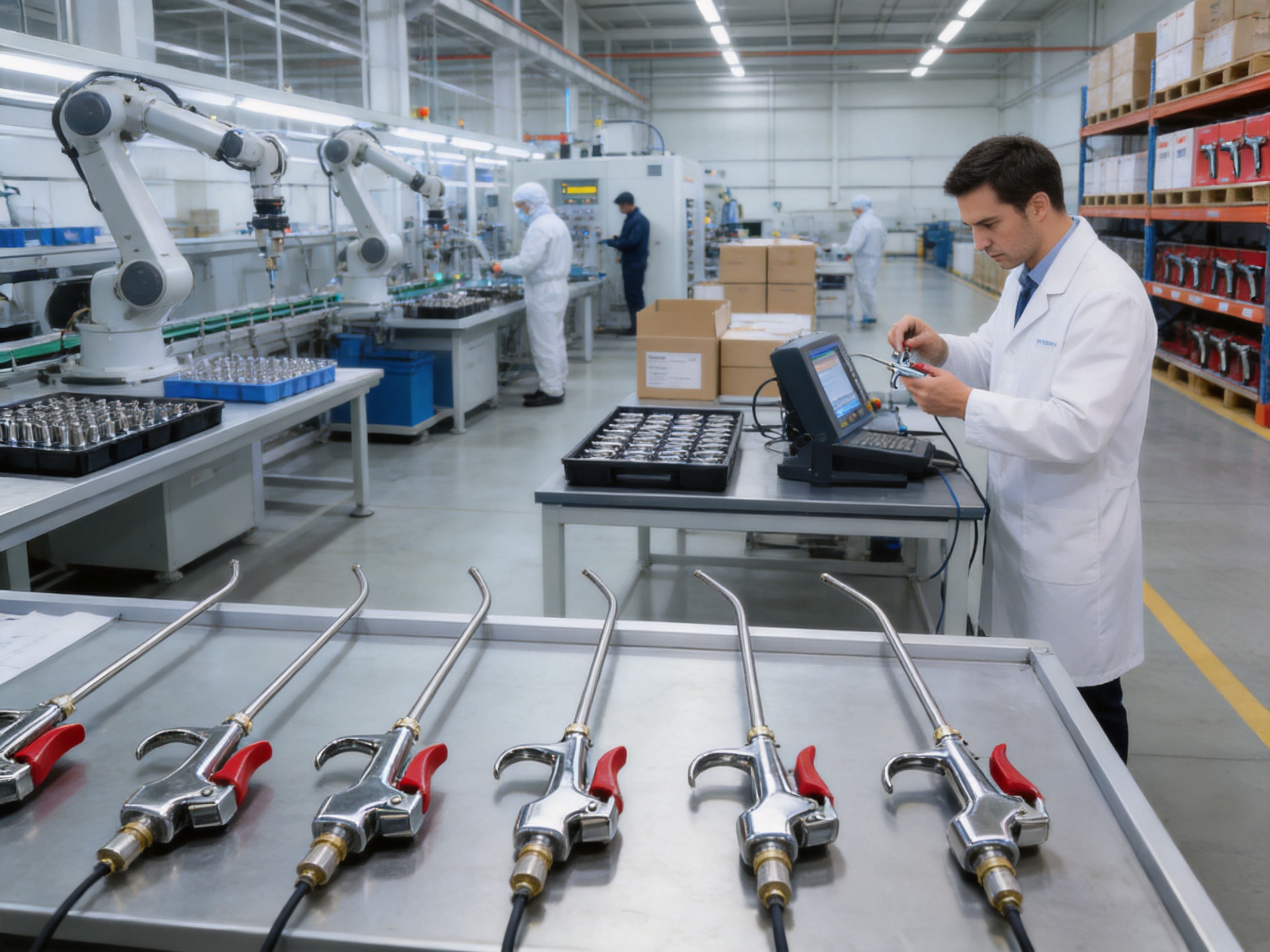
One of the strongest quality measures for an air blowing gun is functional testing. Each unit should be checked for basic operation, trigger response, air delivery, connection integrity, and leakage according to the applicable inspection standard. The manufacturer states that it performs 100 percent functional testing.
Testing every unit provides greater confidence than relying only on statistical sampling for core functions. It can also help protect the customer’s production schedule by reducing the number of tools that require troubleshooting after delivery.
Final inspection and traceability
Final inspection may include appearance, assembly, labeling, packaging, and functional confirmation. Traceability records can help identify production batches, inspection results, and material sources. These records are useful for quality improvement and for responding to customer questions.
For international buyers, traceability and documented inspection can also support internal supplier evaluations. Companies with formal procurement systems may require evidence of consistent quality, corrective action, and production control before approving a supplier.
Safe and Responsible Use
Compressed air can cause serious injury when misused. The BG-2 should never be pointed at a person, animal, or any part of the body. Operators should wear appropriate eye protection because chips and dust can become airborne. Hearing protection may be necessary where several air tools operate together or where workplace noise levels are high.
Compressed air should not be used to clean clothing, hair, skin, or body openings. It can force particles into tissue or create dangerous pressure. Operators should also avoid directing air toward bearings, seals, electrical connectors, or other components unless the equipment manufacturer permits this procedure.
Before cleaning machinery, users should consider lockout and isolation requirements. Moving parts can start unexpectedly, and air may drive loose components or contaminants into dangerous locations. The machine should be in a safe condition before the air blowing gun is used.
Dust management is another important consideration. Air blowing can spread particles rather than remove them from the workplace. For combustible dust, toxic materials, fine powders, or respiratory hazards, a suitable vacuum or extraction system should normally be preferred. Employers should conduct a risk assessment and follow applicable occupational safety regulations.
The air hose should be inspected for cuts, abrasion, swelling, loose connections, and other damage. The gun should not be used if the body, trigger, fitting, or outlet is cracked or deformed. Before disconnecting the tool, the air supply should be shut off and residual pressure released safely.
Maintenance and Service Practices
Regular maintenance helps preserve performance and extend service life. After use, the gun should be kept clean and stored in a dry location. Dust and debris should not be allowed to accumulate around the trigger or connection. If the tool has been used in a dirty environment, the exterior can be wiped with a suitable cloth while avoiding methods that force contaminants into the air passage.
Air-line filters and moisture separators should be inspected and serviced according to the compressor system requirements. A clean air supply reduces the risk of internal contamination. If the tool develops unusual leakage, inconsistent operation, sticking, or damage, it should be removed from service until inspected.
Users should avoid unauthorized modifications. Drilling the outlet, changing internal components, fitting an incompatible nozzle, or exceeding the recommended pressure can change the tool’s performance and create safety risks. Replacement parts and repairs should be handled using approved procedures.
For industrial customers, preventive maintenance can be incorporated into a broader tool-management program. Workstations can be inspected at scheduled intervals, damaged hoses can be replaced promptly, and operators can receive refresher training. These simple actions help reduce downtime and improve workplace safety.
Why Choose an Experienced Manufacturer
The choice of supplier affects more than the quality of one product. It influences delivery reliability, technical communication, replacement availability, customization capability, certification support, and long-term commercial risk. An experienced manufacturer can provide a more stable foundation for distributors and industrial buyers.
Ningbo Lis Industrial Co., Ltd. has served the air-tool and spraying-equipment sector for decades. Its factory scale, engineering resources, broad product range, and international customer base provide useful advantages for buyers seeking an established supplier. The company’s products are distributed in Europe, North America, the Middle East, South Africa, and East Asia.
The company has developed international brands including Voylet and Muzi, while also supporting OEM and ODM programs. This combination is important because different customers have different business models. Some need a recognized product brand, while others need a customized item for their own catalog or distribution network.
The manufacturer’s stated mission focuses on innovative design, high-quality products, professional service, and value creation for global customers. Its stated vision is to support domestic and worldwide painting needs through professional products, services, and solutions. Although the BG-2 is an air blowing gun rather than a coating applicator, it benefits from the same organizational focus on compressed-air equipment and customer application requirements.
Commercial Value for Distributors and Industrial Buyers
For distributors, the BG-2 can complement a broader air-tool offering. Customers who purchase spray guns, compressors, air fittings, or workshop accessories may also need a reliable cleaning gun. Including the BG-2 in a catalog can help create a more complete solution and encourage repeat purchasing through a familiar supplier.
For industrial buyers, a standardized product can simplify procurement. Instead of allowing every department to purchase a different low-cost tool, a company may establish an approved model for routine air cleaning. Standardization can make training easier, improve spare-tool management, simplify inspection, and reduce variation between workstations.
For equipment manufacturers, the BG-2 may be considered for bundled kits or integrated workshop packages. It can be supplied alongside spray equipment, compressors, hoses, fittings, or other air accessories. The suitability of any bundle depends on technical compatibility, packaging design, target-market requirements, and the buyer’s commercial strategy.
Production flexibility is another important consideration. The company states that its capacity can be increased by 30 percent within two months. This can be helpful when a customer experiences seasonal demand, launches a new sales program, or requires a larger quantity after successful market testing. Capacity planning should still be confirmed for each specific order, including product configuration, packaging, lead time, and inspection requirements.
Comparison with Alternative Cleaning Methods
A cloth is inexpensive and useful for wiping oils, liquids, and adhered contamination, but it may be slow for loose dust and difficult to use in narrow recesses. A brush can reach some irregular areas, but it may leave particles behind or create scratches on sensitive surfaces. A vacuum cleaner can capture debris effectively and is often preferred for hazardous or fine dust, but it may be less convenient for small localized tasks.
The BG-2 occupies a practical position between these methods. It is fast for loose non-hazardous particles, portable, and easy to connect to an existing compressed-air system. It is not the best solution for every material or environment, but it can be highly effective when the cleaning task, air source, and safety controls are appropriate.
Compared with an open hose, a purpose-built gun offers better handling and more deliberate activation. Compared with an improvised fitting, it provides a tool body designed for repeated manual use. Compared with a specialized automated air-knife system, it offers lower cost and greater flexibility for localized or variable cleaning tasks.
Recommended Selection Checklist
Before purchasing the BG-2 or a similar air blowing gun, buyers should define the intended use. Identify the materials to be removed, the frequency of operation, the available air source, the fitting standard, the required packaging, and the applicable safety procedures.
Request product information and confirm the operating limits. If the product will be used in a demanding industrial environment, ask about sample testing, inspection procedures, available documentation, replacement parts, and expected production capacity. For private-label programs, clarify drawings, artwork, packaging, quality standards, and approval stages before placing a large order.
It is also useful to test the gun on the actual workpiece. Evaluate cleaning speed, operator comfort, air consumption, access to difficult areas, noise, and the effect on the surrounding environment. A short practical trial can reveal whether the selected tool is appropriate for the application.
Q&A
What is the main purpose of the BG-2?
The BG-2 is designed to direct compressed air for cleaning and clearing loose, non-hazardous dust, chips, particles, and debris from suitable surfaces, tools, workpieces, and equipment.
Does the BG-2 require an electric motor?
The gun operates with compressed air and therefore requires a suitable compressor or air pipeline. It does not need a separate electric motor at the point of use, although the compressor itself may be electrically powered.
Can it be used for woodworking?
Yes. It can support woodworking tasks such as clearing loose sawdust from benches, fixtures, tools, and workpieces. It should be used together with effective dust extraction, and operators must assess the risks of airborne and combustible wood dust.
Can it be used to clean electronic components?
It may be suitable for some external or robust components, but users must follow the equipment manufacturer’s instructions. Air pressure, static electricity, moisture, oil contamination, and the risk of forcing debris into sensitive areas should all be considered.
Is the BG-2 suitable for hazardous dust?
Open air blowing is generally unsuitable for toxic, combustible, explosive, biological, asbestos-containing, or otherwise hazardous dust unless a controlled system specifically permits it. A suitable extraction, filtration, or containment method should normally be used.
What type of air supply is recommended?
The air supply should be clean, appropriately regulated, and compatible with the product’s operating requirements. Filters, moisture separators, and dryers may be necessary for applications involving painting, precision work, electronics, or sensitive surfaces.
Can customers request different fittings?
Fitting requirements should be confirmed with the supplier before ordering. The manufacturer offers air fittings and accessories for different regional standards, including Japanese, European, United States, and Great Britain standards.
Does the manufacturer support OEM and ODM projects?
Yes. The company states that it can produce OEM products according to customer drawings or samples and provide ODM services based on customer needs. Specific customization, packaging, documentation, and minimum-order requirements should be discussed directly.
What quality systems does the manufacturer report?
The company reports control of raw materials, incoming inspection, in-process quality control, 100 percent functional testing, and final inspection. It also reports ISO9001, ISO14001, and OHSAS18001 system certifications, along with CE and GS product certification experience.
Can the BG-2 be included in a larger air-tool program?
Yes. The manufacturer supplies a broad range of air tools, spray equipment, compressors, air fittings, and accessories. Buyers can discuss compatible product combinations, packaging, and supply arrangements for a broader workshop or industrial program.
How should users maintain the gun?
Users should keep the gun clean and dry, inspect the hose and fittings, maintain the compressed-air system, avoid unauthorized modifications, and remove the tool from service if it develops damage, abnormal leakage, or inconsistent operation.
What should operators wear when using an air blowing gun?
Eye protection is essential because compressed air can propel particles. Hearing protection, protective clothing, gloves, or respiratory protection may also be required depending on the material being removed and the workplace risk assessment.
Conclusion
The BG-2 Air Blowing Gun is a practical compressed-air tool for fast, controlled cleaning in workshops, factories, maintenance departments, woodworking areas, automotive facilities, and general production environments. Its value comes from its focused air delivery, handheld format, trigger control, access to difficult areas, and compatibility with existing air systems.
Its advantages become more significant when the product is supported by a capable manufacturer. Ningbo Lis Industrial Co., Ltd. combines long-term industry experience, large-scale production, research and development resources, international certification experience, broad product coverage, functional testing, and OEM and ODM capabilities. These strengths can help customers obtain not only an individual air blowing gun but also a dependable supply solution for wider compressed-air equipment requirements.
As with any air tool, correct application and safe operating practice are essential. The BG-2 should be used with a suitable air source, proper fittings, appropriate protective equipment, and a clear understanding of the material being removed. When integrated into a responsible cleaning and maintenance process, it can improve productivity, support workpiece preparation, and provide a convenient alternative to less controlled cleaning methods.
References
1. Ningbo Lis Industrial Co., Ltd. Product and company information supplied for the BG-2 Air Blowing Gun.
2. Ningbo Lis Industrial Co., Ltd. Quality management and manufacturing information supplied for air tools and spraying equipment.
3. International Organization for Standardization. Quality management systems principles and requirements.
4. International Organization for Standardization. Environmental management system guidance and requirements.
5. Occupational safety guidance concerning compressed-air tools, airborne particles, personal protective equipment, and workshop dust control.
6. General technical principles for compressed-air distribution, filtration, moisture separation, hose inspection, and pneumatic-tool maintenance.