 Search
 English
 中文简体
中文简体 Deutsch
 Español
Content
- 1 The Function of a Filter-Regulator-Lubricator
- 2 Why Air Preparation Matters in Spray Applications
- 3 Product Specifications at a Glance
- 4 Advantages of an Integrated Design
- 5 Comparison with Basic or Uncontrolled Air Supply Systems
- 6 Applications Across Pneumatic Equipment
- 7 Manufacturing Experience and Technical Capability
- 8 Production Processes Relevant to FRL Reliability
- 9 Installation Guidance
- 10 Operating Practices for Better Results
- 11 Maintenance and Service Considerations
- 12 Selection Guidance for Different Users
- 13 Advantages for Distributors and OEM Customers
- 14 International Quality and Market Support
- 15 Troubleshooting Common Problems
- 16 Safety Recommendations
- 17 Environmental and Operational Efficiency
- 18 Recommended Purchasing Checklist
- 19 Frequently Asked Questions
- 19.1 What are the BC2000, BC3000, and BC4000 products?
- 19.2 What pressure range do these units support?
- 19.3 What is the filtration precision?
- 19.4 What is the air inlet size?
- 19.5 Can the unit be used with a spray gun?
- 19.6 Does the FRL unit replace an air dryer?
- 19.7 How should the correct model be selected?
- 19.8 Does every pneumatic tool need lubrication?
- 19.9 What maintenance does the unit require?
- 19.10 Can the manufacturer provide customized products?
- 19.11 What manufacturing strengths support this product?
- 20 Conclusion
- 21 References
- 22 Product: BC2000/3000/4000
Compressed air is the working power behind spray guns, pneumatic tools, air brushes, inflating guns, polishing equipment, and many other workshop devices. However, compressed air is not automatically clean, dry, stable, or properly lubricated when it leaves a compressor. Moisture, oil vapor, pipe scale, dust, and pressure fluctuations can all travel through an air pipeline and reach the connected tool. These contaminants and variations can reduce performance, damage sensitive components, and create inconsistent finishing results.
The BC2000, BC3000, and BC4000 series combines three essential air-treatment functions in one compact assembly: filtration, pressure regulation, and lubrication. This type of integrated filter-regulator-lubricator, commonly called an FRL unit, helps prepare compressed air before it reaches downstream equipment. By removing particles and condensed water, controlling working pressure, and supplying a measured amount of lubricant where required, the unit supports more stable operation and longer equipment life.
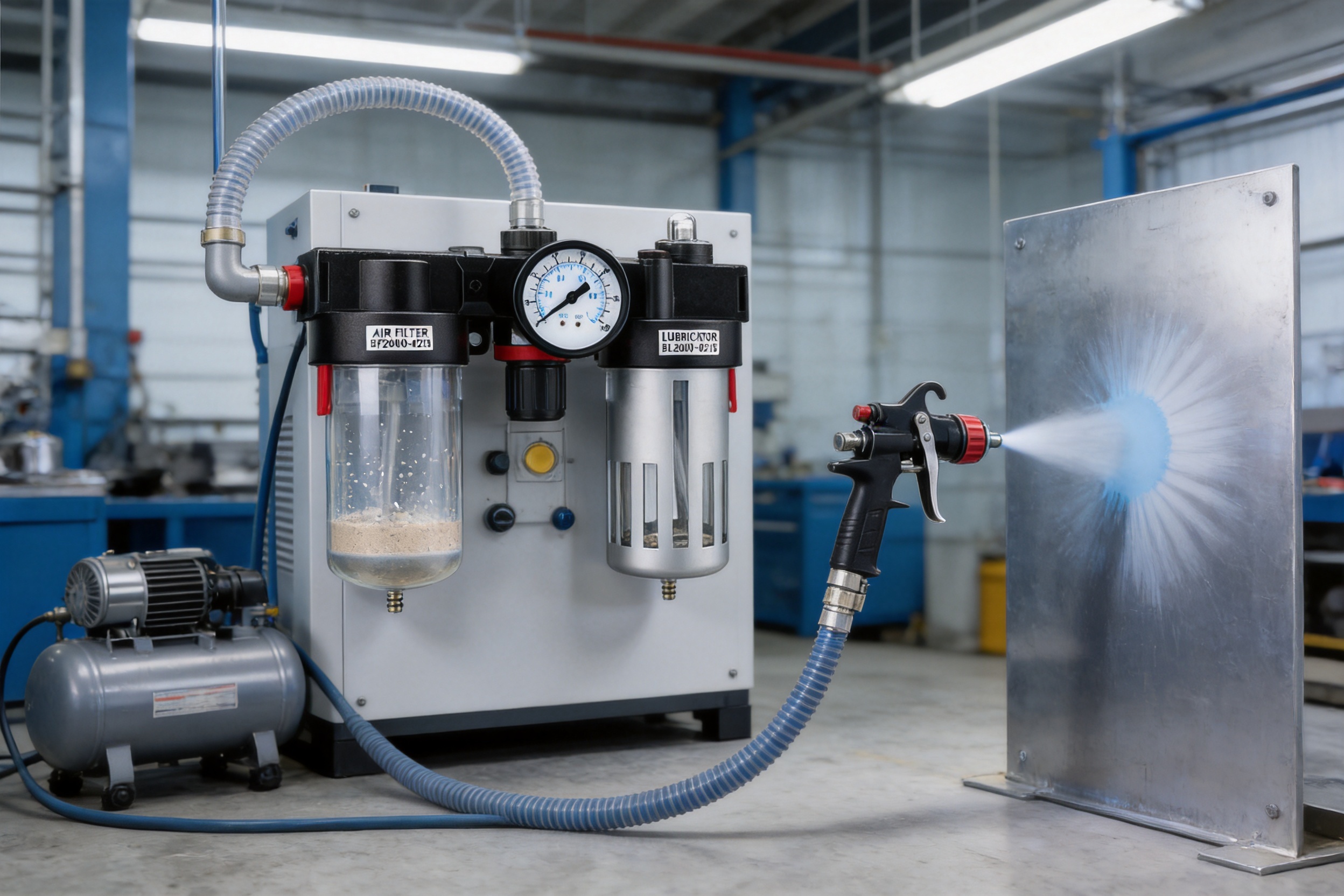
For spray-painting applications, the quality of the air supply is especially important. A spray gun requires a clean and consistent air stream to atomize coating material evenly. Excessive pressure can produce overspray, dry spray, or inefficient material transfer, while insufficient pressure can lead to poor atomization and an uneven finish. Water and oil contamination can create surface defects such as fisheyes, blushing, pinholes, or adhesion problems. The BC series addresses these common air-system challenges at the pipeline level.
Manufactured by Ningbo Lis Industrial Co., Ltd., the BC2000/3000/4000 family is designed for professional workshops, production lines, maintenance areas, and general pneumatic applications. The company has specialized in spray guns, air tools, mini compressors, and related spraying equipment since 1984. Its experience in air-painting technology provides a practical foundation for developing accessories that support the complete compressed-air system rather than treating the spray gun as an isolated product.
The Function of a Filter-Regulator-Lubricator
An FRL unit performs three related but distinct tasks. The filter removes unwanted particles and separates condensed moisture from the compressed air. The regulator reduces and stabilizes the pressure supplied to the tool. The lubricator introduces a controlled quantity of oil mist into the air stream for pneumatic equipment that requires internal lubrication.
Although these functions can be installed as separate components, an integrated unit offers several practical advantages. It occupies less space, reduces the number of pipe joints, simplifies installation, and creates a more organized air-treatment station. A combined assembly also makes it easier for an operator to inspect and adjust the air supply at one location.
The BC series is specified with a filtration precision of 40 microns. This rating is suitable for general-purpose compressed-air preparation, where the objective is to remove common solid particles and separated liquid contaminants before the air reaches a downstream tool. The filter is not intended to replace a specialized oil-removal or ultra-fine coating filter when a process requires extremely high-purity air. Instead, it provides an important first stage of protection and conditioning within the pipeline.
The regulator allows the operator to set a working pressure within a range of 10 to 120 PSI. The maximum pressure rating is no greater than 140 PSI. This gives users a useful adjustment range for spray guns, air brushes, inflating tools, and many other pneumatic devices while maintaining a defined operating limit. Correct pressure adjustment can improve control, reduce compressed-air waste, and help the connected equipment operate within its intended performance range.
The air inlet is G1/4 inch, a common connection size for many workshop air circuits and pneumatic accessories. Compatibility with a widely used thread standard can simplify replacement, maintenance, and integration with existing pipelines. The exact connection method should still be checked against the user’s hose, fitting, seal, and local installation requirements.
Why Air Preparation Matters in Spray Applications
Spray finishing is sensitive to changes that may be overlooked in ordinary pneumatic work. A spray gun converts liquid coating into a controlled pattern of atomized droplets. The size, velocity, and distribution of those droplets depend on several factors, including coating viscosity, nozzle design, fluid delivery, gun setup, and compressed-air pressure. If the pressure fluctuates during spraying, the fan pattern and atomization can change from one area of the workpiece to another.
Moisture is one of the most common sources of compressed-air trouble. Atmospheric air contains water vapor, and compression causes part of that vapor to condense. The amount of condensate increases as air cools inside the compressor receiver, hose, or pipeline. If the water is not separated, it may travel toward the spray gun and mix with the coating material or disturb the atomizing air. The visible result can be an uneven finish, cloudy appearance, surface cratering, or poor adhesion.
Solid contamination presents another risk. Rust particles, pipe scale, dust, and debris can enter an air line through the compressor intake, storage tank, fittings, or aging hoses. Even small particles can interfere with spray-gun passages, nozzle openings, valve seats, and needle assemblies. A filter positioned upstream of the tool helps capture this material before it reaches sensitive components.
Pressure that is too high can be equally problematic. It may create excessive overspray and airborne mist, consume more compressed air, and reduce transfer efficiency. In certain applications, excessive air velocity can cause the coating to dry before it reaches the surface, producing a rough texture or a dry, powdery appearance. A regulator gives the operator a practical way to reduce line pressure to a level appropriate for the selected spray gun and coating.
Pressure that is too low may produce incomplete atomization, an unstable spray pattern, or an uneven film thickness. An integrated regulator helps maintain a more consistent downstream pressure when the compressor or wider workshop system experiences variations. Stable adjustment is especially useful when several pneumatic devices share a common pipeline.
Lubrication is important for pneumatic tools containing moving internal parts that are designed to operate with oil mist. A lubricator can introduce a controlled quantity of lubricant into the air stream, reducing friction and helping protect valves, pistons, and other internal components. However, lubrication must be applied selectively. Many modern paint-spray applications require oil-free air at the gun to protect coating quality. In such cases, the lubricator should be correctly adjusted, isolated, or omitted from the air path according to the tool manufacturer’s instructions.
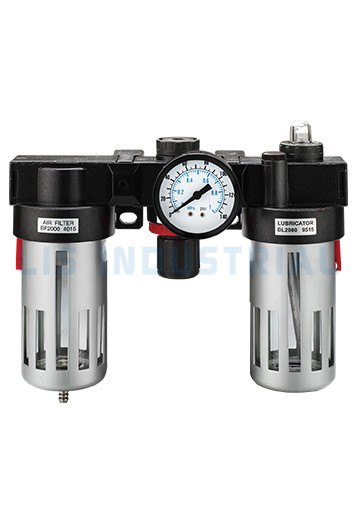
BC2000/3000/4000
Product Specifications at a Glance
| Item | BC2000 | BC3000 | BC4000 |
|---|---|---|---|
| Product type | Filter, regulator, and lubricator | Filter, regulator, and lubricator | Filter, regulator, and lubricator |
| Pressure range | 10–120 PSI | 10–120 PSI | 10–120 PSI |
| Maximum pressure | Up to 140 PSI | Up to 140 PSI | Up to 140 PSI |
| Air inlet | G1/4 inch | G1/4 inch | G1/4 inch |
| Filtration precision | 40 microns | 40 microns | 40 microns |
| Primary purpose | Compact air preparation | Compact air preparation | Compact air preparation |
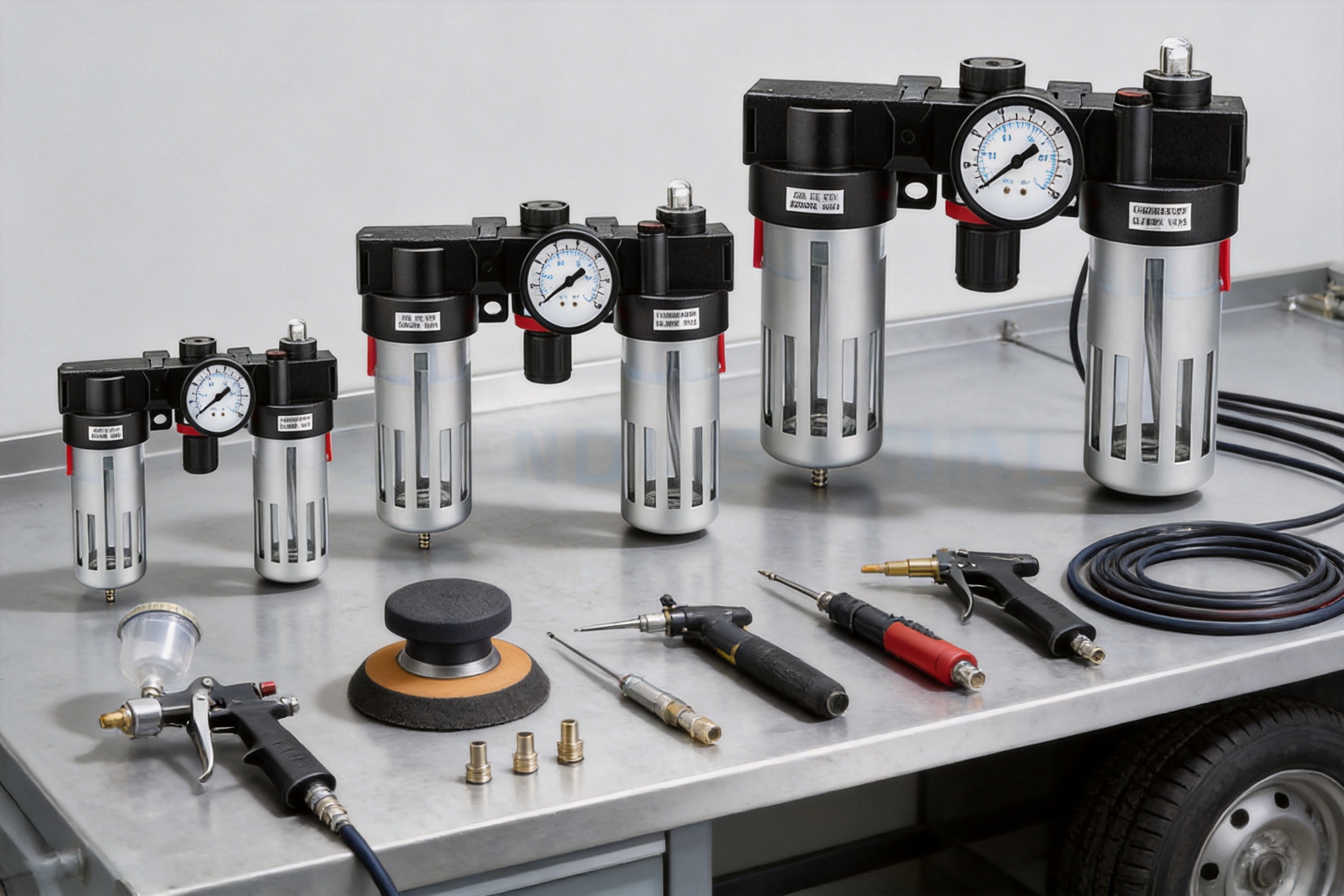
| Typical use | Small pneumatic tools and spray equipment | Workshop and medium-duty pneumatic systems | Higher-flow workshop and production applications |
The BC2000, BC3000, and BC4000 models share the same basic air-preparation functions and stated pressure and filtration specifications. Their model designations allow users and system designers to select a size appropriate to the intended installation and air-demand level. Before choosing a model, the user should verify the required flow rate, port arrangement, available space, operating temperature, and compatibility with the connected equipment.
A product specification is useful only when it is considered together with the complete air system. Compressor capacity, receiver size, pipe diameter, hose length, tool consumption, and the number of simultaneous users all affect real-world performance. A correctly sized FRL unit minimizes unnecessary restriction while still providing effective filtration and control. Undersizing may create a pressure drop during high-demand operation, while oversizing can increase cost and occupy more installation space than necessary.
Advantages of an Integrated Design
One Compact Assembly
One of the most visible advantages of the BC series is the combination of three functions in a single assembly. Separate filters, regulators, and lubricators require additional brackets, fittings, connectors, and installation time. An integrated unit creates a shorter and more orderly air-treatment section. This is valuable in small workshops where wall and bench space are limited, as well as in production lines where every component must fit within a defined machine layout.
Reduced Connection Complexity
Every additional connection in a pneumatic system is a possible point of leakage, misalignment, or maintenance difficulty. By combining the primary treatment functions, the FRL assembly can reduce the number of external joints required. Fewer joints do not eliminate the need for correct sealing and inspection, but they can make the complete installation easier to assemble and troubleshoot.
Convenient Pressure Adjustment
When the regulator is positioned close to the spray gun or pneumatic tool, the operator can adjust the working pressure according to the task. Different coatings, nozzle sizes, and application methods often require different pressure settings. A local regulator reduces the need to return to the compressor or adjust a remote control valve, making setup more convenient and repeatable.
Improved Protection for Downstream Equipment
Removing moisture and solid particles before they reach a spray gun or air tool helps reduce contamination-related problems. The filter can protect small internal passages and moving components, while the regulator helps prevent operation at unnecessarily high pressure. For tools that need pneumatic lubrication, the lubricator can support smoother internal movement and reduce wear when set correctly.
Support for Consistent Production
Consistency is a major advantage in professional finishing. A spray operator needs the air supply to behave in a predictable manner from the beginning to the end of a job. A well-maintained FRL unit contributes to consistent pressure, cleaner air, and more repeatable tool operation. This can reduce rework and support more uniform coating quality across multiple workpieces.
Comparison with Basic or Uncontrolled Air Supply Systems
A basic compressed-air installation may connect the compressor directly to a hose and tool. This arrangement can appear inexpensive, but it transfers the responsibility for air quality and pressure control to the compressor, hose, and operator. The compressor itself may not remove all downstream moisture, and its pressure switch is not a substitute for precise point-of-use regulation.
Compared with a direct connection, the BC series provides a dedicated preparation stage between the air source and the tool. The filter addresses contaminants, the regulator addresses pressure, and the lubricator addresses the needs of compatible pneumatic machinery. This three-part approach is more complete than relying on a compressor receiver alone.
Separate components can offer flexibility, especially in specialized installations. A large factory may choose a high-capacity coalescing filter, a precision regulator, an oil-removal filter, and an automatic drain as independent modules. However, that arrangement may involve a higher purchase cost, more complex pipework, and more maintenance points. For general workshops and many medium-duty applications, an integrated FRL unit offers a practical balance between functionality, compactness, and cost.
| Evaluation area | Direct compressor connection | Separate air-treatment components | Integrated BC-series approach |
|---|---|---|---|
| Moisture and particle control | Limited or dependent on the compressor | Can be highly specialized | General-purpose filtration in a compact unit |
| Pressure adjustment at the tool | Often inconvenient | Available if separately installed | Convenient local regulation |
| Installation complexity | Low, but with limited control | Higher because of multiple modules | Lower than a multi-component installation |
| Space requirement | Small | May be substantial | Compact and organized |
| Maintenance points | Few, but protection is limited | Several | Centralized inspection and servicing |
| Suitability for general workshops | Basic applications only | Useful for specialized systems | Strong balance of function and convenience |
The integrated approach does not mean that every application should use exactly the same air-treatment configuration. High-performance coating lines may require additional filtration stages, refrigerated dryers, desiccant dryers, or dedicated oil-free branches. The strength of the BC series is its role as a dependable general-purpose air-conditioning unit that can be incorporated into a broader system when required.
Applications Across Pneumatic Equipment
The BC2000/3000/4000 series is suitable for air pipeline accessory applications serving many kinds of equipment. Spray guns are an important use because atomization depends on controlled air, but the unit can also support air brushes, air blowing guns, tyre inflating guns, polishing tools, sandblast equipment, and other air-powered devices.
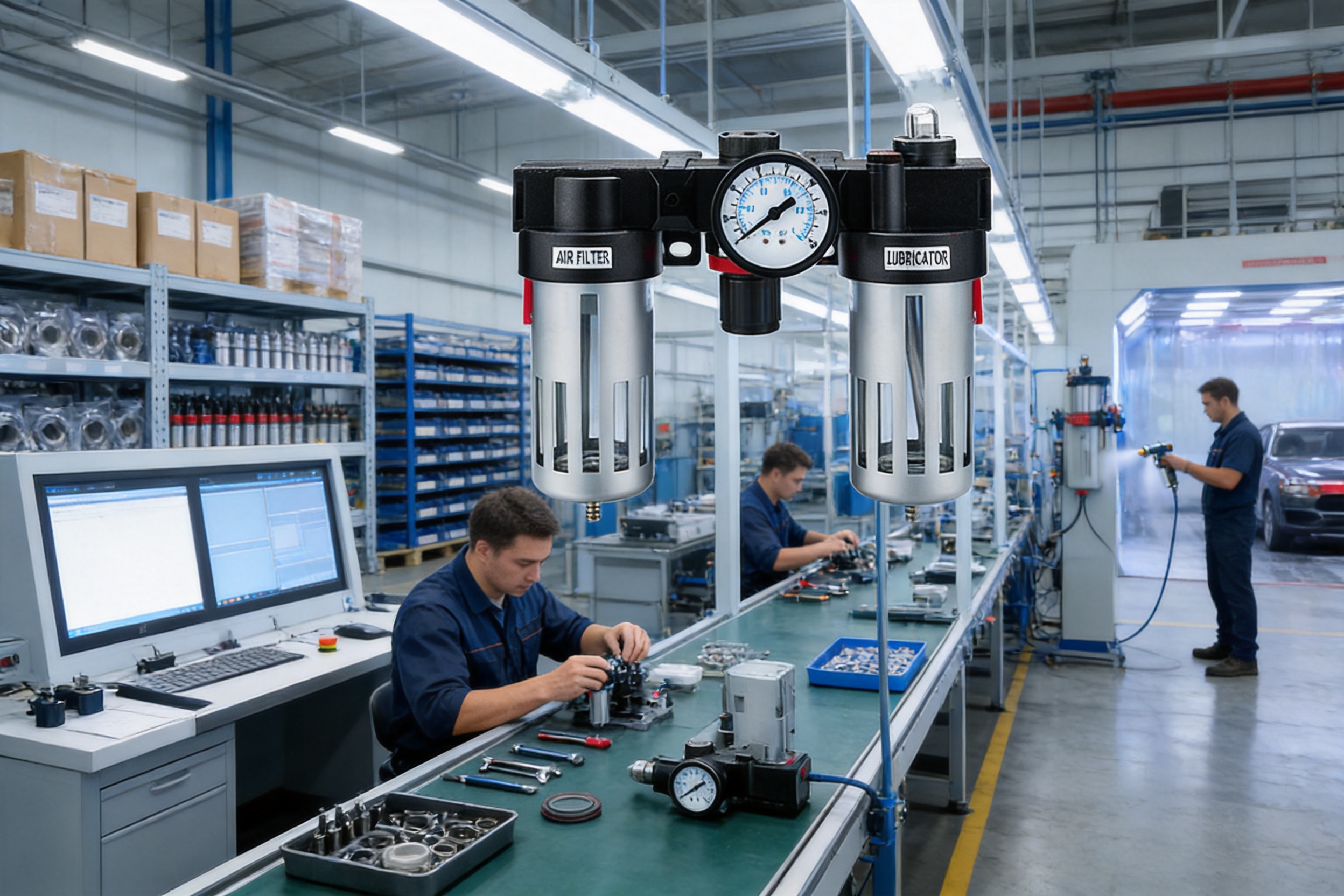
In an automotive refinishing area, an FRL unit can be installed near the workbench or spray-gun connection to provide a convenient pressure-control point. In a woodworking shop, it can help condition air supplied to finishing tools, cleaning guns, and pneumatic fastening equipment. In general maintenance areas, it can serve a group of small air tools that share a common branch line.
For air brushes and small spray equipment, accurate adjustment is valuable because the tools often operate at lower pressure and lower air volume than heavy-duty spray guns. For polishing machines and other pneumatic tools, filtration helps reduce the entry of debris, while lubrication may support the movement of internal parts when the equipment is designed for lubricated operation.
Air blowing guns benefit from clean air because particles in the pipeline can otherwise be discharged onto a cleaned surface. Tyre inflating equipment benefits from pressure control because the operator can work within a more manageable and repeatable range. Sandblasting and high-consumption applications require careful sizing, but a suitable BC-series unit can form part of the air-preparation arrangement when its flow capacity matches the system demand.
When a single pipeline serves different categories of equipment, the system designer should consider whether all users require the same air condition. A spray gun may require clean, dry, oil-free air, while a pneumatic polisher may benefit from lubrication. Separate branches may therefore be appropriate. The BC unit can be installed at a suitable point for each branch, allowing the air-treatment strategy to match the equipment connected to that branch.
Manufacturing Experience and Technical Capability
Ningbo Lis Industrial Co., Ltd. has been engaged in the development, manufacture, and marketing of air-painting spray guns, mini air compressors, and related air tools since 1984. This long operating history is significant because air-treatment accessories must be understood in the context of the equipment they serve. Experience with spray guns and pneumatic tools helps a manufacturer evaluate how pressure stability, contamination, fittings, seals, and lubrication influence actual workshop performance.
The company operates from Ningbo, China, a port city with established industrial infrastructure and convenient transportation connections. Its manufacturing site covers more than 400,000 square feet and employs more than 400 people. The stated annual output exceeds 40 million US dollars. These resources support large-scale production, product development, quality management, logistics coordination, and customer service for international markets.
The company’s product range includes heavy-duty spray guns, HVLP spray guns, low-pressure woodworking spray guns, conventional spray guns, texture paint spray guns, paraffin and washing guns, air blowing guns, sandblast and foam guns, tyre inflating guns, water and grease guns, automatic spray guns, air brushes, mini oil-free compressors, pipeline accessories, paint tanks, air fittings, polishers, spray-gun kits, electric spray equipment, and airless spray guns.
This broad portfolio provides an important manufacturing advantage. The BC series is not developed in isolation from spray technology. It is part of a wider product ecosystem in which the manufacturer works with air supply, air delivery, paint atomization, and application equipment. Such an ecosystem can help the company understand the practical requirements of distributors, professional users, original equipment manufacturers, and complete spraying-system integrators.
Research and Development
The company maintains a research and development team focused on spraying machinery and related air tools. It has established a spraying machinery engineering technology center and has conducted technical cooperation with American Wagner Spraying Technology Co., Ltd. This type of technical background supports product improvement, application testing, and the development of equipment for different markets.
Research and development is important even for a compact accessory such as an FRL unit. Reliable air preparation depends on the interaction of the filter element, bowl, seals, pressure-control mechanism, lubricator, fittings, and housing. The assembly must remain functional under the pressure and operating conditions for which it is specified. Design choices also influence ease of adjustment, serviceability, installation footprint, and compatibility with other air tools.
The company states that it can provide OEM production based on customer drawings or samples and ODM services based on customer requirements. This flexibility may be useful for distributors and equipment manufacturers that need private-label products, customized packaging, special configurations, or integration into a larger pneumatic system. The suitability of any customization should be confirmed through technical review and sample approval before mass production.
Quality-System Approach
Product quality depends not only on final inspection but also on control throughout the manufacturing process. The company describes a quality system covering raw-material selection, incoming inspection, in-process quality control, functional testing, and final inspection of finished products. This full-process approach is particularly relevant to air accessories because small defects in sealing surfaces, threads, valves, or transparent bowls can affect field performance.
The company reports compliance with ISO9000 quality-system requirements and states that its products have passed CE and GS certifications. It also reports certification related to ISO9001 quality management, ISO14001 environmental management, and OHSAS18001 occupational health and safety management. Certification scope and current validity should always be verified against the exact product, production site, and applicable market requirements.
A structured quality system can improve consistency between production batches. Incoming inspection helps ensure that purchased materials and components meet specifications. Process control helps identify deviations during assembly rather than waiting until the final stage. Functional testing can verify key operating characteristics, and final inspection provides an additional release check before products are packed and shipped.
The company also reports that its factory has received recognition as a national high-tech enterprise, an advanced customs-certification enterprise, an individual-item champion of Ningbo City, and a provincial engineering and technology center. These achievements indicate an emphasis on industrial capability, technical development, and organized export operations.
Production Processes Relevant to FRL Reliability
Although the exact internal production sequence for each BC model is proprietary, a high-quality FRL manufacturing process generally involves several controlled stages. These stages may include engineering design, material preparation, component forming or machining, surface treatment, seal installation, subassembly, pressure-related testing, functional inspection, cleaning, packaging, and traceability management.
The housing and structural components must be manufactured with suitable dimensional control. Threaded connections need to match the specified G1/4-inch standard and should be produced with clean, accurate thread profiles. Poorly formed threads may cause leakage, cross-threading, or difficult installation. Dimensional consistency is also important where filters, bowls, adjustment mechanisms, and seals meet.
Sealing components are central to pneumatic safety and performance. Seals must be correctly selected for the intended pressure range, temperature conditions, and contact with lubricants or contaminants. During assembly, seals must be seated without twisting, cutting, or contamination. A controlled assembly environment and trained personnel help reduce the risk of leakage caused by installation errors.
The filter section must provide a reliable path for air while retaining particles and separated moisture at the stated filtration level. The regulator must respond to adjustment and maintain an appropriate downstream pressure under the expected operating conditions. The lubricator must deliver lubricant in a controlled manner rather than flooding the air line. These functions require more than visual inspection; they benefit from functional tests and appropriate production fixtures.
Testing may include pressure holding, leakage inspection, adjustment verification, airflow checks, and visual examination. The exact tests used depend on the model and manufacturing specification. A complete quality program should define test methods, acceptance criteria, calibration requirements, and procedures for handling nonconforming products.
Packaging is also part of product quality. Air accessories should be protected from impact, dust, moisture, and thread damage during storage and transport. Clear identification of the model, specifications, quantity, and destination can reduce errors during warehouse handling. For international distribution, packaging should be suitable for long-distance transportation and the documentation should support installation and maintenance.
Installation Guidance
The BC unit should be installed in a position where the direction of airflow matches the marked inlet and outlet orientation. Incorrect orientation can prevent the filter, regulator, and lubricator from functioning as intended. The unit should be mounted securely and supported so that the connected hose or pipe does not place excessive mechanical stress on the body or fittings.
Before installation, the pipeline should be inspected and cleaned. New pipework may contain metal particles, thread sealant, cutting debris, or dust. Existing pipelines may contain rust, oil residue, and accumulated condensate. Flushing the line before connecting the FRL unit reduces the possibility that installation debris will immediately enter the filter or downstream equipment.
Use compatible fittings and an appropriate sealing method. Thread sealant should be applied carefully so that loose material cannot enter the air passage. Excessive force during tightening may damage threads or the housing. The connection should be tightened sufficiently to prevent leakage while avoiding over-tightening.
The unit should be located as close as practical to the point of use when local pressure adjustment is important. At the same time, it should remain accessible for inspection, bowl drainage, pressure adjustment, and lubricator servicing. Installation in a location exposed to impact, extreme heat, corrosive chemicals, or direct physical damage should be avoided unless the complete system has been designed for those conditions.
The stated maximum pressure is up to 140 PSI, while the operating pressure range is 10 to 120 PSI. The system should not be operated beyond the applicable maximum rating. Users must also follow the pressure limits of the connected hose, fittings, spray gun, compressor, and other components, because the lowest-rated component determines the safe system limit.
After installation, pressurize the system gradually and inspect all connections. Check for audible leaks, abnormal pressure loss, damage to the bowl or body, and correct regulator response. If a leak or malfunction is identified, depressurize the system before attempting any adjustment or repair.
Operating Practices for Better Results
Set the regulator before beginning a production job rather than relying on the compressor’s tank pressure. The correct setting depends on the tool, nozzle, coating, hose length, and application technique. Operators should consult the spray-gun or tool instructions and make small adjustments while observing the spray pattern or tool response.
Pressure should generally be checked under working conditions. A reading taken while no air is flowing may differ from the pressure observed when the spray gun trigger is opened. This difference can result from compressor capacity, hose restriction, pipeline diameter, and regulator behavior. Testing with the actual tool connected provides a more useful indication of operating performance.
The filter bowl should be inspected regularly for accumulated moisture and contaminants. Condensate should be drained according to the unit’s drainage arrangement and the workshop’s safety procedure. Do not allow collected liquid to remain indefinitely, because a full bowl can reduce effective separation and increase the risk of moisture entering the downstream line.
In a paint-spray installation, the air path should be evaluated for oil contamination. If the selected coating process requires oil-free air, the lubricator should not be used in the branch supplying the spray gun unless the coating-system manufacturer expressly permits it. A separate lubricated branch can serve pneumatic tools that need oil, while a dedicated clean-air branch serves finishing equipment.
When a lubricator is used, it should be adjusted conservatively. Too little lubricant may fail to support a tool that requires oil, while too much can contaminate the pipeline, workpiece, or coating. The correct oil type and lubrication frequency should be determined from the pneumatic-tool manufacturer’s recommendations. The lubricator is not a substitute for direct maintenance of equipment that requires manual oiling or grease.
Operators should avoid turning adjustment controls aggressively or forcing them beyond their intended range. Sudden changes may disturb the spray pattern or place unnecessary stress on the pneumatic system. A controlled setup routine, documented pressure setting, and regular inspection can make results more repeatable between operators and shifts.
Maintenance and Service Considerations
Routine maintenance helps preserve the performance of any air-preparation unit. The first step is a visual inspection. Check the housing, bowl, fittings, mounting points, adjustment mechanism, and connecting hoses for cracks, impact damage, corrosion, or abnormal wear. Any damaged pressure-containing component should be removed from service and evaluated by a qualified technician.
Filter service intervals depend on air quality, operating hours, compressor condition, and the level of contamination in the pipeline. A workshop with a dirty compressor intake, aging steel pipe, or high humidity may require more frequent service than a clean, dry installation. Increasing pressure drop, reduced airflow, visible contamination, or recurring downstream defects can indicate that the filter needs attention.
Before servicing the unit, isolate it from the compressed-air supply and release trapped pressure. Stored pneumatic energy can cause unexpected movement or discharge. Maintenance should be performed by trained personnel using suitable replacement parts. The filter element, seals, bowl, and other service items should match the model and application requirements.
Keep the external surfaces clean so that leaks and damage can be detected easily. Do not use cleaning chemicals that could attack the housing, seals, or transparent components. If a solvent is required, verify its compatibility before application. The same principle applies to lubricants: only use products approved for the relevant pneumatic components.
A maintenance record can be useful in professional environments. It may include installation date, pressure setting, filter service date, drainage checks, lubricant adjustment, observed faults, and replacement components. Such records help identify recurring problems and support preventive maintenance rather than emergency repair.
Selection Guidance for Different Users
Small workshops often value compactness and simplicity. A BC2000-type configuration may be appropriate where the air demand is moderate and the installation serves small spray guns, air brushes, inflating tools, or general maintenance equipment. The user should still confirm the required flow and port configuration before purchase.
Medium-duty workshops may need a higher-capacity configuration to support longer operating periods or multiple tools. A BC3000-type unit can be considered when the workshop requires a more substantial air-preparation station while retaining a compact integrated format. Actual suitability should be determined by the tool consumption and pipeline requirements rather than by model name alone.
Higher-flow workshop or production applications may consider a BC4000-type configuration where the air system requires a larger air-preparation assembly. These applications may include production spray areas, industrial maintenance stations, or shared branches serving several pneumatic tools. The complete pipeline must be designed to provide sufficient compressor capacity and avoid excessive pressure drop.
Users should also distinguish between a general-purpose FRL unit and specialized coating-air treatment. If a painting process demands exceptionally clean, dry, and oil-free air, the BC unit may need to be combined with an air dryer, coalescing filter, oil-removal filter, or final point-of-use filter. The correct configuration depends on the coating chemistry, finish standard, environmental conditions, and equipment instructions.
Advantages for Distributors and OEM Customers
For distributors, an integrated air-preparation product is easy to position within a broader range of spray guns and air tools. It provides a practical accessory that can be offered with compressors, spray-gun kits, pipeline fittings, and workshop packages. A unified product source can simplify purchasing, packaging, technical communication, and after-sales support.
The BC series also supports a solution-oriented sales approach. Instead of selling only a spray gun, a distributor can help the customer address the complete air path, including filtration, regulation, hose selection, fittings, and maintenance. This approach may improve user satisfaction because many spray-gun complaints are caused by unstable or contaminated air rather than by the gun itself.
OEM customers may benefit from the manufacturer’s experience with custom production. The company states that it can work from customer drawings or samples and provide ODM services based on customer needs. Potential projects may involve customized labels, packaging, mounting arrangements, model combinations, or integration into a larger spray system. Technical requirements should be documented clearly, including pressure limits, connection standards, materials, flow expectations, test criteria, and certification needs.
Production capacity is another consideration for international buyers. The company reports that its production capacity can be increased by 30 percent within two months. This stated scalability may help address changes in seasonal demand, project-based purchasing, or distributor expansion. Buyers should confirm lead times, minimum order quantities, forecast requirements, inspection procedures, and shipment arrangements for each program.
International Quality and Market Support
The manufacturer serves customers in Europe, North America, the Middle East, South Africa, East Asia, and other regions. International distribution requires more than product availability. It also requires consistent specifications, export documentation, packaging suitable for transportation, communication across time zones, and technical support for different regulatory environments.
Reported CE and GS certifications can support access to certain markets, but certification requirements vary by product category and destination. Importers and end users should verify that the supplied model carries the correct documentation and that the certification applies to the exact configuration being purchased. Local regulations may also govern pressure equipment, workplace safety, noise, emissions, and installation practice.
A global service network and established brand experience can provide value when customers operate multiple sites or purchase repeat shipments. Consistent replacement parts, clear model identification, and accessible technical information help reduce downtime. For a pipeline accessory, support may include installation recommendations, troubleshooting guidance, service-part identification, and compatibility information.
Troubleshooting Common Problems
Pressure Drops During Spraying
A pressure drop may result from an undersized FRL unit, insufficient compressor capacity, a restricted filter, a small hose, excessive hose length, or a partially closed valve. Check the pressure while air is flowing, inspect the filter condition, and compare the tool’s air consumption with the compressor’s delivery capacity. Increasing regulator pressure without solving the restriction may increase overspray without restoring stable performance.
Moisture Reaches the Spray Gun
Moisture may appear when the compressor produces substantial condensate, the pipeline is not drained, the filter is full, or the air is cooling downstream of the compressor. Drain the appropriate components, inspect the filter, and consider additional drying equipment if the application requires a higher level of moisture control. The FRL unit should be installed and maintained correctly, but it cannot remove every form of water vapor from a compressed-air system.
Air Tool Operates Roughly
Rough operation may be caused by inadequate lubrication, contaminated air, a damaged tool, or pressure that is outside the tool’s recommended range. Confirm whether the tool is designed for lubricated air. If it is, check the lubricator setting and lubricant type. If it is not, use a clean, oil-free branch and investigate the tool independently.
Regulator Setting Is Unstable
Unstable regulation may be associated with an incorrect installation direction, pressure supply fluctuations, contamination in the regulator, a damaged seal, or demand that exceeds the unit’s practical capacity. Check the inlet pressure, confirm the operating range, inspect the installation, and arrange qualified service if the regulator does not respond normally.
Spray Finish Contains Defects
Surface defects can have many causes, including coating viscosity, nozzle condition, gun technique, ambient humidity, contamination, and air pressure. The FRL unit should be checked as part of a complete diagnostic process. Verify filtration, moisture drainage, pressure under load, and the absence of unwanted oil in the spray branch. A clean and stable air supply cannot compensate for incorrect coating preparation or a damaged spray gun, but it removes several common sources of variation.
Safety Recommendations
Compressed air must be treated as stored energy. Before disconnecting a hose, changing a filter, removing a bowl, or servicing the unit, isolate the supply and release pressure. Never point compressed air at the body, clothing, or another person. Airborne particles can cause serious eye, skin, and respiratory injuries.
Wear suitable eye protection when installing or maintaining the unit. In spray environments, use respiratory protection, gloves, protective clothing, and ventilation appropriate to the coating material. The FRL unit improves air preparation but does not replace required workplace controls for paint vapors, solvents, dust, or noise.
Do not exceed the specified maximum pressure. Inspect hoses and fittings regularly, and replace damaged components immediately. Use only compatible materials and lubricants. If the unit is incorporated into a machine or automated line, provide suitable isolation, pressure relief, and emergency-stop arrangements according to the applicable safety standards.
Keep the installation away from excessive heat, open flames, and aggressive chemicals unless the complete system has been designed for those conditions. Ensure that the bowl and other visible components are protected from impact. A damaged pressure-containing part must not be repaired with improvised methods or returned to service without proper evaluation.
Environmental and Operational Efficiency
Correct air preparation can contribute to more efficient compressed-air use. A regulator prevents the tool from operating at a higher pressure than necessary, which may reduce overspray and unnecessary air consumption. Clean filtration can help maintain airflow and prevent small passages from becoming restricted. Stable spray conditions may also reduce coating rework, material waste, and the energy used to repeat a finishing operation.
Maintenance has an environmental benefit as well. Prompt drainage reduces contamination in the workshop, while timely filter replacement helps prevent a dirty element from forcing the compressor to work against avoidable restriction. Properly controlled lubrication reduces the risk of excess oil entering the air system or surrounding work area.
The environmental performance of the complete system depends on many factors, including compressor efficiency, leak control, coating technology, ventilation, material transfer efficiency, and maintenance discipline. The BC series is one component within that system, but its pressure-control and filtration functions can support more responsible operation when properly selected and maintained.
Recommended Purchasing Checklist
Before ordering a BC2000, BC3000, or BC4000 unit, identify the required application and the equipment that will be connected downstream. Record the tool’s operating pressure, air consumption, inlet connection, lubrication requirement, and duty cycle. Determine whether the branch will supply a spray gun, an air tool, or multiple devices with different air-quality requirements.
Confirm the pressure conditions at the installation point. The regulator’s operating range is 10 to 120 PSI, and the maximum pressure is up to 140 PSI. The air inlet is G1/4 inch, and filtration precision is 40 microns. These specifications should be compared with local pipeline standards, hose connections, and tool requirements.
Consider the installation environment. Check available space, mounting orientation, temperature, humidity, exposure to impact, and accessibility for drainage and maintenance. For mobile equipment, evaluate whether vibration or hose movement could stress the assembly. For fixed production lines, review the mounting bracket, pipe supports, and isolation points.
Ask for the documentation required by the destination market. This may include product specifications, inspection records, certificates, material information, packaging details, spare-parts information, and installation instructions. OEM and ODM customers should also agree on approval samples, production tolerances, labeling, testing, and change-control procedures before mass production.
Frequently Asked Questions
What are the BC2000, BC3000, and BC4000 products?
They are integrated filter-regulator-lubricator units designed for compressed-air pipeline preparation. Each unit combines filtration, pressure regulation, and lubrication functions in one assembly for use with spray equipment and compatible pneumatic tools.
What pressure range do these units support?
The stated pressure range is 10 to 120 PSI. The stated maximum pressure is up to 140 PSI. Users must also observe the pressure limits of the compressor, hose, fittings, spray gun, and other connected components.
What is the filtration precision?
The stated filtration precision is 40 microns. This is intended for general-purpose removal of solid particles and separated moisture. Applications requiring extremely dry or oil-free air may need additional filtration or drying equipment.
What is the air inlet size?
The air inlet is G1/4 inch. Compatibility should be confirmed with the existing fittings, hose, pipework, thread standard, and sealing method before installation.
Can the unit be used with a spray gun?
Yes. The regulator can help provide a more suitable and stable air pressure, while the filter helps reduce particles and condensed moisture reaching the spray gun. The lubricator must be handled carefully because many coating applications require clean, oil-free air. A dedicated non-lubricated branch may be appropriate for spray finishing.
Does the FRL unit replace an air dryer?
No. The filter can separate condensed liquid and remove particles, but it does not necessarily remove all water vapor from compressed air. A refrigerated or desiccant dryer may be required when the application demands a lower dew point or more advanced moisture control.
How should the correct model be selected?
Selection should be based on air demand, pipeline conditions, installation space, tool requirements, and the expected duty cycle. The model designation alone is not sufficient. Confirm the required flow and pressure performance with the supplier or system designer before purchase.
Does every pneumatic tool need lubrication?
No. Some pneumatic tools are designed for lubricated air, while others are designed to operate with oil-free air. Follow the tool manufacturer’s instructions. Lubrication should not be introduced into a spray-gun branch if it could contaminate the coating process.
What maintenance does the unit require?
Inspect the body, fittings, bowl, seals, and adjustment mechanism. Drain collected moisture, check the filter condition, maintain the correct lubricant level when lubrication is required, and replace worn components with compatible parts. Always isolate and depressurize the unit before servicing.
Can the manufacturer provide customized products?
The company states that it offers OEM production based on customer drawings or samples and ODM services based on customer requirements. Custom projects should be reviewed technically and confirmed through drawings, samples, specifications, testing requirements, and approval procedures.
What manufacturing strengths support this product?
The manufacturer has operated in the spray-gun and air-tool industry since 1984, maintains a large production site and workforce, operates a research and development team, and describes quality control from incoming materials through final inspection. It also reports international certifications and experience serving customers in multiple global markets.
Conclusion
The BC2000/3000/4000 series provides a practical method for preparing compressed air before it reaches spray guns and pneumatic equipment. By combining a 40-micron filter, a 10–120 PSI regulator, and a lubricator in one compact assembly, the product helps address three common air-system requirements: cleanliness, pressure control, and tool lubrication.
Its advantages over an uncontrolled compressor connection include more convenient point-of-use adjustment, improved protection for downstream equipment, reduced connection complexity, and better organization of the air pipeline. Compared with a large collection of separate modules, the integrated design can reduce installation space and simplify general-purpose workshop systems while remaining adaptable to broader air-treatment arrangements.
The product’s value is reinforced by the manufacturer’s long experience in spray guns, air tools, compressors, and spraying solutions. Ningbo Lis Industrial Co., Ltd. combines product development, large-scale manufacturing, OEM and ODM capability, international market experience, and a quality-management approach that covers materials, production, functional testing, and final inspection.
For the best results, the BC series should be selected according to actual air demand and installed as part of a complete compressed-air strategy. Users should maintain the filter, control moisture, set pressure under working conditions, and keep lubricated and oil-free branches separate when necessary. With correct selection, installation, and maintenance, an integrated air-preparation unit can contribute to more reliable tools, more consistent spray performance, lower rework, and a more efficient workshop.
References
1. Product specification information for the BC2000/3000/4000 filter-regulator-lubricator series, including pressure range, maximum pressure, inlet size, and filtration precision.
2. Ningbo Lis Industrial Co., Ltd. company information concerning spray-gun manufacturing, air tools, research and development, production capacity, quality control, and international markets.
3. General compressed-air system engineering principles concerning filtration, pressure regulation, condensate separation, lubrication, and point-of-use air preparation.
4. General pneumatic-tool maintenance and workplace compressed-air safety practices.
5. General spray-finishing principles concerning atomization pressure, air contamination, moisture control, coating consistency, and transfer efficiency.
6. Quality-management and conformity-assessment concepts associated with ISO-based manufacturing systems and applicable product certification practices.