 Search

 English
 中文简体
 Deutsch
 Español
Content
- 1 1. The Role of a Quick Coupler Plug in a Pneumatic System
- 2 2. Product Positioning of the JPM20 Quick Coupler Plug
- 3 3. Why Standard Compatibility Matters
- 4 4. Design Advantages of a Quick-Connection System
- 5 5. Performance Factors That Distinguish Quality Fittings
- 6 6. Comparison with Less Suitable Alternatives
- 7 7. Advanced Manufacturing Strengths Behind the Product
- 8 8. Quality-Control Process
- 9 9. Application Guidance for Workshops and Industry
- 10 10. Installation and Maintenance Recommendations
- 11 11. Purchasing Considerations for Distributors and OEM Buyers
- 12 12. Environmental and Operational Responsibility
- 13 13. International Supply and Customer Support
- 14 14. Recommended Evaluation Procedure
- 15 15. Why the Manufacturer’s Broader Expertise Matters
- 16 16. Frequently Asked Questions
- 16.1 Q1: What is the JPM20 product?
- 16.2 Q2: Is the JPM20 compatible with every quick socket?
- 16.3 Q3: Where can this type of plug be used?
- 16.4 Q4: Can the plug improve air-system efficiency?
- 16.5 Q5: What should be checked before ordering?
- 16.6 Q6: Can the product be supplied for OEM applications?
- 16.7 Q7: How should the fitting be maintained?
- 16.8 Q8: What should be done if the plug does not insert smoothly?
- 16.9 Q9: Does the fitting require thread sealant?
- 16.10 Q10: Is a quick coupler safe to disconnect under pressure?
- 16.11 Q11: What quality systems support the product?
- 16.12 Q12: Why choose an experienced air-tool manufacturer?
- 17 17. Conclusion
- 18 References
- 19 Product: JPM20 Pneumatic fittings Air Compressor Hose Quick Coupler Plug+
In compressed-air systems, the quality of a connection often determines the quality of the entire installation. A spray gun, air compressor, pneumatic tool, or air pipeline can be technically advanced, yet still perform poorly if the coupling and plug between the components are unsuitable. Air leakage, difficult connection, premature wear, inconsistent pressure, and unsafe disconnection can all result from a poorly selected fitting.
The JPM20 pneumatic fitting air compressor hose quick coupler plug is designed for applications that require a practical and dependable connection solution under the Japan Standard category. It is intended to support the connection of compressed-air hoses and pneumatic equipment while helping users reduce installation time, simplify equipment changes, and maintain a stable air supply.
As part of a broader range of spraying equipment and air tools, this fitting benefits from the manufacturing experience of Ningbo Lis Industrial Co., Ltd. The company has specialized in air painting spray guns, mini air compressors, air tools, fittings, and related spraying solutions since 1984. Its production system combines product development, precision manufacturing, process inspection, functional testing, and international quality management.
This article examines the design purpose, application value, manufacturing strengths, quality-control procedures, and purchasing considerations associated with the JPM20 quick coupler plug. It also explains why standard compatibility, dimensional accuracy, surface quality, and production consistency are important when comparing pneumatic fittings from different suppliers.
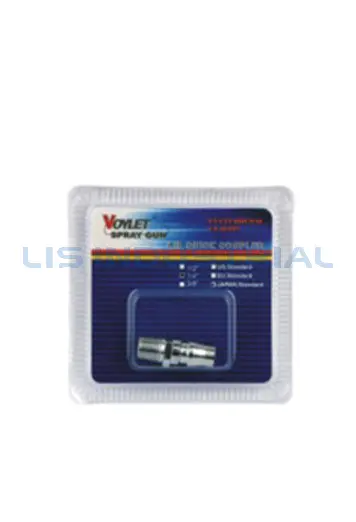
JPM20 Pneumatic fittings Air Compressor Hose Quick Coupler Plug+
1. The Role of a Quick Coupler Plug in a Pneumatic System
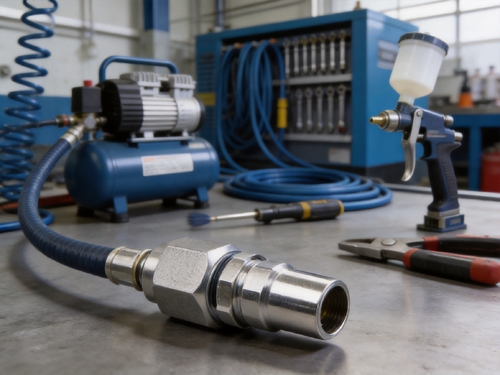
A quick coupler plug is a detachable connection component used with a matching socket or coupling body. The plug is normally installed on an air hose, pneumatic tool, spray gun, or other compressed-air device. When inserted into the corresponding coupler, it creates an air passage that permits compressed air to flow through the system. When the equipment must be removed, the connection can be released without repeatedly disassembling threaded pipe joints.
This operating principle offers a significant practical advantage in workshops and production environments. Operators can exchange spray guns, air hoses, blow guns, polishing tools, inflation tools, or other pneumatic devices quickly. A detachable coupling can also make equipment maintenance easier because a tool can be removed from the air line before inspection, cleaning, or storage.
The coupling is a small component, but it performs several important functions:
• It provides a removable connection between an air source and a pneumatic device.
• It supports efficient equipment replacement and tool changeover.
• It helps maintain an enclosed air path when correctly matched with the receiving coupler.
• It reduces the need for repeated threaded connection and disconnection.
• It contributes to a more organized and serviceable compressed-air installation.
• It can help reduce downtime in spraying, assembly, maintenance, and repair applications.
For these reasons, a quick coupler should not be selected only by appearance or price. Compatibility, pressure requirements, sealing performance, mechanical strength, corrosion resistance, and production consistency all influence the final result.
2. Product Positioning of the JPM20 Quick Coupler Plug
The JPM20 is identified as a pneumatic fitting and air compressor hose quick coupler plug under the Japan Standard category. This positioning indicates that the product is intended for systems using the corresponding Japanese-style connection profile. Standard family selection is essential because quick coupler plugs are not universally interchangeable. A plug that looks similar to another model may still differ in profile, insertion depth, locking geometry, sealing position, or effective air passage.
The JPM20 is therefore best considered as one part of a compatible coupling system rather than an isolated accessory. Before purchasing, the user should confirm that the receiving socket, hose assembly, air tool, and replacement plug all follow the same standard and dimensional specification.
Typical applications may include:
• Air compressor hose connections.
• Pneumatic spray guns and paint application equipment.
• Air blowing guns used for cleaning workpieces and workstations.
• Pneumatic polishing and finishing tools.
• Air-operated maintenance equipment.
• Workshop air pipelines and branch connections.
• General industrial and commercial compressed-air systems.
The fitting may be appropriate for use in workshops, manufacturing plants, vehicle repair facilities, furniture and woodworking operations, equipment maintenance departments, and other locations where pneumatic devices are frequently changed.
3. Why Standard Compatibility Matters
Quick coupler systems depend on precise mating geometry. The plug must enter the socket correctly, reach the intended locking position, and create a reliable seal. If the standard is mismatched, several problems may occur even when the components appear visually similar.
A mismatched connection may fail to lock completely. It may release unexpectedly under hose movement, permit excessive leakage, restrict air flow, or damage the internal sealing elements of the socket. In some cases, an incompatible plug may not insert at all. Forcing the connection can create a safety hazard and may permanently deform the coupling.
The Japan Standard classification gives buyers an important starting point for product selection. However, the standard name should be verified against the actual equipment specification. Buyers should confirm the following points with the supplier or technical department:
• The required standard profile.
• Plug dimensions and connection geometry.
• Thread specification, if the model includes a threaded end.
• Nominal hose or tube size.
• Working pressure and temperature range.
• Recommended socket or mating coupler.
• Material and surface-treatment requirements.
• Application-specific air quality or fluid compatibility.
This verification process is especially important for export projects, replacement orders, and mixed-brand installations. A fitting supplied for one national or regional standard should not be assumed to be compatible with every other quick-coupler family.
4. Design Advantages of a Quick-Connection System
4.1 Faster Equipment Changeover
A principal advantage of the JPM20 quick coupler plug is the ability to connect and disconnect pneumatic equipment without lengthy threaded assembly. In a workshop where several tools share one air compressor, this can improve productivity. An operator may change from a spray gun to an air blow gun, or from a cleaning tool to a pneumatic polisher, with less interruption to the work sequence.
Faster changeover is also valuable in paint application. Different coating materials, nozzle arrangements, and spray guns may be used for different workpieces. A practical coupling system helps operators organize these tools and reduce the time spent reconnecting hoses.
4.2 Convenient Maintenance
Pneumatic tools require periodic cleaning, lubrication where applicable, inspection, and repair. A quick coupler allows the tool to be separated from the air line more conveniently than a permanently threaded connection. This can simplify the maintenance routine and reduce the risk of damaging hose threads through repeated removal.
For paint spraying equipment, the ability to remove a spray gun efficiently is particularly useful because cleaning must often be carried out immediately after use. A detachable connection can help separate the air supply from the fluid-cleaning process and make the equipment easier to handle.
4.3 Better Workshop Organization
Standardized quick couplers support a more organized air-tool system. Hoses can be fitted with suitable plugs, while workstations can be equipped with matching sockets or branch connections. This arrangement can reduce clutter and allow tools to be stored separately from the main air pipeline.
In a production environment, standardized connections also make it easier to identify which tools belong to a particular air system. This is useful when multiple pressure requirements, air-quality grades, or application areas exist within the same facility.
4.4 Reduced Thread Wear
Repeatedly connecting and disconnecting a threaded fitting can gradually wear the thread, especially when tools are changed frequently or when operators use excessive force. A correctly installed quick coupler transfers the repeated connection operation to the coupling mechanism, reducing the need to disturb the permanent threaded joint.
The threaded end, where present, still requires proper installation and sealing. Once correctly fitted, however, it can remain in place while the user performs daily tool changes through the quick-connect interface.
4.5 Support for Flexible Pneumatic Layouts
Compressed-air systems often change as a factory expands, a production line is reorganized, or a new pneumatic tool is introduced. Quick coupler plugs help provide flexibility because equipment can be connected to different compatible air outlets without redesigning the entire installation.
This flexibility is valuable for maintenance departments, rental equipment providers, mobile repair operations, and production environments with multiple workstations.
5. Performance Factors That Distinguish Quality Fittings
Not all pneumatic fittings deliver the same practical performance. The apparent simplicity of a plug can conceal important differences in material quality, dimensional tolerance, machining accuracy, sealing behavior, and inspection standards.
5.1 Dimensional Accuracy
The plug profile must be manufactured within controlled dimensional limits. Critical areas may include the insertion section, locking surface, sealing area, body diameter, threaded portion, and end geometry. If these dimensions vary excessively, the plug may be difficult to insert or may not form a consistent connection with the receiving coupler.
Precision manufacturing also supports repeatability between production batches. A professional supplier should be able to provide consistent parts rather than relying on manual adjustment during assembly.
5.2 Smooth Surface Quality
Surface condition influences both connection convenience and service life. Rough machining marks, burrs, sharp edges, or contamination can damage seals and make insertion difficult. A properly controlled finishing process helps produce a smoother contact surface and reduces the risk of premature wear.
Surface treatment may also improve resistance to oxidation and environmental exposure, depending on the selected material and finish. The appropriate treatment should be determined by the intended application, storage environment, and buyer requirements.
5.3 Reliable Sealing
Compressed-air leakage reduces system efficiency and may increase compressor operating time. A fitting should therefore be designed and manufactured to support a dependable seal when used with the correct mating component and installed according to instructions.
Sealing performance depends on more than the plug alone. It also depends on the condition of the socket, seal materials, operating pressure, hose movement, thread sealing, installation quality, and maintenance. Nevertheless, accurate plug geometry and controlled surface quality are essential foundations for a reliable connection.
5.4 Mechanical Strength
A pneumatic fitting can experience repeated insertion, pulling forces, vibration, hose bending, and accidental impact. A quality plug should have sufficient mechanical strength for its intended working conditions. The body should resist deformation during normal installation and use, while the connection area should remain stable when the hose is handled correctly.
Users should avoid treating the plug as a lifting point or using it to support heavy equipment. Proper hose support and strain relief remain important even when a robust fitting is selected.
5.5 Stable Air Passage
Internal geometry influences air resistance and pressure loss. A suitable design provides an effective air path while maintaining the mechanical strength required for the coupling. Excessive restrictions may reduce tool performance, especially in spray guns and air-consuming pneumatic equipment.
For a complete system evaluation, users should consider the plug, socket, hose inside diameter, compressor capacity, pipeline layout, filters, regulators, and other fittings together. A single fitting cannot compensate for an undersized hose or insufficient air source.
6. Comparison with Less Suitable Alternatives
When comparing the JPM20 with lower-quality or incorrectly selected alternatives, the most important difference is usually not visual appearance. The practical difference lies in compatibility, consistency, serviceability, and quality assurance.
Low-cost fittings may be produced with loose dimensional control. They may look acceptable during a visual inspection but show inconsistent insertion force, imperfect locking, or leakage after repeated use. Some alternatives may use unsuitable materials or inadequate surface finishing, which can reduce service life.
Another disadvantage of generic alternatives is uncertain standard compatibility. A seller may describe a product as a quick coupler without clearly identifying the applicable standard family. This creates a risk that the plug will not match the existing socket or that the connection will not perform as expected.
In contrast, a product clearly positioned under the Japan Standard category gives the buyer a defined basis for technical verification. When supported by a manufacturer with established air-tool production experience, the fitting can be evaluated as part of a wider product system rather than as an anonymous component.
| Evaluation Factor | JPM20 Japan Standard Plug | Unverified Generic Alternative | Practical Importance |
|---|---|---|---|
| Standard identification | Positioned for Japan Standard applications | May be unclear or inaccurately described | Supports correct mating with the receiving coupler |
| Dimensional control | Manufactured within an organized production system | May vary between batches | Influences insertion, locking, and sealing |
| Application range | Suitable for compatible air hoses, tools, and workshop equipment | May have limited or uncertain use conditions | Helps users select a safe and practical fitting |
| Manufacturing support | Backed by an established pneumatic-equipment producer | May be supplied without technical support | Important for OEM, replacement, and project orders |
| Quality management | Supported by documented quality-control practices | Inspection methods may not be disclosed | Improves confidence in repeat orders |
| Customization potential | Can be discussed with a manufacturer offering OEM and ODM capability | Often limited to standard catalog items | Useful for special packaging, branding, or assemblies |
| Long-term supply | Produced by a company with international market experience | Supply continuity may be uncertain | Reduces replacement and production-planning risks |
This comparison does not mean that every inexpensive fitting is unsuitable or that every branded component is automatically superior. The correct approach is to compare verified specifications, samples, test results, manufacturing capability, and after-sales support. The JPM20 offers value when its standard, dimensions, and application requirements match the user’s system.
7. Advanced Manufacturing Strengths Behind the Product
The performance of a pneumatic fitting is closely connected with the manufacturing system used to produce it. Ningbo Lis Industrial Co., Ltd. has developed a long-term specialization in spraying equipment, air tools, mini air compressors, fittings, and associated products. This experience creates an important foundation for understanding compressed-air applications and the requirements of professional users.
The company was established in 1984 and has grown into a large manufacturer in China’s paint spray gun industry. Its facilities cover more than 400,000 square feet, with a workforce of more than 400 employees and an annual output value reported at more than 40 million United States dollars. This scale supports investment in production equipment, process engineering, product development, quality inspection, logistics, and customer service.
A broad product portfolio is another manufacturing advantage. The company produces heavy-duty spray guns, HVLP spray guns, woodworking low-pressure spray guns, conventional spray guns, texture paint spray guns, paraffin guns, air blowing guns, sandblast and foam guns, tyre inflating guns, water and grease guns, automatic spray guns, air brushes, mini oil-free compressors, air pipeline accessories, paint tanks, air fittings, air polishers, spray gun kits, touch-up spray guns, car polishing machines, airless spray guns, electric spray guns, and paint sprayers.
This range allows the manufacturer to understand how fittings are used in complete air and spraying systems. The JPM20 is not treated merely as an isolated metal part; it belongs to a product environment that includes air sources, hoses, regulators, spray guns, and pneumatic tools.
7.1 Research and Development
Lis Industrial maintains a research and development capability focused on spraying machinery and related air equipment. The company has established a spraying machinery engineering technology center and has carried out technical cooperation with American Wagner Spraying Technology Co., Ltd. This experience supports product development, design improvement, production engineering, and technical problem solving.
For fittings and couplers, research and development may involve improving connection geometry, reducing leakage, enhancing user convenience, selecting suitable materials, and adapting products to different market standards. A supplier with engineering capability is better positioned to respond to technical questions than a trading company that only resells unverified components.
7.2 OEM and ODM Capability
The company can provide OEM production according to customer drawings or samples and can also develop ODM products according to customer requirements. This capability may be useful for distributors, equipment manufacturers, private-label brands, and industrial buyers who require customized packaging, markings, product combinations, or technical adaptations.
For a quick coupler plug, customization discussions may include packaging quantity, labeling, surface finish, connection configuration, special inspection requirements, documentation, and integration with a complete hose or tool assembly. Any requested modification should be confirmed through engineering review and sample approval before mass production.
7.3 Production Capacity and Supply Flexibility
According to the provided company information, production capacity can be increased by approximately 30 percent within two months to meet different purchase quantities. This flexibility can be important for customers whose demand changes seasonally or whose projects require a rapid increase in supply.
Supply capability involves more than maximum output. It also includes material planning, production scheduling, quality control, packaging, export documentation, and communication. A large and experienced manufacturer is generally better equipped to coordinate these functions for repeat orders and international distribution.
8. Quality-Control Process
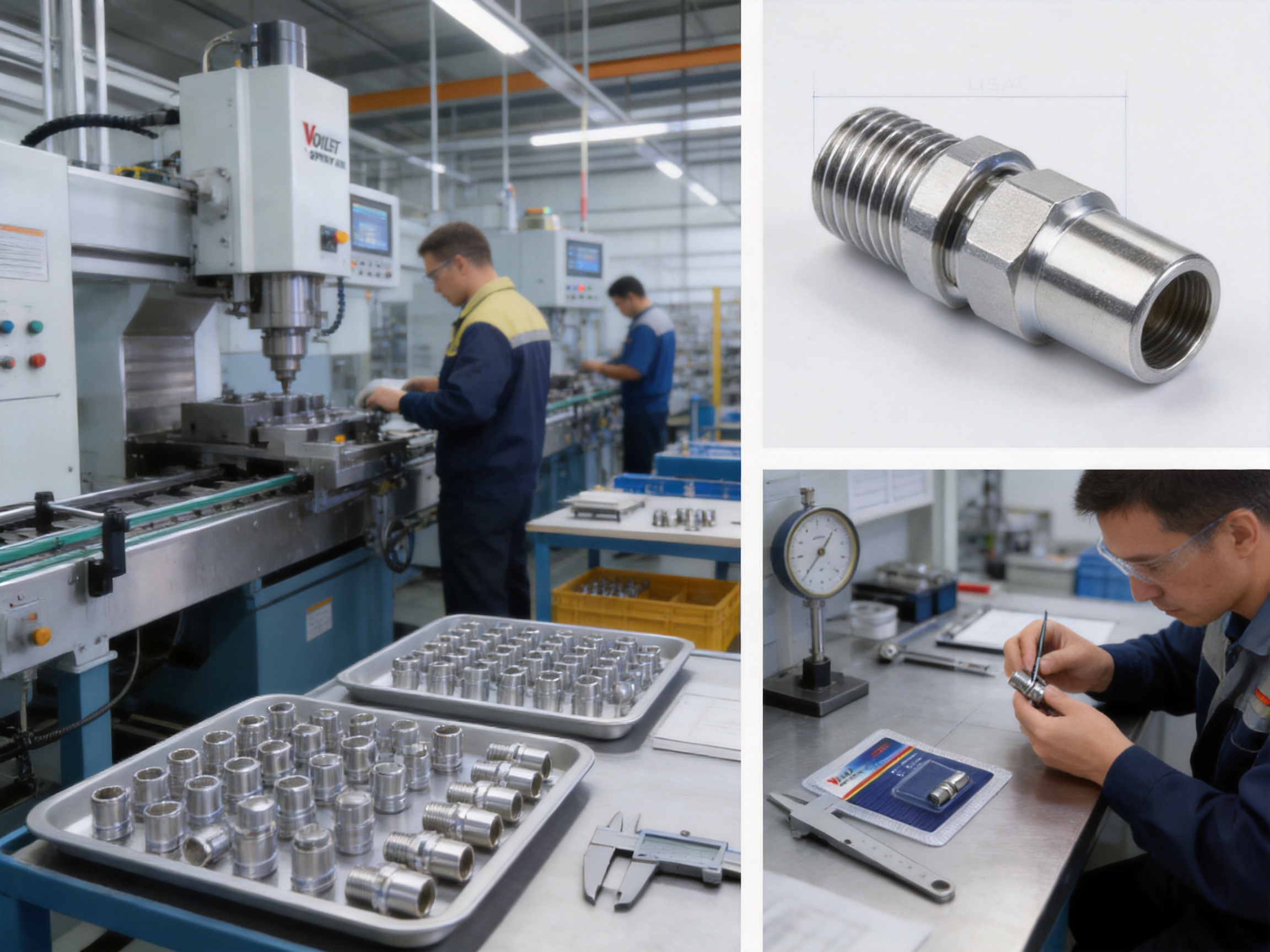
Product quality is most reliable when it is controlled throughout the entire manufacturing process rather than checked only at the end. The stated quality system at Lis Industrial includes raw-material control, incoming inspection, in-process quality control, 100 percent functional testing, and final inspection of finished products.
8.1 Raw-Material and Incoming Inspection
Material quality can influence strength, machinability, surface finish, corrosion resistance, and dimensional stability. Incoming inspection helps confirm that purchased materials and components meet the required specifications before entering production.
This stage may include checking material appearance, dimensions, quantity, surface condition, and relevant supplier documentation. The exact inspection items depend on the material and product design.
8.2 In-Process Inspection
In-process inspection helps identify problems while a product is being manufactured. It can include dimensional checks, visual examination, thread verification, surface inspection, and monitoring of critical production steps. Detecting deviations early reduces waste and helps prevent a large number of nonconforming products from reaching final assembly.
For a quick coupler plug, inspection should pay particular attention to the connection profile, locking surfaces, threaded portions, burrs, and other areas that affect assembly and performance.
8.3 Functional Testing
The company reports 100 percent functional testing as part of its quality-control approach. Functional testing is valuable because it evaluates whether the finished item operates as intended rather than relying solely on dimensional inspection.
Depending on the product and agreed specification, testing may involve connection fit, air passage, leakage behavior, operation of moving elements, and visual confirmation of the finished part. Test requirements should be clarified for each application, especially when the fitting is used in a specialized industrial system.
8.4 Final Quality Inspection
Final inspection provides a last review before packaging and shipment. It may cover quantity, appearance, labeling, packaging condition, and compliance with the purchase order. Proper final inspection helps ensure that the correct product reaches the customer in suitable condition.
8.5 Management-System Certifications
The provided company information states that Lis Industrial has passed ISO9001 international quality system certification, ISO14001 environmental management system certification, and OHSAS18001 occupational health and safety system certification. It also states that the company’s products have passed European CE and German GS international product certification where applicable.
Certifications should always be reviewed according to their scope, validity, issuing body, and relationship to the specific product being purchased. Nevertheless, the presence of structured management systems demonstrates an established approach to quality, environmental responsibility, and occupational safety.
9. Application Guidance for Workshops and Industry
9.1 Spray-Painting Operations
Spray-painting equipment depends on a stable supply of clean and adequately regulated air. The JPM20 can be used as part of a compatible connection system between an air hose and a spray gun or related equipment. Operators should ensure that the hose is appropriate for the working pressure and that the air line includes suitable filtration and regulation where required.
Paint contamination must be kept away from pneumatic connection surfaces. Coating material, solvent residue, dust, and overspray can interfere with coupling operation. The plug and socket should be protected during painting and cleaned according to the equipment manufacturer’s recommendations.
9.2 Automotive Repair
Automotive workshops commonly use several air tools, including spray guns, tyre inflating tools, blow guns, polishers, impact tools, and cleaning equipment. A standardized quick-coupler system can allow these tools to share air outlets efficiently.
Because automotive workshops may expose fittings to oils, cleaning chemicals, dust, vibration, and frequent handling, the connection should be inspected regularly. Damaged threads, bent plugs, leaking seals, or weak locking action should be corrected before continued use.
9.3 Woodworking and Furniture Production
Woodworking operations often require spray finishing, pneumatic cleaning, and air-powered tools. Dust accumulation can affect coupling performance, so the fitting should be protected from excessive contamination. Quick connections can support flexible workstations and make it easier to move equipment between finishing, assembly, and cleaning areas.
9.4 Industrial Maintenance
Maintenance teams may use compressed air for cleaning, testing, assembly, and machine servicing. A quick coupler plug can help technicians connect portable tools to designated air outlets. Clear identification of standard type and pressure requirements is essential when several air systems exist in a plant.
9.5 Mobile and Temporary Installations
Portable compressors and temporary air lines benefit from connections that can be assembled and removed efficiently. The JPM20 may be considered for compatible mobile equipment, provided that the plug, socket, hose, and compressor are correctly matched and protected during transport.
10. Installation and Maintenance Recommendations
Correct installation is necessary to obtain the expected benefit from any pneumatic fitting. The following recommendations provide general guidance, but the supplier’s technical instructions and the requirements of the complete pneumatic system should take priority.
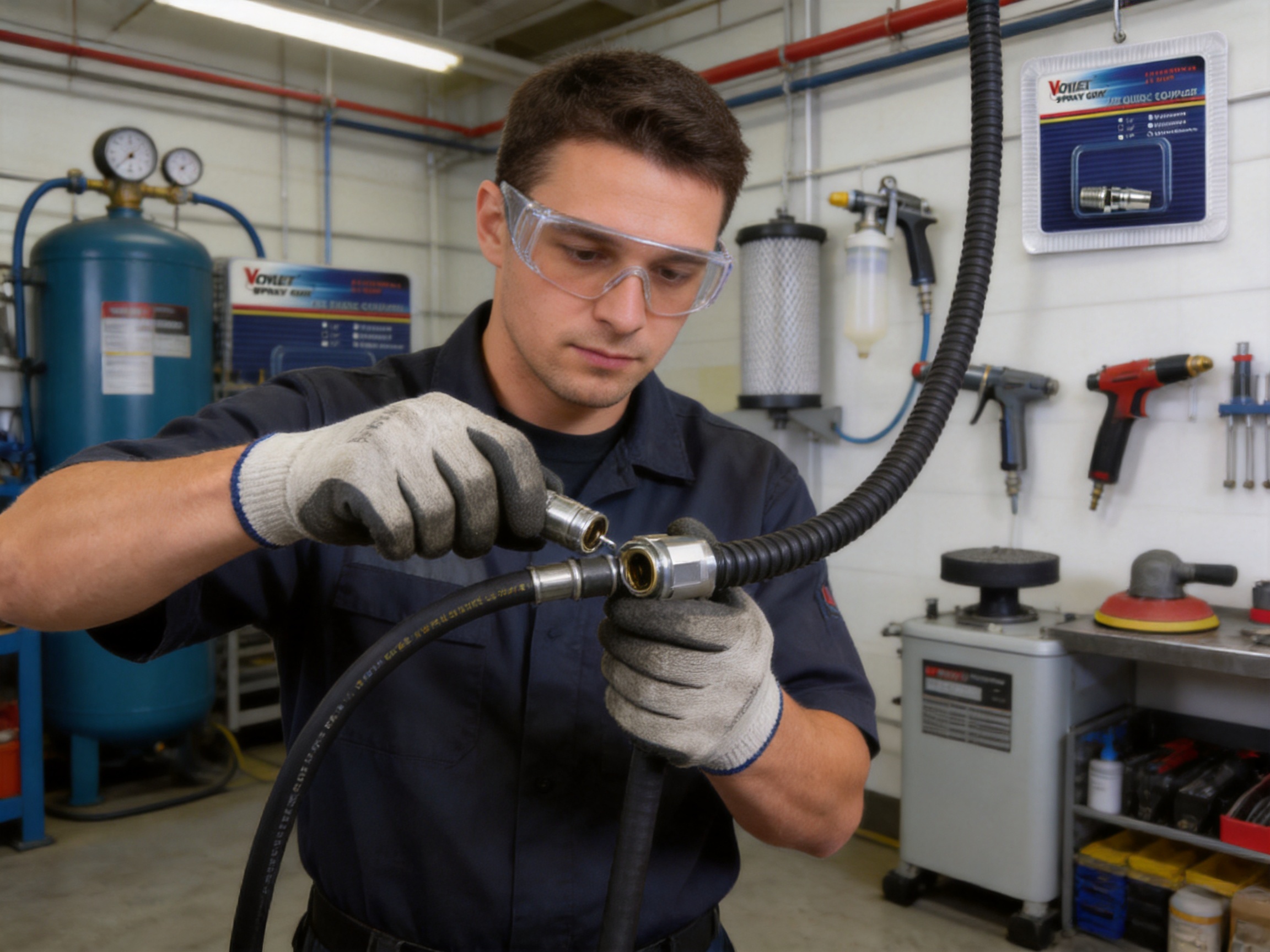
First, verify that the plug and socket belong to the same standard family. Do not force a plug into a socket that does not accept it smoothly. If unusual resistance is felt, stop the installation and inspect the profile, dimensions, and condition of both components.
Second, inspect the fitting before installation. Look for burrs, dents, corrosion, contamination, damaged threads, or other visible defects. A damaged plug may impair sealing or harm the socket.
Third, use the correct thread-sealing method if the model includes a threaded connection. Excessive sealing tape or compound can enter the air passage and cause blockage. The sealing material should be applied in a manner compatible with the thread design and the air equipment.
Fourth, support the hose properly. A quick coupler should not carry unnecessary bending or pulling loads. Use suitable hose routing, clamps, strain relief, or support brackets where required.
Fifth, depressurize the system before disconnecting equipment unless the coupling and operating procedure are specifically designed for the relevant condition. Pressurized disconnection can create a sudden hose movement, noise, or release of stored energy.
Sixth, inspect the connection regularly. Signs of leakage may include audible air loss, reduced tool performance, unusual compressor cycling, or a pressure drop when the system is not in use. Leaking components should be repaired or replaced promptly.
Finally, keep the plug and socket clean and capped when not in use. Dust and debris can damage sealing surfaces and reduce the service life of the coupling.
11. Purchasing Considerations for Distributors and OEM Buyers
Industrial buyers should evaluate more than unit price when sourcing pneumatic fittings. The total cost of ownership includes product life, leakage, maintenance, downtime, compatibility problems, inspection requirements, replacement availability, and supplier responsiveness.
Before placing an order, buyers should request or confirm:
• Product model and standard classification.
• Technical drawing or dimensional information.
• Compatible socket or coupler reference.
• Recommended working pressure and temperature conditions.
• Material and surface-finish information.
• Available packaging and labeling options.
• Inspection and testing procedures.
• Sample availability.
• Minimum order quantity and production lead time.
• Export packaging and shipping documentation.
• Warranty and replacement policy.
For distributors, consistent packaging and clear identification are particularly important. A fitting should be easy to identify in inventory and should not be confused with similar products from another standard family.
For OEM customers, early communication with the manufacturer can reduce later changes. Drawings, samples, application conditions, and expected annual demand should be reviewed before finalizing the product. When a customer requires a customized item, the supplier should confirm which changes affect tooling, testing, certification, cost, and lead time.
12. Environmental and Operational Responsibility
Efficient compressed-air use is an important part of responsible industrial operation. Air leakage forces a compressor to work longer, increasing energy consumption and operating cost. Although a quick coupler is only one component in the system, a well-matched and well-maintained connection can contribute to better air-system efficiency.
Environmental performance also depends on manufacturing practices. The company’s stated ISO14001 environmental management certification indicates that environmental management has been incorporated into its organizational systems. Buyers should still evaluate the specific material, packaging, recycling, and disposal requirements relevant to their region and application.
Occupational safety is equally important. Pneumatic systems store energy, and incorrect connection or disconnection can create hazards. Operators should receive appropriate training and should use protective equipment suitable for the work. Couplers, hoses, and tools should be inspected as part of a regular safety program.
13. International Supply and Customer Support
Lis Industrial serves customers in Europe, North America, the Middle East, South Africa, East Asia, and other regions. Its international customer base includes distributors, industrial users, and strategic business partners. This experience is relevant to buyers who need more than a single shipment of standard fittings.
International supply requires attention to product classification, packaging, documentation, communication, inspection, and delivery planning. A manufacturer with an established export network can help coordinate these activities more effectively than an inexperienced supplier.
The company’s brands include Voylet and Muzi, and its product portfolio covers complete spraying and air-tool solutions. This broad market presence can support customers who want to source fittings together with spray guns, compressors, air hoses, pipeline accessories, or other equipment from one manufacturing group.
For customers with special requirements, technical communication should include drawings, sample approval, application photographs where useful, performance expectations, and local regulatory needs. Clear communication reduces the risk of receiving a product that is technically correct in general but unsuitable for a particular installation.
14. Recommended Evaluation Procedure
A practical evaluation process can help a buyer determine whether the JPM20 is appropriate for a specific project.
Step one is to identify the existing socket or coupler standard. Record its model, manufacturer, dimensions, and application. If the information is unavailable, provide a sample or technical drawing for comparison.
Step two is to confirm the air-system requirements. These include working pressure, hose size, expected air consumption, ambient temperature, exposure to oil or chemicals, and frequency of connection and disconnection.
Step three is to request product information from the supplier. Dimensional drawings, compatible product references, material details, inspection procedures, and packaging information should be reviewed before ordering.
Step four is to test samples under realistic conditions. Connect the plug to the actual socket, operate the tool at the intended pressure, inspect for leakage, and perform repeated connection cycles if frequent changeover is expected.
Step five is to approve the final specification. The approved model, standard, dimensions, packaging, labeling, and inspection requirements should be recorded for future orders.
Step six is to monitor performance after installation. Record leakage, replacement frequency, connection difficulty, and user feedback. This information can help the buyer optimize future purchases and maintenance procedures.
15. Why the Manufacturer’s Broader Expertise Matters
A pneumatic fitting manufacturer that also produces spray guns, compressors, and air tools can evaluate the fitting in relation to real equipment requirements. This broader expertise helps connect product design with practical use.
Spray-gun performance, for example, may be affected by air pressure stability, hose diameter, fitting restrictions, regulator accuracy, and filtration. A supplier familiar with the entire spraying system is more likely to understand how a small connector can influence the operator’s experience.
Likewise, pneumatic tool users need reliable connections that withstand repeated workshop handling. Experience in air-tool production provides insight into common failure modes, maintenance practices, and user expectations.
The company’s long operating history, extensive workforce, engineering resources, quality systems, and international sales network provide a foundation for stable product development and supply. These strengths do not remove the need for technical verification, but they give buyers a stronger basis for evaluating a long-term supplier relationship.
16. Frequently Asked Questions
Q1: What is the JPM20 product?
The JPM20 is identified as a pneumatic fitting and air compressor hose quick coupler plug in the Japan Standard category. It is intended for use with a compatible receiving coupler in compressed-air applications.
Q2: Is the JPM20 compatible with every quick socket?
No. Quick coupler plugs must match the correct standard profile and dimensions. The JPM20 should be used with a compatible Japan Standard socket or coupler. Buyers should verify the exact specification before installation.
Q3: Where can this type of plug be used?
It may be used in compatible compressed-air systems for spray guns, air hoses, pneumatic tools, air blowing guns, polishing equipment, maintenance equipment, and workshop air pipelines. The operating pressure, temperature, and fluid conditions should be confirmed for the specific application.
Q4: Can the plug improve air-system efficiency?
A correctly matched and properly maintained plug can help reduce connection-related leakage. Overall system efficiency also depends on the socket, hose, seals, compressor, regulator, filters, and pipeline design.
Q5: What should be checked before ordering?
Check the standard family, dimensions, thread specification if applicable, hose size, pressure requirements, material, surface finish, compatible socket, packaging, and supplier inspection procedures.
Q6: Can the product be supplied for OEM applications?
Lis Industrial provides OEM production according to customer drawings or samples and offers ODM services according to customer needs. Specific customization should be reviewed with the company’s engineering and sales teams.
Q7: How should the fitting be maintained?
Keep the plug clean, protect it from dust and paint contamination, inspect it for damage, avoid excessive hose pulling, and replace it if the connection becomes loose, difficult to operate, or visibly damaged.
Q8: What should be done if the plug does not insert smoothly?
Do not force the connection. Depressurize the system, inspect the plug and socket, confirm that they use the same standard, and check for dirt, burrs, deformation, or incorrect dimensions.
Q9: Does the fitting require thread sealant?
If the model includes a threaded end, the connection may require an appropriate sealing method. The correct sealant or tape and installation procedure depend on the thread design and system requirements. Excess material should be prevented from entering the air passage.
Q10: Is a quick coupler safe to disconnect under pressure?
Safe disconnection depends on the coupling design and operating procedure. In general, the system should be depressurized before disconnecting unless the product is specifically designed for pressurized release and the user follows the approved procedure.
Q11: What quality systems support the product?
The provided company information states that Lis Industrial operates under ISO9001, ISO14001, and OHSAS18001 certified management systems and has products with CE and GS certifications where applicable. Buyers should request documentation relevant to the exact product and order.
Q12: Why choose an experienced air-tool manufacturer?
An experienced manufacturer can provide better understanding of pneumatic applications, more organized production and inspection, technical support, OEM or ODM assistance, and greater potential for stable long-term supply.
17. Conclusion
The JPM20 pneumatic fittings air compressor hose quick coupler plug is designed to support convenient, detachable connections in Japan Standard compressed-air systems. Its value lies in more than quick connection alone. When correctly matched with a suitable socket, hose, and air system, it can contribute to faster tool changes, easier maintenance, improved workshop organization, and a more serviceable pneumatic installation.
The most important purchasing consideration is compatibility. Buyers should verify the standard profile, dimensions, pressure requirements, thread details, materials, and application conditions before ordering. Correct installation and regular maintenance are also essential for achieving reliable performance.
The product is supported by the manufacturing capabilities of Ningbo Lis Industrial Co., Ltd., a company with long-term experience in spray guns, compressors, air tools, fittings, and spraying solutions. Its engineering resources, OEM and ODM capability, production scale, documented quality-control procedures, international certifications, and global customer experience provide meaningful advantages over unverified alternatives.
For distributors, industrial users, equipment manufacturers, and professional workshops, the JPM20 can be considered as part of a complete and standardized compressed-air connection strategy. By combining appropriate product selection with sound installation practices and supplier cooperation, users can obtain a more reliable, efficient, and manageable pneumatic system.
References
1. Ningbo Lis Industrial Co., Ltd. Product and company information supplied for the JPM20 pneumatic fitting air compressor hose quick coupler plug.
2. ISO 9001, Quality Management Systems — Requirements.
3. ISO 14001, Environmental Management Systems — Requirements with Guidance for Use.
4. ISO 4414, Pneumatic Fluid Power — General Rules and Safety Requirements for Systems and Their Components.
5. Occupational health and safety management system principles based on OHSAS 18001.
6. General manufacturer guidance for compressed-air hose installation, coupling inspection, leakage prevention, and pneumatic-tool maintenance.
7. General engineering practices for air compressor systems, pneumatic fittings, hose assemblies, and quick-release couplings.