 Search

 English
 中文简体
 Deutsch
 Español
Content
- 1 Product Overview
- 2 How the Sandblasting Gun Works
- 3 Key Product Advantages
- 4 Applications
- 5 Advantages Compared with Basic Alternative Tools
- 6 Manufacturing Strengths Behind the Product
- 7 Recommended Operating Procedure
- 8 Maintenance and Service Guidance
- 9 Choosing the Right Abrasive and Pressure
- 10 Purchasing Considerations for Distributors and Industrial Buyers
- 11 Role of the Manufacturer in Global Supply
- 12 Environmental and Workplace Considerations
- 13 Limitations and Proper Expectations
- 14 Quality-Control Perspective
- 15 Q&A
- 15.1 What is the PS4 Steel Nozzle Sandblasting Gun with a Cup designed for?
- 15.2 What is the rated pressure?
- 15.3 What is the maximum pressure?
- 15.4 What type of nozzle does the product use?
- 15.5 Does the product require a separate abrasive tank?
- 15.6 Can it be used for large industrial blasting projects?
- 15.7 What compressor is required?
- 15.8 Can the gun be used on wood?
- 15.9 How should the tool be maintained?
- 15.10 What is the carton packing quantity?
- 15.11 What are the carton dimensions?
- 15.12 Does the manufacturer offer OEM or ODM services?
- 15.13 What quality systems does the manufacturer report?
- 15.14 Who is the product manufacturer?
- 16 Conclusion
- 17 References
- 18 Product: PS4 Steel Nozzle Sandblasting Gun with A Cup
Surface preparation is one of the most important stages in painting, repair, renovation, maintenance, and workshop production. Before a new coating can perform properly, the surface must be clean, dry, and free from loose paint, rust, oxidation, dirt, and other contaminants. A sandblasting gun provides a practical way to remove unwanted material with compressed air and abrasive media, helping operators prepare metal, wood, masonry, and selected manufactured surfaces for further treatment.
The PS4 Steel Nozzle Sandblasting Gun with a Cup is designed for users who need a compact, straightforward, and economical blasting tool. Its configuration combines a steel nozzle with an integrated abrasive cup, allowing the operator to work without depending on a large external abrasive tank for many small and medium tasks. With a rated pressure of 70 PSI and a maximum pressure of up to 150 PSI, the tool is suitable for a broad range of workshop, maintenance, restoration, and touch-up applications when used with a correctly regulated compressed-air supply.
This article examines the product’s construction, operating principle, technical data, application value, maintenance requirements, and purchasing considerations. It also explains how the manufacturing capabilities of Ningbo Lis Industrial Co., Ltd. support consistent production, quality control, customization, and supply reliability for professional buyers and distributors.
Product Overview
The PS4 is a cup-style sandblasting gun developed for abrasive cleaning and surface preparation. The design is intentionally compact. Instead of using a separate pressure pot or large abrasive reservoir, the gun carries abrasive material in its attached cup. This arrangement reduces the number of components required for basic operation and makes the tool convenient for localized work.
The product is classified within the sandblast gun and foam gun category, although its principal function is abrasive blasting. The gun uses compressed air to draw or transport abrasive particles through the air passage and discharge them through a steel nozzle. The resulting air-abrasive stream can remove surface contamination and create a profile that improves coating adhesion.
Its rated pressure is 70 PSI, while its maximum pressure is listed as no more than 150 PSI. These figures are important because the operating pressure should be selected according to the material being removed, the abrasive used, the surface substrate, the available compressor, and the operator’s safety requirements. Maximum pressure is not automatically the recommended working pressure. In many applications, a lower setting provides sufficient cleaning performance with less surface damage and lower abrasive consumption.
| Specification | Product Information |
|---|---|
| Product name | PS4 Steel Nozzle Sandblasting Gun with a Cup |
| Product category | Sandblast Guns/Foam Guns |
| Rated pressure | 70 PSI |
| Maximum pressure | Not more than 150 PSI |
| Nozzle material | Steel |
| Abrasive supply | Integrated cup |
| Carton packing | 10 pieces per carton |
| Carton dimensions | 59 × 37.5 × 24 cm |
The compact format makes the PS4 particularly useful when the operator must move around a workpiece or reach a small area. It can be used in a workshop, garage, maintenance room, fabrication area, vehicle repair environment, or other location equipped with a suitable air compressor and air connection.
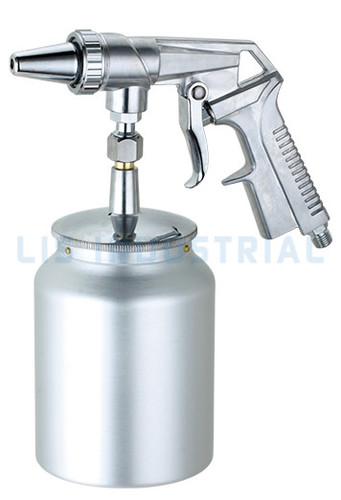
PS4 Steel Nozzle Sandblasting Gun with A Cup
How the Sandblasting Gun Works
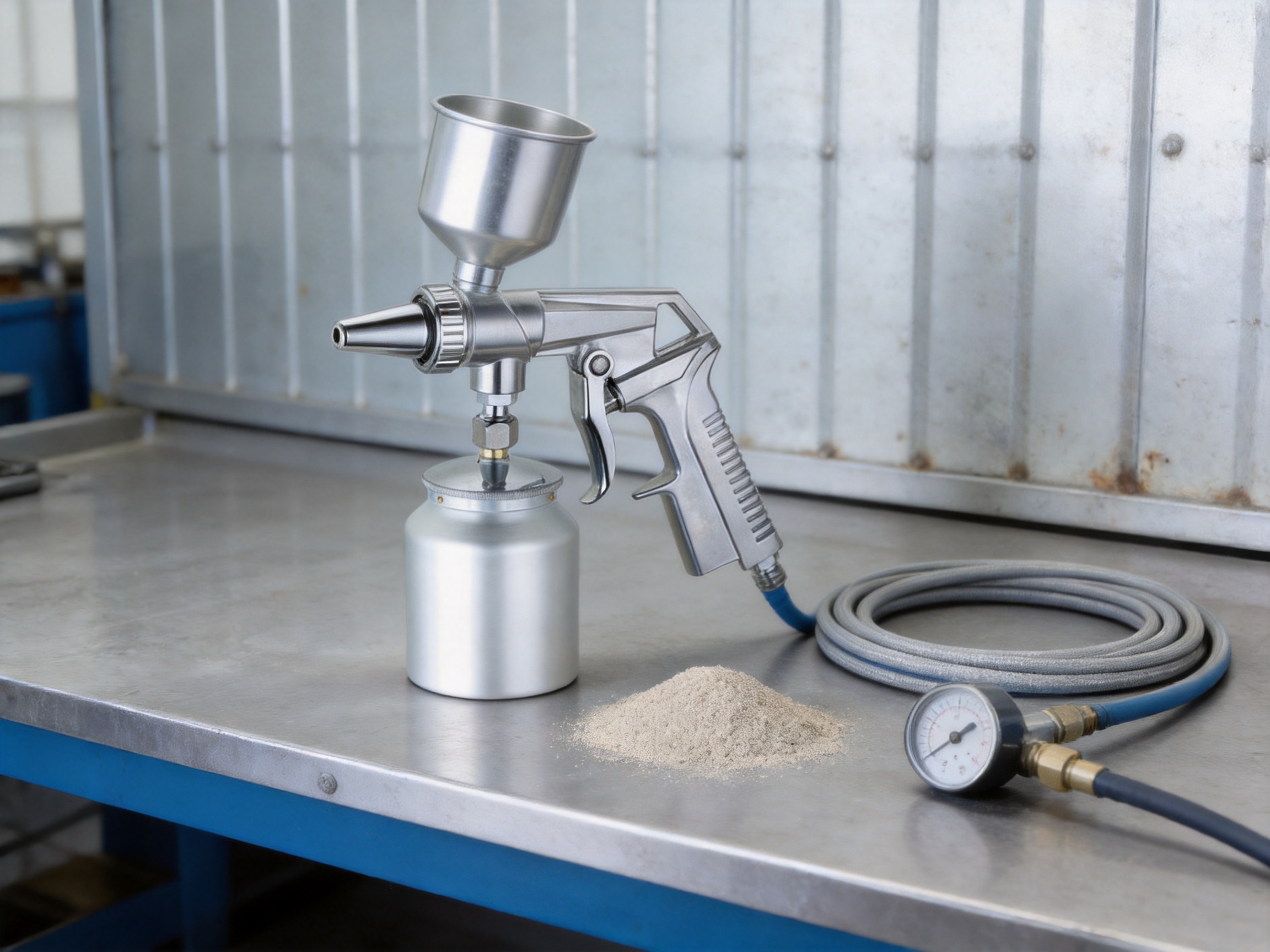
A sandblasting gun operates by directing compressed air through an internal passage. As the air accelerates, it creates the flow required to move abrasive material from the cup toward the nozzle. The abrasive particles are then expelled at high speed in a concentrated stream.
The force of the blasting stream depends on several factors. Air pressure is one factor, but it is not the only one. Air volume, nozzle condition, abrasive particle size, abrasive hardness, distance from the workpiece, angle of application, and the design of the internal passages all influence the final result.
The operator normally begins by selecting a compatible abrasive. The abrasive should be clean, dry, and suitably sized for the gun. Damp or contaminated media can restrict the passage, cause uneven delivery, or create blockages. The workpiece should be inspected before blasting to identify thin sheet metal, delicate edges, seams, glass, plastic, electrical components, or other areas that may be damaged by abrasive impact.
After connecting the gun to a properly regulated compressed-air line, the operator tests the spray pattern on a scrap piece or an inconspicuous section of the workpiece. This test helps determine whether the pressure and abrasive flow are appropriate. The gun is then moved steadily across the surface rather than held motionless in one position.
Correct technique is essential. Holding the gun too close can concentrate excessive energy on a small area, potentially causing deformation, excessive roughness, or unnecessary material removal. Holding it too far away can reduce cleaning efficiency. A consistent distance and controlled sweeping motion normally produce more uniform results.
Key Product Advantages
Compact Cup-Based Configuration
The integrated cup is one of the most practical features of the PS4 design. A separate abrasive tank can provide greater capacity, but it also increases equipment size, setup time, and component count. For small jobs, those additional requirements may not be justified. A cup-style gun allows the user to load a manageable quantity of abrasive directly into the tool and begin work with minimal preparation.
This configuration is advantageous for spot repairs, edge cleaning, rust removal, hardware preparation, restoration work, and other applications where the operator does not need continuous blasting for long periods. The tool can be carried easily from one work area to another, and storage is simpler because fewer auxiliary parts are needed.
Steel Nozzle Construction
The nozzle is exposed to a high-velocity mixture of compressed air and abrasive. For that reason, nozzle material has a direct effect on service life and operating consistency. The PS4 uses a steel nozzle, providing a practical balance between strength, availability, and cost for general-purpose abrasive work.
A steel nozzle is appropriate for users who require a durable working component without moving immediately to a specialized premium nozzle material. Nozzle wear remains a normal part of abrasive blasting, and its rate depends on the abrasive type, operating pressure, work cycle, and cleaning conditions. However, a robust steel nozzle can support dependable day-to-day use when the tool is operated within its intended pressure range.
Useful Pressure Range
The listed 70 PSI rated pressure provides a clear reference for normal operation. The maximum pressure of up to 150 PSI gives the user additional capacity when the application and equipment are suitable. This range allows the tool to be adjusted for different surface conditions rather than forcing every task to use the same setting.
Lower pressure may be appropriate for thin metal, painted surfaces, softer substrates, or controlled detail work. Higher pressure may be considered for heavy oxidation or firmly bonded contamination, provided the abrasive, surface, air supply, and safety controls are suitable. The operator should always follow the pressure limits of the complete system, including the air hose, fittings, regulator, compressor, and gun.
Simple Operation
Compared with a more complex blasting system, the PS4 has a relatively simple operating concept. The user connects the air supply, fills the cup with suitable abrasive, adjusts the air pressure, and performs a controlled test. Fewer controls can reduce training requirements for basic tasks while making the product accessible to workshops, maintenance teams, contractors, and experienced hobby users.
Simplicity also supports easier troubleshooting. If performance decreases, the operator can inspect the air supply, abrasive condition, cup outlet, nozzle, and fittings in a logical sequence. A simple tool structure can be especially valuable in locations where maintenance resources are limited.
Efficient for Localized Work
The PS4 is not intended to replace every type of industrial blasting equipment. Large pressure pots and continuous-feed systems remain more suitable for major production work and extensive surface areas. The strength of the PS4 lies in its practicality for localized and intermittent jobs.
It can help users avoid setting up a large system for a small repair. This saves preparation time and can reduce equipment handling. In maintenance departments, the tool can be kept ready for occasional work without occupying the space required by a full-scale blasting cabinet or pressure vessel.
Convenient Distribution and Storage
The product is packed at 10 pieces per carton, with carton dimensions of 59 × 37.5 × 24 centimeters. This packaging format is convenient for importers, wholesalers, retailers, and industrial distributors. It provides a clear unit count for inventory planning and supports efficient carton-based shipment.
Compact packaging can also reduce warehouse complexity. Distributors can allocate stock according to regional demand, while end users can store spare tools or replacement units without requiring a large amount of space.
Applications
Rust and Oxidation Removal
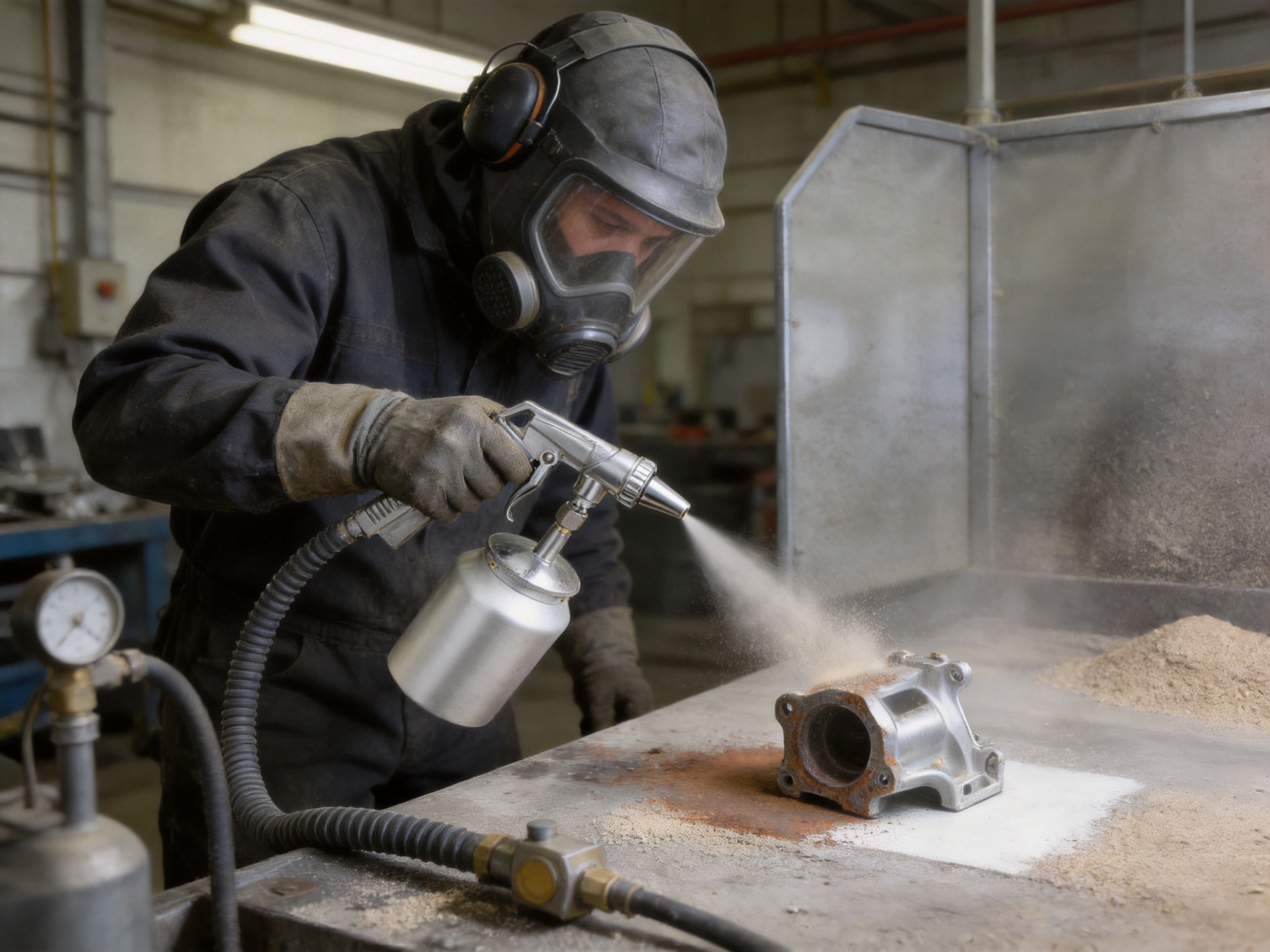
Rust removal is one of the most common uses for a sandblasting gun. Abrasive impact can remove loose oxidation and prepare sound metal for priming or painting. The operator should control the pressure and movement speed to avoid unnecessary removal of healthy material or excessive roughening.
For heavily corroded components, several passes may be more appropriate than one aggressive pass. After blasting, the surface should be cleaned of residual dust and protected promptly because freshly exposed metal can oxidize quickly in humid conditions.
Old Paint and Coating Removal
The PS4 can be used to remove loose, flaking, or unwanted coatings from selected metal components and other compatible substrates. Its concentrated stream is useful for corners, brackets, hardware, edges, and repair zones that are difficult to clean with a brush or sanding pad.
Coating removal must be approached carefully. Some old paints may contain hazardous substances, and blasting can create airborne dust. Users should identify the coating where possible, follow local regulations, use suitable containment, and wear respiratory and personal protective equipment designed for the work.
Surface Preparation Before Painting
A clean and appropriately textured surface can improve coating adhesion. Blasting can remove contamination while creating a mechanical profile that gives primer or paint a better foundation. The correct degree of profile depends on the coating manufacturer’s requirements and the substrate.
After blasting, the surface must be free from loose abrasive and dust. Any oil or grease contamination should be dealt with using an appropriate cleaning method, since blasting alone does not always remove or neutralize oily residues. The painting process should begin within the recommended time window for the material and environmental conditions.
Automotive and Equipment Repair
In automotive and equipment maintenance, a cup-style sandblasting gun can be useful for brackets, fasteners, small panels, wheels, housings, tools, and localized repair zones. It can assist with preparation before refinishing and help expose defects that are hidden beneath corrosion or old coatings.
Vehicle components should be removed or carefully protected before abrasive work. Bearings, seals, electrical connectors, rubber parts, glass, and precision surfaces may be damaged by abrasive particles. The product is best used as part of a controlled repair process rather than as an unrestricted cleaning tool.
Metal Fabrication
Fabricators can use the PS4 to clean weld areas, remove surface scale, prepare repair sections, and improve the appearance of small metal parts. It may be particularly useful where a full blasting cabinet is unavailable or where only one section of a larger assembly requires treatment.
Because the gun is manually operated, the final finish depends on the operator’s technique. Consistent passes and appropriate abrasive selection are important when visual uniformity is required.
Wood and Restoration Work
Some restoration projects use controlled abrasive blasting to remove old finishes or weathered surface layers from wood. However, wood is more sensitive than steel, and aggressive blasting can damage grain, soften edges, or create an uneven appearance. Low pressure, a suitable gentle abrasive, greater working distance, and careful testing are essential.
The same principle applies to masonry, composite materials, and other non-metallic surfaces. The user should confirm substrate compatibility before beginning a large area.
Advantages Compared with Basic Alternative Tools
Different surface-preparation tools serve different purposes. Wire brushes, sanding discs, scrapers, chemical removers, and blasting systems may all be appropriate in specific circumstances. The PS4 offers particular advantages when the user needs concentrated abrasive action in a compact pneumatic format.
Compared with Manual Brushing
Manual brushing is inexpensive and useful for loose contamination, but it can require significant physical effort. A brush may not reach small recesses effectively, and it may polish rather than remove firmly bonded deposits. The PS4 can direct abrasive into corners and irregular areas with greater impact, potentially reducing preparation time for suitable jobs.
Compared with Hand Sanding
Hand sanding offers precise control and is often suitable for delicate finishing. However, it can be slow on corrosion, textured surfaces, and recessed areas. A blasting gun can provide a more effective cleaning action on compatible surfaces, although it requires dust control and careful pressure management.
Compared with Large Abrasive Systems
Large blasting systems offer higher capacity and longer continuous operation, but they usually require more space, setup, maintenance, and investment. The PS4 is more accessible for occasional work and small repair zones. Its cup-based format can reduce the preparation burden for users who do not need industrial-scale throughput.
Compared with Low-Quality Disposable Tools
Very low-cost blasting tools may suffer from inconsistent air passages, weak fittings, poor trigger response, or short nozzle life. A product developed within an established air-tool manufacturing system can offer stronger support in areas such as production consistency, inspection, packaging, and after-sales communication.
The practical advantage is not simply the purchase price. Total value also includes operating stability, availability of technical information, replacement planning, product consistency between batches, and the supplier’s ability to support repeat orders.
Manufacturing Strengths Behind the Product
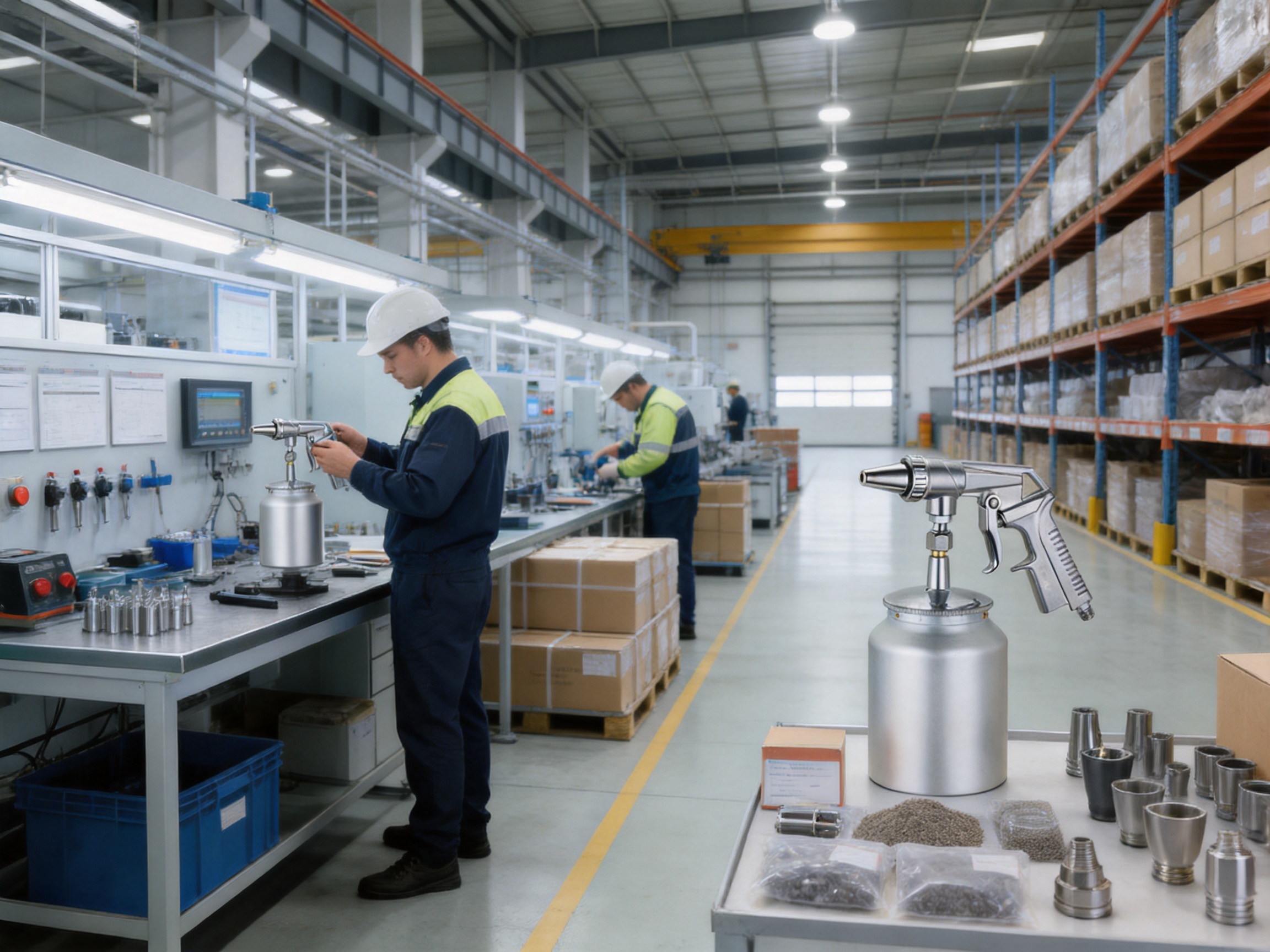
Ningbo Lis Industrial Co., Ltd. has specialized in air painting spray guns, mini air compressors, and related air tools since its establishment in 1984. The company’s long-term focus on pneumatic and spraying equipment provides an industrial foundation for products such as the PS4 sandblasting gun.
The company operates from Ningbo, China, and has developed a large manufacturing site covering more than 400,000 square feet. Its workforce includes more than 400 employees, and the company reports annual output exceeding 40 million United States dollars. These resources support production planning, engineering development, procurement, assembly, testing, packaging, and international order fulfillment.
Scale alone does not guarantee product quality, but it can provide important advantages when supported by disciplined management. A broad manufacturing base allows the supplier to maintain dedicated processes, coordinate component sourcing, manage production capacity, and respond to different customer requirements.
Research and Development
The company maintains a research and development team focused on spraying machinery and air tools. Its capabilities include original product development, OEM production based on customer drawings or samples, and ODM support according to customer requirements.
For distributors and professional buyers, this capability can be valuable when a standard product must be adapted for a regional market. Possible areas of discussion may include packaging, labeling, color, accessories, operating instructions, connection standards, and order configuration, subject to engineering and commercial review.
Product development in pneumatic tools requires attention to air passage geometry, trigger operation, sealing, material compatibility, nozzle behavior, assembly accuracy, and user handling. These details can affect the actual performance of a tool even when the external appearance is simple.
Production Process Control
The manufacturer describes a quality system that covers raw-material and incoming inspection, in-process quality control, functional testing, and final inspection of finished products. This multi-stage approach is important because defects can originate in materials, machining, forming, assembly, or packaging.
Incoming inspection helps verify that purchased materials and components meet the required specifications before they enter production. In-process inspection can identify problems earlier, reducing the risk that a complete batch will require rework. Functional testing provides an additional check of practical operation, while final inspection helps confirm that the finished goods are ready for shipment.
For a sandblasting gun, relevant inspection points may include the condition of the steel nozzle, trigger action, cup attachment, air connection, seals, surface finish, dimensional conformity, and basic pressure or leakage performance. The exact inspection plan depends on the product specification and internal quality procedures.
Functional Testing
Air tools must function as complete systems. A component can meet a dimensional requirement and still perform poorly if an internal passage is obstructed, a seal is damaged, or the trigger does not regulate airflow correctly. Functional testing is therefore a valuable part of production control.
The company states that it performs 100 percent functional testing within its quality process. This type of testing is intended to reduce the chance that a non-functioning unit reaches the customer. It also supports more consistent performance across production batches.
Quality and Certification Background
Ningbo Lis Industrial Co., Ltd. reports conformity with ISO9001 quality management requirements and certifications or approvals including CE and GS for applicable products. The company also describes experience with ISO14001 environmental management and OHSAS18001 occupational health and safety management systems.
Certification should always be evaluated according to the specific product, certificate scope, current validity, and destination-market requirements. Nevertheless, experience with formal management systems indicates that the supplier is familiar with documented processes, traceability, audit preparation, corrective action, and controlled production practices.
Capacity and Supply Continuity
The company reports that production capacity can be increased by 30 percent within two months. For buyers handling seasonal demand, promotional programs, or new distribution contracts, scalable capacity can reduce the risk of extended lead times.
Capacity planning should still be confirmed for each order. Buyers should discuss forecast quantity, target delivery date, packaging requirements, inspection expectations, spare-parts needs, and shipping arrangements before placing a purchase order.
Recommended Operating Procedure
1. Inspect the Tool
Before use, inspect the gun, cup, nozzle, trigger, air inlet, and visible seals. Do not use the tool if a component is cracked, loose, damaged, or excessively worn. Confirm that the air hose and fittings are rated for the intended pressure.
2. Select a Suitable Abrasive
Use clean, dry abrasive media with a particle size compatible with the gun. Avoid media that contains moisture, large foreign particles, oil, or debris. The abrasive should also be suitable for the workpiece and the desired finish.
3. Prepare the Work Area
Remove unnecessary objects from the work area. Protect nearby equipment, finished surfaces, electrical components, windows, seals, and other vulnerable items. Establish suitable ventilation or containment, especially when blasting indoors.
4. Wear Protective Equipment
Blasting can produce dust, rebound particles, and high noise levels. Operators should use suitable eye and face protection, hearing protection, gloves, protective clothing, and respiratory protection appropriate for the abrasive and coating being removed. Workplace risk assessments and local regulations should determine the required protection.
5. Regulate the Air Pressure
Set the air regulator to a conservative level before beginning. The rated pressure is 70 PSI, and the maximum pressure is no more than 150 PSI. Never exceed the pressure rating of the complete system. Start with a low setting and increase gradually only when necessary.
6. Test the Spray Pattern
Perform a test on scrap material or an inconspicuous area. Check the abrasive flow, cleaning effect, surface impact, and consistency of the spray. Adjust pressure, distance, angle, or media selection as required.
7. Use Controlled Passes
Move the gun steadily across the surface. Avoid concentrating the stream in one location for too long. Overlapping passes can improve uniformity, but excessive overlap may produce unnecessary roughness or remove too much material.
8. Clean and Inspect the Surface
After blasting, remove dust and residual abrasive. Inspect the surface for remaining rust, coating, grease, or uneven areas. If painting will follow, use the coating manufacturer’s recommendations for cleanliness, surface profile, primer selection, and application timing.
Maintenance and Service Guidance
Good maintenance helps preserve airflow, abrasive delivery, and operating consistency. After each use, empty remaining abrasive from the cup. Do not leave abrasive inside the tool where it can absorb moisture or settle into the passage.
Clean the cup and visible air passages using an appropriate method. Compressed air may be used carefully for clearing dry residue, but the operator should avoid directing debris toward people or sensitive equipment. Inspect the nozzle regularly for wear. A worn nozzle can change the spray pattern, increase air consumption, and reduce control.
Check the air hose, quick coupler, and threaded connections for leakage. Air leaks waste compressor capacity and can reduce effective blasting performance. Replace damaged seals or fittings with compatible parts. Threads should be assembled carefully to avoid cross-threading or damage.
Moisture management is also important. Water in the compressed-air line can cause abrasive clumping, inconsistent flow, corrosion, and internal contamination. A suitable filter or moisture separator can help improve air quality. The compressor should be maintained according to its own instructions.
Store the gun in a clean, dry location away from excessive humidity, corrosive chemicals, and impact. If the product is used infrequently, inspect it before the next operation rather than assuming that previous condition remains unchanged.
Choosing the Right Abrasive and Pressure
Abrasive selection should be based on the substrate, contamination, desired surface profile, environmental requirements, and available equipment. Harder abrasives may remove heavy corrosion more quickly but can also damage delicate surfaces and accelerate nozzle wear.
Finer media may provide greater control for detail work, while coarser media may be more effective for thick coatings or heavy scale. The operator should consider the manufacturer’s guidance for the chosen abrasive and confirm that the particles can pass through the gun without blockage.
Pressure should be treated as a control variable, not simply a performance target. A higher setting may increase cleaning speed, but it can also increase abrasive consumption, dust, substrate damage, and wear on the nozzle and internal components. The most efficient setting is often the lowest pressure that achieves the required result.
The correct working distance is equally important. A closer distance concentrates energy, while a greater distance spreads the stream. The ideal position depends on the surface, nozzle condition, abrasive, and desired finish. Operators should develop technique through testing rather than relying on a single universal measurement.
Purchasing Considerations for Distributors and Industrial Buyers
Buyers should evaluate more than the product photograph when sourcing a sandblasting gun. The technical specification, nozzle material, pressure information, packaging, inspection process, documentation, and supplier communication all influence the product’s value.
For repeat purchasing, buyers should request confirmation that the product specification will remain consistent between orders. Any changes to nozzle material, cup dimensions, fittings, packaging, or labeling should be communicated through an agreed change-control process.
Packaging is particularly relevant for international distribution. The PS4 is packed 10 pieces per carton, with a stated carton size of 59 × 37.5 × 24 centimeters. Buyers can use this information to estimate pallet utilization, warehouse space, freight planning, and landed cost.
Documentation may include product specifications, operating instructions, safety guidance, inspection records, certificates applicable to the destination market, and replacement-part information. Retail distributors may also require barcode labels, multilingual packaging, and customized marketing materials.
OEM and ODM capability can provide additional flexibility. A supplier able to support customized products may help buyers develop a differentiated package rather than competing only on price. Any customized arrangement should define drawings, samples, acceptance criteria, tooling responsibility, minimum order quantity, lead time, and ownership of technical information.
Role of the Manufacturer in Global Supply
Ningbo Lis Industrial Co., Ltd. serves customers in Europe, North America, the Middle East, South Africa, East Asia, and other markets. Its reported export experience and international customer base indicate familiarity with overseas supply requirements and distributor relationships.
The company’s product portfolio includes high-volume spray guns, low-pressure spray guns, texture guns, air-blowing guns, tyre inflating guns, water and grease guns, automatic spray guns, airbrushes, mini oil-free compressors, air fittings, paint tanks, air polishers, spray gun kits, electric spray guns, airless spray guns, and other spraying equipment.
This broader product range can benefit buyers who want to consolidate sourcing. A distributor may be able to purchase related pneumatic and spraying products from one manufacturing partner, simplifying communication, quality coordination, shipping arrangements, and product development discussions.
The company also states that it has cooperated technically with American spraying technology specialists and has established a spraying machinery engineering technology center. Such experience can support continued improvement in product design, manufacturing methods, and application knowledge.
Environmental and Workplace Considerations
Abrasive blasting should be managed responsibly. Dust can affect workers, nearby people, machinery, and the surrounding environment. Containment, ventilation, filtration, waste collection, and appropriate disposal procedures should be considered before work begins.
The selected abrasive can influence environmental impact and cleanup requirements. Users should follow applicable regulations for abrasive waste and removed coatings. If the existing coating may contain hazardous substances, professional assessment and regulated handling may be necessary.
Noise is another consideration. Compressed-air tools and abrasive impact can produce high sound levels. Hearing protection, exposure-time management, and suitable workplace controls help reduce risk.
From a manufacturing perspective, a supplier with experience in environmental and occupational health management may be better prepared to document responsible processes. The manufacturer reports experience with environmental management and occupational health and safety systems, although buyers should confirm the current scope and applicability of any certification for their specific project.
Limitations and Proper Expectations
The PS4 is a compact cup-style sandblasting gun, not a replacement for every industrial blasting system. Its cup capacity is suited to localized work, and frequent refilling may be necessary when treating large surfaces. A pressure pot or continuous-feed system may be more efficient for extensive production blasting.
Performance also depends on the compressor. The compressor must provide adequate air volume at the required pressure. A compressor with insufficient capacity may cause the pressure to fall during operation, leading to an inconsistent abrasive stream.
The tool should not be used on surfaces that can be damaged by abrasive impact unless the operator has tested and approved the method. Delicate components, precision-machined surfaces, thin sheet metal, glass, soft plastics, and sensitive finishes require special care or an alternative cleaning process.
Finally, a sandblasting gun does not eliminate the need for preparation after blasting. Dust removal, inspection, degreasing where necessary, corrosion protection, and coating application remain important parts of the complete process.
Quality-Control Perspective
For professional users, the value of a sandblasting gun is closely connected to repeatability. A tool that performs differently from one unit to the next can increase labor time and make surface preparation difficult to standardize. Consistent nozzle dimensions, trigger behavior, seals, cup connections, and air passages are therefore important.
A structured quality system can help control these variables. Incoming inspection verifies materials and components. In-process checks monitor assembly and production conditions. Functional testing verifies operation. Final inspection confirms appearance, packaging, and shipment readiness.
Ningbo Lis Industrial Co., Ltd. describes this type of multi-stage quality process and reports 100 percent functional testing. For buyers, the most useful approach is to connect these general capabilities with a product-specific inspection plan. The plan may identify critical dimensions, pressure requirements, leakage limits, trigger operation, nozzle condition, cup attachment, and packaging standards.
Clear communication between buyer and manufacturer is essential. Product drawings, approved samples, written specifications, inspection methods, and change notifications can reduce misunderstanding and support stable quality over time.
Q&A
What is the PS4 Steel Nozzle Sandblasting Gun with a Cup designed for?
It is designed for localized abrasive cleaning and surface preparation. Common applications include rust removal, old coating removal, preparation before painting, cleaning of small metal components, workshop maintenance, restoration, and selected automotive or fabrication tasks.
What is the rated pressure?
The rated pressure is 70 PSI.
What is the maximum pressure?
The listed maximum pressure is no more than 150 PSI. The operator must also respect the pressure rating of the hose, fittings, compressor, regulator, and other connected equipment.
What type of nozzle does the product use?
The product uses a steel nozzle. Steel offers a practical combination of strength, availability, and cost for general-purpose abrasive work.
Does the product require a separate abrasive tank?
No separate abrasive tank is normally required for its basic cup-style configuration. Abrasive is loaded into the attached cup. This makes the tool convenient for small and localized jobs.
Can it be used for large industrial blasting projects?
It can assist with localized work, but a larger pressure pot or continuous-feed blasting system may be more efficient for extensive surfaces and long production cycles. The PS4 is best understood as a compact and practical tool rather than a high-capacity industrial blasting plant.
What compressor is required?
The compressor must provide adequate air volume at the selected working pressure. The exact requirement depends on the abrasive, nozzle condition, operating technique, and duty cycle. Users should confirm the compressor’s output and avoid operating a system that cannot maintain stable pressure.
Can the gun be used on wood?
It may be used on suitable wood surfaces with careful testing. Wood can be damaged by excessive pressure or aggressive abrasive, so low-pressure operation, a suitable medium, controlled movement, and a test area are recommended.
How should the tool be maintained?
Empty the cup after use, keep abrasive dry, inspect the nozzle and fittings, check for air leakage, manage moisture in the compressed-air line, and store the gun in a clean and dry location. Worn or damaged components should be replaced before further operation.
What is the carton packing quantity?
The stated packing quantity is 10 pieces per carton.
What are the carton dimensions?
The stated carton dimensions are 59 × 37.5 × 24 centimeters.
Does the manufacturer offer OEM or ODM services?
The manufacturer states that it can provide OEM production according to customer drawings or samples and ODM services according to customer requirements. Specific customization conditions should be confirmed during technical and commercial discussions.
What quality systems does the manufacturer report?
The manufacturer reports a quality-control process covering raw-material and incoming inspection, in-process quality control, 100 percent functional testing, and final inspection. It also reports experience with ISO9001, ISO14001, OHSAS18001, CE, and GS requirements or certifications for applicable products. Buyers should verify current certificates and scope for their specific order.
Who is the product manufacturer?
The product is manufactured and supplied by Ningbo Lis Industrial Co., Ltd., a Chinese producer of spray guns, air tools, mini compressors, and related spraying equipment.
Conclusion
The PS4 Steel Nozzle Sandblasting Gun with a Cup offers a practical solution for users who need controlled abrasive cleaning without the size and complexity of a large blasting system. Its integrated cup supports quick setup, its steel nozzle is suited to general-purpose work, and its 70 PSI rated pressure with a maximum pressure of up to 150 PSI provides useful operating flexibility when paired with an appropriate air supply.
The product is especially suitable for rust removal, coating preparation, maintenance, repair, restoration, fabrication, and other localized applications. Its main advantages are compact handling, straightforward operation, convenient storage, economical deployment, and compatibility with a broad range of workshop tasks.
Product value also depends on the manufacturing system behind it. Ningbo Lis Industrial Co., Ltd. brings decades of experience in air spraying equipment, a substantial production base, research and development capability, OEM and ODM support, international market experience, and a quality process that includes incoming inspection, in-process control, functional testing, and final inspection.
For best results, users should select appropriate abrasive media, regulate pressure carefully, maintain a clean and dry air supply, protect surrounding equipment, wear suitable safety equipment, and test the process before full operation. When applied within its intended range, the PS4 can serve as a dependable and economical addition to professional workshops, maintenance departments, distributors, and surface-preparation tool ranges.
References
1. Product specification supplied for the PS4 Steel Nozzle Sandblasting Gun with a Cup.
2. Manufacturer information supplied for Ningbo Lis Industrial Co., Ltd., including company history, product portfolio, manufacturing capacity, quality systems, and research and development capabilities.
3. General principles of compressed-air tool operation and pneumatic equipment maintenance.
4. General workplace guidance for abrasive blasting, respiratory protection, hearing protection, dust control, and surface-preparation safety.
5. General coating-preparation practices concerning surface cleanliness, surface profile, primer compatibility, and corrosion protection.