 Search

 English
 中文简体
 Deutsch
 Español
Content
- 1 Introduction
- 2 Product Overview
- 3 How the KCG451 Works
- 4 Advantages of a Pneumatic Water and Grease Gun
- 5 Applications and Suitable Working Environments
- 6 Comparison with Common Alternatives
- 7 Installation and Operating Guidance
- 8 Safety Considerations
- 9 Maintenance and Service Practices
- 10 Manufacturing Strengths
- 11 Support for OEM and ODM Programs
- 12 Value for Distributors and Professional Buyers
- 13 Environmental and Operational Efficiency
- 14 Recommended Purchasing Checklist
- 15 Q&A
- 15.1 What type of product is the KCG451?
- 15.2 What is the air inlet size?
- 15.3 What is the normal rated pressure?
- 15.4 What is the maximum pressure?
- 15.5 Can the tool be used without a compressor?
- 15.6 Can any chemical or grease be used with the gun?
- 15.7 Is the product suitable for industrial use?
- 15.8 How does it compare with a manual washing gun?
- 15.9 How does it compare with a large pressure washer?
- 15.10 How many units are packed in one carton?
- 15.11 What manufacturing support is available?
- 15.12 What should be done after using the tool?
- 16 Conclusion
- 17 References
- 18 Product: KCG451

Introduction
The KCG451 is a practical compressed-air water and grease gun designed for workshops, maintenance departments, vehicle service centers, industrial cleaning stations, and general-purpose air-tool applications. Its compact pneumatic format combines a standard G1/4-inch air inlet with a rated working pressure of 70 PSI and a maximum pressure of no more than 140 PSI. These specifications make the tool suitable for controlled cleaning, washing, fluid application, and maintenance tasks where an air-assisted gun is preferred over manual pumping or less consistent hand-operated equipment.
In professional working environments, a water or grease gun must offer more than a simple trigger and air connection. It must be easy to integrate into an existing compressed-air system, stable during repeated use, sufficiently robust for routine workshop conditions, and straightforward for operators to maintain. The KCG451 is positioned around these practical requirements. Its specifications are clear, its air connection follows a widely used thread standard, and its pressure range supports both normal operating work and higher-pressure applications within the stated limit.
The product is manufactured by Ningbo Lis Industrial Co., Ltd., an established Chinese producer of spray guns, air tools, mini compressors, paint application equipment, and related accessories. The company has been developing air-tool products since 1984 and operates a large manufacturing base with research, production, testing, quality-control, and export capabilities. This background is important because the performance of a pneumatic gun depends not only on the final assembly but also on the consistency of machining, sealing, inspection, pressure testing, packaging, and production management behind it.
This article examines the KCG451 in detail. It explains its technical specifications, operating advantages, application possibilities, installation requirements, maintenance practices, manufacturing strengths, quality-management approach, and suitability for distributors and professional users. It also compares the practical value of the tool with common alternatives and answers frequently asked questions about its use.
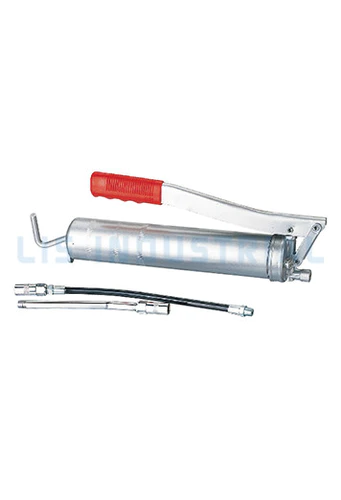
KCG451
Product Overview
The KCG451 belongs to the water guns and grease guns category. It is an air-powered tool intended to use compressed air as the driving medium for controlled fluid-related work. The product data identifies the following core specifications:
| Specification | KCG451 Data |
|---|---|
| Product model | KCG451 |
| Product category | Water Guns and Grease Guns |
| Air inlet | G1/4-inch |
| Rated pressure | 70 PSI |
| Maximum pressure | 140 PSI or less |
| Packaging quantity | 10 pieces per carton |
| Carton size | 42 × 29 × 34.5 cm |
| Operating medium | Compressed air, with the intended fluid determined by the application and product configuration |
The 70 PSI rated pressure is particularly relevant for ordinary working conditions. A rated pressure gives users a practical reference for normal operation, while the maximum pressure specification establishes an upper boundary that should not be exceeded. The difference between normal rated pressure and maximum pressure allows the KCG451 to support a range of workshop conditions without encouraging operation beyond safe limits.
The G1/4-inch air inlet is another important feature. G1/4-inch connections are widely used in pneumatic tools, air hoses, regulators, quick couplers, filters, and workshop air-treatment systems. A standard connection reduces the need for specialized adapters and makes the gun easier to add to an existing air network. For distributors, a common thread size also simplifies stock planning because the same fittings and accessories may be suitable for multiple pneumatic products.
The carton configuration is ten pieces per carton, with an external carton size of 42 × 29 × 34.5 centimeters. This packaging arrangement is useful for wholesale distribution, dealer supply, warehouse organization, and consolidated shipment planning. The relatively compact carton volume allows multiple units to be stored and transported efficiently while maintaining a defined quantity per package.
How the KCG451 Works
An air-powered water or grease gun uses compressed air to assist the delivery or projection of a fluid. When the operator connects the tool to an appropriate air supply and activates the control mechanism, pressurized air moves through the internal passage and supports the release of the working medium. Depending on the specific setup and intended application, the tool may be used for washing, rinsing, maintenance work, fluid application, or related service operations.
The compressed-air principle offers several practical advantages over manual tools. It reduces the physical effort required from the operator, supports more repeatable operation, and allows the gun to be connected to an existing compressor or plant air system. In a busy workshop, this can improve workflow because the operator can activate the tool quickly whenever a cleaning or maintenance task arises.
Pressure control is central to effective use. At the rated pressure of 70 PSI, the KCG451 is intended to provide a balanced operating condition for normal tasks. A suitable regulator can be installed upstream to adjust the air supply according to the work being performed. For delicate surfaces or light cleaning, a lower pressure may be appropriate. For more demanding tasks, the supply may be increased within the permitted limit, provided that the hose, couplers, fluid container, fittings, and workpiece are all suitable for the selected pressure.
The maximum pressure of 140 PSI or less should be treated as an absolute operating boundary rather than a target. Pneumatic systems can be hazardous when pressure is uncontrolled. Users should always follow the operating instructions supplied with the complete system, use a properly adjusted regulator, inspect all connections, and avoid applying pressure to surfaces or components that could be damaged.
Advantages of a Pneumatic Water and Grease Gun
Reduced Operator Effort
One of the principal benefits of an air-assisted gun is reduced manual effort. A hand-operated washing or fluid gun may require repeated pumping, squeezing, or continuous physical pressure. Over a long workday, this can contribute to hand fatigue and slower productivity. The pneumatic design of the KCG451 allows compressed air to provide the working force, leaving the operator to control the direction, timing, and duration of application.
This advantage is especially useful in vehicle maintenance, machinery servicing, agricultural-equipment cleaning, and industrial repair. In such environments, operators may need to clean several components or perform repeated maintenance operations. A pneumatic tool can make each cycle more convenient and reduce unnecessary strain.
Consistent Air Connection
The G1/4-inch inlet gives the KCG451 a familiar interface for connection to common workshop air systems. Compared with products using less common or proprietary fittings, a standard inlet can reduce installation complexity and support easier replacement. A user can select a compatible hose, coupler, regulator, or filter from a broad range of pneumatic accessories.
For industrial buyers, standardization also has a financial benefit. Maintenance departments often prefer equipment that shares fittings and service components with other tools already in use. This reduces the number of unique parts kept in storage and makes troubleshooting more straightforward.
Defined Pressure Performance
The specified 70 PSI rated pressure gives the buyer a clear reference point for normal working conditions. Products with vague or incomplete pressure information can be difficult to evaluate because users do not know how to size the air supply or regulator. By providing both rated and maximum pressure data, the KCG451 offers a more transparent basis for system design and operating procedures.
Defined pressure information is also useful for distributors. It enables sales teams to explain the product accurately and helps customers determine whether it matches their available compressor, hose system, and application requirements.
Practical Workshop Integration
The KCG451 can be integrated into many existing pneumatic work areas without requiring an unusual infrastructure. A typical installation may include an air compressor, receiver tank, moisture separator, regulator, hose, quick coupler, and the gun itself. This arrangement allows the operator to benefit from clean, regulated, and stable air delivery.
Because the product is part of a broader range of air tools and spraying equipment, it can also be included in a coordinated workshop purchasing program. A distributor may supply the KCG451 alongside air fittings, hoses, regulators, spray guns, paint tanks, air-blowing guns, and other maintenance tools.
Efficient Storage and Distribution
The ten-piece carton configuration makes the KCG451 suitable for wholesale and professional distribution. Retailers can receive a manageable quantity, while importers and regional distributors can calculate pallet space and shipment requirements using consistent carton dimensions. Organized packaging also helps reduce handling confusion in warehouses.
Packaging efficiency does not replace product quality, but it contributes to the total value of a professional tool. A product that is easy to store, count, move, and reorder can reduce logistical friction throughout the supply chain.
Applications and Suitable Working Environments
Automotive Service and Vehicle Maintenance
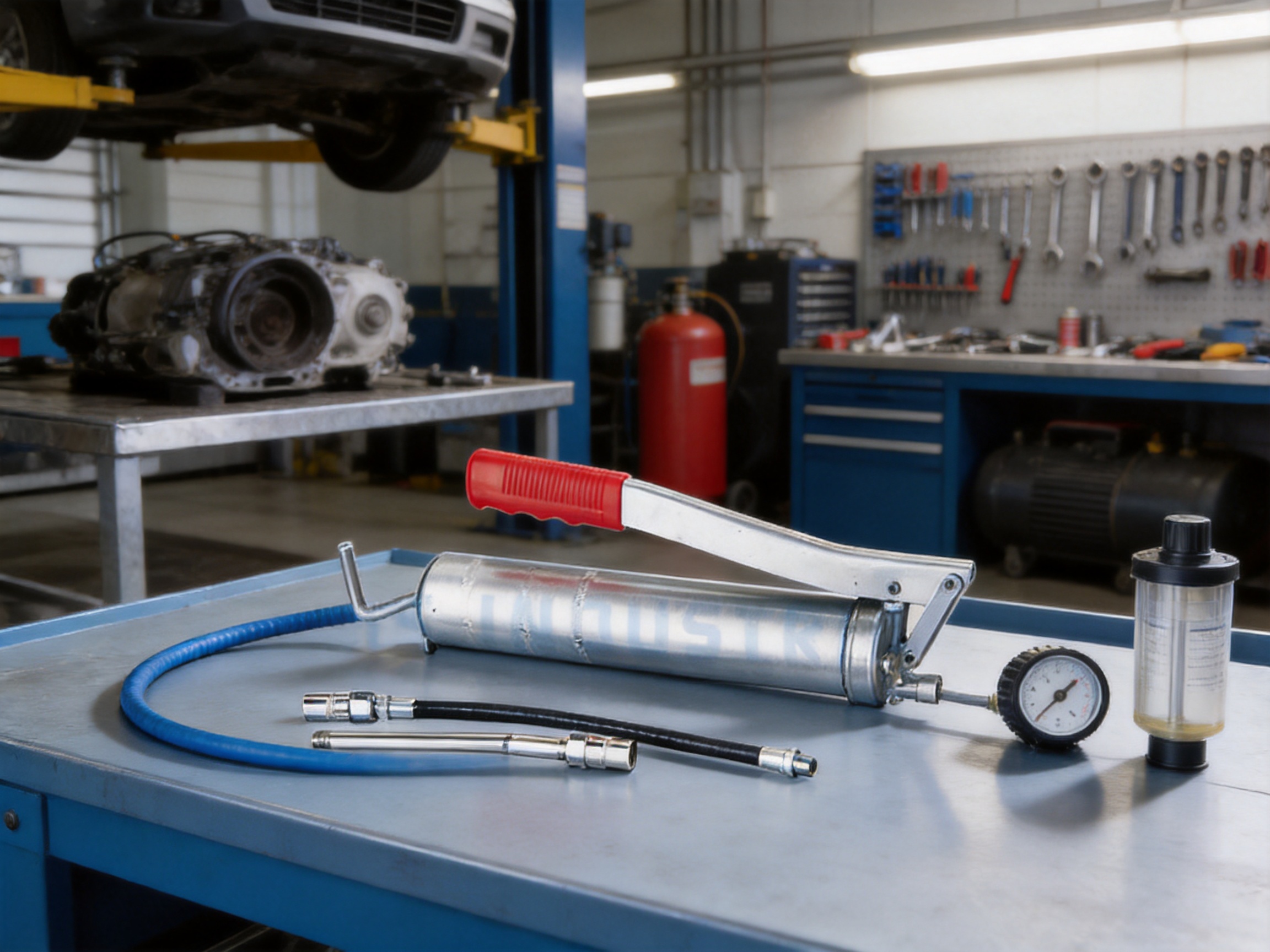
Vehicle repair shops often require compressed-air tools for cleaning components, preparing surfaces, and removing residues. The KCG451 can be considered for controlled washing or fluid-related maintenance tasks where air assistance improves convenience. It may be used around service bays, engine-maintenance areas, wheel-service stations, and general workshop cleaning zones, provided the selected fluid and application are compatible with the equipment.
Automotive users should take care around electrical connectors, sensors, bearings, brake components, and painted surfaces. Not every vehicle part should be exposed to pressurized water, grease, or air-assisted fluid. A trained technician should determine the appropriate pressure, distance, fluid, and direction of application before beginning work.
Industrial Equipment Maintenance
Manufacturing plants, repair facilities, and machine shops frequently clean or service machinery. An air-powered gun can assist with maintenance routines by providing a convenient way to apply or remove suitable fluids. It can be useful in areas where a larger washing system would be impractical or where a handheld tool provides better access.
For industrial use, the tool should be selected as part of a complete maintenance system. The plant should consider the compressor capacity, air quality, hose length, work environment, fluid compatibility, operator training, and local safety requirements. The KCG451 is a component in that system, not a substitute for a complete risk assessment.
Agricultural and Outdoor Equipment
Agricultural machinery, landscaping equipment, and outdoor power equipment can accumulate dirt, oil, and other residues. A controlled pneumatic gun may be convenient for maintenance areas where compressed air is already available. Its compact form can help operators reach selected areas without moving a large cleaning machine.
Outdoor users should protect the air line and tool from unnecessary exposure to rain, mud, and extreme contamination. After use, the gun should be cleaned, dried, and stored in a suitable location. If water or another liquid is used, residual fluid should not be allowed to remain in the tool or connected line where it could promote corrosion or contamination.
General Workshop Cleaning
In general-purpose workshops, one tool may be expected to support many routine tasks. The KCG451 can contribute to this flexibility by working from the shop’s compressed-air network. It may be suitable for cleaning workstations, washing selected components, applying compatible fluids, or assisting with maintenance procedures.
The tool is most valuable when it is used for targeted work rather than indiscriminate spraying. Controlled application helps conserve fluid, reduces unnecessary mess, and supports a cleaner working environment. Operators should always consider ventilation and personal protection when handling cleaning agents, oils, greases, or other substances.
Comparison with Common Alternatives
The KCG451 should be evaluated according to the needs of the user rather than by price alone. Different tool types serve different purposes. A manual water gun may be adequate for occasional household work, while an electric sprayer may be more suitable where no compressed-air system exists. A high-pressure washer may deliver greater cleaning force but can be unnecessarily large or aggressive for localized maintenance. The KCG451 occupies a practical middle position for users who already have compressed air and need a compact handheld tool.
| Alternative | Typical Strength | Potential Limitation Compared with the KCG451 |
|---|---|---|
| Manual pump or hand gun | Simple operation and no compressor required | Greater operator effort and less convenient for repeated work |
| Electric fluid sprayer | Independent operation without plant air | Requires electrical power and may be less compatible with existing pneumatic systems |
| Large pressure washer | High output and strong cleaning capability | Bulkier, less portable, and potentially excessive for targeted tasks |
| Basic low-cost pneumatic gun | Low initial purchase price | May offer less transparent pressure information or weaker supply support |
| KCG451 | Standard G1/4-inch inlet, defined pressure data, compact pneumatic format | Requires a suitable compressed-air source and correct operating procedures |
Compared with manual equipment, the KCG451 offers the benefit of pneumatic assistance and can reduce repetitive hand action. Compared with a large pressure washer, it may be easier to handle in confined spaces and more appropriate for controlled, localized work. Compared with an electric unit, it can fit naturally into workshops that already rely on compressors and air lines.
Its strongest competitive argument is therefore system compatibility. Buyers that already use pneumatic spray guns, air blow guns, polishers, impact tools, or other air equipment may find the KCG451 easier to incorporate than a separate electrically powered system. The G1/4-inch inlet further supports this compatibility.
Another advantage is specification transparency. The stated rated and maximum pressures help customers compare the product with alternatives using objective data. While pressure alone does not determine overall performance, clear specifications improve purchasing decisions and reduce the chance of selecting a product that is unsuitable for the available air system.
Installation and Operating Guidance
Preparing the Air Supply
Before connecting the KCG451, the user should confirm that the compressor and air network can provide clean, stable air at the required pressure and flow. A regulator should be used to control pressure. A filter or moisture separator is recommended because water, oil contamination, rust particles, and other debris in the air line may affect tool performance.
The hose and couplers should be rated for the intended pressure. Connections must be firmly secured without over-tightening or damaging the threads. The air line should be inspected for cuts, wear, swelling, and leakage before use. If the system contains a quick coupler, the coupler should be fully engaged and checked before the operator activates the tool.
Checking the Fluid System
The fluid used with the gun should be compatible with the product configuration and the intended application. Users should not assume that every chemical, solvent, detergent, oil, or grease is suitable. Aggressive chemicals can damage seals, internal components, containers, or surrounding surfaces. If a fluid is unfamiliar, the operator should consult its safety data and confirm compatibility before use.
Any container, hose, nozzle, or accessory connected to the gun must be suitable for the pressure and fluid involved. The complete assembly should be checked for leakage before normal operation. A small controlled test is preferable to immediately applying the tool to a valuable component or finished surface.
Operating Technique
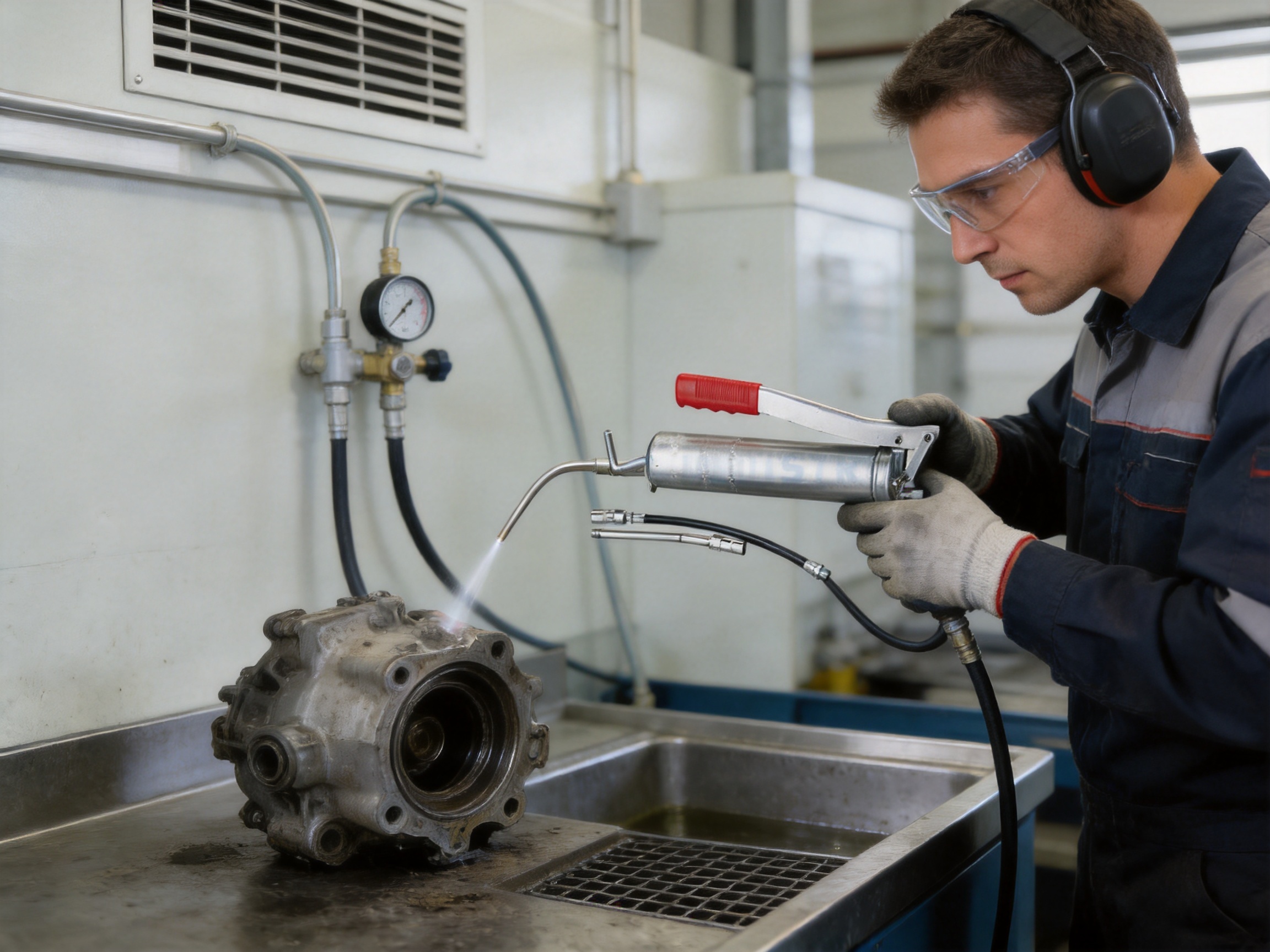
The operator should hold the gun securely, direct it away from people, and maintain a suitable distance from the workpiece. Application should begin at a moderate setting, with pressure increased only when necessary and permitted. Moving the gun evenly helps prevent concentrated application in one area.
For cleaning, it is generally better to work methodically from a less contaminated area toward a more contaminated area, depending on the surface and cleaning method. For fluid application, an even motion can help reduce excess accumulation. The operator should avoid forcing fluid into seals, bearings, electrical housings, or other sensitive locations.
When the task is complete, the air supply should be shut off and pressure released before disconnecting the hose or servicing the tool. This prevents stored energy from causing unexpected movement or discharge. The gun should never be left connected to an uncontrolled or excessive-pressure source.
Safety Considerations
Pressurized air and fluid can cause injury if misused. Operators should wear suitable eye protection and, where required, gloves, protective clothing, hearing protection, respiratory protection, and non-slip footwear. The correct protective equipment depends on the fluid, pressure, work environment, ventilation, and local occupational-safety rules.
Never point the gun at a person, animal, or any part of the body. Pressurized fluid can penetrate skin or damage eyes. Air should not be used to clean clothing or the body. Work areas should be kept clear of unnecessary personnel, and warning signs should be used where spraying or pressure-related maintenance is taking place.
The 140 PSI or less maximum pressure must not be exceeded. A regulator should be installed where necessary to prevent accidental over-pressurization. The operator should also confirm that the connected hose, container, coupler, and accessory components have suitable pressure ratings. The weakest component in a pneumatic assembly determines the practical safety limit of the system.
Flammable liquids require special care. Spraying or atomizing certain liquids may create vapors or airborne particles that can ignite. Users must follow the fluid manufacturer’s instructions, provide suitable ventilation, eliminate ignition sources, and comply with applicable regulations. The KCG451 should not be used for an application merely because the fluid can pass through the tool.
Maintenance and inspection should be performed with the air supply disconnected and pressure fully released. Damaged seals, cracked fittings, leaking hoses, or malfunctioning controls should be addressed before the tool is returned to service. Unapproved modifications may affect performance and safety and should be avoided.
Maintenance and Service Practices
Routine maintenance helps preserve the useful life of a pneumatic gun. After each work period, the exterior should be wiped clean and inspected for residue, damage, or leakage. If the tool has been used with water or cleaning fluid, it should be dried appropriately to reduce the chance of corrosion or contamination. The air inlet should be protected from dirt when the gun is not connected.
Hoses and couplers deserve particular attention. A damaged air hose can reduce performance and create a safety risk. Coupler seals should be checked for leakage, and threads should be inspected for wear. A leaking connection can cause pressure loss, increase compressor cycling, and make the tool less predictable.
Where the product configuration permits fluid flushing, the user should follow the recommended procedure and use a compatible cleaning medium. Harsh solvents should not be introduced without confirmation from the supplier. Internal disassembly should be performed only by trained personnel using appropriate replacement components.
Storage should take place in a clean, dry area away from direct sunlight, extreme temperatures, corrosive chemicals, and impact hazards. If the tool is being stored for an extended period, the air connection and fluid passages should be protected according to the applicable maintenance instructions.
Manufacturing Strengths
The KCG451 benefits from the manufacturing background of Ningbo Lis Industrial Co., Ltd. The company has specialized in air painting spray guns, mini air compressors, air tools, and related spraying products since 1984. Its long operating history provides experience in product development, component sourcing, production planning, tool assembly, inspection, packaging, and international customer service.
The company reports a manufacturing site covering more than 400,000 square feet, a workforce of over 400 employees, and annual output exceeding 40 million United States dollars. These figures indicate the capacity to support both standard product production and larger customer programs. For buyers, manufacturing scale can be valuable when consistent supply, repeat orders, and production scheduling are important.
A larger industrial base may also support greater specialization. Product development, engineering, purchasing, injection molding, machining, assembly, testing, quality control, warehousing, and export operations can be coordinated within a structured manufacturing system. Such coordination is particularly relevant for pneumatic tools because performance depends on the fit and consistency of multiple components.
Research and Development
The company has established a spraying machinery engineering technology center and has carried out technical cooperation with American spraying-technology organizations. Its research and development capabilities support original product development, design improvement, and customer-specific engineering. In addition to producing according to customer drawings or samples, the company states that it can provide original design and development services based on customer requirements.
For the KCG451 and similar products, engineering competence can contribute to improvements in air passages, trigger operation, sealing, ergonomics, pressure behavior, component durability, and manufacturing consistency. Product development is not limited to visual design. It includes selecting suitable materials, defining tolerances, testing assembly methods, and confirming that the finished product behaves as expected.
Quality-Control Process
The company describes a quality system that includes raw-material control, incoming inspection, in-process quality control, functional testing, and final inspection. This multi-stage approach is stronger than relying only on a visual inspection at the end of production.
Raw-material and incoming inspection can help identify unsuitable components before they enter assembly. In-process controls can detect variation during manufacturing rather than allowing large quantities of potentially defective products to continue. Functional testing can confirm that the assembled tool operates as intended, while final inspection provides a final check before packaging and shipment.
The company also states that products undergo 100 percent functional testing. For pneumatic equipment, functional testing is highly relevant because a tool may appear visually acceptable while still having an air leak, restricted passage, poor trigger response, or inconsistent operation. Testing each unit provides greater assurance than testing only a small sample of a production batch.
Certifications and Management Systems
The company reports certification and compliance experience including ISO 9001 quality-management certification, ISO 14001 environmental-management certification, OHSAS 18001 occupational-health-and-safety certification, European CE certification, and German GS certification for relevant products or systems. It also reports recognition as a national high-tech enterprise, an advanced customs-certified enterprise, a Ningbo individual-item champion, and a provincial engineering and technology center.
Certifications do not replace product-specific evaluation, but they demonstrate an organized approach to management, documentation, environmental responsibility, occupational safety, and product conformity. For international buyers, a structured quality system can make communication, auditing, corrective actions, and order management more reliable.
Support for OEM and ODM Programs
Distributors and equipment manufacturers may require more than an off-the-shelf product. They may need private labeling, packaging changes, customized documentation, special color schemes, modified accessories, or product adjustments for a particular market. The company’s stated OEM and ODM capabilities can support these commercial requirements.
OEM production is useful when a buyer has an established design, drawing, sample, or brand specification. ODM support is appropriate when the buyer needs engineering assistance to develop a product or adapt an existing design. In both cases, successful cooperation depends on clear technical documents, agreed inspection standards, sample approval, packaging confirmation, and an established change-control process.
For the KCG451, potential customization discussions may include labeling, carton artwork, instruction manuals, fitting requirements, accessory combinations, and market-specific packaging. Any modification should be reviewed technically because changing a connection, seal, container, nozzle, or pressure-related component can affect performance and safety.
Value for Distributors and Professional Buyers
The KCG451 offers several characteristics that are useful in a distribution portfolio. Its product category is easy to understand, its principal specifications are concise, and its G1/4-inch inlet aligns with common pneumatic practice. The ten-piece carton quantity is suitable for wholesale handling, while the manufacturer’s broader product range creates opportunities for cross-selling.
A distributor may position the tool for automotive workshops, industrial maintenance companies, agricultural-equipment dealers, general hardware stores, pneumatic-equipment retailers, and professional cleaning-supply channels. It can be sold as an individual tool or included in a larger air-tool package with hoses, couplers, regulators, and other accessories.
Technical sales support is important. Customers should receive accurate information about rated pressure, maximum pressure, air connection, fluid compatibility, operating procedures, and safety precautions. Clear information helps prevent misuse and improves customer satisfaction. A professional manufacturer can also support distributors with product documentation, packaging details, samples, production planning, and quality communication.
Environmental and Operational Efficiency
Compressed-air tools are not automatically more energy-efficient than every alternative. Compressors consume energy, and leaks in an air system can create waste. However, when a workshop already operates a compressed-air network, adding a compact pneumatic tool may be operationally efficient because it uses existing infrastructure. The tool can be moved between work areas without requiring a separate electrical motor or large cleaning machine.
Controlled application can also help reduce unnecessary fluid consumption. A trained operator can direct the output to the target area, apply only the required amount, and avoid broad overspray. This may reduce cleanup requirements and lower the amount of wastewater or contaminated residue generated during maintenance.
Environmental performance depends on the complete process. Users should select appropriate fluids, prevent spills, collect contaminated waste correctly, maintain the air system, and dispose of cleaning materials according to local regulations. The product can support a more organized workflow, but responsible environmental management remains the responsibility of the operating organization.
Recommended Purchasing Checklist
Before ordering the KCG451, buyers should confirm that the product matches the intended application. The following questions can help:
- Is a compressed-air system already available at the point of use?
- Can the air system provide regulated pressure at the required flow?
- Are G1/4-inch fittings, hoses, and couplers available or easily sourced?
- Is the selected fluid compatible with the tool and all connected components?
- Will the application require water, grease, cleaning fluid, or another approved medium?
- Are the operator, ventilation, and personal-protection requirements understood?
- Does the working environment require special electrical, chemical, or explosion-control precautions?
- Are the product’s 70 PSI rated pressure and 140 PSI or less maximum pressure suitable?
- Are replacement parts, accessories, and technical support available for the intended market?
- Does the ten-piece carton quantity match the buyer’s distribution and storage plan?
Buyers should request any additional technical documentation needed for their application, including drawings, operating instructions, material information, pressure guidance, packaging data, and inspection requirements. Large users may also wish to discuss pre-shipment inspection, sample approval, batch traceability, and customized labeling.
Q&A
What type of product is the KCG451?
The KCG451 is an air-powered water and grease gun. It is designed for fluid-related workshop and maintenance applications where compressed air is available. The exact fluid and use method should be confirmed according to the product configuration, application requirements, and fluid compatibility.
What is the air inlet size?
The air inlet is G1/4-inch. This is a common pneumatic connection size and can simplify integration with standard hoses, regulators, filters, and quick couplers.
What is the normal rated pressure?
The rated pressure is 70 PSI. This should be treated as the normal reference pressure for operation unless the applicable instructions specify otherwise.
What is the maximum pressure?
The maximum pressure is 140 PSI or less. Users should never intentionally exceed this limit. A regulator should be used when necessary to control the supply pressure.
Can the tool be used without a compressor?
No. The KCG451 is a pneumatic product and requires a suitable source of compressed air. It is most convenient in workshops or service environments that already have an air compressor or centralized air line.
Can any chemical or grease be used with the gun?
No. Fluid compatibility must be confirmed before use. Some chemicals, solvents, oils, or greases may damage seals or other components, create unsafe vapors, or be unsuitable for the intended surface. Users should consult the relevant technical and safety information.
Is the product suitable for industrial use?
The KCG451 is intended for workshop and maintenance applications, and its pneumatic format can be suitable for industrial environments when it is integrated into a correctly designed system. The user must confirm air quality, pressure, fluid compatibility, ventilation, safety controls, and local regulations.
How does it compare with a manual washing gun?
The pneumatic design can reduce repetitive hand effort and may provide a more convenient solution for frequent work. A manual gun may still be preferable for occasional tasks where no compressor is available.
How does it compare with a large pressure washer?
A large pressure washer may provide higher output and stronger cleaning force. The KCG451 is more appropriate when a compact, handheld, air-assisted tool is preferred for targeted work and the user already has compressed air.
How many units are packed in one carton?
There are ten pieces per carton. The carton size is 42 × 29 × 34.5 centimeters.
What manufacturing support is available?
The manufacturer reports experience in research, development, production, quality control, OEM, and ODM services. Buyers can discuss standard supply, customized packaging, private labeling, drawings, samples, and product-development requirements with the supplier.
What should be done after using the tool?
Shut off the air supply, release all residual pressure, disconnect the hose when appropriate, clean the exterior, check for damage or leakage, and store the gun in a clean and dry location. If fluid has entered the system, follow the applicable flushing or cleaning procedure.
Conclusion
The KCG451 is a practical pneumatic water and grease gun for users who need a compact, manageable, and easily connected tool for workshop and maintenance applications. Its G1/4-inch air inlet supports compatibility with widely used pneumatic equipment, while the 70 PSI rated pressure and maximum pressure of 140 PSI or less provide clear operating references. The ten-piece carton configuration also makes the product suitable for professional distribution and organized inventory management.
Its advantages over manual tools include reduced operator effort and easier repetitive use. Compared with large pressure washers, it offers a more compact approach for localized work. Compared with electrically powered alternatives, it can integrate naturally into facilities that already depend on compressed air. These advantages are strongest when the tool is used with a regulated, filtered, properly maintained air supply and with fluids that are confirmed to be compatible.
The manufacturing capabilities behind the product add further value. Ningbo Lis Industrial Co., Ltd. brings long-term experience in air tools and spraying equipment, a large production base, engineering resources, OEM and ODM support, documented quality procedures, functional testing, and international certification experience. Its approach covers the full product cycle from research and incoming inspection through assembly, testing, final inspection, packaging, and customer service.
For workshops, maintenance departments, equipment distributors, and professional users seeking a dependable air-assisted fluid tool, the KCG451 represents a balanced combination of standard connectivity, defined pressure performance, practical packaging, and manufacturing support. Correct application, careful pressure control, suitable personal protection, and regular maintenance will help users obtain the best performance and service life from the product.
References
1. Ningbo Lis Industrial Co., Ltd., KCG451 Product Specification Information.
2. Ningbo Lis Industrial Co., Ltd., Corporate Manufacturing and Company Profile Materials.
3. International Organization for Standardization, ISO 9001 Quality Management Systems—Requirements.
4. International Organization for Standardization, ISO 14001 Environmental Management Systems—Requirements with Guidance for Use.
5. General pneumatic-tool safety principles concerning compressed-air pressure, hose inspection, pressure regulation, and personal protective equipment.
6. General industrial maintenance practices for fluid compatibility, equipment cleaning, pneumatic-system inspection, and safe storage.