 Search
 English
 中文简体
中文简体 Deutsch
 Español
Content
- 1 Understanding the Role of an Air Fitting
- 2 MP-2 in Spray Equipment Systems
- 3 Advantages of a Purpose-Designed Air Accessory
- 4 Comparison with Less Suitable Alternatives
- 5 Manufacturing Strengths Behind the Product
- 6 Quality-Controlled Production Process
- 7 Certifications and International Manufacturing Experience
- 8 Applications in Different Working Environments
- 9 Installation and Operating Guidance
- 10 How the Product Supports Total Spraying Solutions
- 11 Purchasing Considerations for Distributors and Industrial Buyers
- 12 Environmental and Workplace Considerations
- 13 Why Manufacturing Experience Matters for a Small Component
- 14 Technical Communication and Customer Support
- 15 Frequently Asked Questions
- 15.1 What is the MP-2?
- 15.2 Can the MP-2 be used with every spray gun?
- 15.3 Why is an air fitting important for spray quality?
- 15.4 Does the MP-2 replace an air regulator or filter?
- 15.5 How can leakage around the MP-2 be reduced?
- 15.6 Can the MP-2 be used in an industrial production line?
- 15.7 Is the product suitable for OEM projects?
- 15.8 What quality systems support production?
- 15.9 What should be checked before placing an order?
- 15.10 Can the fitting be used with other air tools?
- 15.11 How should the MP-2 be maintained?
- 15.12 What makes the supplier suitable for international customers?
- 16 Conclusion
- 17 References
- 18 Product: MP-2
In professional spray finishing, the quality of the coating depends on more than the spray gun, nozzle, paint, or compressor. Every component in the air path contributes to the final result. A poorly selected fitting can create leaks, restrict airflow, introduce contamination, complicate maintenance, or reduce the consistency of atomization. For this reason, air fittings and accessories deserve the same careful attention given to major equipment.
The MP-2 is an air fitting accessory designed for use within spray equipment and compressed-air systems. As a compact connection component, it supports the practical requirements of workshops, industrial finishing lines, maintenance departments, automotive repair facilities, woodworking operations, and general pneumatic applications. Its purpose is to help create a dependable connection between compatible air-system components while supporting convenient assembly, operation, and servicing.
Although an air fitting is physically smaller than a spray gun or compressor, its influence on system performance can be significant. A fitting must be compatible with the connected equipment, suitable for the working environment, properly installed, and capable of maintaining a stable air path. The MP-2 provides a practical solution for users who need a reliable accessory within a broader spraying or pneumatic setup.
The product is manufactured by Ningbo Lis Industrial Co., Ltd., an established Chinese manufacturer of spray guns, mini compressors, air tools, fittings, and related spraying equipment. The company combines product development, engineering, manufacturing, inspection, and international supply capabilities. This integrated background is important because an accessory intended for spraying equipment must be developed with a clear understanding of air pressure, airflow, coating application, operator requirements, and equipment compatibility.
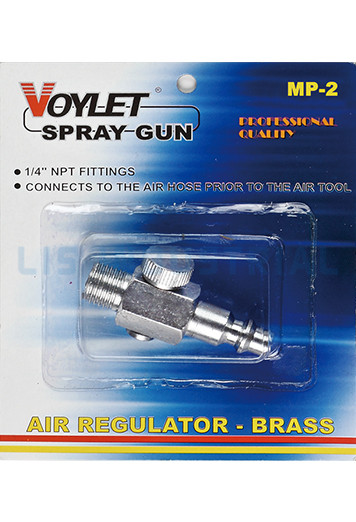
MP-2
Understanding the Role of an Air Fitting
An air fitting provides a mechanical connection between parts of a compressed-air system. Depending on the design and application, it may connect an air hose, spray gun, regulator, filter, manifold, compressor outlet, paint equipment accessory, or other pneumatic component. The connection should remain secure during operation while allowing the system to be assembled, adjusted, inspected, and maintained efficiently.
In a spray application, compressed air travels through multiple sections before reaching the air cap or atomizing passage. The path may include a compressor, air receiver, filter, regulator, hose, coupling, fitting, and spray gun. Every joint creates a potential point of pressure loss or leakage. A suitable fitting helps reduce that risk and contributes to a more stable supply of air at the tool.
Stable air delivery is important because the spray gun uses compressed air to atomize coating material into a controlled pattern. If air pressure fluctuates because of an unsuitable connection, the operator may experience changes in fan width, atomization quality, transfer efficiency, or surface appearance. Inconsistent pressure can also increase overspray, material waste, rework, and finishing time.
The MP-2 should therefore be viewed not merely as a small replacement part, but as a functional element in the overall air-management system. Its value lies in helping users build a dependable connection arrangement around their spray equipment and pneumatic tools.
Connection reliability
A reliable fitting should remain properly seated during normal use. The connection must resist loosening caused by vibration, hose movement, repeated handling, and the pulsation that can occur in compressed-air systems. Correct installation remains essential, but the fitting itself should be manufactured with consistent dimensions and suitable surface quality so that it can be installed correctly and perform predictably.
Airflow continuity
A fitting should support the intended air path without creating unnecessary restriction. The internal passage, connection geometry, and interface quality all influence how smoothly air moves through the component. The appropriate fitting must be selected according to the air requirement of the connected equipment. A small fitting may be suitable for one tool and insufficient for another, so users should always confirm thread, size, pressure, and flow requirements before installation.
Service convenience
Spray equipment is frequently cleaned, adjusted, moved, and reconfigured. An accessory that is easy to inspect and replace can reduce maintenance time. This is especially useful in workshops where several spray guns, hoses, or air tools are used during the same working day. Practical serviceability also helps maintenance personnel identify leaks and replace worn sealing elements before they affect production.
MP-2 in Spray Equipment Systems
The MP-2 is categorized as an air fittings and accessories product. It can be considered for applications where a suitable air connection is required in a spray or pneumatic arrangement. Its exact use depends on the configuration of the equipment, the connection standard, the thread or interface specification, the operating pressure, and the requirements of the user’s air system.
Because different markets use different connection standards, a responsible selection process is essential. Before purchasing or installing the MP-2, buyers should confirm the relevant technical information with the supplier or equipment manufacturer. Important points may include connection type, thread specification, dimensional compatibility, material, sealing method, maximum working pressure, temperature range, and intended application.
This verification process does not reduce the value of the product. Instead, it reflects good pneumatic engineering practice. A high-quality fitting can only perform properly when it is matched to compatible components. The MP-2 can serve as part of a carefully designed system in which every connection has been selected according to the operating conditions.
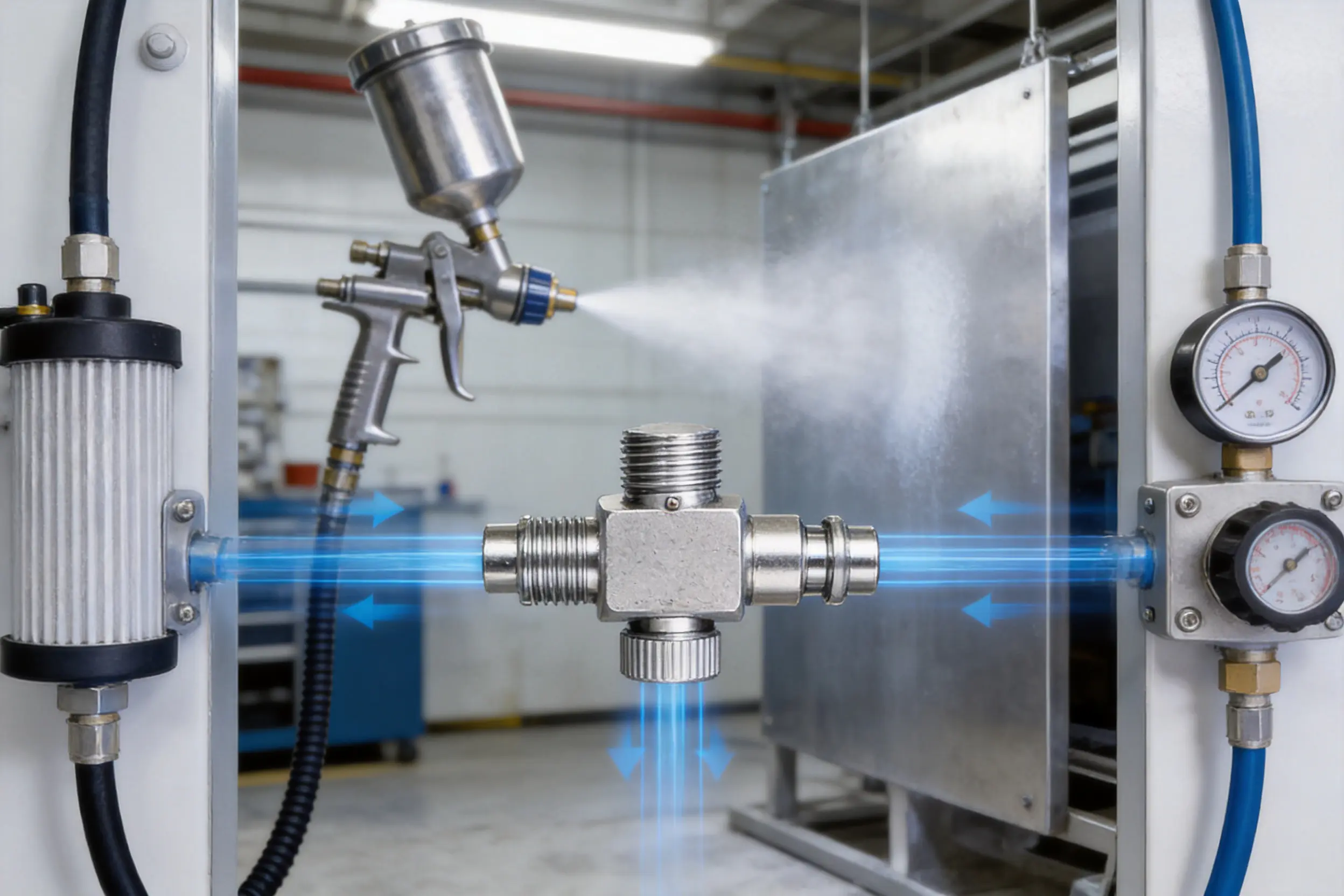
For spray shops, the accessory may support the connection of equipment such as conventional spray guns, high-volume low-pressure spray guns, heavy-duty spray guns, touch-up spray guns, automatic spray guns, texture spray guns, electric spray equipment, and other compatible air-operated devices. It may also be relevant to air brushes, pneumatic polishers, air blowing guns, sandblast equipment, tire inflating tools, and other air tools when the connection requirements are appropriate.
Advantages of a Purpose-Designed Air Accessory
One advantage of using a purpose-designed air fitting instead of an improvised connection is better control over system compatibility. Improvised arrangements may use mismatched adapters, excessive sealant, damaged threads, or unsuitable hose connections. Such practices can result in leaks, difficult maintenance, accidental disconnection, or restricted airflow. A dedicated accessory encourages a more organized and repeatable installation.
Support for consistent spray performance
Spray finishing requires repeatability. Operators want the same spray pattern, atomization behavior, and material application from one workpiece to the next. While the fitting does not determine the entire result, it contributes to the integrity of the air supply. A secure and properly sized connection helps the spray gun receive air according to the requirements of the system.
Consistent air delivery may improve the operator’s ability to control coating thickness, fan shape, and overlap. It can also reduce the need for frequent adjustments caused by unstable connections. In production environments, even small improvements in repeatability can reduce material waste and improve throughput over time.
Reduced risk of leakage
Compressed-air leakage represents lost energy and reduced equipment efficiency. A compressor may run more frequently to compensate for air escaping through loose or poorly sealed connections. The additional operating time can increase energy consumption, noise, wear, and maintenance requirements.
A properly installed MP-2 connection can help reduce the possibility of leakage at the relevant interface. Users should still inspect the fitting regularly, use the correct sealing procedure, avoid overtightening, and replace damaged components. Product quality and installation practice work together to achieve a reliable result.
Useful for organized equipment layouts
A well-organized air system is easier to operate and maintain. Fittings help create defined connection points between hoses, tools, regulators, filters, and other accessories. This can make it easier to isolate equipment, change tools, or identify the source of an air problem.
In a professional workshop, organized connections also support safer working conditions. Hoses can be routed more deliberately, equipment can be positioned according to the operator’s workflow, and unnecessary movement around the work area can be reduced. The MP-2 can be included in such layouts when its interface matches the selected equipment.
Support for replacement and maintenance
Air-system components are subject to repeated assembly, disassembly, cleaning, movement, and exposure to workshop conditions. A replaceable fitting allows users to renew a connection without replacing an entire spray gun or air hose. This can be economically beneficial when the main equipment remains in good condition.
Replacement accessories also help standardize maintenance procedures. A service department can inspect air connections during scheduled equipment checks and replace components that show wear, deformation, corrosion, contamination, or damaged threads.
Comparison with Less Suitable Alternatives
The MP-2 should be compared with alternatives according to application requirements rather than appearance alone. An air fitting may look simple, but differences in connection standards, internal passage, material quality, manufacturing accuracy, and sealing performance can affect the complete system.
| Selection factor | Purpose-designed air fitting | Improvised or mismatched connection | Practical benefit of correct selection |
|---|---|---|---|
| Compatibility | Selected according to the required interface | May require multiple adapters or force-fitting | Improved installation reliability |
| Air path | Designed for a defined pneumatic connection | May create unnecessary restriction | More stable air delivery |
| Sealing | Used with an appropriate sealing method | May leak because of damaged or mismatched threads | Reduced air loss |
| Maintenance | Can be inspected and replaced as a component | May be difficult to remove or identify | Shorter service time |
| System organization | Supports planned hose and tool layouts | Can produce complicated connection arrangements | Better workshop management |
| Quality control | Manufactured within an organized production system | Quality may vary between unverified sources | More predictable performance |
Compared with low-cost, unverified accessories, a fitting supplied by an experienced spray-equipment manufacturer offers the advantage of being developed within a broader product ecosystem. The manufacturer understands how air fittings interact with spray guns, hoses, compressors, air preparation equipment, and pneumatic tools. This knowledge supports more appropriate product planning and technical communication.
Compared with using a collection of adapters, a correctly selected MP-2 may simplify the system. Fewer unnecessary connection points can mean fewer potential leak locations and fewer parts to inspect. A simpler layout is also easier for operators to understand, especially when equipment is shared among several users.
Compared with replacing an entire tool because of a worn connection, an accessory replacement can extend the useful life of equipment. This supports lower maintenance cost and more sustainable use of industrial products. The decision should be based on inspection results and compatibility, but modular replacement is often more efficient than complete equipment replacement.
Manufacturing Strengths Behind the Product
The reliability of a small air accessory depends heavily on the manufacturing system behind it. Ningbo Lis Industrial Co., Ltd. has operated in the spray-equipment industry since 1984. Over that period, the company has developed experience in research, product design, manufacturing, quality management, and international supply.
The company’s product range includes air painting spray guns, mini oil-free compressors, air fittings and accessories, air tools, paint tanks, airless spray guns, electric spray equipment, and related products. This broad range provides a practical engineering foundation for the MP-2 because the accessory is developed in an environment where compressed-air behavior and spraying requirements are central areas of expertise.
Large-scale production resources
The company operates from a manufacturing site covering more than 400,000 square feet and employs more than 400 people. Its annual output is reported at more than 40 million United States dollars. These resources support the production of multiple product categories and help the manufacturer serve customers with different order volumes.
Production scale can provide several advantages when it is supported by appropriate management. It can improve access to specialized equipment, production personnel, engineering resources, inspection facilities, and supply-chain coordination. It can also help the manufacturer maintain continuity when customers require repeat orders or increased quantities.
The company states that production capacity can be increased by approximately 30 percent within two months. This flexibility may be valuable for distributors, importers, equipment assemblers, and industrial customers who need dependable replenishment or a rapid response to changing demand.
Research and development capabilities
Product development is an important part of the company’s operating model. The manufacturer maintains a research and development team and has established a spraying machinery engineering technology center. Its capabilities include original equipment manufacturing based on customer drawings or samples and original design manufacturing based on customer requirements.
For an air fitting accessory, research and development may involve interface design, dimensional control, material selection, sealing performance, compatibility evaluation, production tooling, and testing procedures. Even when a product appears simple, these details influence whether the component can be manufactured consistently and integrated into a customer’s equipment range.
Engineering cooperation with international spraying-technology organizations has also contributed to the company’s understanding of professional spray applications. Such cooperation can encourage attention to product performance, user requirements, process improvement, and international market expectations.
Quality-Controlled Production Process
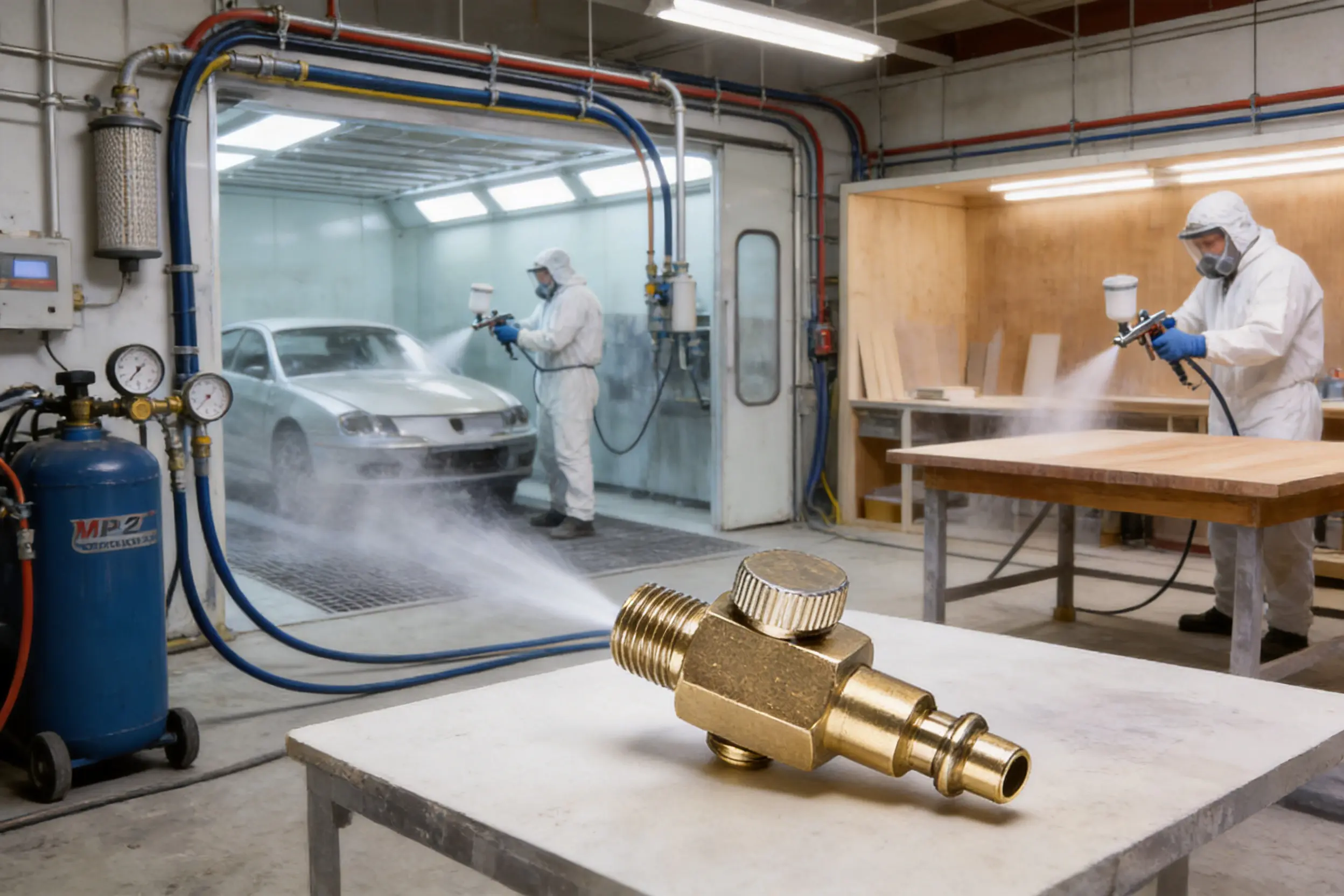
The company describes a quality system based on ISO9000 principles. Its stated control process extends from raw-material management and incoming inspection through in-process quality control, functional testing, and final inspection of finished products. This complete-process approach is especially relevant to air fittings because dimensional or surface defects may not be obvious until the product is installed.
Raw-material and incoming inspection
Materials used in pneumatic accessories should be checked before entering production. Incoming inspection may include verification of material identity, dimensions, surface condition, quantity, and supplier documentation. Effective incoming controls help prevent unsuitable material from moving into machining, forming, assembly, or finishing operations.
For a fitting, the quality of the material can influence thread durability, dimensional stability, resistance to workshop conditions, and the ability to maintain a dependable connection. Material selection should correspond to the intended service environment, and buyers should request detailed material information when their application requires it.
Process control
In-process quality control helps maintain consistency during manufacturing. Depending on the production method, controls may include tooling checks, dimensional measurement, thread inspection, visual inspection, surface checks, assembly verification, and process documentation. Identifying variation during production is preferable to discovering a problem only after the product reaches the customer.
Consistent dimensions are particularly important for fittings. A small deviation in a thread, shoulder, sealing face, or internal passage may affect installation or sealing. Controlled production helps reduce variation and supports interchangeability between replacement components of the same model.
Functional testing
The company states that it performs 100 percent functional testing within its quality process. For products associated with compressed air, functional testing can help identify leakage, connection problems, incomplete assembly, or other defects before shipment. The exact test method and acceptance criteria should be confirmed for the specific MP-2 configuration and customer requirement.
Full inspection is valuable for distributors and equipment manufacturers because it reduces the likelihood that defective components will enter their own assembly or sales channels. It also supports confidence when products are supplied to international customers with strict expectations for consistency.
Final inspection
Final inspection provides an additional review before products are packed and shipped. It may include product identification, appearance, quantity, packaging condition, and verification against the order. Proper final inspection helps ensure that the correct model reaches the customer and that products are protected during handling and transportation.
Certifications and International Manufacturing Experience
The company reports certification and recognition that include ISO9001 international quality-system certification, ISO14001 environmental-management certification, OHSAS18001 occupational health and safety certification, European CE certification, and German GS product certification for relevant products. Certification scope should always be confirmed for the specific product model and current production site, but these systems indicate an established commitment to formal management and compliance.
Quality certification provides a framework for documented procedures, corrective action, process monitoring, and continual improvement. Environmental certification encourages control of environmental aspects associated with manufacturing. Occupational health and safety certification supports attention to employee safety and workplace risk management.
International product certification can also assist customers who distribute or use equipment in regulated markets. Buyers should obtain current certificates, declarations, test reports, and technical files where necessary. Compliance is a shared responsibility between manufacturer, importer, distributor, and end user, and product documentation should match the destination market.
The company has developed customers and business relationships across Europe, North America, the Middle East, South Africa, and East Asia. This international experience is useful because different markets may require different connection standards, packaging expectations, documentation, labeling, and supply arrangements.
Applications in Different Working Environments
Automotive refinishing
Automotive refinishing requires clean, stable, and controllable compressed air. Spray guns are used for primers, basecoats, clearcoats, spot repairs, and other coating tasks. A dependable air connection can support the stable operation of compatible equipment and reduce the risk of interruptions during a repair process.
Automotive workshops should pay particular attention to contamination control. Oil, water, dirt, and degraded sealing material can affect coating quality. The MP-2 should therefore be used within an air system that includes appropriate filtration, drainage, hose maintenance, and regular inspection.
Woodworking and furniture finishing
Woodworking shops use spray equipment for stains, lacquers, paints, sealers, and protective finishes. Production may involve frequent changes between tools and materials. A serviceable air fitting can support equipment changes and help maintain a practical connection system around the spray booth or finishing area.
Wood dust can accumulate around pneumatic equipment, so operators should keep connections clean and protect unused openings. Routine cleaning and inspection are important for preserving reliable operation.
Industrial coating
Industrial users may apply coatings to metal parts, machinery, fabricated structures, appliances, or general manufactured products. Production requirements often emphasize repeatability, uptime, and efficient maintenance. A well-managed air system with correctly selected fittings supports these objectives.
When multiple spray stations are operated simultaneously, the system designer should calculate total air demand and select suitable hoses, regulators, filters, and fittings. The MP-2 should be integrated only where its specifications match the station’s requirements.
Maintenance and repair operations
Maintenance departments often use several pneumatic tools, including blow guns, inflating tools, polishers, sanding equipment, and spray devices. A standardized accessory can simplify tool management when the interface is compatible across the equipment group.
Maintenance personnel should record the location and function of each fitting, inspect connections during scheduled service, and replace components that show wear. Standardized procedures help reduce unexpected downtime.
Small workshops and general users
Small workshops may require a flexible accessory that can be included in a compact compressor and spray-tool arrangement. The MP-2 can be considered when the user needs a compatible air connection for a suitable tool or hose. The system should be designed with the same care as a larger installation, even when the equipment is used only occasionally.
Installation and Operating Guidance
Before installation, confirm that the MP-2 matches the connection standard of the hose, spray gun, regulator, compressor outlet, or other component. Do not force a connection that appears close but does not fit correctly. Mismatched threads can be damaged during assembly and may create a dangerous or unreliable connection.
Inspect the fitting before use. Check for visible damage, contamination, burrs, deformation, damaged threads, or signs of corrosion. Examine the mating component as well. Replacing only one damaged part may not solve a problem if the connecting component is also worn.
Use the sealing method recommended for the specific interface. Excessive sealant can enter the air passage and contaminate the spray system. Insufficient sealing can cause leakage. Apply sealant carefully and keep it away from the internal air path whenever possible.
Tighten the fitting according to appropriate installation practice. Excessive force may damage threads, deform sealing surfaces, or make later maintenance difficult. If a torque specification is supplied for the specific configuration, follow that specification.
After installation, pressurize the system gradually and inspect the connection. A suitable leak-detection method can help identify escaping air. Never place fingers near a suspected high-pressure leak, and never inspect compressed-air connections in a way that may cause injury.
Before spraying, confirm that the air pressure and airflow are suitable for the connected tool. Adjust the regulator according to the spray gun or tool instructions. The fitting does not replace the need for correct air preparation and pressure control.
Routine maintenance checklist
| Inspection item | Recommended action | Reason |
|---|---|---|
| Connection tightness | Check for looseness and retighten only as appropriate | Helps prevent leakage and accidental separation |
| Thread condition | Inspect for cross-threading, wear, or deformation | Protects connection integrity |
| Sealing area | Check for damaged or deteriorated sealing material | Supports airtight assembly |
| Air cleanliness | Keep dirt, paint, oil, and water away from the connection | Reduces contamination risk |
| Surface condition | Look for corrosion, impact damage, or abnormal wear | Identifies components requiring replacement |
| System behavior | Monitor pressure stability and unusual compressor cycling | May reveal a hidden leak or restriction |
How the Product Supports Total Spraying Solutions
A major strength of an experienced spray-equipment manufacturer is the ability to supply more than one isolated component. Ningbo Lis Industrial Co., Ltd. offers a broad selection of products covering spray guns, compressors, air fittings, paint tanks, air tools, and other spraying accessories. This product range allows customers to develop a more coordinated equipment package.
For distributors, a broad portfolio can simplify sourcing and product training. Sales teams can discuss spray guns, compressors, hoses, fittings, and accessories within one technical framework. This may reduce the difficulty of combining products from unrelated suppliers with different standards and documentation practices.
For equipment assemblers, the manufacturer’s OEM and ODM capabilities can support customized product programs. Customers may provide drawings, samples, performance requirements, packaging instructions, or branding specifications. The manufacturer can then evaluate the technical and production requirements for the requested program.
For end users, product compatibility can be a practical advantage. A fitting selected from the same professional product ecosystem as the spray gun or air tool may reduce uncertainty during installation. Compatibility must still be verified, but a unified product range provides a useful starting point.
The company’s stated mission emphasizes innovative design, high-quality products, professional services, and value creation for global customers. Its stated vision focuses on serving painting needs through professional products, services, and solutions. These objectives align with the role of the MP-2 as part of a complete and maintainable air-system solution.
Purchasing Considerations for Distributors and Industrial Buyers
When purchasing the MP-2, buyers should begin by defining the application. The same fitting may not be suitable for every tool or market. Identify the equipment to be connected, the air-system layout, the required connection standard, the working environment, the expected order volume, and the destination-market requirements.
Technical documentation should be requested before a volume order. Relevant information may include product drawings, dimensions, thread details, material data, pressure ratings, applicable standards, inspection procedures, packaging information, and certificates. If the product will be incorporated into another machine, the buyer should also confirm the responsibilities for final system compliance.
Sample evaluation is recommended for new projects. Install the sample in the intended equipment and check connection fit, sealing, assembly effort, airflow behavior, maintenance convenience, and long-term performance under representative conditions. A sample program can identify compatibility issues before mass production or large-scale distribution.
For distributors, packaging and identification are important. Each unit or package should be clearly marked so that warehouse staff and customers can distinguish the MP-2 from similar accessories. Correct labeling reduces picking errors and supports after-sales service.
Order planning should account for replacement demand. Air fittings are small components, but users may require them for new equipment, routine service, emergency replacement, or workshop expansion. A suitable inventory policy can prevent delays caused by a missing connection accessory.
Questions to confirm before ordering
Buyers should confirm the precise MP-2 specification, available connection versions, compatible standards, minimum order quantity, sample availability, production lead time, packaging method, inspection documents, and shipping arrangements. They should also determine whether the requested product is a standard item or requires customization.
For customized orders, customers should provide accurate technical information. Drawings should identify critical dimensions and tolerances. Samples should represent the intended production condition. Application information should include pressure, temperature, connected media, duty cycle, and environmental exposure where relevant.
Environmental and Workplace Considerations
Efficient compressed-air use contributes to responsible workshop operation. Air leaks increase compressor run time and energy consumption. By maintaining fittings, hoses, regulators, and tools, users can reduce avoidable losses. The MP-2 is one component in this wider maintenance strategy.
Painting operations also require attention to ventilation, personal protective equipment, fire prevention, waste handling, and coating-material safety. An air fitting cannot replace these controls. Users should follow the instructions for the spray material, compressor, spray gun, and workplace regulations.
The company’s environmental-management certification indicates that environmental considerations are included within its formal management framework. Customers requiring environmental documentation should request current information relevant to the product and manufacturing site.
Worker safety is equally important. Compressed air can cause injury when misused, and spray operations may involve hazardous vapors or particles. Operators should depressurize equipment before maintenance, use suitable protective equipment, secure hoses, and follow established safety procedures.
Why Manufacturing Experience Matters for a Small Component
Some buyers evaluate air fittings only by unit price. However, the real cost of a connection accessory includes installation time, leakage, downtime, replacement frequency, product returns, maintenance labor, and the possible effect on finished-product quality. A low purchase price may not represent the lowest total cost if the component creates repeated operational problems.
A manufacturer with decades of industry experience is better positioned to understand these factors. Since 1984, Ningbo Lis Industrial Co., Ltd. has focused on spray guns, compressors, and related air tools. This specialization provides accumulated knowledge about how accessories behave in practical applications.
Experience also supports continual improvement. Customer feedback can reveal recurring installation issues, regional preferences, packaging problems, compatibility requirements, or opportunities for design refinement. An established manufacturer can use this information to improve products and service procedures over time.
The company’s international customer base further exposes its production and support teams to varied market expectations. Customers in different regions may require different standards, documentation, distribution models, or product configurations. Experience across these markets can support more effective communication and order management.
Technical Communication and Customer Support
Good technical communication is essential when purchasing an air fitting. Product names alone are not enough to establish compatibility. Customers should have access to clear information about dimensions, connection types, operating limitations, and recommended applications.
The supplier should also be able to discuss OEM and ODM requirements where relevant. A customer developing a private-label spray-equipment range may need a consistent accessory family, special packaging, customized markings, or integration with a proprietary tool. Engineering communication at the beginning of a project can prevent costly changes later.
After-sales support is another important consideration. Questions about leakage, installation, replacement, or system compatibility should be answered promptly and accurately. A manufacturer with spray-equipment expertise can often provide more useful guidance than a general hardware supplier.
Customers may contact Ningbo Lis Industrial Co., Ltd. through its sales department for product information, quotations, samples, technical confirmation, and supply discussions. Buyers should provide their application details and destination market so that the supplier can respond with the most relevant information.
Frequently Asked Questions
What is the MP-2?
The MP-2 is an air fitting and accessory product intended for use in compatible compressed-air, spraying, or pneumatic equipment systems. Its precise function depends on the connection configuration and the equipment with which it is used.
Can the MP-2 be used with every spray gun?
No. Compatibility must be confirmed before use. Spray guns and air systems may use different thread types, sizes, connection standards, or hose interfaces. Buyers should compare the MP-2 specification with the equipment documentation or request confirmation from the supplier.
Why is an air fitting important for spray quality?
An air fitting helps maintain the connection between the air source and the tool. If the connection leaks, restricts airflow, or becomes unstable, the spray gun may not receive air consistently. This can influence atomization and the operator’s ability to maintain a uniform finish.
Does the MP-2 replace an air regulator or filter?
No. A fitting is a connection accessory. It does not replace a regulator, filter, moisture separator, compressor, or other air-preparation equipment. A complete spray system should include the components required by the spray gun and coating application.
How can leakage around the MP-2 be reduced?
Use a compatible mating component, inspect the threads and sealing surfaces, apply the correct sealing method, tighten appropriately, and test the system after installation. If leakage continues, inspect both connected components and replace damaged parts.
Can the MP-2 be used in an industrial production line?
It may be suitable for an industrial line when its technical specifications match the application. The buyer should confirm pressure, airflow, temperature, connection standard, duty cycle, environmental conditions, and any required certification before approval.
Is the product suitable for OEM projects?
The manufacturer provides OEM services based on customer drawings or samples and also offers ODM support according to customer needs. Customers should discuss the MP-2 specification, customization requirements, tooling, quality criteria, packaging, and production quantities with the engineering and sales teams.
What quality systems support production?
The company describes quality control based on ISO9000 principles, including raw-material inspection, incoming inspection, in-process control, 100 percent functional testing, and final inspection. It also reports ISO9001, ISO14001, OHSAS18001, CE, and GS certifications or qualifications for relevant products and operations. Current scope should be verified for the specific product.
What should be checked before placing an order?
Confirm the exact model, connection type, dimensions, material, pressure rating, compatibility, packaging, certification needs, order quantity, delivery schedule, and destination-market requirements. Samples and technical drawings are recommended for new applications.
Can the fitting be used with other air tools?
It may be used with compatible air tools such as air brushes, polishers, blow guns, inflating guns, sandblasting equipment, or other pneumatic devices. Compatibility should be verified for each tool rather than assumed from the product category.
How should the MP-2 be maintained?
Keep the fitting clean and dry, inspect it for leakage or damage, protect the connection from contamination, avoid excessive force during assembly, and replace it if the threads, sealing area, or body are damaged. Depressurize the system before maintenance.
What makes the supplier suitable for international customers?
The company has operated since 1984, maintains a large manufacturing base and experienced workforce, supplies multiple spray-equipment categories, supports OEM and ODM projects, and serves customers in Europe, North America, the Middle East, South Africa, and East Asia. These capabilities can support international sourcing and long-term supply programs.
Conclusion
The MP-2 is a compact but important accessory for compatible air and spray-equipment systems. Its role is to help establish a dependable connection, support stable air delivery, simplify maintenance, and contribute to a more organized workshop or production-line layout. When correctly matched to the equipment, installed according to good pneumatic practice, and maintained regularly, an air fitting can help protect system efficiency and finishing consistency.
The product benefits from the manufacturing background of Ningbo Lis Industrial Co., Ltd., a company focused on spray guns, compressors, air tools, fittings, and related spraying solutions since 1984. Its large production base, research and development capabilities, OEM and ODM services, international market experience, and documented quality-management approach provide a strong foundation for supplying air accessories to professional customers.
Compared with improvised or poorly matched connection arrangements, a purpose-selected fitting offers better compatibility, easier service, and a more predictable role within the air system. Buyers should nevertheless verify the technical specification for their application and request current documentation before purchase. The best results come from combining a suitable accessory with correct air preparation, proper installation, routine inspection, and responsible equipment operation.
For distributors, equipment manufacturers, workshops, and industrial users seeking a dependable component for a spray-equipment program, the MP-2 represents a practical option to evaluate. Its value is not limited to the fitting itself; it is also connected to the engineering knowledge, quality controls, product range, and supply capabilities of the manufacturer behind it.
References
1. Ningbo Lis Industrial Co., Ltd., company information and product category materials supplied for this article.
2. Ningbo Lis Industrial Co., Ltd., MP-2 product information, Air Fittings and Accessories category.
3. International Organization for Standardization, ISO 9001, Quality Management Systems—Requirements.
4. International Organization for Standardization, ISO 14001, Environmental Management Systems—Requirements with Guidance for Use.
5. Occupational health and safety management-system principles and related certification practices.
6. General compressed-air system maintenance and pneumatic connection practices for spray-equipment applications.
7. Professional spray-finishing principles concerning airflow stability, air preparation, equipment compatibility, and preventive maintenance.