 Search

 English
 中文简体
 Deutsch
 Español
Content
- 1 The Importance of Filtration and Pressure Regulation
- 2 AFR80A Product Overview
- 3 Advantages in Compressed-Air Applications
- 4 Comparison with Basic Unregulated Air Connections
- 5 Application with Spray Guns and Paint Sprayers
- 6 Application with Pneumatic Tools
- 7 Manufacturing and Engineering Strengths
- 8 Production Capacity and Supply Reliability
- 9 Installation Planning
- 10 Maintenance and Operating Practices
- 11 Advantages for Distributors and OEM Customers
- 12 How the AFR80A Supports Total Spraying Solutions
- 13 Selection Guide for Buyers
- 14 Quality, Safety, and Responsible Use
- 15 Why Manufacturing Experience Matters
- 16 Q&A
- 16.1 What is the AFR80A?
- 16.2 What pressure range does the AFR80A support?
- 16.3 What is the maximum pressure rating?
- 16.4 What filtration precision does it provide?
- 16.5 Which inlet sizes are available?
- 16.6 Can it be used with spray guns?
- 16.7 Can it be used with pneumatic tools?
- 16.8 Does it replace an air dryer?
- 16.9 Where should the product be installed?
- 16.10 What should be checked before ordering?
- 16.11 What manufacturing services are available?
- 16.12 What is the standard carton quantity?
- 16.13 Why is filtration important for painting?
- 16.14 Why is pressure regulation important?
- 17 Conclusion
- 18 References
- 19 Product: AFR80A
Compressed air is one of the most useful energy sources in modern workshops, factories, maintenance departments, automotive service centers, and surface-finishing operations. It powers spray guns, air brushes, pneumatic tools, blowing guns, inflating equipment, polishing machines, and many other devices. However, the performance of every downstream air tool depends heavily on the quality and stability of the air supplied to it. Excessive pressure, moisture, dust, and pipeline contamination can reduce operating efficiency, damage components, create inconsistent results, and increase maintenance costs.
The AFR80A filter/regulator is designed to address two of the most important air-management requirements in a compact assembly: filtration and pressure regulation. Installed in a compressed-air pipeline, it helps remove solid particles from the air stream while allowing the operator to control the working pressure delivered to connected equipment. With a pressure range of 10–120 PSI, a maximum pressure rating of no more than 140 PSI, filtration precision of 40 microns, and inlet options of G1/4, G3/8, or G1/2, the unit is suitable for a broad variety of air-tool installations.
Its value is not limited to the individual component. The AFR80A forms part of a complete approach to compressed-air management developed by Ningbo Lis Industrial Co., Ltd., a manufacturer and supplier with extensive experience in air painting equipment, mini compressors, air tools, pipeline accessories, and related spraying solutions. The company combines product development, engineering, production control, inspection, testing, and international service to provide equipment intended for dependable use in demanding commercial and industrial environments.
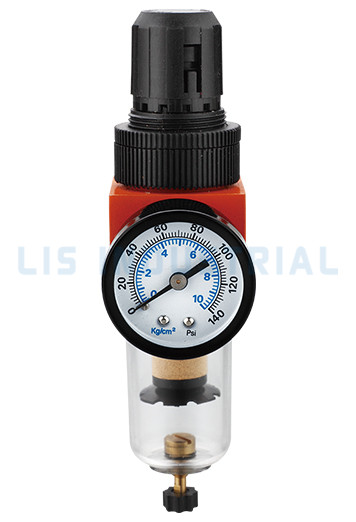
AFR80A
The Importance of Filtration and Pressure Regulation
Compressed air may appear clean when it leaves a compressor, but it can contain moisture, rust particles, dust, oil residue, and other contaminants. Some contamination originates inside the compressor, while additional particles may be introduced by aging storage tanks, hoses, fittings, or distribution pipes. Even a small amount of particulate matter can affect the operation of precision air tools and spray equipment.
Air pressure also changes during normal operation. A compressor may produce pressure higher than the level required by a spray gun or pneumatic tool. Pressure can rise when demand is low and fall when several tools operate at the same time. Without suitable regulation, the tool may receive pressure that is too high, too low, or inconsistent. Such variation can affect spray atomization, tool speed, surface finish, material consumption, and operator control.
A filter/regulator combines these two control functions in one practical installation point. The filter section helps trap particles from the compressed-air stream. The regulator section allows the working pressure to be adjusted to a suitable level for the connected equipment. This arrangement reduces the number of separate components required and simplifies the design of an air pipeline.
For painting applications, pressure stability is especially important. A spray gun needs an appropriate air supply to atomize coating material correctly. If the pressure is too high, overspray and excessive material consumption may occur. If it is too low, the coating may be poorly atomized, producing an uneven surface, heavy droplets, or inadequate coverage. A filter/regulator positioned near the point of use can help provide cleaner and more controlled air to the spray equipment.
For pneumatic tools, regulation can also protect the equipment from unnecessary stress. Many air tools are designed to operate within a specified pressure range. Supplying pressure above that range may increase wear, accelerate seal deterioration, and create unsafe operating conditions. A correctly adjusted regulator supports more consistent tool performance and helps the operator match the air supply to the application.
AFR80A Product Overview
The AFR80A is categorized as an air pipeline accessory and is intended to be installed in a compressed-air distribution system. Its primary function is described as a filter/regulator, meaning that it combines air filtration with adjustable pressure management. The design is suitable for air lines supplying painting equipment, air tools, workshops, and other pneumatic devices.
The unit supports a pressure range of 10–120 PSI. This broad adjustment range allows users to select a working pressure appropriate for different tools and processes. Low-pressure applications can be supported by setting the regulator near the lower end of the range, while more demanding pneumatic equipment can use a higher setting within the product’s operating limits.
The maximum pressure is specified as no more than 140 PSI. This rating provides an important reference for system designers and installers. The upstream compressed-air source should be selected and adjusted so that the filter/regulator is not exposed to pressure above its stated maximum. Correct installation and proper pressure management are essential for safe and dependable service.
Filtration precision is rated at 40 microns. This level is intended to remove many common solid particles found in compressed-air systems. It is particularly useful as a general-purpose filtration stage for air tools and spraying equipment. Users requiring removal of very fine aerosols, oil vapor, or specialized contaminants may need to combine the AFR80A with additional filtration equipment suited to the application.
Air inlet options include G1/4, G3/8, and G1/2. These connection sizes provide flexibility when integrating the product into different pipeline layouts. The appropriate inlet version can be selected according to the existing pipe, hose, fitting, and equipment requirements. Matching the connection size correctly helps reduce installation complexity and supports a more efficient air path.
| Item | AFR80A Specification | Practical Significance |
|---|---|---|
| Product type | Filter/regulator | Combines particle filtration and pressure adjustment |
| Product category | Air pipeline accessories | Designed for integration into compressed-air systems |
| Pressure range | 10–120 PSI | Supports a wide variety of air-tool applications |
| Maximum pressure | ≤140 PSI | Defines the upper operating limit for system planning |
| Filtration precision | 40 microns | Helps remove common solid contaminants from compressed air |
| Air inlet options | G1/4, G3/8, or G1/2 | Allows compatibility with different pipeline configurations |
| Carton quantity | 40 pieces | Suitable for distributor and project-based purchasing |
| Carton size | 55 × 25 × 35 cm | Provides a reference for logistics and warehouse planning |
Advantages in Compressed-Air Applications
Combined Functionality
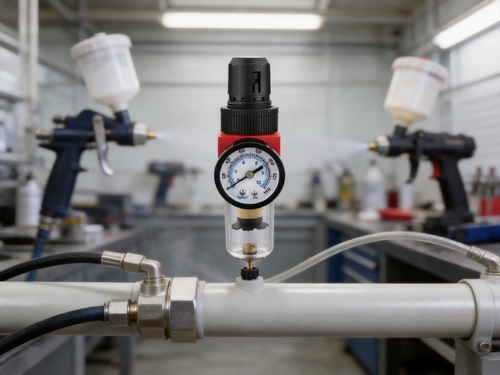
One of the most practical advantages of the AFR80A is its combined filter and regulator configuration. A separate filter and regulator can perform similar functions, but using an integrated assembly may reduce the number of components, connections, and mounting points required. Fewer connections can simplify installation and reduce the potential for leakage caused by poorly fitted joints.
An integrated product can also make routine system planning more straightforward. Instead of selecting two separate products with potentially different flow characteristics, mounting arrangements, and maintenance requirements, the user can specify one filter/regulator assembly for a particular pipeline section. This is useful for workshops, production lines, equipment distributors, and original equipment manufacturers that need repeatable air-management arrangements.
Broad Pressure Adjustment
The 10–120 PSI adjustment range makes the AFR80A adaptable to different types of air equipment. Spray guns may require a controlled pressure appropriate to the coating and nozzle arrangement. Air brushes often operate at lower pressures, while some pneumatic tools require a stronger air supply. The broad range allows the same general product family to be used across multiple workstations, subject to the requirements of each application.
Adjustability also supports process optimization. Operators can begin with the equipment manufacturer’s recommended pressure and make careful adjustments according to the coating, hose length, air consumption, material viscosity, and desired finish. The regulator provides a practical control point rather than forcing every connected device to operate at the compressor’s unregulated output pressure.
40-Micron Filtration
Contaminants in compressed air can cause problems that are not always immediately visible. Dust may obstruct small passages, affect valves, scratch moving surfaces, or become embedded in a coated finish. The 40-micron filtration precision of the AFR80A provides general-purpose protection against many solid particles circulating through an air pipeline.
Cleaner air can support more stable performance from downstream equipment. In spray applications, removing particulate matter helps reduce the likelihood that contamination will reach the spray gun or coating surface. In pneumatic tools, filtration helps limit the amount of debris entering internal passages. The filtration stage should still be maintained properly, and users should select supplementary drying or fine-filtration equipment where the application demands a higher level of air purity.
Flexible Connection Options
Air systems vary considerably in scale. A small workshop may use compact tubing and smaller fittings, while a production line may use a larger distribution pipe to support several air-consuming devices. The AFR80A can be specified with G1/4, G3/8, or G1/2 inlet sizes, helping users choose a version that corresponds to the installation requirements.
Connection compatibility is more than a convenience. An unsuitable connection can create restrictions, leakage, excessive turbulence, or unnecessary adapters. Selecting the correct inlet size supports a cleaner installation and may help preserve air delivery efficiency. Before ordering, users should confirm the thread standard, pipe size, flow requirement, available space, and orientation of the existing system.
Suitability for Multiple Industries
The AFR80A is not restricted to one narrow application. It can be considered for automotive repair, furniture finishing, general manufacturing, equipment maintenance, metalworking, woodworking, small-scale production, and professional workshops. It is also relevant to distributors that supply air pipeline accessories together with spray guns, compressors, hoses, fittings, and other pneumatic products.
In a woodworking environment, the filter/regulator can help provide cleaner and controlled air for spray finishing, pneumatic fastening, blowing, or cleaning operations. In an automotive workshop, it can be used with spray guns, tire inflators, air blow guns, polishers, and other common tools. In industrial production, it can serve as a point-of-use control device for individual workstations or equipment groups.
Comparison with Basic Unregulated Air Connections
A basic air hose connected directly to a compressor may be sufficient for simple low-demand tasks, but it provides limited control. The tool receives air that may contain pipeline debris and may be exposed to pressure fluctuations or excessive pressure. This arrangement can be inconvenient when the same compressor supplies several different tools with different operating requirements.
By contrast, the AFR80A provides a designated point for air preparation and pressure adjustment. The operator can set the outlet pressure according to the connected tool instead of relying solely on the compressor setting. The filter section also adds a layer of protection between the air source and the equipment.
Compared with a separate filter and regulator, the integrated arrangement may offer a more compact layout. It can be easier to mount near a workstation and may reduce the space needed on a crowded equipment panel. It can also simplify product selection for customers who prefer a single air-preparation component.
These advantages do not mean that every air system requires the same configuration. High-demand installations may need larger separators, dryers, lubricators, coalescing filters, automatic drains, or multiple stages of air treatment. The AFR80A is best viewed as a versatile general-purpose filter/regulator that can be incorporated into a properly designed system.
Application with Spray Guns and Paint Sprayers
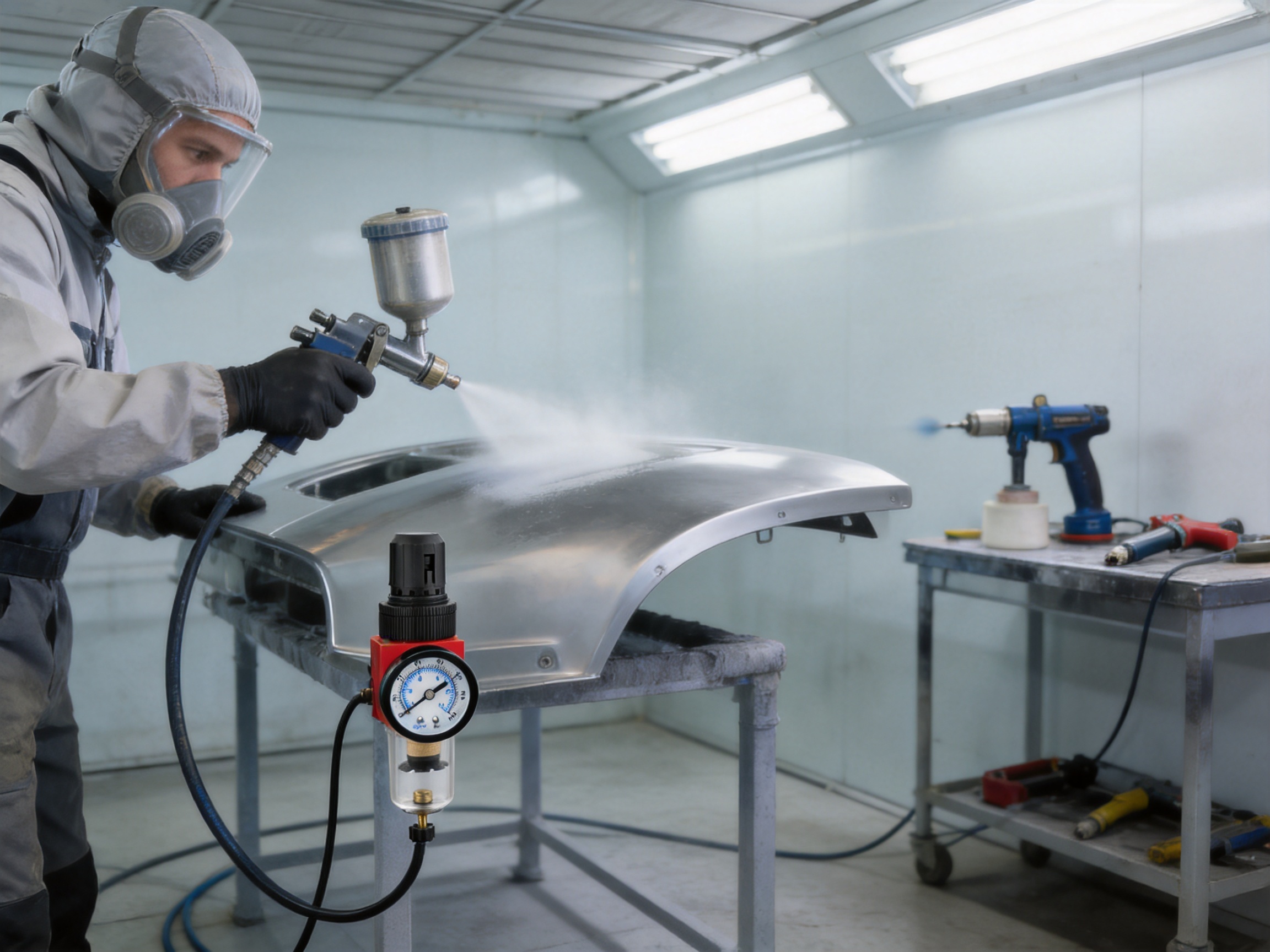
Spray equipment depends on a stable air supply for consistent atomization. Whether the application involves automotive refinishing, furniture coating, industrial painting, touch-up work, or general maintenance, the air pressure should be adjusted to the gun, nozzle, material, and operating method. The AFR80A can be installed in the air line before the spray gun to provide a convenient adjustment point.
When a spray gun receives excessive pressure, the air stream may break coating material into very fine particles and carry more material beyond the target surface. This can increase overspray, reduce transfer efficiency, and make the work area more difficult to control. Excessive pressure may also create a dry spray effect if droplets lose too much solvent or moisture before reaching the surface.
When pressure is insufficient, the spray pattern may become uneven. Material may leave the nozzle in larger droplets, producing poor atomization, runs, orange peel, or inconsistent coverage. By allowing the operator to adjust pressure within the 10–120 PSI range, the AFR80A can help establish a more suitable working condition.
Filtration is equally relevant to coating quality. Dust and rust particles carried through the air line may enter the spray gun or land on a wet coating surface. The 40-micron filter provides general particle control and can contribute to a cleaner painting process. However, professional finishing systems should also address moisture and oil contamination through suitable compressor maintenance, tank drainage, air drying, and additional filtration where necessary.
The filter/regulator should be positioned according to the equipment layout. In many cases, placing an air-preparation unit near the point of use makes adjustment easier and reduces the chance that unregulated pressure will be introduced through a long downstream hose. The installation should avoid locations exposed to impact, excessive heat, aggressive chemicals, or conditions outside the product’s intended operating environment.
Application with Pneumatic Tools
Pneumatic tools are often designed around a specific pressure and air-consumption requirement. Air polishers, impact tools, grinders, drills, nailers, staplers, and blow guns may not all operate optimally at the same pressure. A filter/regulator allows the user to create a more appropriate supply for the individual workstation.
Regulated pressure can improve operator control. A tool receiving too much pressure may run faster than necessary, making it more difficult to handle and potentially increasing wear. A tool receiving too little pressure may lose performance, forcing the operator to work more slowly or apply additional force. Matching the pressure to the tool helps create a more predictable working experience.
Particle filtration can help reduce the amount of debris entering the tool. This is particularly important for equipment with small air passages, sensitive valves, or closely fitted moving components. Filtration does not replace lubrication or regular maintenance, but it can support a broader preventive-maintenance program.
For air blow guns and cleaning equipment, the regulator can help limit the pressure used for a particular task. This may be useful when cleaning delicate components or working near dust-sensitive surfaces. Operators should always follow workplace safety procedures and use appropriate personal protective equipment because compressed air can propel particles and cause injury.
Manufacturing and Engineering Strengths
The AFR80A is supported by the manufacturing capabilities of Ningbo Lis Industrial Co., Ltd. The company has been engaged in the development, manufacture, and marketing of air painting spray guns, mini air compressors, air tools, and relevant accessories since 1984. Its long operating history provides experience in product design, production organization, quality management, and international customer service.
The company operates from Ningbo, China, a major harbor city with developed transportation and industrial infrastructure. Its manufacturing site covers more than 400,000 square feet and employs more than 400 people. The company reports annual output exceeding 40 million United States dollars, indicating a substantial production base capable of supporting both standard product programs and larger customer requirements.
A significant strength is the company’s ability to connect product engineering with practical market applications. Its product range includes high-volume low-pressure spray guns, heavy-duty spray guns, woodworking low-pressure spray guns, economical conventional spray guns, texture paint spray guns, paraffin guns, air blowing guns, sandblast and foam guns, tire inflating guns, water and grease guns, automatic spray guns, air brushes, mini oil-free compressors, air pipeline accessories, paint tanks, air fittings, polishers, spray gun kits, touch-up spray guns, car polishing machines, airless spray guns, electric spray guns, and paint sprayers.
This broad product portfolio helps the manufacturer understand how air pipeline accessories are used in complete spraying and pneumatic systems. A filter/regulator is not treated as an isolated component; it is part of a larger equipment environment involving compressor performance, hose selection, fittings, spray-gun requirements, coating materials, and operator technique.
Research and Development
The company maintains a strong research and development capability and provides OEM services based on customer drawings or samples. It also offers ODM development according to customer requirements. This is valuable for distributors, equipment brands, industrial customers, and project integrators that need modifications in connection sizes, labeling, packaging, appearance, or system configuration.
Technical development has been a continuing focus since the company’s establishment. Ningbo Lis Industrial Co., Ltd. established a spraying machinery engineering technology center and carried out technical cooperation with American Wagner Spraying Technology Co., Ltd. Such technical cooperation and engineering investment support the development of practical products for paint application and pneumatic equipment.
For a filter/regulator, effective development involves more than selecting a housing shape. Engineers must consider pressure resistance, sealing performance, thread accuracy, filtration consistency, regulator response, drainage, durability, usability, and compatibility with the surrounding air system. Production equipment and inspection procedures must then reproduce the design reliably across batches.
Quality-System Approach
The company states that it follows the requirements of the ISO9000 quality system and applies control throughout the product life cycle. The described process includes raw-material inspection, incoming inspection, in-process quality control, 100 percent functional testing, and final quality inspection of finished products.
This sequence is important because quality cannot be created through final inspection alone. Incoming materials must meet requirements before entering production. Manufacturing operations must be monitored while components are formed and assembled. Functional testing must verify that products perform as intended, and final inspection must confirm that completed goods are suitable for packaging and delivery.
For air pipeline accessories, functional control may include checks related to pressure handling, connection quality, sealing, regulator operation, filtration components, and general appearance. The exact inspection plan may vary according to product configuration and customer requirements, but a controlled process provides a stronger foundation than informal visual checking.
International Certifications and Compliance
The manufacturer reports certification and compliance experience that includes ISO9001 international quality system certification, OHSAS18001 occupational health and safety system certification, ISO14001 environmental management system certification, European CE certification, and German GS product certification. The company also reports recognition as a national high-tech enterprise, an advanced customs certification enterprise, a Ningbo individual item champion, and a provincial engineering and technology center.
Certification does not eliminate the need for correct installation or application-specific evaluation. Nevertheless, documented management systems and product certifications can provide useful confidence to importers, distributors, industrial buyers, and project customers. They also demonstrate that the manufacturer has experience working with structured requirements for quality, environmental management, occupational safety, and product conformity.
Production Capacity and Supply Reliability
Supply continuity is an important consideration when selecting a component for resale or repeated industrial use. A product may be technically suitable, but delays, inconsistent batches, or limited production capacity can disrupt a customer’s operations. Ningbo Lis Industrial Co., Ltd. reports that its production capacity can be increased by 30 percent within two months, helping it respond to changing purchase volumes.
The AFR80A is packed with 40 pieces per carton, with a stated carton size of 55 × 25 × 35 centimeters. This information supports purchasing, warehouse organization, shipping calculations, and distributor planning. Buyers can use the packing quantity to estimate inventory requirements and coordinate mixed or full-carton orders.
For OEM and wholesale customers, production scalability can be particularly useful. A distributor may begin with a small market test and later require larger quantities. An industrial customer may need repeated deliveries for several facilities or production lines. A manufacturer with established production resources can support these changes more effectively than a supplier dependent on very small-scale or irregular production.
Supply reliability also depends on communication, documentation, inspection coordination, packaging standards, and after-sales support. The company’s international marketing and service network, together with its experience serving customers in Europe, North America, the Middle East, South Africa, and East Asia, provides a foundation for cross-border business cooperation.
Installation Planning
Before installing the AFR80A, users should review the compressed-air system and identify the actual requirements of the connected equipment. The compressor’s maximum pressure, the pipeline size, the expected air flow, the number of simultaneous users, the air quality requirements, and the operating environment should all be considered.
The inlet thread must match the selected version of the product. Available options are G1/4, G3/8, and G1/2. If adapters are required, they should be selected carefully to avoid reducing the effective passage, introducing leaks, or creating unnecessary mechanical stress. Thread sealant should be used only in a manner compatible with the fitting design and manufacturer instructions.
The filter/regulator should be installed in the correct airflow direction. If the body includes directional markings, those markings should be followed. The unit should be mounted securely and positioned so that the adjustment control, pressure indication, and filter area can be accessed during operation and maintenance.
It is advisable to install the product in a location protected from impact and excessive vibration. The air line should be supported independently so that its weight does not hang from the filter/regulator body or threaded connection. Hoses should not be sharply bent immediately at the inlet or outlet, since tight bends can restrict flow and apply stress to the fittings.
Before pressurizing the system, installers should inspect all connections. The system should be brought up to pressure gradually, and joints should be checked for leaks using an appropriate method. The regulator should then be adjusted to the recommended working pressure for the downstream tool. Users should not exceed the maximum rated pressure of 140 PSI.
Maintenance and Operating Practices
Regular maintenance helps preserve the effectiveness of a filter/regulator. The air supply should be shut off and pressure released before service work is performed. The filter section should be inspected periodically for accumulated contamination. If the filter element or bowl requires cleaning or replacement, the procedure should follow the applicable product instructions and workplace safety requirements.
Compressed-air systems often contain moisture, especially when the air cools after compression. Moisture may collect in tanks, filters, hoses, and low points in the pipeline. A filter/regulator intended for general particle filtration should not be assumed to replace a dedicated air dryer or water separator. Draining the compressor tank and maintaining upstream moisture-control equipment can reduce the burden placed on the filter.
The pressure setting should be checked when tools are changed or when process conditions vary. A setting suitable for one spray gun may not be suitable for another. Operators should use the tool manufacturer’s recommendations as the starting point, then make controlled adjustments based on the actual application.
Leaks should be addressed promptly. A small leak may appear insignificant, but multiple leaks can cause the compressor to run more frequently, increase energy consumption, and reduce pressure available to the equipment. A well-maintained filter/regulator and properly sealed connections contribute to a more efficient air distribution system.
Users should also avoid exposing the product to chemicals or environmental conditions for which it was not designed. Paint solvents, corrosive vapors, high temperatures, freezing conditions, and mechanical impact may affect seals, housing components, or readability of pressure-control elements. The installation environment should be evaluated before the product is selected.
Advantages for Distributors and OEM Customers
For distributors, the AFR80A offers a straightforward product proposition. It belongs to a widely used category of air pipeline accessories, has a clear set of technical specifications, and can be marketed alongside spray guns, compressors, hoses, fittings, and pneumatic tools. The availability of several inlet sizes helps distributors serve customers with different pipeline requirements.
The product can also be included in air-preparation kits for workshops and equipment packages. A distributor may combine the filter/regulator with a spray gun, hose, couplings, and maintenance accessories to create a more complete solution. This approach helps customers understand the relationship between air quality, pressure adjustment, and tool performance.
OEM customers may benefit from the manufacturer’s ability to work from drawings or samples. Depending on the project, customization may involve product identification, packaging, connection configuration, documentation, or integration into a larger equipment assembly. ODM support can assist customers that require a product developed around their own market or application requirements.
Long-term cooperation is supported by the company’s experience in manufacturing, certification, export operations, and customer service. Its own brands, including Voylet and Muzi, demonstrate experience in developing and marketing products for international markets. The company also provides products under customer programs and maintains relationships with customers in multiple regions.
How the AFR80A Supports Total Spraying Solutions
A high-quality spray result depends on more than the gun itself. The compressor must provide sufficient air. The hose must have an appropriate internal diameter and length. Fittings should be compatible and properly sealed. The coating must be prepared correctly. The operator must select an appropriate technique. The air pipeline must provide stable, suitably filtered pressure.
The AFR80A supports this complete-system approach by addressing air preparation close to the equipment. It can help create a controlled interface between the main air supply and the spray gun or pneumatic tool. This is particularly useful where one compressor serves several workstations or where different tools require different pressure settings.
In a professional workshop, multiple filter/regulator units can be installed at individual points of use. Each operator can then adjust the pressure for the particular gun or tool without changing the compressor setting for the entire facility. In a smaller workshop, one unit can provide basic filtration and pressure control for a selected work area.
For equipment manufacturers, the AFR80A can be incorporated into a complete spray system, finishing machine, or pneumatic control panel. The choice of G1/4, G3/8, or G1/2 inlet allows the designer to match the component to the intended scale of the system. The 40-micron filtration specification and 10–120 PSI pressure range provide clear reference points during equipment design.
Selection Guide for Buyers
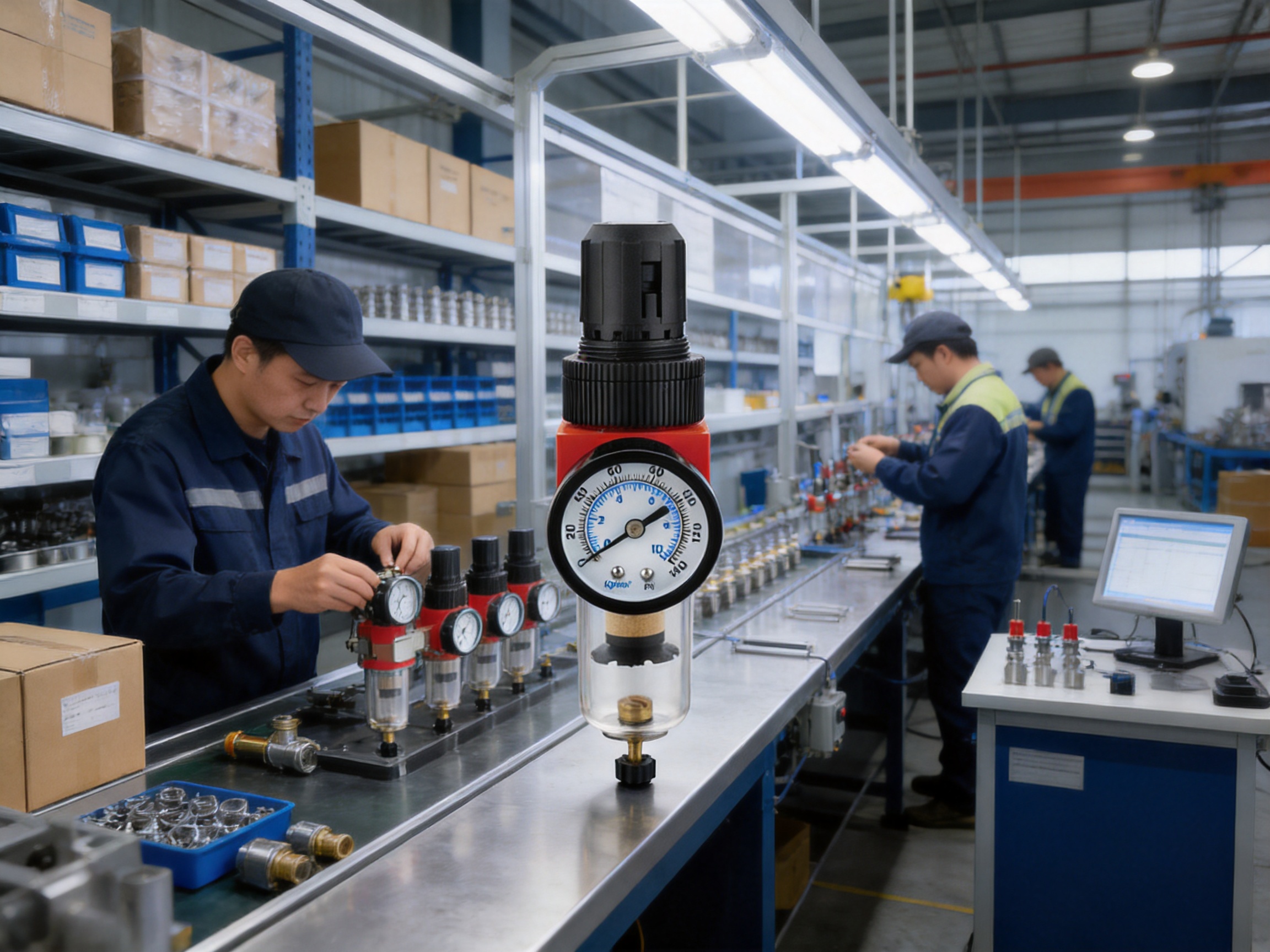
Buyers should begin by identifying the application. A spray gun used for fine finishing may have different air requirements from a heavy-duty pneumatic tool. A filter/regulator used in a small repair shop may have different connection and flow needs from one used on a production line. The product should be selected as part of the complete air system rather than by pressure range alone.
The next step is to confirm the connection size. The AFR80A is available with G1/4, G3/8, or G1/2 air inlets. Buyers should check the existing pipe threads and determine whether the product will be installed directly or through a suitable fitting. Thread compatibility should be confirmed before purchase, especially when equipment is being shipped across regions where different thread standards may be common.
Pressure requirements should then be reviewed. The working pressure must fall within the 10–120 PSI pressure range, and the upstream supply must not exceed the maximum pressure of 140 PSI. The tool manufacturer’s recommended pressure should be considered together with hose length, air consumption, and the number of devices operating on the line.
Air-quality requirements should also be assessed. The 40-micron filtration precision is appropriate for general particle filtration, but specialized processes may require additional stages. Automotive refinishing, high-gloss furniture finishing, electronics production, laboratory applications, and other sensitive operations may require more advanced control of moisture, oil, and fine aerosols.
Finally, buyers should evaluate quantity, packaging, delivery, documentation, technical support, and customization. The standard carton quantity of 40 pieces may be useful for wholesale purchasing. OEM customers should discuss drawings, samples, labeling, inspection requirements, packaging, and production schedules with the manufacturer before placing a project order.
Quality, Safety, and Responsible Use
Compressed air contains stored energy and must be handled responsibly. The AFR80A should be used only within its stated pressure limits and in a system designed for the intended operating conditions. Operators should wear suitable eye protection when working with compressed air, spray equipment, or tools that may release particles.
Compressed air should never be directed toward people or used to clean clothing or skin. A regulated outlet does not remove the risk of flying debris, noise, or injection injury. Workshop procedures should address hose condition, fitting security, pressure release, emergency isolation, and proper use of personal protective equipment.
Paint applications introduce additional hazards, including flammable vapors, airborne coating particles, and solvent exposure. Adequate ventilation, respiratory protection, grounding, and fire-prevention measures should be used according to the coating manufacturer’s safety information and local regulations.
Responsible product use also includes correct disposal of contaminated filter elements and maintenance materials. Environmental management systems, such as the ISO14001 framework reported by the manufacturer, can support more systematic control of manufacturing impacts. Users and distributors should likewise follow local requirements for waste handling and equipment disposal.
Why Manufacturing Experience Matters
Air pipeline accessories may appear simple, but their reliability depends on accurate components, consistent sealing, pressure resistance, and repeatable assembly. A manufacturer with experience across spray guns, compressors, air tools, and fittings can draw on a broader understanding of how compressed-air products behave in real applications.
Ningbo Lis Industrial Co., Ltd. has developed its operations over more than four decades. Its workforce, engineering resources, production site, quality systems, product certifications, and international customer base provide a substantial platform for manufacturing. The company’s history also reflects an ability to adapt its product portfolio as air-tool and painting requirements change.
The combination of standard products and customization capability is another strength. Standard specifications allow customers to order a proven product for common applications. OEM and ODM services allow larger customers to address special market needs or integrate the product into a proprietary system. This balance can reduce development time while preserving flexibility.
International business also requires more than manufacturing capacity. Customers need clear communication, dependable packaging, export experience, technical documentation, and responsive service. A supplier with established sales and service coverage can help reduce the practical challenges associated with cross-border procurement.
Q&A
What is the AFR80A?
The AFR80A is a compressed-air filter/regulator used as an air pipeline accessory. It helps filter solid contaminants from the air stream and regulate the pressure delivered to downstream spray guns, pneumatic tools, and other air-operated equipment.
What pressure range does the AFR80A support?
The stated pressure range is 10–120 PSI. The selected outlet pressure should match the requirements of the connected equipment and should be adjusted within the operating limits of the product and the complete air system.
What is the maximum pressure rating?
The maximum pressure is specified as no more than 140 PSI. The upstream air source should be controlled so that the filter/regulator is not exposed to pressure above this limit.
What filtration precision does it provide?
The AFR80A has a stated filtration precision of 40 microns. This provides general-purpose filtration of solid particles. Applications requiring control of fine aerosols, oil vapor, or high levels of moisture may require additional air-treatment equipment.
Which inlet sizes are available?
The available air inlet options are G1/4, G3/8, and G1/2. Buyers should select the version that matches the pipeline, fittings, hose, and equipment arrangement.
Can it be used with spray guns?
Yes. The AFR80A can be used in compressed-air lines supplying spray guns and paint sprayers. Its regulator can help establish a suitable working pressure, while its filter section helps reduce solid contamination reaching the spray equipment.
Can it be used with pneumatic tools?
Yes. It may be suitable for air polishers, blow guns, inflating guns, and other pneumatic tools, provided that the pressure, air quality, connection, and flow requirements of the tool are compatible with the installation.
Does it replace an air dryer?
No. The AFR80A is described as a filter/regulator with 40-micron filtration precision. It should not automatically be treated as a substitute for a refrigerated dryer, desiccant dryer, water separator, coalescing filter, or oil-vapor filter. The required air-treatment configuration depends on the application.
Where should the product be installed?
It is commonly useful near the point of use, where the operator can adjust pressure for the connected tool. The final position should provide protection from impact, access for maintenance, correct airflow direction, and compatibility with the pipeline layout.
What should be checked before ordering?
Customers should confirm the application, operating pressure, maximum upstream pressure, connection size, air-quality requirements, installation space, quantity, packaging, and any OEM or ODM requirements. They should also verify whether additional filtration or drying equipment is needed.
What manufacturing services are available?
Ningbo Lis Industrial Co., Ltd. reports OEM support based on customer drawings or samples and ODM services according to customer requirements. Customers should discuss technical specifications, samples, packaging, labeling, inspection, and production schedules directly with the manufacturer.
What is the standard carton quantity?
The stated quantity per carton is 40 pieces. The listed carton size is 55 × 25 × 35 centimeters. These details can assist distributors with inventory and shipping planning.
Why is filtration important for painting?
Particles in compressed air may enter the spray gun or land on the coating surface. General particle filtration can help reduce contamination and support a cleaner painting process. Proper moisture control, coating preparation, ventilation, and spray technique remain important as well.
Why is pressure regulation important?
Different tools and spray applications require different working pressures. Regulation helps prevent the downstream equipment from receiving unnecessary or unstable pressure. Correct pressure can improve operator control, tool performance, atomization, and process consistency.
Conclusion
The AFR80A is a practical filter/regulator for compressed-air systems serving spray guns, paint sprayers, pneumatic tools, and general workshop equipment. Its principal advantages are the combination of filtration and pressure control, a 10–120 PSI adjustment range, a maximum pressure specification of no more than 140 PSI, 40-micron filtration precision, and three inlet-size options: G1/4, G3/8, and G1/2.
These features make the product adaptable to many air pipeline arrangements. It can help users create cleaner, more controlled air at the point of use while reducing the need for separate filtration and regulation components. Its value is strongest when it is correctly matched to the compressor, pipeline, tool, hose, and air-quality requirements of the application.
The product is supported by the engineering, manufacturing, quality-control, certification, and international-service capabilities of Ningbo Lis Industrial Co., Ltd. With a history extending back to 1984, a large production facility, more than 400 employees, OEM and ODM development services, and a broad portfolio of spraying and air-tool products, the company is equipped to serve both standard purchasing programs and customized industrial requirements.
For distributors, workshops, equipment manufacturers, and professional users seeking a dependable general-purpose air-management component, the AFR80A offers a balanced combination of functionality, installation flexibility, and manufacturer support. With proper selection, installation, maintenance, and safe operation, it can contribute to more stable compressed-air delivery and more reliable performance across a wide range of pneumatic applications.
References
1. Product specification information for the AFR80A filter/regulator, including pressure range, maximum pressure, inlet options, filtration precision, and packaging data.
2. Ningbo Lis Industrial Co., Ltd. corporate information concerning product development, manufacturing capability, quality management, certifications, OEM services, ODM services, and international markets.
3. International Organization for Standardization. Quality management system principles and ISO 9001 guidance.
4. International Organization for Standardization. Environmental management system principles and ISO 14001 guidance.
5. General compressed-air system engineering practices for filtration, pressure regulation, moisture control, pipeline installation, and pneumatic-equipment maintenance.
6. General spray-application principles concerning atomization pressure, air cleanliness, coating consistency, overspray control, and point-of-use air preparation.