 Search

 English
 中文简体
 Deutsch
 Español
Content
- 1 Product Overview
- 2 Technical Specifications
- 3 Why Automatic Spraying Matters in Modern Production
- 4 Advantages of the ST5 Over Basic Competitor Models
- 5 Manufacturing Strengths Behind the Product
- 6 Materials, Coatings, and Application Flexibility
- 7 Installation in an Automated System
- 8 Operating Guidance for Consistent Results
- 9 Maintenance and Service Considerations
- 10 Quality and Cost Benefits for Industrial Users
- 11 Applications Across Different Industries
- 12 Supplier Capabilities and Global Support
- 13 Recommended Purchasing Checklist
- 14 Safety Requirements
- 15 Frequently Asked Questions
- 15.1 What type of product is the ST5?
- 15.2 What nozzle sizes are available?
- 15.3 What is the stated air pressure?
- 15.4 What air connection does the gun use?
- 15.5 Can the ST5 be used with different coatings?
- 15.6 Can it be used with robotic equipment?
- 15.7 How does it compare with a manual spray gun?
- 15.8 What maintenance does the ST5 require?
- 15.9 Is the product suitable for high-volume purchasing?
- 15.10 Does the manufacturer offer customized services?
- 15.11 What should be checked before placing an order?
- 16 Conclusion
- 17 References
- 18 Product: ST5
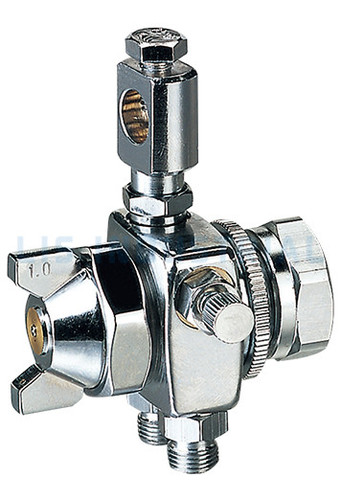
The ST5 automatic spray gun is designed for production environments that require repeatable coating results, controlled material application, and dependable operation. As an automatic spray gun, it is intended to work as part of a wider spraying system rather than as a manually operated hand tool. Its compact design, selectable fluid nozzle options, standardized air connection, and 50 PSI operating pressure make it suitable for many industrial and commercial applications where a consistent finish is more important than occasional, low-volume spraying.
Automatic spraying technology is used in industries such as woodworking, furniture manufacturing, metal finishing, vehicle component production, household appliance manufacturing, general fabrication, and industrial maintenance. In these applications, the spray gun must deliver a stable atomized pattern while working with pumps, regulators, automation equipment, conveyors, fixtures, or robotic systems. The ST5 is developed around these requirements, offering a practical combination of operating simplicity, adaptable nozzle selection, and integration flexibility.
The product is manufactured by Ningbo Lis Industrial Co., Ltd., an established Chinese producer of air painting spray guns, mini air compressors, air tools, and related spraying equipment. The company has developed extensive experience in spraying technology since its establishment in 1984. Its production capabilities include research and development, tooling, assembly, quality control, functional testing, OEM production, and ODM support. This background is important because the performance of an automatic spray gun depends not only on its visible body and nozzle, but also on machining accuracy, sealing quality, assembly consistency, testing discipline, and long-term parts availability.
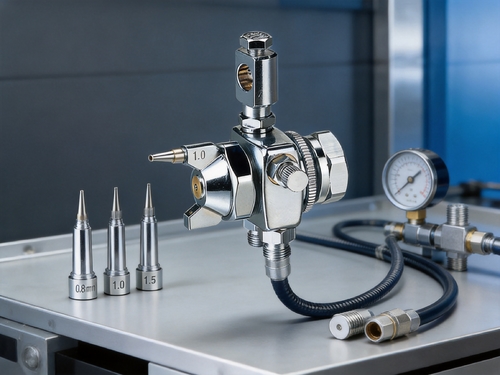
With fluid nozzle options of 0.8 mm, 1.0 mm, 1.5 mm, and other sizes, the ST5 can be configured for different coating materials, flow requirements, and finishing conditions. It has a stated air pressure of 50 PSI and uses a G1/4-inch air inlet, a widely recognized connection specification for compressed-air equipment. The product is packed in cartons measuring 44 by 34 by 22 centimeters, with 50 pieces per carton, supporting organized distribution and efficient shipment for wholesalers, project contractors, and equipment integrators.
ST5
Product Overview
The ST5 automatic spray gun is a pneumatic coating tool that uses compressed air to atomize liquid material into a controlled spray. Instead of relying on the operator to move and trigger the gun manually, an automatic model can be activated through an external control system. This makes it suitable for repetitive production cycles, fixed spraying stations, conveyor-based processes, and automated coating lines.
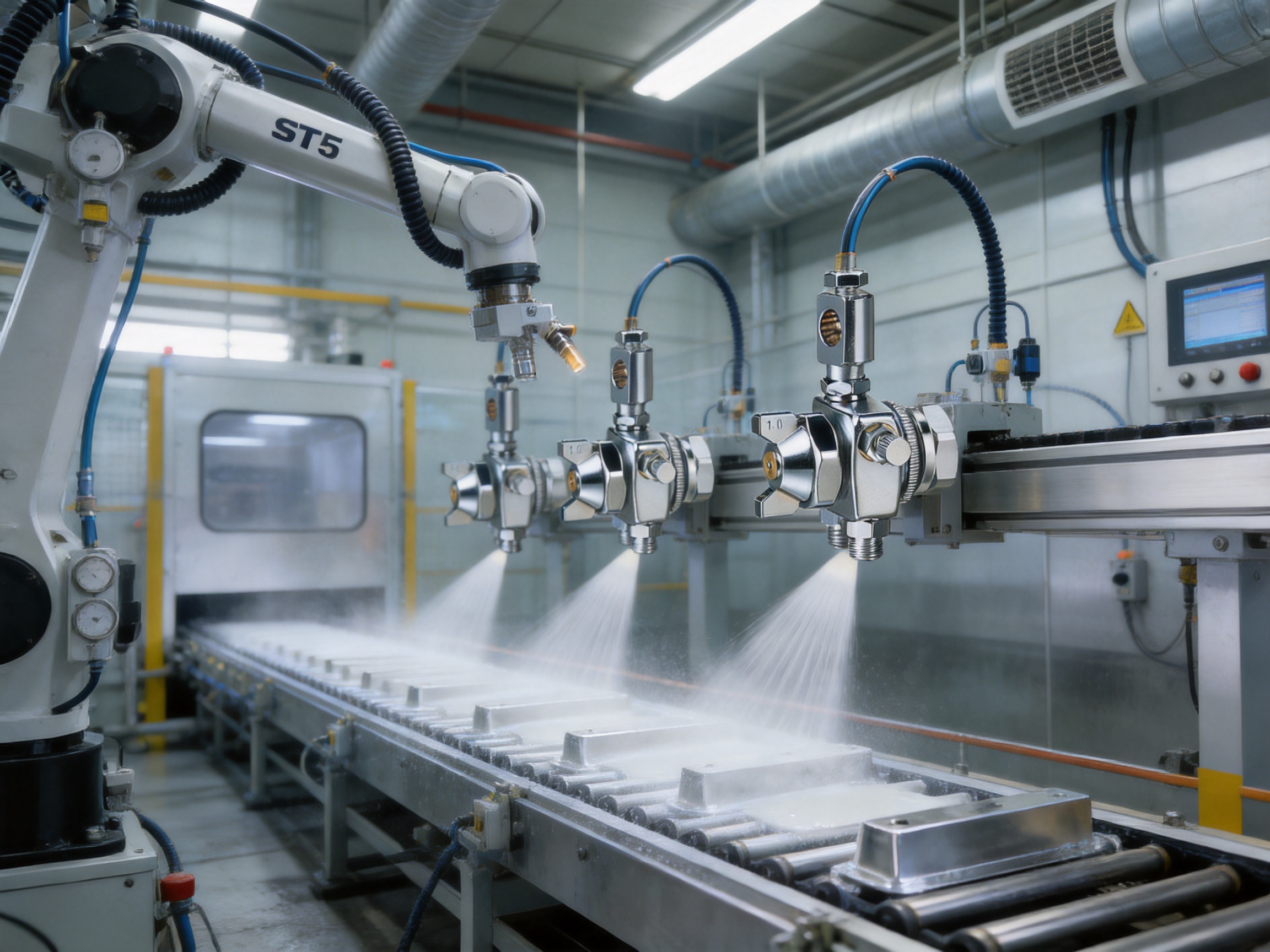
In a conventional manual spray gun, the operator controls the trigger, movement speed, distance, overlap, and spray duration. These variables can change from one operator to another and may also change as fatigue develops during a long shift. The ST5 allows the activation and spraying sequence to be incorporated into a production system, helping reduce variation between workpieces. The gun can be mounted in a fixed position, installed on a reciprocator, connected to a robotic arm, or integrated into a specially designed fixture, depending on the application.
The basic operating principle is straightforward. Compressed air enters through the G1/4-inch air inlet and passes through the air cap area. Coating material is delivered to the fluid nozzle, where the air stream breaks the liquid into droplets. The resulting spray pattern is influenced by nozzle size, coating viscosity, fluid pressure, atomizing pressure, spray distance, and the geometry of the air cap. Proper adjustment of these factors is necessary to achieve the desired balance between coverage, transfer efficiency, surface appearance, and production speed.
A key advantage of the ST5 is its configurable nozzle range. A 0.8 mm nozzle is generally associated with relatively fine material delivery and detailed coating work. A 1.0 mm nozzle provides a middle-range option for applications requiring a balance between atomization and output. A 1.5 mm nozzle can support higher material flow when the coating is more viscous or when faster coverage is needed. The correct choice depends on the coating formulation and the required finish, so the availability of multiple nozzle sizes gives users more flexibility than a fixed-nozzle system.
Technical Specifications
| Specification | ST5 Information | Practical Significance |
|---|---|---|
| Product type | Automatic spray gun | Suitable for fixed, repeatable, or externally controlled spraying operations |
| Fluid nozzle options | 0.8 mm, 1.0 mm, 1.5 mm, and other options | Supports different coating viscosities, flow rates, and finish requirements |
| Air pressure | 50 PSI | Provides a defined pneumatic operating reference for system design and adjustment |
| Air inlet | G1/4 inch | Facilitates connection with compatible air hoses, regulators, and fittings |
| Carton dimensions | 44 × 34 × 22 cm | Suitable for organized storage and shipping |
| Carton quantity | 50 pieces per carton | Supports wholesale orders, project supply, and distributor inventory planning |
Specifications should always be considered together with the coating material and the complete air-supply system. The stated 50 PSI air pressure is a product reference, but actual operating conditions may need to be adjusted according to the coating, nozzle, air cap, required pattern, and installation arrangement. A pressure regulator, clean air supply, and suitable filtration are essential for stable performance.
Why Automatic Spraying Matters in Modern Production
Manufacturers increasingly use automatic spraying because surface finishing is often a critical part of product quality. A coating can protect a component from corrosion, improve resistance to chemicals or abrasion, create a decorative appearance, or provide a specific texture. When the coating thickness is inconsistent, the result may include runs, dry spray, orange peel, pinholes, uneven gloss, poor adhesion, or excessive material consumption.
Automation does not eliminate the need for process knowledge, but it helps make the process more controllable. A properly installed automatic spray gun can repeat the same spray distance, angle, activation timing, and movement pattern. This consistency is especially valuable when large numbers of similar products must be finished in the same way.
The ST5 can be used in systems where the gun remains stationary and the workpiece moves past it. It can also be used where the gun travels across the product. In either arrangement, the automatic activation function can be coordinated with conveyors, sensors, programmable controllers, reciprocators, or robotic equipment. The result is a more structured spraying process with less dependence on manual triggering.
Another benefit is improved labor utilization. Operators can focus on loading, inspection, process monitoring, and maintenance rather than repeatedly pulling a trigger throughout the shift. This can help reduce physical strain and improve production organization. The actual labor benefit depends on the degree of automation, line design, coating requirements, and production volume, but the ST5 provides a suitable spray-gun platform for these systems.
Advantages of the ST5 Over Basic Competitor Models
Adaptable Nozzle Selection
Some basic automatic spray guns are offered with only one standard nozzle. That approach may be adequate for a narrow application, but it can limit the equipment when a factory changes coating materials or production requirements. The ST5 offers 0.8 mm, 1.0 mm, 1.5 mm, and other nozzle possibilities, giving users more room to optimize the spray process.
Nozzle selection affects material output and atomization behavior. A smaller nozzle may be more appropriate when the coating is relatively fluid and a fine finish is required. A larger nozzle can be useful when the material is thicker or when the process prioritizes coverage speed. Instead of replacing the entire gun when requirements change, users may be able to configure the ST5 with a more suitable fluid nozzle and related components.
This adaptability is valuable for contract manufacturers and workshops that process several products. It also benefits distributors because one product family can serve a broader range of customer applications. The ability to discuss multiple nozzle configurations allows an equipment supplier to recommend a more appropriate solution instead of treating every spraying task as identical.
Practical Pneumatic Compatibility
The G1/4-inch air inlet is a practical feature for system integration. Standardized air connections make it easier to connect the gun to hoses, regulators, filters, valves, and other pneumatic accessories. While compatibility must always be checked against the actual equipment, a recognized inlet specification reduces the need for unusual adapters and simplifies installation planning.
A stable air connection also contributes to predictable atomization. Poorly fitted hoses, leaks, contaminated fittings, or undersized air lines can reduce the pressure reaching the gun and create an irregular spray pattern. By using the correct connection components and maintaining a clean air circuit, the ST5 can be incorporated into a controlled pneumatic system with fewer avoidable installation problems.
Designed for Repetitive Operation
Manual spray guns are useful for repair work, small batches, and applications that require continuous human judgment. However, repetitive production can expose their limitations. The ST5 is designed as an automatic spray gun, making it more suitable for repeated spray cycles and controlled activation. This can help improve product-to-product consistency and reduce variation caused by differences in manual trigger operation.
For a production engineer, this means the spray gun can be considered as one component in a complete process. The engineering team can define spray timing, travel speed, distance, overlap, and workpiece positioning. Once the process is validated, the ST5 can support repeatable operation under the same conditions.
Efficient Bulk Supply
The 50-piece carton quantity and 44 by 34 by 22 centimeter carton size are useful for commercial distribution. Industrial buyers often need several guns for a production line, replacement stock, pilot projects, or multiple facilities. A predictable packing format assists warehouse planning and reduces uncertainty during shipment.
Bulk packing is also relevant to distributors serving regional markets. It supports consolidated orders and allows inventory to be managed by carton or project quantity. The suitability of the packing arrangement will depend on local logistics requirements, but the stated carton configuration provides a clear basis for purchasing and shipping calculations.
Support from an Experienced Spraying Manufacturer
Product performance is influenced by the manufacturer’s engineering and quality systems. Ningbo Lis Industrial Co., Ltd. has specialized in spray guns, air compressors, and related air tools for decades. The company reports a production facility covering more than 400,000 square feet, a workforce of more than 400 employees, and annual output exceeding 40 million US dollars. These resources indicate an industrial manufacturing structure rather than a small-scale assembly operation.
The company also reports cooperation and technical development activity in spraying machinery, a dedicated engineering technology center, OEM production based on customer drawings or samples, and ODM services developed around customer requirements. These capabilities can be important when a standard automatic spray gun must be adapted for a particular coating line, mounting arrangement, connection requirement, or market specification.
Manufacturing Strengths Behind the Product
Research and Development
An automatic spray gun must be designed as a complete fluid and air-management system. The body, fluid passage, nozzle, needle, air cap, seals, control mechanism, and mounting arrangement all influence the final result. Research and development work is therefore essential for improving atomization, reducing leakage risk, supporting stable operation, and making maintenance more practical.
The manufacturer’s research and development resources allow product improvements to be evaluated through design work, prototype testing, process feedback, and customer application experience. A company that serves different regional markets is also exposed to a wider range of coating materials, air systems, operating environments, and production expectations. That experience can help inform product development and application support.
For buyers, the benefit of an established R&D capability is not limited to the current product specification. It also affects the likelihood that the supplier can help with future adaptations, replacement components, process questions, and custom development. This is particularly important for automatic equipment, where the spray gun must function correctly with the surrounding system.
Controlled Production Processes
Consistent spray performance requires consistent manufacturing. Small differences in a nozzle or air cap can affect fluid delivery and spray pattern. Inaccurate threads can make assembly difficult. Poorly controlled sealing surfaces can create leaks. Inconsistent trigger or control components can influence activation. A professional production process must therefore control dimensions, materials, assembly procedures, and inspection standards.
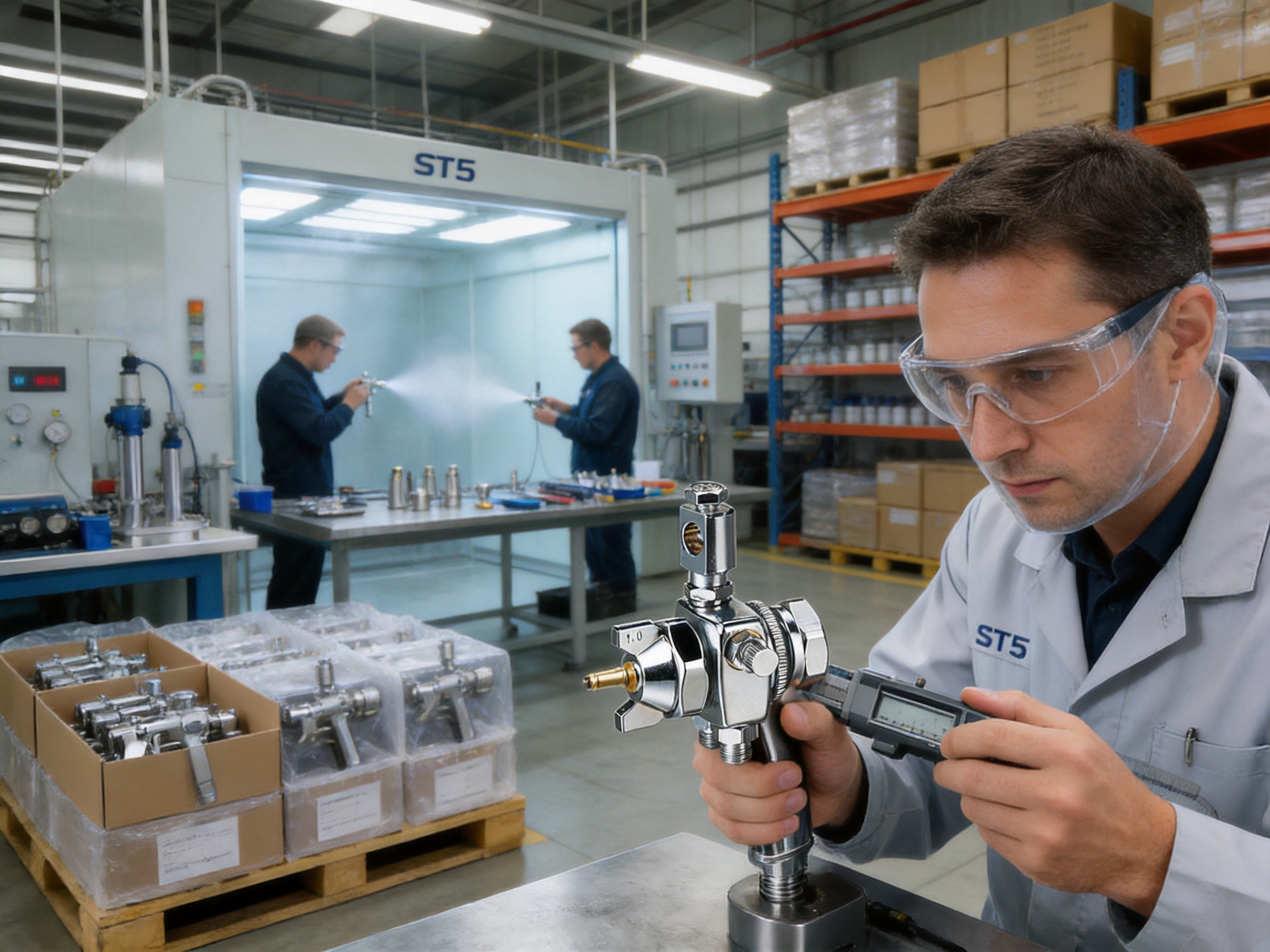
The company describes an elaborate production process supported by ISO9000 quality-system requirements. It also reports control from raw-material inspection and incoming inspection through in-process quality control, functional testing, and final inspection of finished products. This sequence is significant because quality cannot be created by final inspection alone. It must be managed throughout the production chain.
Incoming inspection helps ensure that purchased materials and components meet defined requirements before they enter production. In-process inspection can identify problems during machining, surface treatment, assembly, or adjustment. Functional testing provides a direct check that the completed spray gun operates as intended. Final inspection adds another level of verification before packaging and shipment.
Functional Testing
Functional testing is especially important for pneumatic spraying equipment. A spray gun may appear visually acceptable while still having an internal problem that affects air delivery, fluid shutoff, control response, or sealing. Testing can reveal issues that cannot be identified through appearance inspection alone.
For an automatic model such as the ST5, functional evaluation may include checking air passages, fluid delivery, activation behavior, sealing performance, and spray response. The exact internal test procedure is determined by the manufacturer, but the stated use of 100 percent functional testing demonstrates a commitment to checking each finished product rather than relying only on sampling.
Individual functional testing can improve confidence for distributors and industrial users. It also helps reduce the risk that a defective gun will reach a production line, where installation and troubleshooting may be more expensive. No manufacturing system can eliminate every possible problem, but systematic testing is a strong safeguard against avoidable performance variation.
Certification and Management Systems
The manufacturer reports certifications and management systems including ISO9001, ISO14001, OHSAS18001, CE, and GS-related product credentials. Buyers should verify the current scope, validity, and applicability of any certification for the exact product and market. Nevertheless, these reported systems indicate attention to quality management, environmental management, occupational health and safety, and product conformity.
Quality management supports repeatable processes and documented responsibilities. Environmental management encourages more systematic control of resource use, waste, and environmental impact. Occupational health and safety management is relevant to a factory that handles metal parts, machinery, coatings, solvents, compressed air, and packaging materials. Product certifications may support market access where regional compliance documentation is required.
For an automatic spray gun, compliance is only one part of a purchasing decision. Application suitability, maintenance support, spare parts, technical documentation, and total cost of ownership must also be considered. However, a structured management system provides an important foundation for reliable commercial supply.
Materials, Coatings, and Application Flexibility
The ST5 may be considered for a range of liquid coating applications, but the correct configuration must be selected according to the material. Paints, lacquers, primers, stains, protective coatings, adhesives, and specialty finishes can differ significantly in viscosity, solids content, drying behavior, solvent compatibility, and sensitivity to shear or atomization.
A lower-viscosity material may work well with a smaller nozzle and a comparatively fine spray. A higher-viscosity material may require a larger nozzle, additional material pressure, or a different atomizing setup. The 0.8 mm, 1.0 mm, and 1.5 mm options offer useful starting points, but they do not replace application testing. The coating supplier’s technical data should be reviewed before selecting operating parameters.
Material filtration is also important. Particles or partially cured material can obstruct a small nozzle, disturb the spray pattern, or damage sealing components. A suitable filter between the material container and the gun can help protect the fluid passage. The filter grade should match the coating and flow requirements, since an unsuitable filter can restrict delivery or become blocked quickly.
Compatibility between the coating and wetted components must be confirmed. Some coatings contain aggressive solvents or additives that may attack seals, hoses, or internal surfaces. Industrial users should obtain material compatibility information and conduct a controlled trial before placing the gun into continuous production. This is good practice for any spray equipment, regardless of brand or model.
Installation in an Automated System
The performance of the ST5 depends heavily on how it is installed. The gun should be mounted securely so that vibration does not alter its position during spraying. The mounting bracket or fixture must provide adequate rigidity while allowing access for cleaning, nozzle changes, and inspection. The spray gun should be aligned with the workpiece and positioned at a consistent distance from the coating surface.
The air supply should be clean, dry, and sufficiently stable. A compressor, receiver, regulator, filter, and water separator should be selected according to the total demand of the spraying system. Pressure fluctuations can affect atomization and spray width. Moisture or oil contamination can damage the finish and may interfere with coating adhesion.
The G1/4-inch inlet should be connected using suitable fittings and a hose with sufficient internal diameter. Connections should be checked for leaks, but excessive thread sealant should not be allowed to enter the air passage. Hoses should be routed to avoid sharp bends, abrasion, heat exposure, and interference with moving equipment.
Automatic control can be achieved through pneumatic valves, electrical solenoids, programmable controllers, sensors, or robotic interfaces. The control system should be configured so that the gun receives the correct activation signal and shuts off reliably. Delayed opening or closing can cause unwanted buildup at the beginning or end of a spray pass. The exact control arrangement will depend on the automation platform and the required production cycle.
Before production begins, the system should be tested with an approved material or a suitable test fluid. The test should confirm the spray pattern, activation timing, fluid shutoff, air pressure, travel speed, workpiece positioning, and overspray containment. Process parameters should be documented so that operators and maintenance personnel can reproduce the approved settings.
Operating Guidance for Consistent Results
Selecting the Correct Nozzle
Nozzle selection should begin with the coating manufacturer’s recommendations. If the material is fluid and the application requires a smooth, controlled finish, the 0.8 mm or 1.0 mm option may be evaluated. If the material is thicker or the process requires greater coverage, the 1.5 mm option may be more appropriate. Other nozzle sizes may be available for specialized requirements.
A nozzle that is too small can restrict material flow and encourage excessive pressure or repeated passes. A nozzle that is too large can deliver too much material, increase the risk of runs, or produce a finish that is not sufficiently fine. The objective is to achieve the required coverage with the least unnecessary material and air consumption.
Balancing Air and Material Flow
Atomizing air breaks the coating into droplets, while the fluid system determines how much material reaches the nozzle. Excessive atomizing air may create dry spray, overspray, and unnecessary turbulence. Insufficient air may produce large droplets, uneven coverage, or a poor finish. Fluid pressure that is too high can also cause excessive output and unstable application.
The stated 50 PSI air-pressure specification provides a reference point for system design, but users should make controlled adjustments within the product’s approved operating range. Changes should be made gradually, with the spray pattern and finished surface inspected after each adjustment. A pressure gauge located near the gun can provide more useful information than relying only on the compressor pressure gauge.
Maintaining Spray Distance and Movement
Spray distance affects transfer, wetness, coverage, and surface appearance. If the gun is too far from the workpiece, droplets may begin to dry before reaching the surface, causing roughness or dry spray. If it is too close, the coating may become too wet and produce runs or uneven film thickness.
In an automated installation, the distance should be determined during process setup and maintained throughout the spray path. The angle should be kept as close as possible to the intended orientation. The movement speed and overlap between passes should also be consistent. These process factors often have as much influence on final quality as the spray gun itself.
Preventing Contamination
Cleanliness is essential. Dust, dried coating, oil, moisture, and fibers can affect the spray pattern or contaminate the finished surface. Air lines should be maintained, material containers should be covered when appropriate, and the spray area should be kept as clean as practical.
The gun should be cleaned according to the coating manufacturer’s instructions after use or when changing materials. Residual coating can harden inside the nozzle, fluid passage, or air cap. This may lead to an uneven fan, spitting, restricted flow, or delayed activation. Cleaning should be performed with compatible materials and safe procedures rather than with solvents that could damage seals or other components.
Maintenance and Service Considerations
Preventive maintenance helps preserve the performance of an automatic spray gun. A maintenance schedule should include inspection of the nozzle, air cap, needle, seals, fittings, hoses, mounting hardware, and control components. The frequency depends on coating type, operating hours, cleaning method, and production conditions.
The nozzle and air cap should be inspected for wear or damage. Even a small deformation can change the spray pattern. Sharp tools should not be used carelessly to remove deposits because they can damage precision surfaces. Appropriate cleaning brushes and approved cleaning solutions should be used in accordance with the maintenance instructions.
Seals and packing components may eventually require replacement, especially when the gun is exposed to aggressive solvents, high production cycles, or inadequate cleaning. Early signs of wear can include fluid leakage, air leakage, irregular shutoff, delayed response, or a spray pattern that cannot be corrected through normal adjustment.
Air quality should be checked as part of gun maintenance. Water or oil in the compressed-air line can affect the coating and may cause internal corrosion or contamination. Filters and separators should be drained and replaced as required. Regulators should be checked for stable pressure, and hoses should be inspected for cracks, soft spots, or damage.
Because the ST5 is intended for automatic operation, the surrounding control system should also be inspected. A pneumatic valve that does not close fully, a sensor that sends an inconsistent signal, or a controller with incorrect timing can appear to be a spray-gun problem. Troubleshooting should therefore consider the gun, material circuit, air circuit, and automation controls together.
Quality and Cost Benefits for Industrial Users
The purchase price of a spray gun is only one part of its economic value. Industrial users should consider material consumption, maintenance frequency, downtime, replacement parts, installation time, cleaning effort, product rejection, and the availability of technical support. A reliable automatic spray gun may provide value by helping stabilize the entire coating process.
Repeatability can reduce rework caused by inconsistent coverage. A suitable nozzle can help match output to the coating requirement, reducing excessive application. A standardized air inlet can simplify installation and replacement. Bulk packaging can reduce procurement complexity for customers who require multiple units. These benefits may become more significant in medium- and high-volume production.
The ST5 can also support gradual automation. A company may first install the gun in a simple fixed station and later integrate sensors, conveyors, or robotic movement. This staged approach can help manufacturers improve process control without immediately replacing an entire production line. The feasibility of such an upgrade depends on the workpiece, coating, available space, safety provisions, and control architecture.
Reduced variation can benefit downstream operations as well. If a coating is applied more consistently, drying, curing, assembly, inspection, and packaging may become easier to manage. The actual results must be validated through production trials, but the automatic format provides a useful basis for controlled process development.
Applications Across Different Industries
Woodworking and Furniture
Woodworking manufacturers often apply stains, lacquers, sealers, primers, and topcoats to panels, cabinets, furniture parts, doors, and decorative components. These materials can require different nozzle sizes and spray settings. The ST5’s interchangeable nozzle options make it suitable for evaluating different flow and finish requirements in a controlled production environment.
Automatic mounting can be useful for flat panels, repetitive cabinet parts, chair components, and other products that follow a predictable path. The system can be designed to apply a consistent pass while the part moves through the spray area. Proper ventilation, solvent management, filtration, and fire-safety measures remain essential for woodworking coatings.
Metal Finishing
Metal components may require primers, protective coatings, decorative finishes, or corrosion-resistant layers. Automatic spraying can help create repeatable coverage on brackets, housings, frames, fittings, and fabricated parts. The correct preparation of the metal surface is critical, since cleaning, degreasing, abrasion, and pretreatment influence adhesion and final durability.
For metal finishing, the ST5 should be evaluated with the selected coating and the required film thickness. A production trial can establish whether the selected nozzle and air pressure provide adequate coverage without excessive overspray. The gun must also be cleaned carefully when coatings contain abrasive pigments or fast-drying solids.
Automotive and Vehicle Components
Vehicle component manufacturers often need consistent appearance and protection across repeated parts. Automatic spray guns can be incorporated into fixtures, reciprocating systems, and robotic cells. The ST5 may be considered for suitable primers, color coats, protective finishes, or specialty applications, provided that material compatibility and process requirements are confirmed.
General Industrial Manufacturing
Industrial products such as machinery housings, tools, electrical enclosures, appliances, agricultural components, and fabricated assemblies may benefit from controlled coating application. The ST5’s pneumatic connection and nozzle flexibility support integration into different equipment arrangements. Its suitability should be determined by the coating, part geometry, required production speed, and environmental controls.
Supplier Capabilities and Global Support
Ningbo Lis Industrial Co., Ltd. has developed a broad product range that includes automatic spray guns, heavy-duty spray guns, HVLP spray guns, low-pressure woodworking guns, conventional spray guns, texture spray guns, air-blowing guns, sandblast guns, foam guns, tire-inflating guns, air brushes, compressors, fittings, paint tanks, polishers, spray-gun kits, airless spray guns, electric spray guns, and paint sprayers. This range allows the company to understand spraying equipment as a system rather than as isolated products.
A broad product portfolio can be useful to industrial customers because one supplier may provide related equipment, replacement tools, fittings, or accessories. It may also simplify communication when a customer is developing a complete spraying solution. The ST5 can be evaluated alongside air supply equipment, fluid delivery equipment, hoses, fittings, and other spray products according to the needs of the application.
The company reports sales and service relationships in Europe, North America, the Middle East, South Africa, East Asia, and other international markets. It also reports established brands including Voylet and Muzi, as well as OEM and ODM capabilities. For international buyers, these capabilities may support private-label projects, regional packaging requirements, customized specifications, and larger purchase programs.
Purchasers should confirm lead times, minimum order quantities, packaging requirements, available spare parts, documentation, certification status, and after-sales procedures before placing an order. A detailed technical discussion is particularly valuable when the ST5 will be used in a new automated line or with a difficult coating material.
Recommended Purchasing Checklist
Before purchasing the ST5, the buyer should identify the coating type, viscosity, solids content, solvent system, application method, required film thickness, target production speed, and surface finish. This information helps determine the most appropriate nozzle and supporting equipment.
The buyer should also define the installation arrangement. Important questions include whether the gun will be fixed or moving, how many guns will operate simultaneously, what the spray distance will be, how the workpiece will be positioned, and what type of control signal will activate the automatic function.
The compressed-air system should be reviewed for capacity, pressure stability, filtration, moisture separation, hose size, and connection compatibility. The stated G1/4-inch air inlet should be matched with appropriate fittings. If the air supply is shared with other equipment, the total demand and possible pressure drops should be calculated.
Maintenance planning should be completed before installation. The buyer should ask about nozzle and needle availability, seal kits, air caps, cleaning instructions, technical drawings, operating manuals, and recommended service intervals. Having replacement components available can reduce downtime when a production line is operating continuously.
Finally, the buyer should conduct a sample test. The test should use the intended coating, substrate, nozzle, air pressure, spray distance, movement speed, and curing conditions. Test results should be recorded and reviewed for coverage, appearance, adhesion, film thickness, transfer efficiency, and material consumption.
Safety Requirements
Spray operations involve compressed air, liquid chemicals, vapors, overspray, moving machinery, and, in some cases, flammable materials. The ST5 should be installed and operated only by trained personnel who understand the coating manufacturer’s safety data and the requirements of the complete spraying system.
Appropriate ventilation and overspray extraction are necessary. Operators should use personal protective equipment suitable for the coating, including eye protection, gloves, protective clothing, and respiratory protection where required. The spray area should be designed to control ignition sources, static electricity, and chemical exposure in accordance with applicable local regulations.
Compressed-air lines should be depressurized before maintenance or disassembly. The automatic control system should include suitable safeguards to prevent unintended activation. Moving robots, reciprocators, conveyors, and fixtures require guarding and emergency-stop provisions. Cleaning solvents must be stored, handled, and disposed of correctly.
Safety certification and regulatory requirements vary by country and application. Buyers should verify that the complete installation, not only the spray gun, meets the requirements of the intended workplace and market.
Frequently Asked Questions
What type of product is the ST5?
The ST5 is an automatic pneumatic spray gun. It is designed for integration into spraying equipment, fixed stations, production lines, reciprocating systems, or robotic applications where controlled and repeatable coating is required.
What nozzle sizes are available?
The stated fluid nozzle options include 0.8 mm, 1.0 mm, 1.5 mm, and other sizes. The best choice depends on coating viscosity, required material output, desired atomization, surface finish, and production speed.
What is the stated air pressure?
The product information specifies 50 PSI. Actual adjustment should be based on the coating, nozzle, air cap, spray pattern, and the requirements of the complete installation. Users should follow the manufacturer’s operating guidance and conduct application tests.
What air connection does the gun use?
The ST5 uses a G1/4-inch air inlet. The buyer should select compatible fittings, hoses, regulators, and filters and check the complete air circuit for leakage and pressure stability.
Can the ST5 be used with different coatings?
It may be suitable for different liquid coatings when the material is compatible with the gun’s wetted components and the correct nozzle and operating parameters are selected. Every new coating should be evaluated through a controlled trial, with attention to viscosity, solvent compatibility, filtration, and cleaning requirements.
Can it be used with robotic equipment?
The automatic format makes the ST5 a candidate for robotic or mechanically controlled applications. The final suitability depends on the mounting arrangement, control signal, air and fluid supply, spray distance, robot programming, safety system, and coating process.
How does it compare with a manual spray gun?
A manual gun relies on the operator to control triggering and movement. The ST5 can be externally activated and integrated into a repeatable process. This can reduce variation in repetitive work, although manual guns may remain more convenient for repairs, prototypes, irregular parts, or very small production quantities.
What maintenance does the ST5 require?
Maintenance generally includes cleaning the fluid passage, nozzle, and air cap; checking seals and fittings; inspecting hoses and mounting hardware; verifying air filtration; and replacing worn components. The exact procedure should follow the product manual and coating manufacturer’s cleaning recommendations.
Is the product suitable for high-volume purchasing?
The stated packing arrangement is 50 pieces per carton, with carton dimensions of 44 by 34 by 22 centimeters. This supports distributor inventory, production-line projects, and bulk purchasing. Buyers should confirm order quantities, lead times, packaging details, and spare-parts arrangements with the supplier.
Does the manufacturer offer customized services?
The manufacturer reports OEM services based on customer drawings or samples and ODM services based on customer requirements. Customization should be discussed in detail, including technical specifications, tooling, testing, certification, packaging, branding, order quantity, and delivery schedule.
What should be checked before placing an order?
The buyer should confirm the required nozzle, coating compatibility, air pressure, air inlet standard, mounting method, control arrangement, documentation, certification, maintenance parts, packaging, and after-sales support. A sample application test is recommended whenever the gun will be used in a new or demanding process.
Conclusion
The ST5 automatic spray gun is a practical solution for manufacturers seeking more consistent pneumatic coating application. Its automatic operating format supports fixed and integrated spraying systems, while its 0.8 mm, 1.0 mm, 1.5 mm, and other nozzle options provide useful flexibility for different materials and output requirements. The 50 PSI air-pressure reference and G1/4-inch air inlet provide clear starting points for system design, and the 50-piece carton configuration supports commercial distribution and project purchasing.
Its value is strengthened by the manufacturing resources of Ningbo Lis Industrial Co., Ltd. The company brings long-term experience in spray-gun production, a broad air-tool product portfolio, research and development capability, OEM and ODM support, international market experience, and reported control of quality from incoming materials through final functional testing. These strengths can help customers obtain not only a spray gun, but also a more complete and responsive spraying-equipment supply relationship.
Compared with a basic fixed-nozzle or manually operated alternative, the ST5 offers a stronger foundation for repetitive production, process standardization, and future automation. Its success in any application will still depend on correct nozzle selection, coating compatibility, air preparation, installation, control programming, cleaning, and preventive maintenance. When these factors are managed carefully, the ST5 can contribute to stable finishes, efficient production, and a more disciplined industrial coating process.
References
1. Product specification information supplied for the ST5 automatic spray gun, including nozzle options, air pressure, air inlet, and carton details.
2. Corporate information supplied for Ningbo Lis Industrial Co., Ltd., including manufacturing history, production capabilities, quality systems, certifications, OEM services, and ODM services.
3. General principles of pneumatic spray-gun operation, atomization, nozzle selection, compressed-air preparation, and coating-process control.
4. General industrial guidance concerning spray-booth ventilation, chemical handling, compressed-air safety, personal protective equipment, and automated machinery guarding.
5. Coating-technology practices relating to viscosity, fluid delivery, spray distance, atomizing pressure, surface preparation, curing, maintenance, and finish inspection.