 Search
 English
 中文简体
中文简体 Deutsch
 Español
Content
- 1 Understanding the Role of an Air Blowing Gun
- 2 Product Positioning of the BG-1
- 3 Main Advantages of the BG-1 Air Blowing Gun
- 4 Performance Compared with Basic Air Hoses
- 5 Advantages for Different User Groups
- 6 Manufacturing Strengths Behind the Product
- 7 Production Process and Quality Considerations
- 8 Technical Integration with Compressed-Air Systems
- 9 Operating Practices for Efficient Use
- 10 Safety Requirements
- 11 Comparison with Alternative Cleaning Methods
- 12 Value for Distributors and OEM Buyers
- 13 Why Manufacturing Quality Matters in a Simple Tool
- 14 Environmental and Operational Considerations
- 15 Customer Support and Cooperation
- 16 Recommended Evaluation Checklist
- 17 Frequently Asked Questions
- 17.1 What is the BG-1 air blowing gun used for?
- 17.2 Does the BG-1 require an air compressor?
- 17.3 Can the BG-1 be used for drying parts?
- 17.4 Is the BG-1 suitable for industrial use?
- 17.5 How is an air blowing gun better than an open hose?
- 17.6 Can the product be customized?
- 17.7 What quality systems support production?
- 17.8 How should the BG-1 be maintained?
- 17.9 Can compressed air be used to clean hazardous dust?
- 17.10 Where is Ningbo Lis Industrial located?
- 18 Conclusion
- 19 References
- 20 Product: BG-1
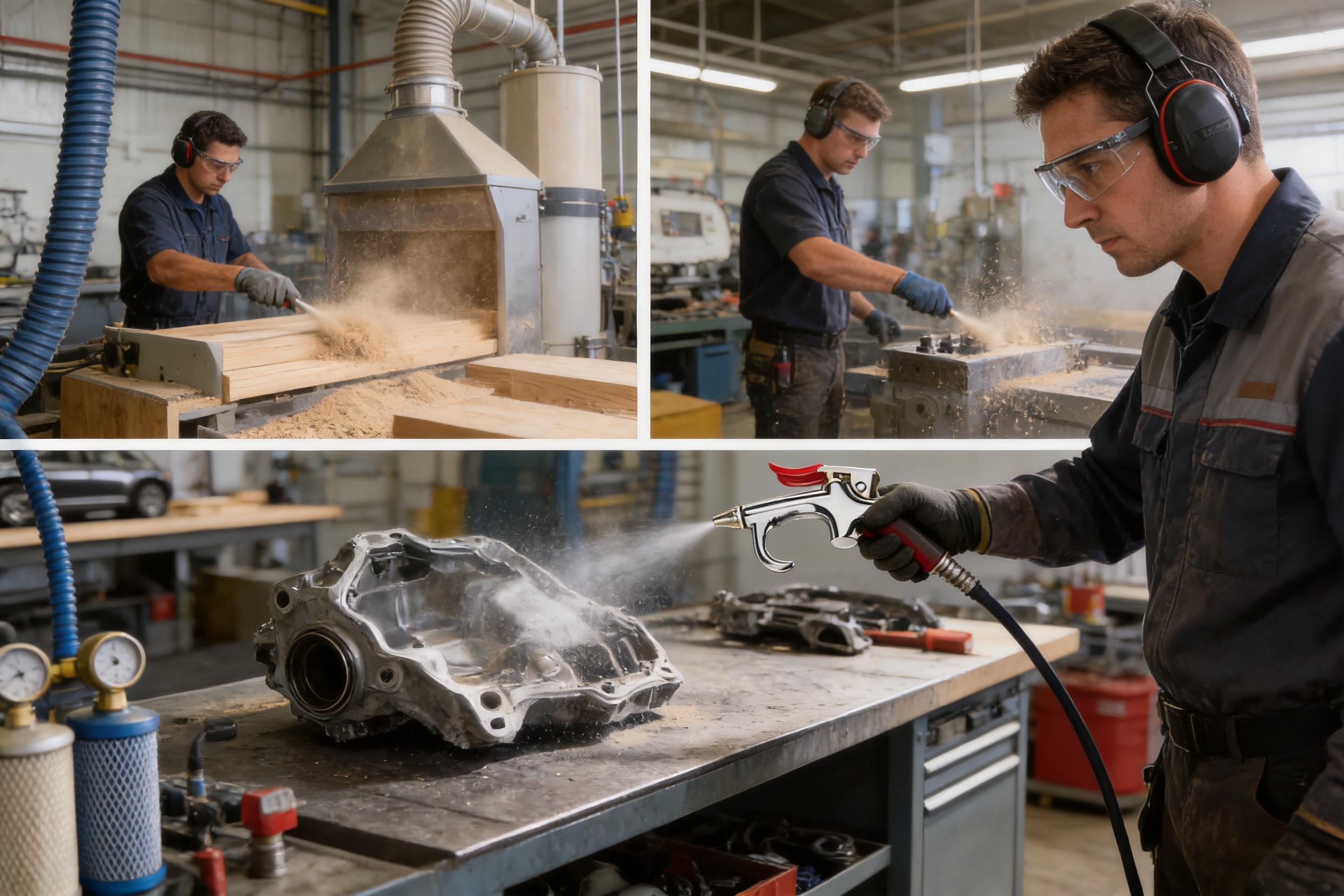
The BG-1 air blowing gun is a practical pneumatic tool designed for cleaning, drying, clearing, and general air-control work in workshops, factories, garages, construction environments, and maintenance areas. By directing compressed air through a controlled nozzle, it helps operators remove dust, chips, moisture, loose particles, and light debris from surfaces that may be difficult to clean with brushes or cloths.
Although an air blowing gun is a relatively simple tool, its usefulness depends on more than the presence of an air inlet and a trigger. The quality of the body, the consistency of the air passage, the precision of the valve, the strength of the trigger, the ergonomics of the handle, the reliability of the connection, and the final inspection process all influence daily performance. The BG-1 is positioned as a dependable air blowing gun for users who need controlled operation, durable construction, and convenient handling.
Manufactured by Ningbo Lis Industrial Co., Ltd., the BG-1 forms part of a broad range of air tools and spraying equipment. The company has developed extensive experience in pneumatic product design, manufacturing, quality management, and international distribution. Its production capabilities support both standard products and customized OEM or ODM solutions, allowing the air blowing gun to serve different distribution channels, professional users, and industrial applications.
Understanding the Role of an Air Blowing Gun
An air blowing gun converts compressed air from a compressor or air pipeline into a directed stream. The operator activates the trigger, and the valve opens to allow air to pass through the internal channel and exit through the nozzle. This concentrated air stream can be used to displace unwanted particles or accelerate the evaporation of moisture.
Air blowing guns are widely used because they provide a fast and contact-free cleaning method. A brush may leave residues behind, while a cloth can push dust into corners or transfer oil from one surface to another. Compressed air can reach grooves, holes, recesses, slots, threads, and other areas where conventional cleaning methods are inconvenient.
In a production environment, the tool can be used between process stages. It may remove machining chips from a workpiece, clear dust from a fixture, dry a cleaned component, or prepare a surface before inspection, assembly, painting, or packaging. In automotive service, it can assist with cleaning brake components, engine areas, filters, tools, and workbenches. In woodworking, it can clear sawdust from equipment and finished pieces. In general maintenance, it can remove loose contamination from machinery and hard-to-reach spaces.
The BG-1 is therefore not limited to one industry. Its value comes from its adaptability. When connected to a suitable compressed-air source and used according to workplace safety procedures, it can support routine cleaning and maintenance tasks without requiring a complicated operating process.
Product Positioning of the BG-1
The BG-1 belongs to the Air Blowing Guns category and is designed as a practical hand-held pneumatic tool. Its straightforward design makes it suitable for professional users who want a reliable tool that can be integrated into an existing compressed-air system.
The product is especially relevant to distributors and equipment suppliers that require a dependable general-purpose air gun for workshops and industrial customers. It can be included in air-tool product lines, maintenance kits, pneumatic accessory ranges, vehicle service packages, and factory cleaning equipment programs.
Because the product is part of a broad manufacturing portfolio, it benefits from the supplier’s experience with air tools, spray guns, compressors, air fittings, paint tanks, and pipeline accessories. This broader knowledge is important because pneumatic products must work as part of a complete system. A hand tool is only as effective as the air supply, connection, filtration, pressure regulation, and maintenance practices supporting it.
The BG-1 offers a balance between simplicity and controlled performance. It does not require the operator to manage a complex electrical drive system, battery platform, or motor assembly. Instead, it uses compressed air that is already available in many workshops and factories. This can make the tool convenient for repeated cleaning operations where a pneumatic connection is more practical than a portable electric device.
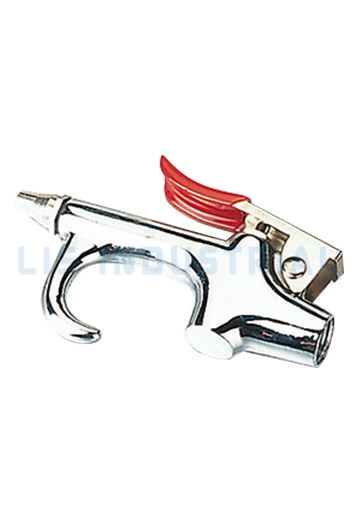
BG-1
Main Advantages of the BG-1 Air Blowing Gun
Directed Air for Precise Cleaning
The primary advantage of the BG-1 is the ability to direct air exactly where it is needed. The operator can aim the nozzle at a particular groove, cavity, surface, or component and activate the air flow through the trigger. This level of direction is more controlled than using an unrestricted air hose.
A controlled hand tool also improves operator convenience. Instead of repeatedly opening and closing a pipeline valve, the user can hold the gun in one hand and regulate operation at the point of use. This helps reduce unnecessary movement around the work area and allows the operator to respond quickly when the cleaning target changes.
Fast Removal of Loose Particles
Compressed air is highly effective for removing loose particles from surfaces. Dust, sawdust, metal chips, plastic fragments, and light debris can often be displaced quickly without direct contact. This is particularly useful when the workpiece has a complex shape or when the cleaning process must be completed within a short production cycle.
The BG-1 can help reduce the time required for routine housekeeping and component preparation. In many workshops, a short air-blowing operation can remove contamination before visual inspection, packaging, or further assembly. The tool can also assist with cleaning around machinery where loose particles might otherwise accumulate.
Contact-Free Drying
A directed air stream can accelerate the drying of washed or rinsed parts. This is useful when a cloth could leave lint, when the surface is irregular, or when moisture remains in narrow spaces. Air blowing can help move water away from edges, holes, channels, and joints.
Drying applications may include tools, metal components, automotive parts, workshop surfaces, and equipment sections that have been cleaned during maintenance. The result depends on the air pressure, air volume, distance from the surface, ambient conditions, and nature of the liquid. Operators should always verify that compressed air is suitable for the specific component and process.
Simple Pneumatic Operation
The BG-1 is powered by compressed air rather than an integrated electric motor. This design has several practical benefits. Pneumatic tools can be convenient in locations where compressed-air lines are already installed. They do not depend on battery charging, and they do not add electrical motor components to a basic cleaning task.
A pneumatic air gun can also be used in a wide range of workshop layouts. It may be connected to a fixed air pipeline, a hose reel, or a suitable compressor through the correct fittings. This makes it easier for users to integrate the tool into their existing equipment arrangements.
Convenient Hand Control
Trigger control is important because it allows the operator to start and stop air flow quickly. Good hand control can make a difference during repetitive tasks. It helps the operator use air only when required, which may support more efficient compressed-air consumption compared with leaving an open hose running continuously.
The handle and trigger arrangement should also support a natural working posture. When a tool is used over long periods, a balanced form can help reduce unnecessary strain. The BG-1 is intended as a hand-held solution that combines direct control with practical workshop handling.
Durability for Repeated Use
An air blowing gun must withstand repeated trigger operation, connection and disconnection, handling, and exposure to ordinary workshop conditions. The body and internal components must be produced consistently so that the tool can maintain dependable function over its service life.
Durability is not determined by one component alone. It results from material selection, machining, assembly, surface treatment where applicable, seal quality, inspection, and packaging. Ningbo Lis Industrial applies a structured production and quality-control approach to its pneumatic products, supporting stable manufacturing across larger orders and different customer requirements.
Performance Compared with Basic Air Hoses
A plain air hose can move compressed air, but it does not provide the same level of control as a dedicated air blowing gun. With an open hose, the outlet may be difficult to position accurately, the air stream may be less focused, and the operator may need to reach back to a valve to stop the flow.
The BG-1 adds a hand-held control point to the air system. This improves usability during tasks that require frequent starting and stopping. It also creates a more professional and consistent solution for workshops that want to equip multiple workstations.
A dedicated air gun can be easier to store, organize, and include in maintenance procedures. It can be fitted with the appropriate connection for the air supply and kept ready for use. In a commercial workshop or factory, the availability of a designated tool can help standardize cleaning practices between operators.
Compared with improvised cleaning methods, the BG-1 provides a more direct and repeatable process. It can be used as part of a defined work instruction, provided that the air source, pressure, nozzle arrangement, and safety requirements are established for the application.
Advantages for Different User Groups
Automotive Repair and Vehicle Maintenance
Vehicle service centers frequently need to remove dust, water, and loose debris from components. An air blowing gun can help clean around engine compartments, tools, filters, brake areas, fasteners, and work surfaces. It may also be used after washing components or during preparation for inspection.
The BG-1 can be useful in both professional garages and smaller repair shops. Its hand-held format makes it suitable for moving around a vehicle or workbench. Operators can use it with an existing compressor system, subject to the system’s capacity and the tool’s operating requirements.
Care is required when blowing around sensitive electronic components, seals, bearings, and exposed fluids. The air stream should be used at a suitable pressure and distance, and the operator should avoid directing debris toward people or vulnerable components.
Metalworking and Machining
Machining operations often produce chips and loose particles that must be cleared from workpieces, fixtures, vises, tables, and surrounding areas. The BG-1 can support cleaning between operations and help prepare a part for measurement or visual examination.
In metalworking environments, users should follow site-specific rules for chip management. Compressed air should not be used in a way that spreads hazardous particles or creates unnecessary airborne contamination. Where chips are sharp, hot, oily, or chemically contaminated, mechanical collection or vacuum systems may be more appropriate. The air gun should be incorporated into a controlled cleaning procedure rather than treated as a universal replacement for all methods.
Woodworking and Furniture Production
Sawdust can collect in corners, joints, tool surfaces, and finished workpieces. An air blowing gun offers a convenient way to clear loose dust from areas that are difficult to reach with a brush. It can also be used during preparation before coating, provided that the surface and surrounding environment are handled carefully.
Woodworking users should consider dust-control requirements. Blowing sawdust into the air may create a respiratory or fire risk. Extraction systems, suitable ventilation, and appropriate personal protective equipment remain essential. The BG-1 is most effective when used as part of a broader dust-management program.
Manufacturing and Assembly Lines
On an assembly line, small quantities of dust or loose particles may interfere with fitting, inspection, labeling, or packaging. A hand-held air blowing gun can provide a quick cleaning step at a workstation. The compact operating principle allows it to be integrated without adding a complicated powered machine.
Production managers can assign the tool to specific stations and establish standard procedures for use. This may support consistent work practices, especially when the same type of component is cleaned repeatedly. The product can also be included in maintenance stations where operators need immediate access to compressed air.
Construction and General Maintenance
Construction workers, equipment technicians, and facility maintenance teams often need to remove dust or loose debris from tools and surfaces. The BG-1 can assist with cleaning portable equipment, work areas, air vents, fixtures, and machinery sections.
Its usefulness in maintenance comes from its simplicity. It does not require a complex setup beyond a suitable compressed-air connection. When the air supply is available, the tool can be used quickly and returned to storage after the task is complete.
Manufacturing Strengths Behind the Product
Long-Term Industry Experience
Ningbo Lis Industrial Co., Ltd. was established in 1984 and has built substantial experience in the research, development, manufacturing, and marketing of air painting spray guns, mini air compressors, and related air tools. This long-term involvement gives the company a broad understanding of pneumatic product requirements.
Experience is particularly valuable in products that appear simple but require consistent internal performance. Air tools depend on reliable sealing, accurate passages, stable connections, and repeatable assembly. Years of manufacturing knowledge can help identify potential failure points and improve production methods.
Large Production Organization
The company operates from Ningbo, China, and covers a production area of more than 400,000 square feet. With more than 400 employees and an established international customer base, the company has the organizational resources to support product development, manufacturing, inspection, packaging, and export operations.
For buyers, production scale can provide several advantages. It may support more stable material purchasing, better production planning, consistent component availability, and the ability to manage different order quantities. The company states that its production capacity can be increased by approximately 30 percent within two months, helping it respond to changing customer demand.
Research and Development Capability
Ningbo Lis Industrial maintains a research and development team focused on continuous improvement in spraying machinery and pneumatic equipment. The company can manufacture according to customer drawings or samples and can also provide ODM services based on customer needs.
This capability is useful for distributors and equipment brands that require a product adapted to a particular market. Customization may involve packaging, product identification, connection standards, handle details, surface finish, nozzle arrangements, or other agreed product features. Any such modifications should be confirmed through technical documentation and sample approval before mass production.
The company has also established a spraying machinery engineering technology center and has carried out technical cooperation with American spraying technology specialists. This background strengthens its ability to develop products for professional painting and pneumatic applications, including air blowing tools that share common principles of air control and component manufacturing.
Structured Quality Management
Quality control is essential for hand-held pneumatic tools because small variations can affect air leakage, trigger action, operating consistency, and service life. Ningbo Lis Industrial follows the requirements of the ISO9000 quality system and applies controls across multiple production stages.
The stated quality process includes raw-material control, incoming inspection, in-process quality control, 100 percent functional testing, and final inspection of finished products. This type of multi-stage approach is stronger than relying only on a final visual check. It allows potential issues to be identified earlier in the production process.
Incoming inspection helps verify that purchased materials and components meet the required criteria. In-process control monitors manufacturing and assembly operations. Functional testing checks whether each finished unit performs its intended basic operation. Final inspection provides another opportunity to confirm product condition, appearance, packaging, and order requirements.
International Certifications and Compliance Awareness
The company reports that its products have passed certifications including CE and GS. It has also passed ISO9001 international quality system certification, OHSAS18001 occupational health and safety system certification, and ISO14001 environmental management system certification.
Certification does not eliminate the need for correct application, maintenance, or workplace safety. However, it demonstrates that the manufacturer has developed formal systems and has experience working with recognized quality, safety, and environmental requirements. This can be important for importers and distributors serving regulated markets.
International Supply and Service Experience
The company’s products are sold in Europe, North America, the Middle East, South Africa, and East Asia. Its long-term customer relationships and worldwide marketing and service network provide experience in export documentation, product communication, packaging, and market-specific expectations.
For buyers considering the BG-1, international experience can simplify cooperation. It may support clearer communication regarding technical requirements, packaging quantities, labeling, quality standards, inspection procedures, and shipment planning. These factors are important when an air tool is being purchased for resale or incorporated into a larger product range.
Production Process and Quality Considerations
Material Selection
The first stage of a dependable air blowing gun is the selection of suitable materials. The body must provide an appropriate combination of strength, weight, dimensional stability, and resistance to ordinary workshop handling. Internal valves, springs, seals, connectors, and trigger components must also be selected according to their function within the pneumatic system.
Material selection affects how the tool feels in the hand, how it responds to repeated operation, and how well it maintains a seal. It also affects compatibility with common workshop conditions, including dust, humidity, oil mist, and temperature changes. A professional manufacturer evaluates these factors during product development and production planning.
Component Manufacturing
Consistent component dimensions are necessary for reliable assembly. The internal air passage, valve seat, connection area, and trigger mechanism must be produced within suitable tolerances. If components vary excessively, the tool may experience inconsistent air flow, leakage, difficult trigger movement, or premature wear.
Modern manufacturing methods help improve repeatability. Depending on the component, production may include precision forming, machining, molding, drilling, deburring, surface finishing, and cleaning. Each stage should be monitored to ensure that the finished part performs as intended.
Assembly Control
During assembly, the body, valve, trigger, spring, seals, air inlet, and nozzle-related components must be installed in the correct sequence and position. Proper assembly protects the tool’s operating consistency and reduces the risk of leakage or mechanical interference.
Assembly operators require clear work instructions, suitable tools, and inspection standards. In a larger production facility, process control can help ensure that different batches are assembled according to the same requirements. This is especially important for export orders where consistent performance across many units is expected.
Functional Testing
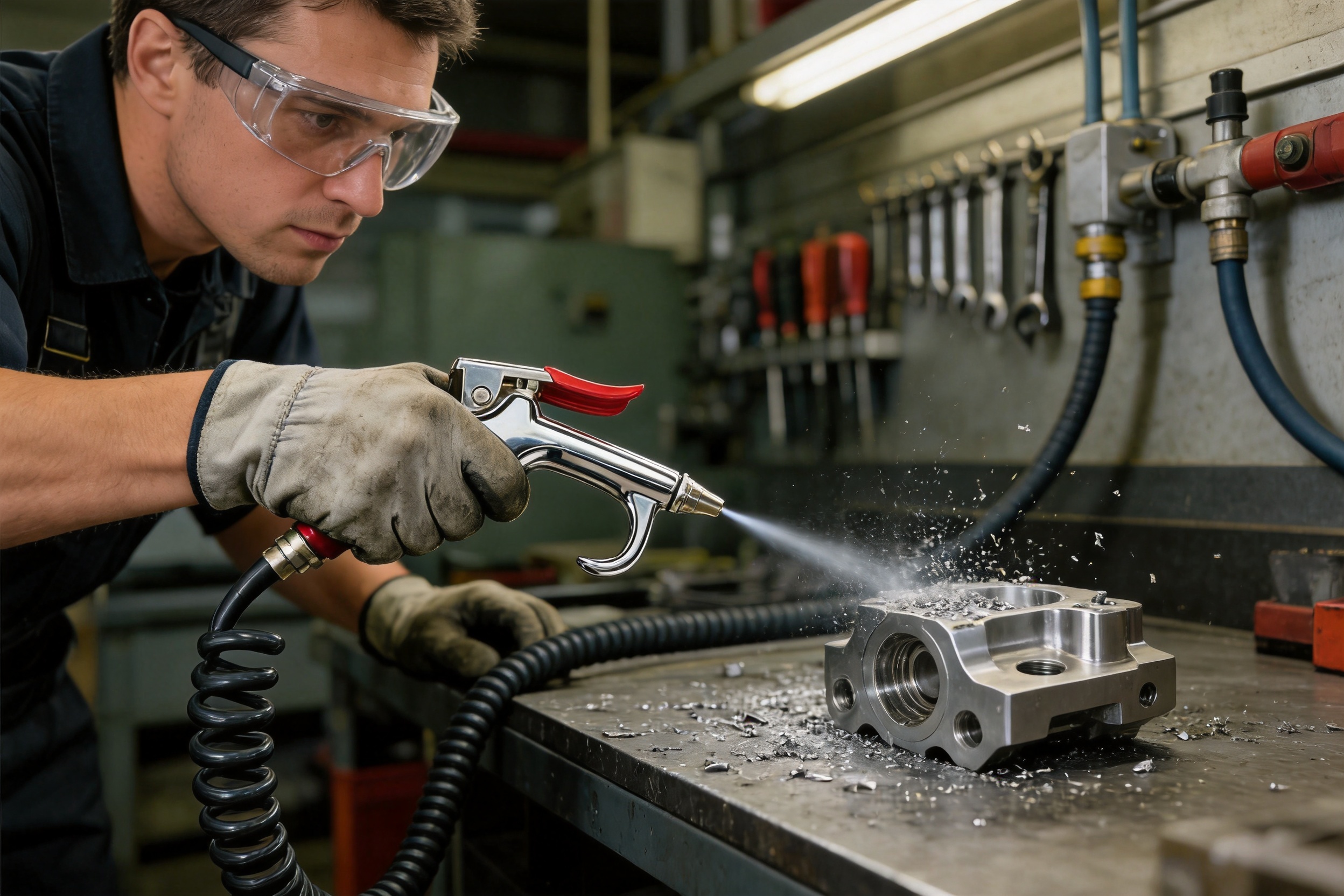
Functional testing is one of the most important stages for an air blowing gun. Each unit should be checked for basic air delivery, trigger operation, leakage, connection integrity, and general condition. The manufacturer states that it applies 100 percent functional testing within its quality-control system.
Testing every finished unit provides a stronger level of assurance than inspecting only a sample. It helps identify issues that may result from assembly variation, damaged seals, blocked passages, incorrect components, or handling during production. Test criteria should be established according to the product specification and customer requirements.
Final Inspection and Packaging
Before shipment, the product should be inspected for appearance, labeling, accessories, packaging, and order accuracy. Packaging must protect the air blowing gun from impact, moisture, contamination, and unnecessary movement during transport.
Good packaging also supports distribution efficiency. Clear product identification, organized cartons, and suitable inner protection can reduce receiving errors and help distributors manage inventory. For private-label or OEM orders, packaging and product markings can be coordinated with the buyer’s approved artwork and documentation.
Technical Integration with Compressed-Air Systems
The BG-1 should be connected to a compressed-air system that is suitable for the tool and the intended application. The system may include a compressor, air receiver, pipeline, hose, filter, regulator, connector, and shut-off arrangement. The exact configuration depends on the user’s work environment.
Clean and appropriately conditioned air helps protect pneumatic tools. Moisture, rust particles, oil contamination, or pipeline debris can affect valves and seals. A suitable filter and regular drainage of the compressed-air system can help reduce contamination. Where required by the application, additional air treatment equipment may be used.
Air pressure should be controlled according to the product instructions and workplace requirements. Excessive pressure may increase noise, scatter debris, accelerate wear, or create an unsafe condition. Insufficient pressure may reduce cleaning effectiveness. The correct operating range should be confirmed through the supplier’s technical documentation before use.
Connections should be secure and compatible. A leaking fitting wastes compressed air and may reduce the effectiveness of the tool. Hoses should be routed so that they do not create a trip hazard or become caught on machinery. Operators should inspect the hose, connector, and air inlet before use.
For installations serving multiple workstations, an air pipeline should be designed to maintain adequate supply and minimize pressure loss. The use of suitable valves, filters, regulators, and hose assemblies can improve the overall performance of the system. Since Ningbo Lis Industrial also supplies air pipeline accessories and air fittings, buyers may discuss complete pneumatic-system requirements with the manufacturer.
Operating Practices for Efficient Use
Preparing the Work Area
Before using the BG-1, the operator should identify where dust, chips, or liquid will be directed. Air blowing should not simply move contamination from one location to another. The work area should have appropriate ventilation, collection, extraction, or containment arrangements.
Nearby personnel should be informed when compressed air is being used. Objects that could be displaced by the air stream should be secured or removed. Sensitive components should be protected, and the operator should confirm that the workpiece can safely withstand the selected air pressure.
Maintaining a Suitable Distance
The nozzle should be held at a practical distance from the surface. Holding it too close may concentrate force unnecessarily, while holding it too far away may reduce cleaning effectiveness. The best position depends on the material, shape, contamination, air pressure, and required result.
Operators should use controlled movements rather than sweeping the air randomly. A systematic pattern can improve coverage and reduce the amount of time the tool is operated. For repetitive work, the distance and movement pattern can be included in a standard operating procedure.
Using Intermittent Air Flow
Short, controlled trigger applications are often sufficient for loose dust and particles. Intermittent operation can reduce unnecessary air consumption and help the operator monitor the cleaning result. Continuous operation may be appropriate for some drying tasks, but it should not be used automatically when short bursts are effective.
Efficient compressed-air use can reduce operating costs. Compressed air is generated using energy, so leaks and unrestricted air flow can increase energy consumption. Proper trigger control, regular maintenance, and a well-designed air system all contribute to better efficiency.
Cleaning and Storage
After use, the air blowing gun should be wiped and stored in a clean, dry location. The nozzle and air inlet should be checked for contamination. If the tool has been used in a dusty or oily environment, additional cleaning may be necessary according to the maintenance instructions.
The air supply should be shut off before disconnecting the tool. Residual pressure should be released safely, and the hose should be stored without sharp bends or damage. Regular inspection can help identify worn seals, loose connections, trigger problems, or visible cracks before they affect operation.
Safety Requirements
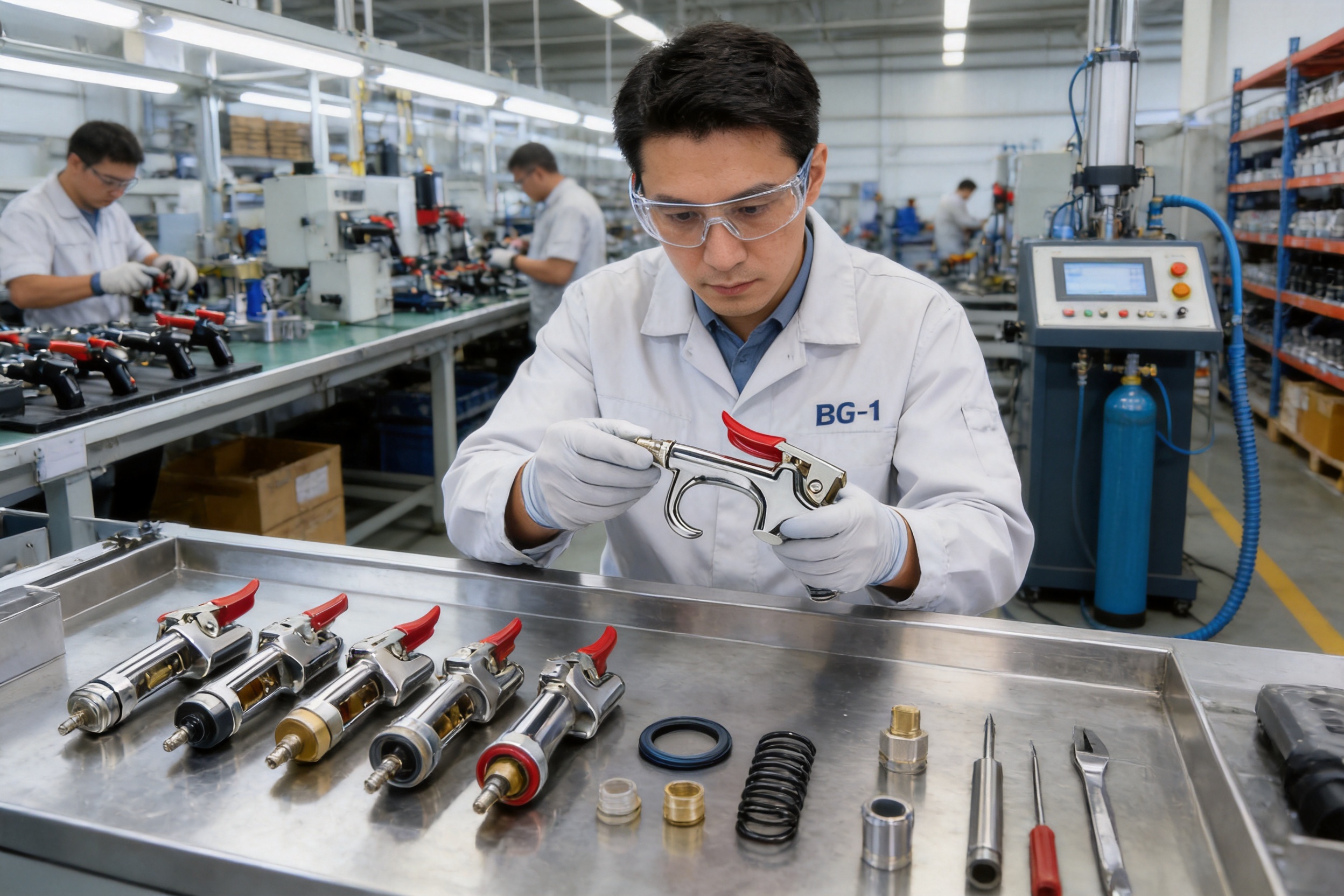
Compressed air can cause serious injury if it is directed toward the skin, eyes, ears, or another person. The BG-1 must never be used as a toy or aimed at people or animals. Operators should wear suitable eye protection and use hearing protection when required by the workplace noise assessment.
Air blowing can make dust, chips, and hazardous particles airborne. The correct respiratory protection, ventilation, extraction, and containment procedures should be used for the material involved. Special care is required when working with asbestos, toxic substances, combustible dust, chemical residues, or biological contamination.
Compressed air should not be used to clean clothing or the body. It may force particles into the skin or create other hazards. It should also be used cautiously around rotating machinery, electrical equipment, bearings, seals, and delicate instruments.
Before maintenance or connection changes, isolate the air supply and release pressure. Do not modify the tool or replace components with unsuitable parts. If the product shows leakage, abnormal trigger resistance, damaged fittings, or other defects, it should be removed from service until it has been inspected.
Safety requirements may vary by country, industry, and workplace. Employers and users should follow applicable regulations and the manufacturer’s instructions. The information in this article is intended as general product guidance and does not replace a formal risk assessment.
Comparison with Alternative Cleaning Methods
The following comparison describes general characteristics of common cleaning approaches. Actual performance depends on the material, contamination, work environment, and operating procedure.
| Cleaning method | Main strength | Typical limitation | Suitable BG-1-related use |
| BG-1 air blowing gun | Fast, directed, contact-free air cleaning | Requires compressed air and suitable safety controls | Dust removal, drying, chip displacement, workstation cleaning |
| Open air hose | Simple and widely available | Less convenient control and less focused handling | Basic low-control air movement |
| Brush | No compressor required and useful for heavy deposits | Requires surface contact and may leave or spread debris | Manual cleaning of accessible surfaces |
| Cloth or wipe | Can collect certain residues directly | May leave lint and is less effective in grooves | Final wiping and surface finishing |
| Vacuum equipment | Collects particles instead of dispersing them | May be larger, slower, or less convenient for certain recesses | Hazardous dust and controlled particle collection |
| Electric blower | Can operate without a central compressor | Requires electrical power and includes a motor system | Portable outdoor or non-pneumatic applications |
The table shows why the BG-1 is best understood as a focused pneumatic cleaning tool rather than a replacement for every cleaning method. Its greatest advantages are rapid air delivery, direct operator control, and compatibility with compressed-air environments. In applications involving hazardous dust or particles, a collection method may be preferable to simply displacing contamination.
Value for Distributors and OEM Buyers
Distributors often need products that are easy to explain, simple to use, and applicable to several industries. The BG-1 has a clear product function that can be communicated to workshops, maintenance departments, automotive service centers, and manufacturing customers.
Its category placement is also straightforward. It can be sold within air-tool catalogs, pneumatic accessory sections, spray-equipment ranges, garage equipment programs, or industrial cleaning product lines. A familiar product purpose can reduce the training burden for sales teams and end users.
For OEM customers, the manufacturer’s design and production capabilities provide opportunities for customized cooperation. Ningbo Lis Industrial can support OEM production based on customer drawings or samples and can provide ODM services according to agreed requirements. Buyers should define technical specifications, quality standards, packaging details, labeling, inspection procedures, and delivery expectations at the quotation and sampling stages.
Long-term supplier cooperation can be strengthened by clear documentation. Product drawings, material information, testing standards, packaging specifications, spare-part policies, and user instructions should be reviewed before bulk production. These documents help ensure that the product supplied matches the buyer’s intended market and application.
The manufacturer’s experience in Europe, North America, the Middle East, South Africa, and East Asia may also support export-oriented purchasing. International supply requires attention to local regulations, language requirements, packaging marks, connection standards, and customer service. A supplier with an established export structure can help buyers manage these practical details more effectively.
Why Manufacturing Quality Matters in a Simple Tool
Some users may assume that an air blowing gun is too simple to require significant engineering. In practice, repeated pneumatic operation places demands on every functional component. A small leak can reduce efficiency. A rough trigger can affect control. An inconsistent valve can create uneven operation. A weak connection can cause downtime or create a safety concern.
Manufacturing quality therefore has a direct relationship with user experience. Consistent dimensions support reliable assembly. Suitable materials support durability. Functional testing identifies defective units. Proper packaging protects the product during shipment. Technical support helps users integrate the tool correctly.
The BG-1 benefits from being produced by a company whose broader business is focused on spraying equipment and air tools. This specialization provides relevant experience in air passages, valves, seals, handles, fittings, production testing, and pneumatic applications. The product is not an unrelated addition to a general hardware catalog; it is part of a focused air-tool manufacturing system.
Environmental and Operational Considerations
Compressed air is useful, but it is not free from environmental or energy considerations. Compressors consume electricity, and poorly maintained systems can waste energy through leaks. Users can improve efficiency by repairing leaks, selecting suitable pressure, using trigger control, maintaining filters, and shutting off air lines when equipment is not in use.
The air blowing gun itself can support efficient operation because the trigger allows air flow to be controlled at the point of use. However, the overall result depends on operator habits and system design. A well-maintained pipeline and correctly sized compressor can improve the performance of several pneumatic tools, including air blowing guns and spray equipment.
ISO14001 environmental management certification reported by the manufacturer indicates that environmental considerations form part of the company’s management system. Buyers with sustainability requirements should confirm the specific environmental documentation, material declarations, packaging policies, and production standards applicable to their orders.
Customer Support and Cooperation
Technical communication is important when selecting an air blowing gun. Customers should provide information about the intended application, air source, expected operating frequency, connection type, market requirements, packaging needs, and forecast quantity. This allows the supplier to recommend the appropriate configuration and confirm compatibility.
Ningbo Lis Industrial provides access to sales and technical communication through its international business organization. Customers can request product information, samples, drawings, packaging details, certificates, and OEM or ODM discussions before placing a production order.
For large or recurring orders, buyers may benefit from a quality agreement that defines inspection standards, acceptable tolerances, functional tests, packaging requirements, and procedures for handling nonconforming products. Clear expectations reduce misunderstandings and support a stable relationship between manufacturer and customer.
The company’s stated mission is to create value for global customers through innovative design, high-quality products, and professional services. Its vision is focused on meeting worldwide and domestic painting needs through products, services, and solutions. Although the BG-1 is a cleaning and air-control tool rather than a paint sprayer, it fits within this wider commitment to practical pneumatic equipment.
Recommended Evaluation Checklist
Before purchasing the BG-1 for professional use, a buyer should review several points. First, confirm that the tool’s operating requirements match the available compressor or pipeline. Second, verify the air inlet and fitting arrangement. Third, evaluate the intended cleaning material and determine whether compressed air is safe for the application.
The buyer should also consider usage frequency. A tool used occasionally in a small workshop may have different requirements from one used continuously on a production line. The number of workstations, expected order quantity, replacement strategy, and spare-part needs should be discussed with the supplier.
Packaging and labeling deserve attention when the product is sold through distribution. The package should communicate the product’s function, operating precautions, connection information, and maintenance guidance in the required language. For private-label products, artwork and markings should be approved before production.
Finally, buyers should request samples when possible. Sample evaluation allows users to review the handle, trigger, air response, connection, balance, finish, and packaging before approving a larger order. It also gives the manufacturer an opportunity to receive practical feedback and make agreed adjustments.
Frequently Asked Questions
What is the BG-1 air blowing gun used for?
The BG-1 is used for directing compressed air to remove dust, loose particles, chips, moisture, and light debris. Common applications include workshop cleaning, automotive maintenance, manufacturing, woodworking, equipment servicing, and general facility maintenance.
Does the BG-1 require an air compressor?
Yes. As a pneumatic tool, the BG-1 requires a suitable source of compressed air, such as a compressor or an installed air pipeline. The air source should meet the operating requirements specified by the manufacturer.
Can the BG-1 be used for drying parts?
It can assist with drying cleaned or rinsed parts by moving moisture away from surfaces and recesses. The result depends on air pressure, air volume, distance, ambient conditions, and the shape and material of the part.
Is the BG-1 suitable for industrial use?
The BG-1 is designed as a practical general-purpose air blowing gun for workshops and industrial environments. Suitability for a specific production process should be confirmed through application testing, air-system evaluation, and workplace safety assessment.
How is an air blowing gun better than an open hose?
A dedicated air blowing gun provides hand-held control and a more directed air stream. The trigger allows the operator to start and stop the air at the point of use, which is generally more convenient and controlled than handling an unrestricted hose.
Can the product be customized?
Ningbo Lis Industrial supports OEM production based on customer drawings or samples and provides ODM services according to customer requirements. Custom details, minimum order quantities, technical specifications, packaging, and delivery conditions should be discussed and approved in advance.
What quality systems support production?
The manufacturer states that it follows ISO9000 quality-system requirements and controls raw materials, incoming inspection, in-process production, functional testing, and final inspection. The company also reports ISO9001, ISO14001, and occupational health and safety system certification, along with CE and GS product certification for its products.
How should the BG-1 be maintained?
Users should keep the tool clean, inspect the nozzle and air inlet, check the hose and fittings, avoid excessive pressure, and store the tool in a dry location. The air supply should be isolated before disconnection or maintenance. Specific maintenance intervals should follow the manufacturer’s instructions.
Can compressed air be used to clean hazardous dust?
Compressed air may disperse hazardous dust and create an airborne exposure. The correct decision depends on the material and workplace procedure. For toxic, combustible, or otherwise hazardous contamination, a suitable extraction or collection method may be required instead of open air blowing.
Where is Ningbo Lis Industrial located?
Ningbo Lis Industrial Co., Ltd. is located in Hengxi Industrial Zone, Yinzhou District, Ningbo, China. Ningbo is a major port city with established manufacturing infrastructure and convenient transportation for international trade.
Conclusion
The BG-1 air blowing gun is a useful pneumatic solution for directed cleaning, drying, particle removal, and general maintenance. Its practical value comes from controlled hand operation, contact-free air delivery, compatibility with existing compressed-air systems, and suitability for a broad range of professional environments.
Compared with a basic open hose, the BG-1 provides a more convenient control point and a more organized tool format. Compared with brushes and cloths, it can reach recesses and irregular surfaces without direct contact. Compared with motorized blowers, it can be especially convenient in workshops and factories that already have compressed-air infrastructure.
The product is supported by Ningbo Lis Industrial’s long history in spraying machinery and air tools, large-scale production organization, research and development capability, OEM and ODM services, international certifications, and multi-stage quality-control system. Raw-material inspection, process control, 100 percent functional testing, and final inspection all contribute to a more dependable manufacturing foundation.
For distributors, the BG-1 offers a clear and broadly applicable addition to an air-tool range. For professional users, it provides a straightforward way to control compressed air during cleaning and maintenance. For OEM customers, it offers a platform for cooperation with an experienced Chinese manufacturer capable of supporting product development, customization, production scaling, and international supply.
The best performance will always depend on correct air-system integration, suitable pressure, responsible operating practices, regular maintenance, and appropriate safety controls. Used within those conditions, the BG-1 can become a valuable everyday tool for workshops, factories, service centers, and maintenance teams seeking practical and repeatable air-cleaning performance.
References
Ningbo Lis Industrial Co., Ltd. Product information for the BG-1 Air Blowing Gun.
Ningbo Lis Industrial Co., Ltd. Corporate information and manufacturing capability statement.
ISO 9001. Quality Management Systems: Requirements.
ISO 14001. Environmental Management Systems: Requirements with Guidance for Use.
International Organization for Standardization. General principles of quality management and process control.
Occupational safety guidance for the use of compressed air and pneumatic hand tools.
Industrial compressed-air system maintenance and energy-efficiency guidance.