 Search
 English
 中文简体
中文简体 Deutsch
 Español
Content
- 1 Understanding the Role of an Air Blowing Gun
- 2 Key Product Value of the DG100
- 3 Advantages Compared with Basic or Poorly Designed Alternatives
- 4 Applications Across Different Industries
- 5 Design and Operating Considerations
- 6 Manufacturing Strengths Behind the Product
- 7 Quality Management and Production Control
- 8 Benefits for Distributors and Original Equipment Buyers
- 9 Recommended Operating Practices
- 10 Air Safety and Workplace Responsibility
- 11 Selection Guide for Buyers
- 12 Comparison Table: DG100 Value Considerations
- 13 Why Manufacturing Experience Matters
- 14 Environmental and Workplace Considerations
- 15 Maintenance Recommendations
- 16 Frequently Asked Questions
- 16.1 What is the DG100 air blowing gun used for?
- 16.2 Is the DG100 a paint spray gun?
- 16.3 Can the DG100 be used in a factory production line?
- 16.4 What type of air supply does the tool require?
- 16.5 Can the tool remove metal chips?
- 16.6 Can the DG100 be used for woodworking dust?
- 16.7 Does the manufacturer support OEM projects?
- 16.8 What quality systems support production?
- 16.9 Can customers purchase other air tools from the same supplier?
- 16.10 How should the DG100 be maintained?
- 16.11 Is compressed air safe for every cleaning task?
- 17 Conclusion
- 18 References
- 19 Product: DG100
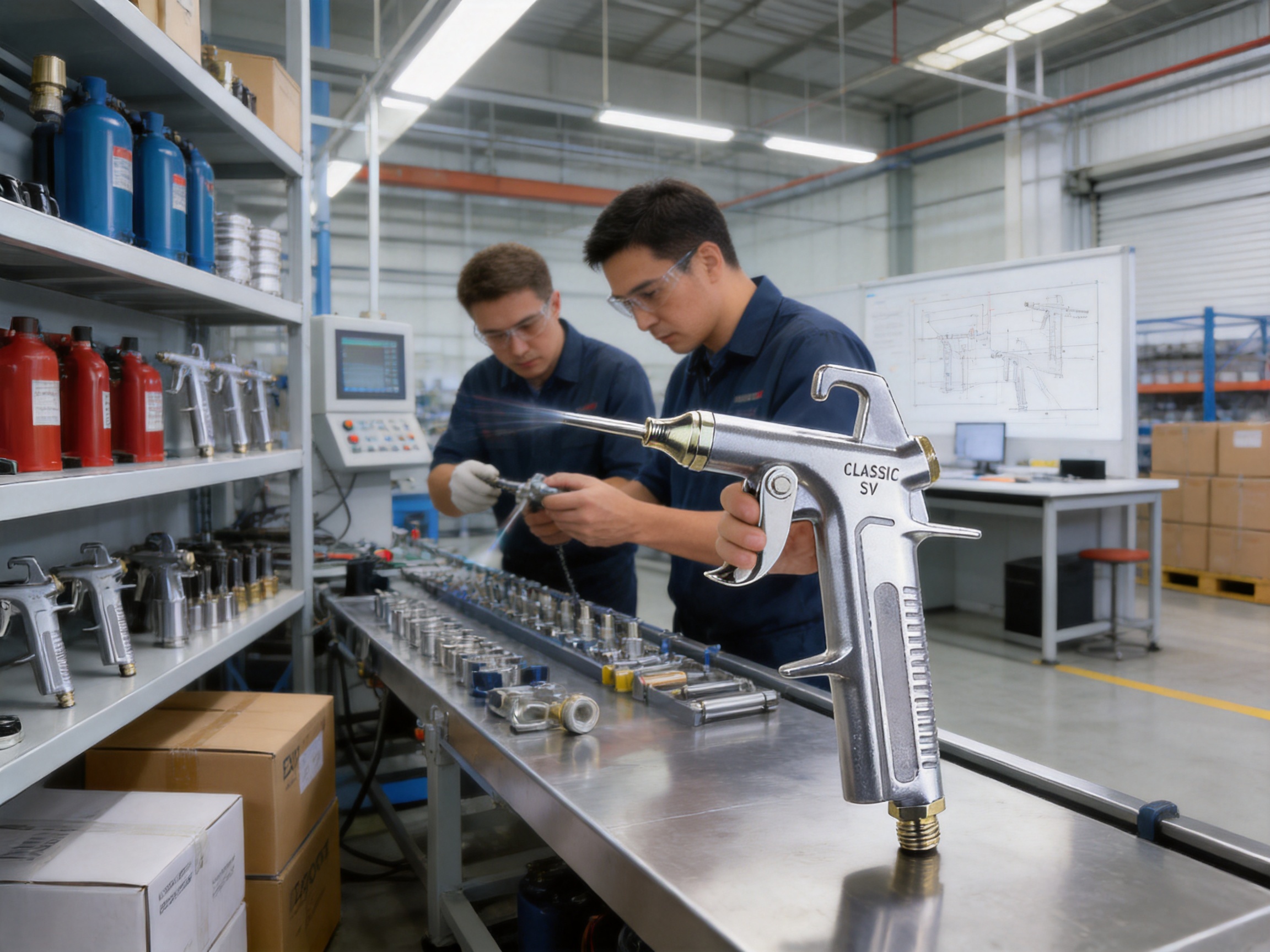
In workshops, factories, repair facilities, assembly lines, and maintenance departments, compressed air is one of the most practical utilities for removing dust, chips, moisture, and loose contamination. The efficiency of an air cleaning operation depends not only on the compressor, but also on the quality of the hand tool connected to the air line. A well-designed air blowing gun can improve cleaning speed, operator control, workplace convenience, and overall productivity.
The DG100 air blowing gun is designed for general-purpose compressed-air cleaning and blow-off applications. It belongs to a professional range of air tools developed for users who need a practical, durable, and easy-to-operate solution. Its purpose is straightforward: to direct a controlled stream of compressed air toward a workpiece or surface so that unwanted particles and moisture can be removed quickly and efficiently.
Although air blowing guns may appear simple, performance differences between products can be significant. Trigger response, body design, air-path efficiency, connection quality, durability, balance, and manufacturing consistency all influence the user experience. A tool that is difficult to control, uncomfortable to hold, or inconsistent in operation can increase cleaning time and contribute to unnecessary air consumption. The DG100 is positioned as a dependable solution for professional and industrial users who value stable operation and convenient handling.
This article examines the working purpose, application value, design considerations, manufacturing strengths, quality-control approach, and purchasing factors associated with the DG100 air blowing gun. It also explains how a mature spray-equipment manufacturer supports the product through research and development, production management, testing, certification, and customer service.
Understanding the Role of an Air Blowing Gun
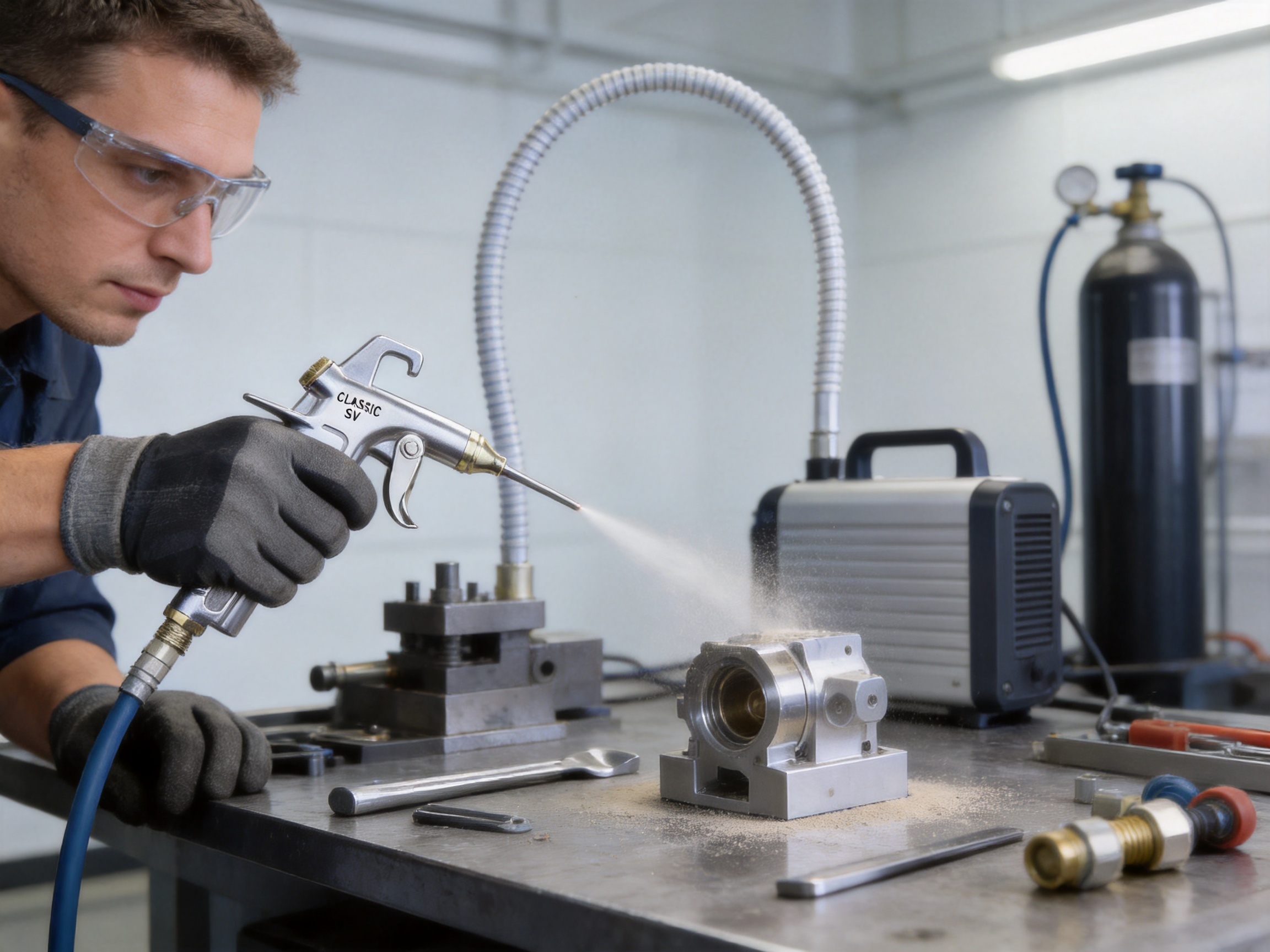
An air blowing gun is a handheld pneumatic tool connected to a compressed-air supply. When the operator presses the trigger, air passes through the internal passage and exits through the front outlet. The resulting airflow can be used to clear dust, sawdust, metal chips, water droplets, machining residue, and other loose material from a surface or component.
The tool is especially useful where brushing or wiping would be slow, inconvenient, or likely to leave residue behind. Air can reach grooves, recesses, holes, corners, and irregular surfaces that are difficult to clean with a cloth. In production environments, an air blowing gun can also help prepare a workpiece before inspection, assembly, painting, packaging, or storage.
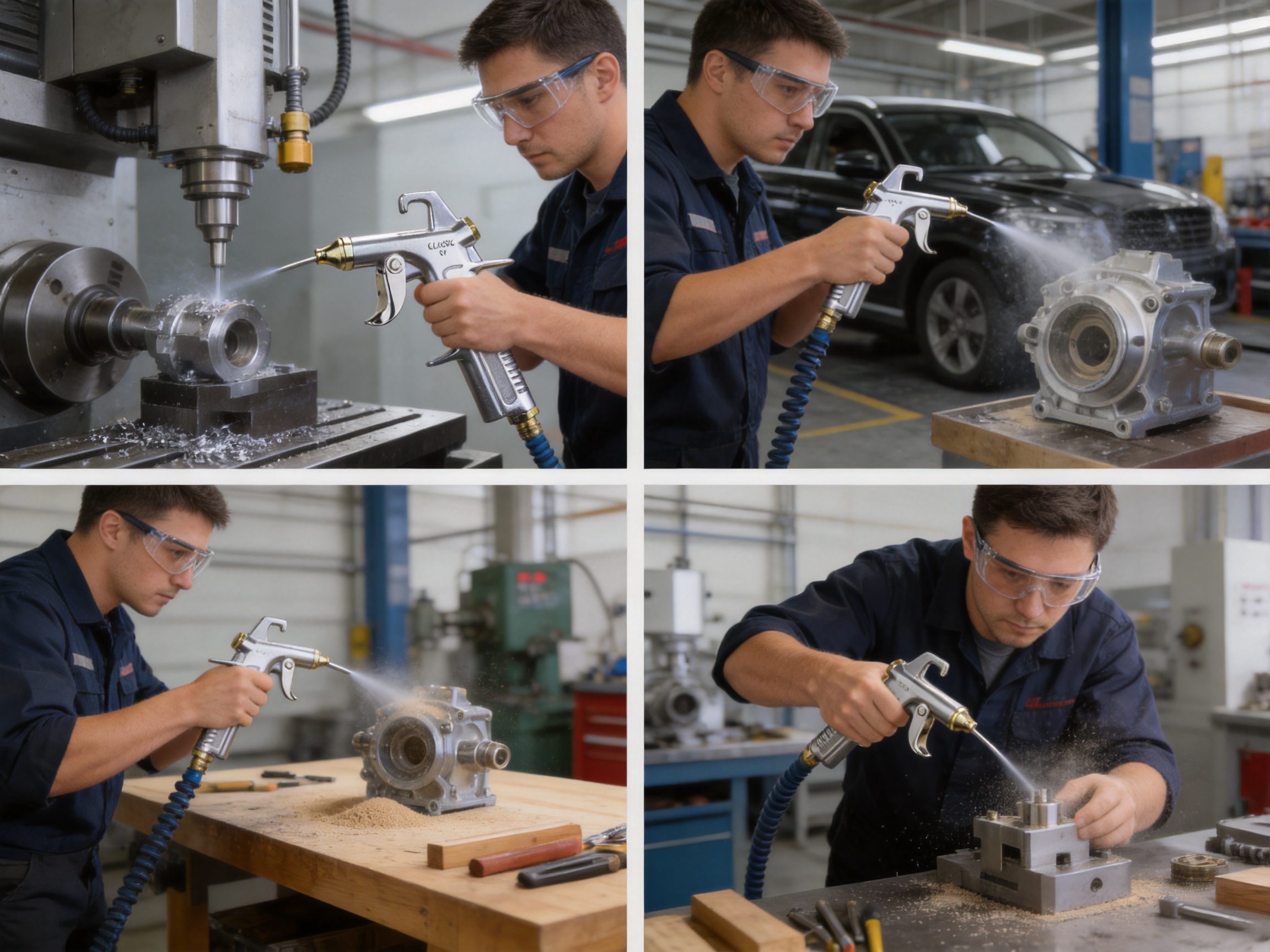
Typical applications include cleaning workbenches, removing chips from machine parts, drying washed components, clearing debris from automotive parts, blowing dust from woodworking equipment, and maintaining general workshop cleanliness. Depending on the air supply and operating conditions, the tool may also be used for light-duty drying and preparation tasks.
The DG100 is categorized as an air blowing gun rather than a coating or fluid-dispensing tool. This distinction is important. Its primary function is the controlled delivery of compressed air, not the atomization of paint, oil, or other liquid materials. Users should therefore select it for cleaning, drying, and blow-off tasks that are appropriate for a pneumatic air nozzle.
Key Product Value of the DG100
The main value of the DG100 lies in its combination of simplicity and practical performance. A professional air blowing gun does not need unnecessary complexity. It needs to respond predictably, remain comfortable during repeated use, connect securely to the air line, and withstand the normal demands of a workshop or production environment.
Controlled Air Delivery
One of the most important features of any blow gun is the operator’s ability to control airflow. A responsive trigger allows the user to start and stop the air stream quickly. This is helpful when cleaning delicate components, directing air into narrow spaces, or adjusting the cleaning process according to the amount of contamination.
Controlled delivery can also support more efficient air use. Instead of leaving the line open continuously, the operator can apply air only when required. In facilities with many pneumatic tools, reducing unnecessary airflow may contribute to lower compressor loading and improved energy management.
Convenient Hand Operation
Air cleaning is often repetitive. Operators may use a blow gun for many cycles during a shift, so the shape and balance of the tool influence comfort and productivity. A practical handle should support a natural grip and allow the trigger to be operated without excessive force.
The DG100 is intended for convenient handheld operation. Its straightforward design makes it suitable for users who need a tool that can be picked up and used immediately without complicated adjustments. Easy handling is particularly valuable in maintenance departments, where different operators may use the same equipment for a variety of cleaning tasks.
Fast Cleaning of Irregular Surfaces
Compressed air can reach spaces that are difficult to access with conventional cleaning tools. A blow gun can be directed into cavities, channels, recesses, and other areas where particles often collect. This makes the tool useful for components with complicated geometries as well as for machinery that contains narrow openings.
In woodworking, airflow can help remove loose sawdust from benches, tools, fixtures, and finished parts. In metalworking, it can clear chips from components and work surfaces. In automotive maintenance, it can assist with cleaning parts and drying areas after washing. In general assembly, it can remove loose particles before a component is installed or inspected.
Simple Maintenance
A blow gun has fewer operating steps than many fluid-based tools. The user generally needs to connect the tool to a suitable air line, check the connection, and operate the trigger. This simplicity reduces training requirements and makes routine maintenance easier.
As with all pneumatic equipment, users should keep the air supply clean and appropriately regulated. Moisture, oil contamination, or solid particles in the air line can affect pneumatic tools over time. Regular inspection of fittings, hoses, filters, and connections can help maintain stable operation and extend service life.
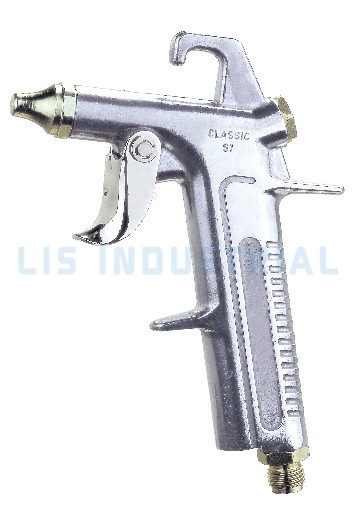
DG100
Advantages Compared with Basic or Poorly Designed Alternatives
Air blowing guns are available in many forms, from low-cost general-purpose products to professionally manufactured tools. Price is one purchasing factor, but it does not fully represent operating value. A product that provides inconsistent airflow, develops leaks, or becomes uncomfortable during repeated use may create higher costs through downtime, replacement, and wasted compressed air.
More Consistent Manufacturing
One advantage of purchasing from an established pneumatic-tool manufacturer is more consistent production. When body components, trigger parts, air passages, and connection areas are produced under controlled conditions, the finished tools are more likely to provide uniform operation from one batch to another.
Consistency matters for distributors and industrial buyers. If a business orders multiple tools for different workstations, operators expect similar trigger behavior and connection compatibility. Stable production quality also simplifies inventory planning, user training, and replacement procedures.
Better Suitability for Repeated Use
Some inexpensive blow guns are designed mainly for occasional household use. Professional workshops often require more frequent operation. A tool used repeatedly must be supported by appropriate material selection, assembly control, and functional testing.
The DG100 is part of a product system manufactured by a company with extensive experience in air painting spray guns, air tools, compressors, fittings, and related equipment. This broader technical background is relevant because pneumatic tools share many engineering requirements, including air-path design, sealing, trigger mechanisms, connection accuracy, ergonomic considerations, and production testing.
Reduced Risk of Air Leakage
Air leakage may appear minor at a single workstation, but it can become significant when many tools are used across a factory. Leakage reduces the efficiency of the compressed-air system and may cause the compressor to run more frequently than necessary.
Reliable threaded connections, properly finished mating surfaces, suitable seals, and careful assembly can reduce the likelihood of leakage. A mature quality-control system helps identify problems before products reach customers. While operating conditions and installation quality also influence air loss, manufacturing accuracy provides an important foundation.
More Predictable User Experience
Professional users generally prefer tools that behave in a predictable way. A trigger that sticks, an outlet that produces irregular airflow, or a fitting that does not seat properly can interrupt the work process. Predictability is especially valuable on production lines, where small interruptions may affect the entire workflow.
The DG100 is designed as a practical, uncomplicated tool for users who want dependable blow-off performance without a steep learning curve. Its straightforward operation makes it suitable for many operators and work environments.
Applications Across Different Industries
Metalworking and Machining
Machining operations produce chips, dust, and cutting-fluid residue. An air blowing gun can be used to clear loose material from workbenches, fixtures, tooling areas, and external surfaces of machined parts. It may also be useful before visual inspection or secondary processing.
Operators should follow safe machining procedures when using compressed air around metal chips. Air should not be directed toward unprotected eyes, skin, other people, or sensitive machine components. Where chips are sharp or hazardous, suitable guarding and personal protective equipment are essential.
Automotive Repair and Maintenance
Automotive workshops frequently require quick cleaning and drying. A blow gun can remove dust from engine-bay areas, clear debris from components, and assist with drying after washing. It may also help remove loose particles from brake, suspension, body, and interior components before repair or inspection.
Because vehicles contain electrical connectors, sensors, seals, and delicate finishes, operators should use appropriate pressure and distance. The DG100 provides a convenient way to direct air, but safe operating technique remains important. Air should be applied carefully where excessive pressure could move contaminants into a sensitive component.
Woodworking
Woodworking shops generate sawdust and fine particles. The DG100 can assist with cleaning benches, hand tools, fixtures, and finished surfaces. It may also be used around assembly areas where loose dust could affect bonding, finishing, or visual quality.
Dust management should not rely solely on a hand blow gun. Local extraction, general ventilation, dust collection, and appropriate respiratory protection remain important. Air blowing may move dust rather than remove it, so the tool should be used as part of a complete workshop-cleaning strategy.
General Manufacturing and Assembly
In assembly operations, parts may need to be free from loose dust before installation. A blow gun can help clear surfaces, holes, grooves, and fixtures. It can also be useful during maintenance of assembly stations and packaging equipment.
The tool’s flexibility allows it to support many workstations without requiring a specialized cleaning machine. This can be particularly useful for small and medium-sized manufacturers that need practical equipment capable of handling different tasks.
Equipment Maintenance
Maintenance personnel often need a compact tool that can be carried from one machine to another. A handheld air blowing gun is easy to store and quick to connect. It can support routine cleaning during scheduled maintenance, helping technicians access areas where dust and loose debris accumulate.
Cleaning should always be performed according to the machine manufacturer’s recommendations. Some equipment may contain sensitive bearings, electronics, optical components, or seals that require low-pressure cleaning or a different method.
Design and Operating Considerations
The performance of a blow gun depends on more than its external appearance. Several design factors affect how effectively the tool performs in actual use.
Trigger Response
The trigger is the operator’s primary control. Smooth movement allows gradual application of airflow, while positive release helps stop the air stream promptly. A well-assembled trigger mechanism can improve comfort during repeated use and support more precise cleaning.
Air Passage Design
The internal air path influences how efficiently compressed air reaches the outlet. Unnecessary restrictions may reduce effective airflow, while poorly finished passages may contribute to turbulence or inconsistent delivery. Product design must balance airflow performance with safe and practical operation.
Connection Compatibility
The inlet connection must match the user’s hose, fitting, or air pipeline accessory. Buyers should confirm the required standard, thread type, and connection size before ordering. The manufacturer supplies air tools for different markets and can support customers with suitable connection configurations when required.
Connection standards vary by region and application. The wider product range includes air fittings and accessories associated with Japanese, European, United States, and British standards. This international orientation can be useful for distributors and original equipment customers serving different markets.
Material and Surface Quality
Material selection affects weight, durability, corrosion resistance, and appearance. External surfaces should be suitable for the working environment, while internal components must support repeated actuation and stable air delivery. Surface finishing and dimensional accuracy are also important because they influence assembly fit and long-term reliability.
Ergonomic Balance
A tool that is too heavy, poorly balanced, or difficult to grip may increase operator fatigue. Good balance helps the user point the outlet accurately and change direction quickly. This is useful when cleaning complex parts or moving around a large workpiece.
Manufacturing Strengths Behind the Product
The DG100 benefits from the manufacturing capabilities of Ningbo Lis Industrial Co., Ltd., a company engaged in the research, development, manufacture, and marketing of air painting spray guns, mini air compressors, and related air tools. Since its establishment in 1984, the company has developed substantial experience in pneumatic equipment and spraying technology.
The company operates from Ningbo, China, and has developed a large industrial facility covering more than 400,000 square feet. With more than 400 employees and annual output exceeding 40 million United States dollars, the organization has the scale to support product development, production, testing, export coordination, and customer service within an integrated business structure.
Engineering and Research Capability
Air tools require more than basic metalworking or plastic molding. They involve fluid dynamics, pressure management, sealing, component fit, trigger mechanisms, ergonomics, and application knowledge. A manufacturer with experience across spray guns, air compressors, air fittings, and other pneumatic products can apply knowledge from multiple product categories.
The company has established a spraying machinery engineering technology center and has carried out technical cooperation with an American spraying technology organization. This type of cooperation supports the development of practical spraying and pneumatic solutions and reflects a commitment to technical improvement.
The company also supports original equipment manufacturing according to customer drawings or samples. In addition, it offers original design manufacturing services based on customer requirements. For buyers seeking product customization, this capability may be valuable when adapting air tools for a specific market, connection standard, packaging format, or distribution channel.
Large-Scale Production Infrastructure
A large production base can provide advantages in purchasing, production scheduling, process organization, and quality management. It can also support different order volumes, from standard product purchases to larger distribution programs. According to the supplied company information, production capacity can be increased by approximately 30 percent within two months when customer demand requires expansion.
Capacity flexibility is important for international customers. Seasonal demand, promotional programs, new distributor launches, and project orders may require output changes. A supplier with an established production system is generally better positioned to respond than a small workshop with limited equipment and manpower.
Integrated Product Portfolio
The company’s product portfolio includes new spray guns, heavy-duty spray guns, low-pressure woodworking spray guns, conventional spray guns, texture paint spray guns, paraffin guns, air blowing guns, sandblast guns, foam guns, tyre inflating guns, water and grease guns, automatic spray guns, air brushes, mini oil-free compressors, air pipeline accessories, paint tanks, air fittings, air polishers, spray gun kits, touch-up spray guns, car polishing machines, airless spray guns, electric spray guns, and paint sprayers.
This wide product range gives customers access to related equipment from one experienced source. A distributor may be able to combine blow guns with spray guns, compressors, hoses, fittings, and other workshop tools. Such product breadth can simplify purchasing and encourage compatibility across a product program.
Quality Management and Production Control
Product quality is determined throughout the manufacturing process, not only during final inspection. Reliable air tools require control of incoming materials, component dimensions, assembly procedures, functional performance, and packaging. A mature quality system considers each stage as part of a connected process.
Incoming Material Inspection
Materials and purchased components should be checked before they enter production. Inspection may include dimensional verification, visual examination, material confirmation, and functional checks where appropriate. Controlling incoming materials helps prevent defects from moving into later processes.
In-Process Quality Control
During production, operators and inspectors monitor key assembly and processing stages. This may include checking component fit, thread quality, trigger movement, sealing areas, surface condition, and other characteristics relevant to air-tool performance.
In-process control is valuable because it allows problems to be identified close to their source. Correcting a process issue early is generally more efficient than discovering a large batch of defects at the end of production.
Functional Testing
The supplied company information states that finished products receive 100 percent functional testing. For an air blowing gun, functional testing can help verify that the trigger operates correctly, air passes through the tool as intended, and the assembled product meets basic operating requirements.
Testing every unit provides an additional level of confidence for customers, particularly when tools are purchased for professional or industrial use. It does not eliminate the importance of correct installation and maintenance, but it helps establish a consistent manufacturing baseline.
Final Inspection
Final inspection may evaluate appearance, assembly completeness, markings, packaging, and overall product condition. This stage helps ensure that products are ready for storage, shipment, and customer use.
For export-oriented manufacturers, final inspection is also important because products may travel long distances and pass through multiple distribution stages. Appropriate packaging and identification help reduce handling problems and support efficient warehouse management.
International Certifications
The company’s products have passed certifications including CE and GS, according to the supplied information. The organization has also passed ISO9001 quality-management, ISO14001 environmental-management, and OHSAS18001 occupational-health-and-safety system certifications.
Certifications should always be evaluated according to the specific product, market, and applicable version of the standard. Nevertheless, these certifications indicate that the manufacturer has established formal systems covering quality, environmental responsibility, and workplace safety.
Benefits for Distributors and Original Equipment Buyers
The DG100 can be considered not only as an individual workshop tool, but also as part of a broader product offering. Distributors may include it in pneumatic-tool catalogs, compressor packages, workshop kits, maintenance programs, and industrial supply ranges.
Easy Product Positioning
Because its purpose is clear, an air blowing gun is relatively easy to explain to customers. It serves cleaning, drying, and blow-off applications and can be used in many industries. This broad applicability can make it a practical addition to a distributor’s product range.
Complementary Sales Opportunities
The product can be offered alongside air compressors, hoses, couplers, regulators, filters, air fittings, spray guns, and other air tools. Customers setting up a new workshop may need several of these products at the same time. A supplier with a broad portfolio can support a more complete purchasing solution.
Private Label and Custom Programs
Original equipment customers may require customized packaging, branding, product configurations, or market-specific connections. The manufacturer’s OEM and ODM capabilities provide a foundation for discussing such requirements. Custom projects should be evaluated according to order volume, technical drawings, product samples, tooling needs, testing requirements, and applicable regulations.
International Market Experience
The company’s products are sold in Europe, North America, the Middle East, South Africa, and East Asia. This international customer base indicates experience with different market expectations, distribution systems, packaging requirements, and connection standards.
International experience can also assist customers who need communication across languages, export documentation, production scheduling, and after-sales coordination. These commercial capabilities are important when the buyer is building a long-term supply relationship rather than placing a single small order.
Recommended Operating Practices
Correct operating technique helps users obtain the best results from an air blowing gun. Before use, inspect the body, trigger, outlet, inlet connection, hose, and coupler. Do not use the tool if a component appears damaged or if the connection cannot be secured properly.
Connect the gun to a clean and suitable compressed-air supply. The supply should be regulated according to the requirements of the application and the manufacturer’s instructions. Excessive pressure can create safety risks, increase noise, and damage sensitive parts.
Hold the tool firmly and direct the outlet away from people. Wear suitable eye protection, especially when removing chips, dust, or other particles. Hearing protection may also be appropriate in noisy production environments.
Use the trigger to apply airflow in controlled bursts when possible. Maintain a suitable distance from the workpiece, particularly when cleaning fragile components, finished surfaces, electrical assemblies, seals, or small parts that could be displaced by strong airflow.
After use, shut off the air supply when appropriate and store the tool in a clean, dry location. Check the hose and fittings periodically. If the tool develops unusual leakage, trigger resistance, or inconsistent operation, remove it from service until it has been inspected.
Air Safety and Workplace Responsibility
Compressed air is useful but can be hazardous when misused. It should never be directed toward the body, clothing, hair, or another person. Air can force particles into the eyes or skin and may create serious injury. It can also disturb hazardous dust or chemicals and spread contamination throughout the work area.
Employers should provide training and establish written procedures for compressed-air tools. Operators should understand the correct pressure range, approved applications, required personal protective equipment, and procedures for reporting damaged equipment.
Where dust may be combustible, toxic, or harmful when inhaled, air blow-off should be carefully evaluated. Local extraction, vacuum cleaning, enclosed cleaning stations, or other methods may be safer and more effective. The DG100 should be integrated into a workplace safety program rather than used as a substitute for proper dust-control equipment.
Selection Guide for Buyers
Before purchasing the DG100 or any comparable air blowing gun, buyers should define the application clearly. Consider the type of material to be removed, the required cleaning speed, the frequency of use, the available air supply, the connection standard, and the working environment.
Users should also determine whether the tool will be used for general workshop cleaning or for a specialized process. Delicate electronics, precision instruments, combustible dust, and hazardous chemicals may require specialized equipment or additional controls.
For distributor purchases, order volume, packaging, labeling, warranty arrangements, delivery schedules, and product documentation should be discussed in advance. For OEM projects, technical drawings, samples, connection details, branding requirements, and testing expectations should be agreed upon before production begins.
Buyers should request current technical information from the supplier for operating pressure, air consumption, inlet configuration, dimensions, materials, packaging, and applicable certifications. Product specifications can vary according to configuration and target market, so confirmation is important before final selection.
Comparison Table: DG100 Value Considerations
| Evaluation Area | DG100 Professional Approach | Potential Limitation of Basic Alternatives | Buyer Benefit |
|---|---|---|---|
| Primary function | General-purpose compressed-air cleaning and blow-off | May be limited to occasional or narrow applications | Suitable for workshops, maintenance, assembly, and production support |
| Operation | Simple handheld trigger control | Trigger movement may be inconsistent or uncomfortable | Easy training and convenient repeated use |
| Manufacturing support | Produced by an established pneumatic-equipment manufacturer | Limited process control or restricted production capability | More dependable supply and batch consistency |
| Quality management | Incoming inspection, process control, functional testing, and final inspection | Inspection may be limited or inconsistent | Greater confidence in regular production orders |
| Product integration | Can be supplied with related air tools, compressors, fittings, and accessories | Customer may need several unrelated suppliers | Simplified sourcing and product-range development |
| Market support | International export and OEM or ODM experience | Limited customization or export assistance | Better suitability for distributors and global buyers |
| Application range | Cleaning, drying, dust removal, chip removal, and maintenance support | May not provide adequate control or durability for frequent use | Flexible use across multiple industries |
Why Manufacturing Experience Matters
A product’s commercial value is closely connected to the reliability of the system behind it. An air blowing gun is a small tool, but its performance depends on engineering decisions, material control, production accuracy, testing discipline, and customer support.
A company that has manufactured spraying equipment since 1984 has had many years to develop knowledge of pneumatic systems and professional tool requirements. Its experience includes product design, manufacturing, export distribution, quality systems, certification, and cooperation with international technology partners.
This background can be especially important for customers who purchase in volume. A supplier must be able to maintain product quality while meeting delivery schedules and supporting different market requirements. Large-scale production, a dedicated engineering team, and established quality procedures provide a stronger foundation for this type of relationship.
The company’s stated mission is to create value for global customers through continuous design innovation, high-quality products, and professional services. Its vision is focused on serving worldwide and domestic painting needs through products, services, and solutions. While the DG100 is an air blowing tool, it benefits from the same broader commitment to practical pneumatic equipment and customer-oriented engineering.
Environmental and Workplace Considerations
Air tools do not produce exhaust gases at the point of use, but compressed-air systems still consume energy. Efficient operation therefore depends on appropriate pressure, good hose and fitting condition, regular leak inspection, and disciplined trigger use.
Users can reduce unnecessary energy consumption by selecting a tool suited to the application, avoiding excessive pressure, shutting off unused branches, and maintaining filters and regulators. A well-managed compressed-air network can improve both operating cost and workplace performance.
The manufacturer’s ISO14001 environmental-management certification indicates that environmental considerations are included in its formal management framework. Buyers may wish to request additional information about materials, packaging, production practices, and environmental documentation when these factors are part of their procurement requirements.
Maintenance Recommendations
Routine maintenance for an air blowing gun is generally simple. Keep the tool clean and inspect the outlet for blockage. Check the inlet and threaded connection for damage. Examine the hose and coupler for wear, and replace damaged components promptly.
If the air supply contains moisture, a suitable filter and drainage routine can help protect pneumatic equipment. Contamination in the air line may affect internal parts and reduce overall tool performance. Users should follow the maintenance guidance supplied with the specific product configuration.
Do not modify the internal mechanism without authorization. Unapproved changes may affect safety, airflow, connection integrity, and certification status. If a tool requires repair, it should be examined by a qualified technician or returned through the supplier’s service process.
Frequently Asked Questions
What is the DG100 air blowing gun used for?
The DG100 is used to direct compressed air for cleaning, drying, dust removal, chip removal, and general workshop blow-off tasks. It can be used in manufacturing, woodworking, automotive maintenance, assembly, and equipment-service environments.
Is the DG100 a paint spray gun?
No. The DG100 is categorized as an air blowing gun. It is designed to deliver compressed air rather than atomize and apply paint or another liquid coating.
Can the DG100 be used in a factory production line?
It can support many production-line cleaning and maintenance tasks, provided that the application, air pressure, safety procedures, and workplace controls are suitable. Buyers should confirm the exact product configuration and operating requirements with the supplier before implementation.
What type of air supply does the tool require?
The tool requires a suitable compressed-air source. The compressor, hose, regulator, filter, and fitting system should be selected according to the required airflow and pressure. Current technical specifications should be confirmed for the specific DG100 configuration.
Can the tool remove metal chips?
It may be used for removing loose chips from appropriate work surfaces and components. Because metal chips can be sharp and may become airborne, operators must use eye protection, maintain a safe direction, and follow the safety procedures of the workplace.
Can the DG100 be used for woodworking dust?
It can assist with cleaning loose sawdust from benches, tools, fixtures, and workpieces. However, it should be used together with suitable dust collection and ventilation. Air blow-off alone may disperse fine dust rather than remove it.
Does the manufacturer support OEM projects?
Yes. The supplied company information states that the manufacturer can produce according to customer drawings or samples and can provide ODM services according to customer needs. Project details such as order volume, connection standards, packaging, branding, and testing should be discussed in advance.
What quality systems support production?
The company describes a quality process that includes raw-material and incoming inspection, in-process quality control, 100 percent functional testing, and final inspection. It also reports ISO9001, ISO14001, and OHSAS18001 system certifications, as well as CE and GS product certifications for its products.
Can customers purchase other air tools from the same supplier?
Yes. The product range includes spray guns, compressors, air fittings, pipeline accessories, air polishers, spray gun kits, inflating guns, grease guns, foam guns, air brushes, and other related equipment. This can help customers create a coordinated pneumatic-tool portfolio.
How should the DG100 be maintained?
Keep the tool clean, use a suitable air supply, inspect the hose and fittings, avoid excessive pressure, and remove the tool from service if it develops leakage or unusual operation. Maintenance should follow the product documentation and the requirements of the specific application.
Is compressed air safe for every cleaning task?
No. Compressed air can injure people, spread dust, damage delicate parts, and create hazards around combustible or toxic materials. Users must evaluate the application, wear suitable protective equipment, and use extraction or alternative cleaning methods where necessary.
Conclusion
The DG100 air blowing gun is a practical pneumatic tool for cleaning, drying, chip removal, dust management, and general maintenance support. Its value comes from straightforward operation, controlled airflow, convenient handheld use, and suitability for a wide range of professional environments.
Compared with basic alternatives, a product supported by established engineering, structured production control, functional testing, international certification experience, and a broad pneumatic-equipment portfolio can offer stronger long-term purchasing value. These advantages are particularly relevant to distributors, factories, maintenance departments, and OEM customers that require consistent supply rather than a one-time low-cost purchase.
Ningbo Lis Industrial Co., Ltd. provides the manufacturing foundation behind the product through decades of experience, a large production facility, research and development resources, international market knowledge, OEM and ODM capability, and formal quality and management systems. Its wider range of spray guns, compressors, air fittings, and related air tools enables customers to source complementary equipment from an experienced supplier.
For the best results, buyers should match the DG100 to the correct air supply and application, confirm current technical specifications, and establish safe operating procedures. When used responsibly and supported by proper compressed-air maintenance, the tool can become a useful part of workshop cleaning, industrial production, equipment service, and professional maintenance programs.
References
1. Manufacturer-supplied product information for the DG100 air blowing gun.
2. Manufacturer-supplied company profile and production capability statement for Ningbo Lis Industrial Co., Ltd.
3. General principles of compressed-air tool operation, pneumatic maintenance, and workshop safety.
4. ISO 9001 quality-management system principles.
5. ISO 14001 environmental-management system principles.
6. Occupational health and safety management system principles associated with OHSAS 18001.
7. General guidance for the safe use of compressed air in industrial and maintenance environments.