 Search
 English
 中文简体
中文简体 Deutsch
 Español
Content
- 1 1. Product Overview
- 2 2. Gravity-Feed Operation and Its Practical Benefits
- 3 3. Nozzle Selection for Different Coatings
- 4 4. Air Pressure and Spray Pattern Management
- 5 5. Heavy-Duty Design for Repeated Use
- 6 6. Advantages Compared with Less Specialized Spray Guns
- 7 7. Manufacturing Capabilities and Engineering Strengths
- 8 8. Quality Assurance from Materials to Finished Product
- 9 9. Applications of the W400
- 10 10. Selecting a Compressor and Air System
- 11 11. Recommended Operating Procedure
- 12 12. Cleaning and Maintenance
- 13 13. Workplace Safety
- 14 14. Advantages for Distributors and Industrial Buyers
- 15 15. Sustainability and Responsible Manufacturing
- 16 16. How the W400 Supports Consistent Finish Quality
- 17 17. Comparison with Alternative Spray-Gun Categories
- 18 18. Troubleshooting Guide
- 19 19. Purchasing and Support Considerations
- 20 20. Conclusion
- 21 Questions and Answers
- 21.1 What type of spray gun is the W400?
- 21.2 What nozzle sizes are available?
- 21.3 What nozzle should be used for fine finishing?
- 21.4 Which nozzle is best for general-purpose work?
- 21.5 When should the 2.0 mm nozzle be selected?
- 21.6 What is the cup capacity?
- 21.7 What is the air inlet size?
- 21.8 What air pressure does the W400 use?
- 21.9 Can the W400 be used for woodworking?
- 21.10 Can the W400 be used for automotive work?
- 21.11 Is the W400 suitable for industrial maintenance?
- 21.12 What kind of compressor is required?
- 21.13 How should the W400 be cleaned?
- 21.14 Why is filtering the coating important?
- 21.15 Does the manufacturer provide OEM and ODM services?
- 21.16 What quality certifications are associated with the manufacturer?
- 21.17 Where is the manufacturer located?
- 21.18 How can buyers request product information?
- 22 References
- 23 Product: W400

In professional painting and surface-finishing work, the spray gun is one of the most important links between the operator, the coating material, and the finished surface. A spray gun must deliver a controlled pattern, maintain a stable atomization process, support consistent production, and remain comfortable and dependable during repeated use. The W400 gravity-feed spray gun is designed for these requirements, combining a practical heavy-duty structure with versatile nozzle options and a straightforward air-powered operating system.
With available fluid nozzles of 1.4 mm, 1.6 mm, and 2.0 mm, the W400 can be adapted to a range of coating viscosities and finishing requirements. Its 600 ml gravity cup provides a useful balance between material capacity and manageable weight, while the G1/4-inch air inlet supports compatibility with commonly used compressed-air systems. A stated air pressure of 50 PSI gives the operator a clear operating reference for general spray applications.
The W400 is manufactured by Ningbo Lis Industrial Co., Ltd., a Chinese producer specializing in air painting spray guns, mini air compressors, air tools, and related spraying solutions. The company combines product development, engineering, quality control, factory manufacturing, and international distribution in one organization. This integrated structure enables the W400 to be developed not merely as a basic spray gun, but as part of a broader professional spraying equipment program.
This article examines the W400 in detail, including its design, operating principles, component selection, application range, production strengths, quality systems, maintenance requirements, and practical advantages compared with less specialized spray guns.
1. Product Overview
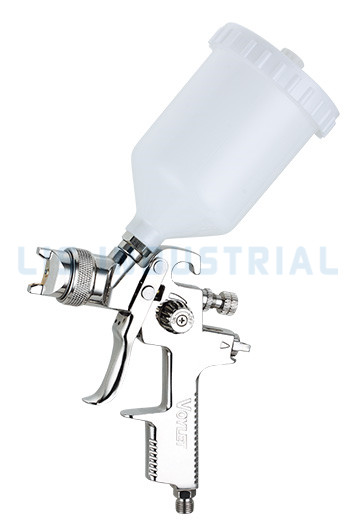
The W400 belongs to the heavy-duty spray gun category and uses a gravity-feed configuration. In this arrangement, the paint or coating material is held in a cup positioned above the gun body. Gravity assists the movement of material toward the fluid nozzle, while compressed air atomizes and projects the coating onto the target surface.
Gravity-feed technology is widely used because it can provide efficient material transfer, good control, and convenient handling for many professional applications. Compared with some traditional suction-feed designs, a gravity-feed gun can often operate with less material remaining in the cup and can respond effectively to changes in trigger movement and fluid adjustment.
The W400 is intended for users who need more than occasional household spraying. Its heavy-duty positioning makes it suitable for workshops, maintenance departments, furniture production, vehicle refinishing, metal fabrication, woodworking, industrial touch-up, and other environments where repeated spraying and dependable operation are important.
The core product specifications are as follows:
| Specification | W400 Details |
|---|---|
| Product category | Heavy-duty spray gun |
| Feed type | Gravity |
| Fluid nozzle options | 1.4 mm, 1.6 mm, and 2.0 mm |
| Recommended reference air pressure | 50 PSI |
| Cup capacity | 600 ml |
| Air inlet | G1/4 inch |
| Carton configuration | 10 units per carton |
| Carton size | 84.5 × 44 × 15 cm |
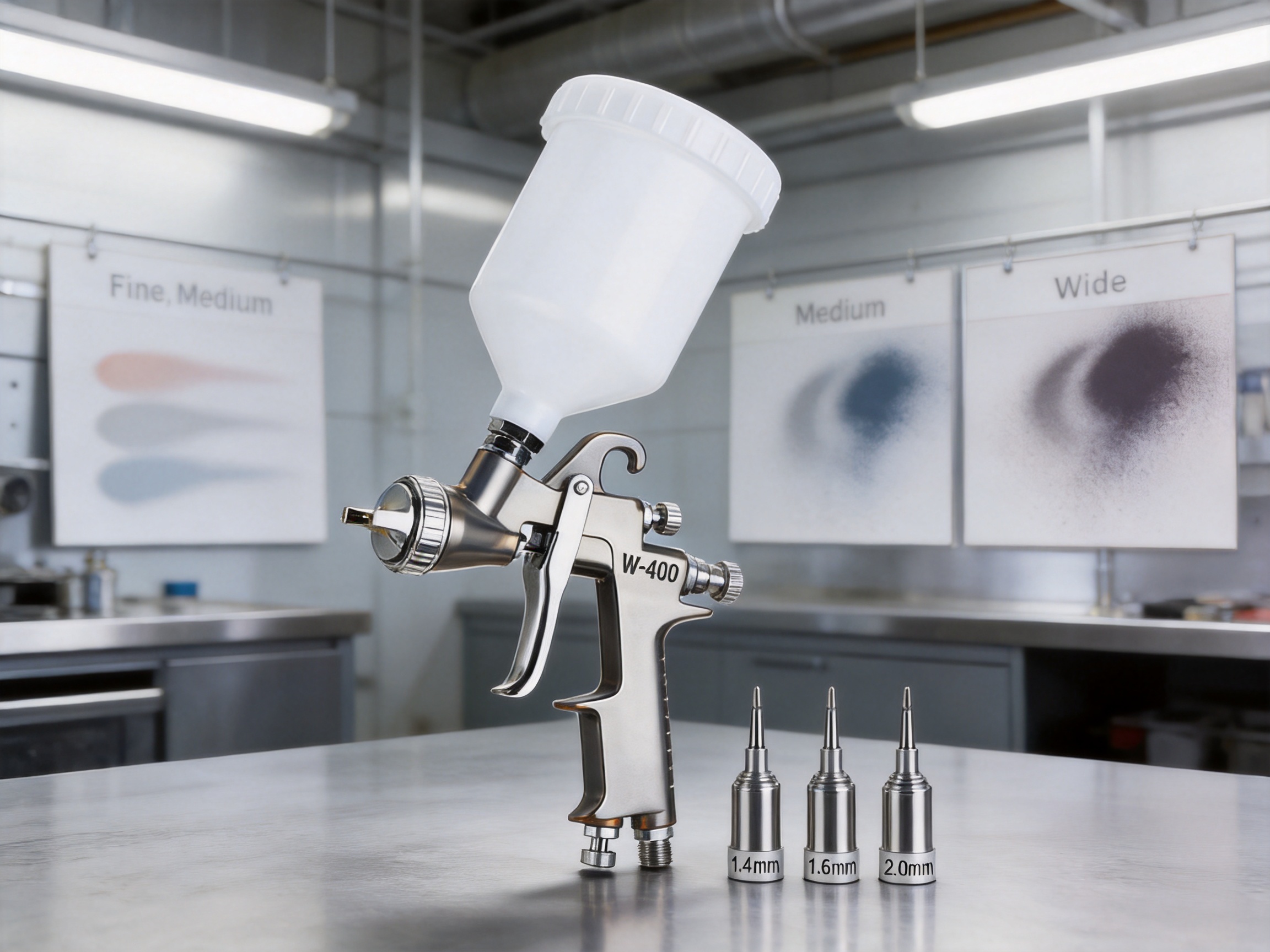
The range of nozzle sizes is particularly useful because different coatings and surfaces require different fluid delivery characteristics. The 1.4 mm nozzle is generally suited to finer finishing and thinner coatings. The 1.6 mm option provides a versatile middle range for many general-purpose tasks. The 2.0 mm nozzle can be selected when a higher volume of material or a thicker coating is required.
Actual performance depends on the coating formulation, viscosity, temperature, air supply, spraying distance, fan adjustment, and operator technique. Nevertheless, the choice of three nozzle sizes gives the W400 a broader working range than a fixed-nozzle spray gun.
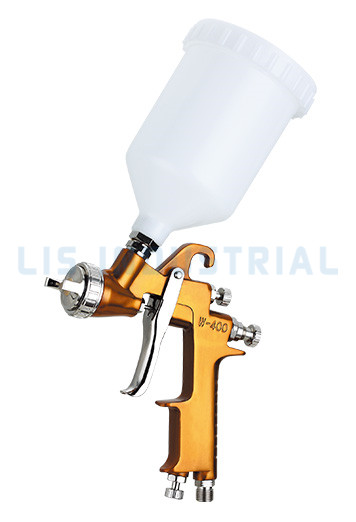
W400
2. Gravity-Feed Operation and Its Practical Benefits
The operating principle of the W400 is simple but effective. Coating material is placed into the upper cup. When the operator pulls the trigger, compressed air passes through the air cap while coating material travels from the cup toward the fluid nozzle. The air stream breaks the material into fine droplets and carries those droplets toward the workpiece.
This arrangement provides several practical benefits. First, the material path is direct and uncomplicated. Second, the operator can work with relatively small quantities of coating without relying on a large pressure vessel. Third, the upper cup allows the user to monitor material consumption and refill the gun conveniently.
Gravity-feed equipment is also useful for jobs requiring changes between colors, coatings, or small batches. A 600 ml cup is large enough for many workshop operations while remaining smaller and easier to manage than a large remote tank system. This makes the W400 suitable for both production support and specialized finishing tasks.
Material Efficiency
A major reason professional users select gravity-feed spray guns is material control. When the gun is adjusted correctly, the operator can apply a controlled quantity of coating with less unnecessary overspray than may occur with poorly matched or improperly adjusted equipment. Reduced waste can lower material costs and reduce the time required for cleanup.
Material efficiency is influenced by many factors, including nozzle selection, fluid adjustment, fan width, air pressure, spray distance, and the speed of gun movement. The W400 gives the operator the mechanical foundation needed to make these adjustments accurately.
Operator Control
The trigger mechanism normally controls air and fluid delivery in a progressive manner. A skilled operator can begin with air flow, introduce material smoothly, and release the trigger without abrupt interruption. This helps reduce heavy spots, dry spray, uneven edges, and start-and-stop marks.
The control available from a gravity-feed gun is valuable when spraying panels, furniture edges, metal components, repair areas, or surfaces with visible appearance requirements. Rather than applying material in an uncontrolled stream, the operator can build the coating gradually through overlapping passes.
Versatility in Workshop Conditions
The W400 can serve different users because it is not limited to one coating thickness or one type of project. With the appropriate nozzle and adjustment, it may be used for primers, paints, clear coats, stains, lacquers, protective coatings, and other compatible materials. Users should always verify material compatibility with the gun, seals, cup, nozzle, and local safety requirements before spraying.
3. Nozzle Selection for Different Coatings
Nozzle diameter is one of the most important factors in spray-gun performance. A nozzle that is too small may restrict material flow and cause the operator to increase pressure or thin the coating excessively. A nozzle that is too large may deliver too much material, making it difficult to control film thickness and increasing the likelihood of runs or sagging.
1.4 mm Nozzle
The 1.4 mm nozzle is appropriate when the user wants a relatively fine atomization pattern. It can be useful for finishing coats, clear materials, thinner paints, small components, furniture work, and automotive-style refinishing tasks where surface appearance is important.
Fine finishing generally requires careful preparation and a properly reduced coating. The operator should avoid forcing material through a small nozzle if the coating is too viscous. Correct filtration and clean material are also important because small passages are more sensitive to contamination.
1.6 mm Nozzle
The 1.6 mm nozzle provides a balanced option for general-purpose spraying. It is often a practical choice for users who need one setup for a variety of workshop tasks. Depending on the formulation, it may support primers, general paints, protective finishes, and medium-viscosity materials.
For many users, the 1.6 mm option is a useful starting point because it offers a compromise between atomization quality and material delivery. Once the operator understands the behavior of the coating, further adjustment can be made through fluid control, fan control, pressure, and spraying speed.
2.0 mm Nozzle
The 2.0 mm nozzle supports higher material flow and can be selected for thicker coatings, primers, textured materials that are compatible with the gun, and applications where coverage is more important than extremely fine finish quality.
When using a larger nozzle, the operator should pay close attention to spray distance and gun speed. A slow pass may deposit excessive material, while an excessive distance may create dry spray. A stable air supply and appropriate material preparation remain essential.
| Typical Need | Suggested Nozzle Option | Primary Consideration |
|---|---|---|
| Fine finish and thinner coating | 1.4 mm | Atomization and surface appearance |
| General-purpose spraying | 1.6 mm | Balance between flow and finish |
| Higher-volume or thicker material | 2.0 mm | Material delivery and coverage |
The table is a general guide rather than a substitute for coating-manufacturer instructions. Different products with the same apparent viscosity may spray differently because of their solids content, solvents, additives, and drying behavior.
4. Air Pressure and Spray Pattern Management
The W400 specification lists an air pressure of 50 PSI. This reference gives users a practical starting point for configuring a compatible compressor and air line. The actual pressure at the gun may differ from the pressure shown at the compressor because of hose length, fittings, filters, regulators, and air consumption.
Pressure should be checked as close to the spray gun as practical. If the pressure is too low, atomization may be coarse, the pattern may become unstable, and the coating may be deposited unevenly. If pressure is too high, overspray may increase, material transfer efficiency may decline, and the surface may become rough from excessive air velocity or dry spray.
Fan Width
A wide fan can improve productivity on broad panels, doors, furniture surfaces, and large metal sections. A narrower fan can provide greater control on edges, narrow components, repair zones, and detailed work. The best setting depends on the shape of the workpiece and the coating requirements.
The operator should test the pattern on a suitable sample surface before beginning final application. A correctly adjusted pattern should appear even from one side to the other, without heavy accumulation at the ends or in the center.
Spraying Distance
Maintaining a consistent distance is essential. Holding the gun too close can cause excessive wetness, runs, and uneven film thickness. Holding it too far away can produce dry spray, poor transfer, and a rough surface. A steady distance combined with parallel gun movement generally provides the most consistent results.
Gun Movement
The W400 should be moved smoothly and evenly. The operator should begin moving before fully opening the fluid control and continue moving until after the trigger is released. The gun should remain approximately perpendicular to the surface rather than being swung in an arc. These techniques help create an even overlap between passes.
5. Heavy-Duty Design for Repeated Use
The heavy-duty category indicates that the W400 is intended for more demanding service than a light occasional-use spray gun. In a professional environment, equipment may be used repeatedly throughout a shift, exposed to solvents and coatings, connected and disconnected from air lines, and handled by multiple operators. Mechanical reliability therefore becomes an important part of total operating cost.
A heavy-duty spray gun must maintain alignment among the air cap, fluid nozzle, needle, trigger mechanism, and adjustment components. If these parts do not function together accurately, the spray pattern can deteriorate and the operator may compensate by using excessive pressure or additional coating.
The W400's design is intended to provide a durable platform for routine professional spraying. Its 600 ml cup allows the operator to carry a useful material load without relying on a separate tank for every project. The G1/4-inch inlet corresponds to a widely used air-connection format, helping users integrate the gun with existing compressed-air equipment.
Durability also depends on responsible use. A well-designed spray gun can still suffer premature wear if it is operated with contaminated air, left filled with coating, cleaned with incompatible chemicals, or assembled incorrectly. For this reason, equipment design and user maintenance should be considered together.
6. Advantages Compared with Less Specialized Spray Guns
The W400 offers several practical advantages over basic spray guns that have limited adjustment, a single nozzle size, or a lighter construction. These advantages are most relevant to users who require repeatable results rather than one-time application.
Multiple Nozzle Options
Many entry-level spray guns are sold with only one nozzle. This can restrict the range of coatings and surface finishes that the tool can handle effectively. The W400's 1.4 mm, 1.6 mm, and 2.0 mm options provide greater flexibility. A workshop can select the configuration that best matches the material instead of forcing every product through the same opening.
Practical Cup Capacity
A 600 ml cup offers more working capacity than many small touch-up guns while remaining easier to handle than a large pressure-fed system. It is suitable for medium-sized jobs, individual panels, furniture components, equipment parts, and repeated repair operations.
Gravity-Feed Efficiency
The gravity arrangement helps make use of the material in the cup and is convenient for small-batch or color-change work. It can also reduce the need for a separate material tank and simplify the overall setup.
Professional Air Connection
The G1/4-inch air inlet is a practical specification for integration with workshop air systems. Users should confirm the thread standard and fitting compatibility before installation, but the format is widely recognized in compressed-air equipment.
Industrial Manufacturing Support
The W400 is supported by a manufacturer with experience across spray guns, compressors, air fittings, air tools, automatic spray equipment, paint tanks, and related products. This broader technical base can be valuable for distributors and professional users who require coordinated spraying solutions rather than isolated components.
Quality-Control Orientation
The manufacturer states that it follows an ISO9000-based quality approach covering raw-material inspection, incoming inspection, process control, functional testing, and final product inspection. A structured quality process is important because spray-gun performance depends on dimensional accuracy, sealing, air passage consistency, thread quality, trigger action, and nozzle alignment.
7. Manufacturing Capabilities and Engineering Strengths
Ningbo Lis Industrial Co., Ltd. has operated in the spray-equipment sector since 1984. The company reports a facility covering more than 400,000 square feet, a workforce of more than 400 employees, and annual output exceeding 40 million US dollars. These figures indicate a substantial manufacturing and organizational base for supporting product development and international supply.
The company is located in Ningbo, China, a major port city with established industrial infrastructure and convenient transportation links. This location supports access to component suppliers, engineering resources, export logistics, and international customers.
Research and Development
Spray-gun development requires more than external styling. Engineers must consider fluid dynamics, air distribution, material compatibility, ergonomics, sealing, manufacturing tolerances, cleaning access, and long-term serviceability. The company maintains a research and development team dedicated to spraying machinery and related air tools.
The company has also established a spraying machinery engineering technology center and reports technical cooperation with American Wagner Spraying Technology Co., Ltd. Such cooperation can contribute to the exchange of engineering knowledge, application experience, and product-development practices.
For a product such as the W400, engineering capability is reflected in the ability to offer multiple nozzle sizes, maintain repeatable component relationships, and support a broad range of customer applications. It also enables the manufacturer to respond to OEM and ODM requirements.
OEM and ODM Services
Some distributors and equipment companies require products manufactured according to their own drawings, samples, packaging, specifications, or market positioning. The company states that it can provide OEM production based on customer drawings or samples and ODM services according to customer requirements.
This capability is useful for buyers who need customized nozzle combinations, labeling, packaging, accessory kits, color schemes, or product configurations. It may also help importers develop private-label spraying equipment while relying on an established manufacturing platform.
Production Expansion
The manufacturer reports that production capacity can be increased by 30 percent within two months. For distributors, this flexibility can be important during seasonal demand, promotional programs, new-market launches, or large project orders. Capacity planning is especially relevant for spray guns because professional buyers often require consistent supply across multiple models and accessories.
8. Quality Assurance from Materials to Finished Product
Spray guns are precision working tools. Small defects in a fluid nozzle, air cap, seal, or needle can affect pattern quality, leakage, trigger response, or coating consistency. Quality assurance must therefore extend across the entire production process.
Raw-Material and Incoming Inspection
Inspection begins with the materials and components entering the factory. Metal parts, plastic components, seals, springs, cups, fittings, and other items must meet defined requirements before entering production. Screening at this stage helps prevent inconsistent materials from moving into later operations.
Process Control
In-process control is designed to identify problems while components are being machined, formed, assembled, or finished. Maintaining process stability can improve dimensional consistency and reduce variation between production batches.
For spray guns, important process considerations may include nozzle geometry, thread accuracy, sealing surfaces, trigger fit, air-cap alignment, coating or surface treatment, and cup attachment. Consistency in these areas contributes to reliable spray behavior.
Functional Testing
The company reports 100 percent functional testing. Functional testing is especially valuable for air-powered tools because a product may appear visually acceptable while still having an internal air leak, restricted passage, irregular trigger action, or poor fluid delivery.
Testing can help identify leakage, operating resistance, assembly problems, and other issues before products are packed for shipment. Although users should still inspect and test equipment before application, factory testing adds an important level of confidence.
Final Inspection
Final inspection provides a last review of the finished product, including appearance, assembly, identification, packaging, and overall condition. This is important for export products because equipment may travel through multiple handling points before reaching the end user.
The company states that its products have passed certifications including CE and GS. Certification requirements vary by product and market, so buyers should confirm the precise certification documentation applicable to the specific model, configuration, and destination.
Management-System Certifications
The manufacturer reports certification to ISO9001, OHSAS18001, and ISO14001 systems, in addition to European CE and German GS product certifications. ISO9001 relates to quality management, ISO14001 addresses environmental management, and OHSAS18001 was an occupational health and safety management standard used before the broader adoption of ISO 45001.
These systems indicate an organizational focus on quality, environmental responsibility, and workplace safety. They do not replace product-specific evaluation, but they can support more systematic factory operations and documentation.
9. Applications of the W400
The W400's nozzle range, gravity-feed configuration, and heavy-duty positioning make it suitable for several types of work. The correct setup depends on the coating and the desired finish.
Automotive and Vehicle Repair
The W400 can be considered for vehicle panels, replacement parts, equipment bodies, repair areas, primers, color coats, and clear finishes when the coating and nozzle are appropriately matched. Automotive work demands careful preparation, controlled overlap, clean air, and a suitable spray environment.
For repair work, the 1.4 mm or 1.6 mm nozzle may be selected depending on the coating. Operators should follow the paint manufacturer's mixing, reduction, flash-time, and application instructions.
Woodworking and Furniture
Woodworking applications often involve stains, sealers, lacquers, paints, and clear protective finishes. The gravity cup is convenient for small and medium furniture components, cabinet doors, trim, and workshop projects.
Wood surfaces require attention to grain direction, edge coverage, sanding quality, and dust control. The operator may use a finer nozzle for finishing materials or a larger nozzle for compatible primers and heavier products.
Metal Fabrication
Fabricators may use spray guns for primers, enamel, protective coatings, machinery components, frames, brackets, and general metal finishing. A heavy-duty spray gun can be valuable in environments where equipment is used regularly and must withstand workshop conditions.
Industrial Maintenance
Maintenance departments often need to repair or refinish equipment without setting up a large production line. A 600 ml gravity cup is convenient for maintenance batches, replacement parts, machinery panels, and localized coating work.
General Workshop and Contractor Work
Professional contractors may need a versatile spray gun for doors, railings, fixtures, fabricated parts, and renovation projects. The W400 can support these tasks when used with compatible materials and a suitable compressor.
10. Selecting a Compressor and Air System
A spray gun can perform only as well as the air system supporting it. The compressor must provide sufficient air volume at the required pressure, not merely reach the pressure shown on its gauge. If the compressor is too small, pressure may drop during spraying, producing an inconsistent pattern and uneven atomization.
The air hose should have an appropriate internal diameter and length. Excessively narrow or excessively long hoses can restrict flow. Couplings, filters, regulators, and moisture separators should be selected and installed carefully.
Clean, dry air is essential. Water or oil contamination can cause defects such as fisheyes, poor adhesion, surface discoloration, or uneven coating. A suitable air filter and moisture separator should be placed in the system, with the regulator positioned where pressure can be monitored accurately.
The G1/4-inch air inlet provides a connection point, but users should not assume that every fitting is automatically compatible. Thread standards, seals, adapters, and coupling types must be verified before use. Connections should be checked for leaks, and compressed-air lines should be depressurized before maintenance or fitting changes.
11. Recommended Operating Procedure
Preparation
Read the coating manufacturer's instructions before mixing or spraying. Confirm that the coating is suitable for spray application and determine the recommended reduction ratio, nozzle size, pressure, and application conditions.
Inspect the W400 before use. Check the cup, lid, fluid nozzle, air cap, trigger, adjustment controls, air inlet, and seals. Make sure the nozzle and air cap are securely installed but do not overtighten precision components.
Material Loading
Filter the coating before filling the cup. This helps remove lumps, dried particles, and other contaminants that could block the fluid passage. Do not exceed the cup's practical fill level, and secure the cup lid properly to reduce the risk of leakage.
Test Spraying
Perform a test spray on cardboard, scrap metal, wood, or another suitable sample. Examine the pattern for uniformity, atomization, and material distribution. Adjust pressure, fluid flow, fan width, reduction, or nozzle selection as necessary.
Application
Hold the gun at a consistent distance and keep it perpendicular to the surface. Move at a steady speed with controlled overlap. Apply several appropriate coats rather than attempting to achieve excessive film thickness in one pass.
Pay attention to environmental conditions. Temperature, humidity, ventilation, dust, and air movement can affect drying and finish quality. Always use the protective equipment specified for the coating being applied.
Completion
Do not leave coating material inside the gun after spraying. Empty unused material according to applicable rules, then clean the cup, fluid passage, nozzle, air cap, and other material-contact areas. A clean gun is more likely to provide a consistent pattern the next time it is used.
12. Cleaning and Maintenance
Cleaning is one of the most important factors in preserving spray-gun performance. Dried coating can obstruct the nozzle, distort the air pattern, damage seals, and increase trigger resistance. Maintenance should begin immediately after use, before the material has hardened.
Basic Cleaning Steps
Disconnect the air supply and remove remaining material from the cup. Follow local procedures for collecting and disposing of unused coating and cleaning solvent. Rinse the cup with a compatible cleaning medium, then operate the gun briefly according to safe cleaning practice to clear residual material from internal passages.
Remove the air cap and fluid nozzle carefully. Clean these parts with the appropriate tools and solvent. Do not use hard objects that could enlarge or deform the nozzle opening. A damaged nozzle can change the spray pattern and make accurate adjustment difficult.
Wipe the needle and other exposed material-contact parts. Inspect seals and gaskets for swelling, cracking, hardening, or chemical damage. Reassemble the gun correctly and store it in a clean, dry location.
Preventive Maintenance
Periodic maintenance should include checking the air inlet, cup connection, trigger action, adjustment controls, fluid nozzle, air cap, needle, and seals. Any unusual leakage, rough trigger movement, irregular pattern, or loss of atomization should be investigated before continued production use.
Use only lubricants recommended for spray-gun equipment and ensure that lubricant does not contaminate the coating path. Incompatible oil or excessive lubricant can create surface defects.
13. Workplace Safety
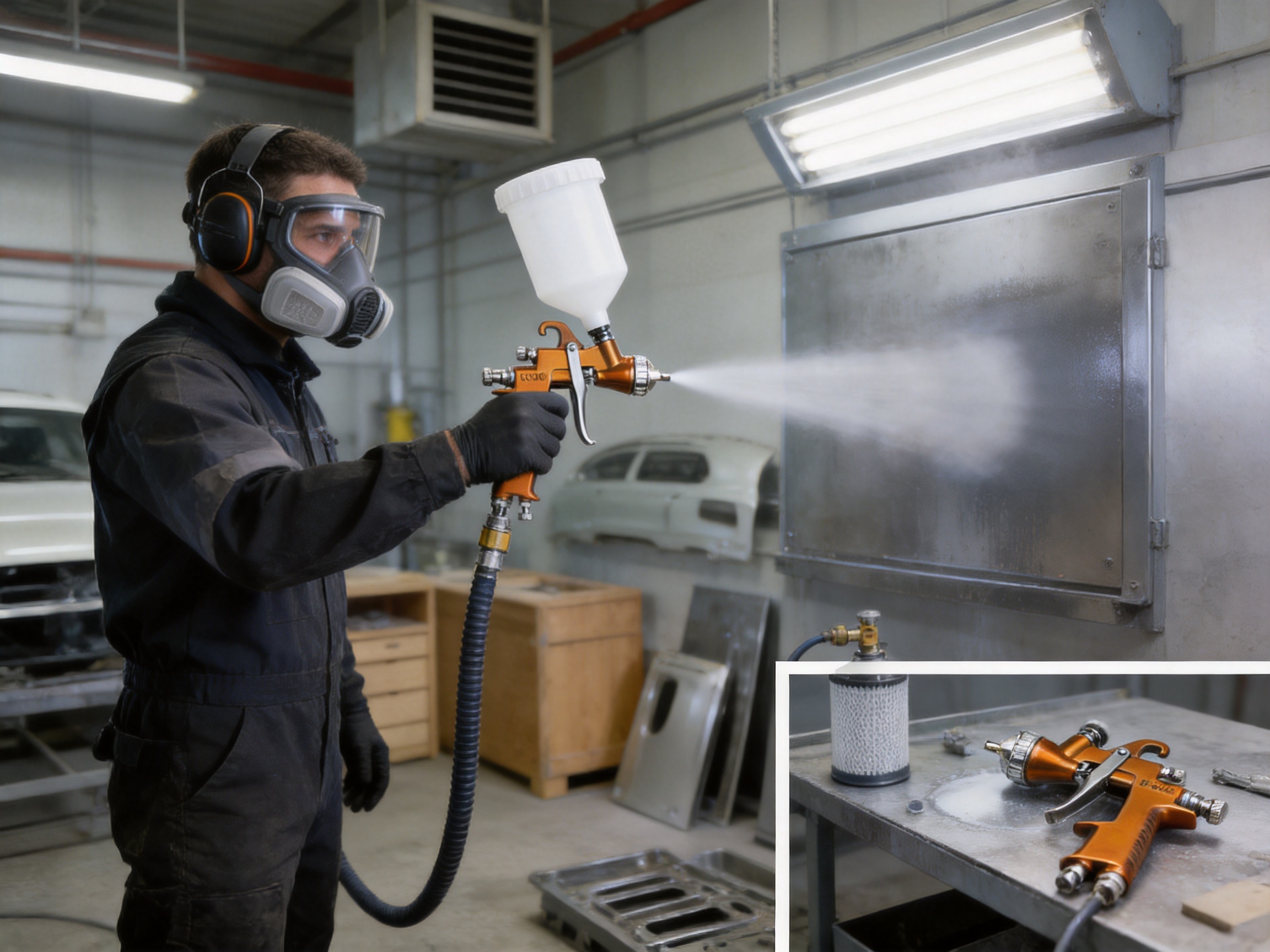
Spraying coatings can involve flammable solvents, harmful vapors, fine aerosols, and pressurized air. The W400 should be used only in a properly ventilated area with suitable fire-prevention controls and personal protective equipment.
Operators should wear appropriate respiratory protection, eye protection, gloves, protective clothing, and hearing protection when required. The exact equipment depends on the coating, solvent, work environment, and local regulations.
Never point a pressurized spray gun at people or animals. Disconnect and depressurize the air supply before disassembly, cleaning, or repair. Keep ignition sources away from flammable coatings and solvents. Grounding and electrostatic precautions should be followed where applicable.
Compressed air should never be directed at skin or clothing. Air injection injuries can be serious even when the skin appears undamaged. Operators should also avoid spraying in enclosed areas without appropriate extraction and air-quality controls.
14. Advantages for Distributors and Industrial Buyers
The W400 is not only a tool for individual operators; it can also serve as a practical product for importers, distributors, workshops, and industrial purchasing departments.
Broad Market Positioning
The product can be positioned for automotive repair, furniture finishing, metal fabrication, maintenance, general contracting, and professional workshop use. This broad application range can help distributors serve several customer groups with one core model.
Configuration Flexibility
Offering 1.4 mm, 1.6 mm, and 2.0 mm nozzle options makes it easier to create product packages for different markets. A distributor may supply a fine-finish configuration, a general-purpose configuration, or a higher-flow configuration depending on customer needs.
Coordinated Product Supply
Because the manufacturer also produces compressors, air fittings, paint tanks, automatic spray guns, air brushes, polishing tools, and other spraying products, buyers may be able to coordinate related equipment through one supply relationship. This can simplify sourcing, packaging, technical communication, and after-sales support.
International Experience
The company reports sales and business relationships in Europe, North America, the Middle East, South Africa, and East Asia. International experience can help a manufacturer understand differing market requirements, packaging expectations, certification questions, and customer-service needs.
Long-Term Cooperation
The manufacturer states that many customers have developed strong and long-term strategic partnerships with the company. For professional buyers, continuity of supply and communication can be as important as the initial product price. A stable manufacturing partner can support replacement parts, repeat orders, product changes, and customized requirements.
15. Sustainability and Responsible Manufacturing
Responsible spraying involves more than equipment durability. Material waste, solvent use, overspray, cleaning waste, energy consumption, and worker exposure all affect the environmental profile of a finishing operation.
A properly adjusted spray gun can help users apply material more efficiently and reduce unnecessary overspray. The operator's technique remains decisive, but a stable gun with suitable nozzle options can support more controlled application.
The manufacturer reports ISO14001 environmental-management certification. Such a system generally provides a framework for identifying environmental impacts, establishing controls, monitoring performance, and improving processes. Buyers interested in environmental compliance should request current documentation relevant to their purchasing requirements.
Users can also improve environmental performance by selecting coatings with suitable solvent or water-based characteristics, maintaining efficient air systems, using transfer-efficient application techniques, and managing cleaning solvents responsibly.
16. How the W400 Supports Consistent Finish Quality
Finish quality is the result of a complete process rather than a single component. Surface preparation, material mixing, filtering, air quality, pressure, nozzle selection, spray technique, drying conditions, and cleaning all contribute to the final result.
The W400 supports this process through its adaptable nozzle range and gravity-feed layout. A user can select a nozzle that corresponds more closely to the material instead of treating every coating in the same way. The 600 ml cup supports controlled batch preparation, and the heavy-duty format is suited to repeated professional use.
Consistency is especially important in production environments. If the same gun model, nozzle size, pressure reference, material ratio, and operating procedure are used across a team, it becomes easier to train operators and reproduce results. Standardization can reduce rework and simplify troubleshooting.
For the best results, users should document successful settings for each coating. Records may include nozzle size, reduction ratio, air pressure, fan setting, spray distance, overlap, number of coats, and drying time. This information can help new operators achieve acceptable results more quickly.
17. Comparison with Alternative Spray-Gun Categories
The W400 should be selected according to the application rather than simply compared by price. Different spray-gun categories are designed for different purposes.
Compared with Small Touch-Up Guns
Small touch-up guns are useful for narrow areas and minor repairs, but their cups and material capacity may be limited for larger surfaces. The W400's 600 ml cup and multiple nozzle options make it more practical for medium-sized jobs and repeated workshop use.
Compared with Suction-Feed Guns
Suction-feed guns can be useful in certain applications, especially where a larger or lower-mounted container is preferred. However, gravity-feed designs are often convenient for small batches, material changes, and efficient use of the coating remaining in the cup.
Compared with Pressure-Feed Systems
Pressure-feed systems are often selected for high-volume production and large-area coverage. They may be less convenient for small jobs, color changes, or mobile repair work. The W400 provides a simpler, more portable alternative for users who do not need a remote pressure tank.
Compared with Electric Sprayers
Electric sprayers can be convenient where compressed air is unavailable, but pneumatic spray guns offer a different operating experience and may integrate more naturally into workshops that already use compressors and air tools. The W400 is most appropriate where a reliable compressed-air system is available.
Compared with Low-Cost General Guns
Low-cost general-purpose guns may have limited component choices, less manufacturing consistency, or less support for professional use. The W400 is positioned around heavy-duty operation, nozzle flexibility, factory testing, and the broader engineering resources of an established spraying-equipment manufacturer.
18. Troubleshooting Guide
| Observed Problem | Possible Cause | Recommended Check |
|---|---|---|
| Uneven spray pattern | Blocked or damaged air cap or nozzle | Clean and inspect the air cap and fluid nozzle |
| Coating too wet | Excessive fluid flow, low gun speed, or gun too close | Reduce fluid, increase movement speed, or adjust distance |
| Dry or rough finish | Low material flow, excessive distance, or high air pressure | Check nozzle, pressure, distance, and coating reduction |
| Intermittent spray | Low material level, blocked passage, or loose connection | Check cup, fluid path, nozzle, and fittings |
| Air leakage | Loose fitting, damaged seal, or incorrect assembly | Depressurize, inspect seals, and tighten correctly |
| Trigger feels stiff | Contamination, dried coating, or insufficient maintenance | Clean the trigger area and inspect moving parts |
Troubleshooting should always begin with the simplest checks: material condition, cup level, nozzle cleanliness, air pressure, hose connections, and gun distance. If the problem continues, the gun should be removed from service for a more detailed inspection.
19. Purchasing and Support Considerations
When purchasing the W400, buyers should confirm the desired nozzle size, cup configuration, packaging requirements, air fittings, replacement parts, and destination-market documentation. Different applications may require different accessories or spare-component packages.
For bulk orders, buyers may also discuss labeling, carton marks, manuals, inspection procedures, color requirements, and delivery schedules. OEM and ODM customers should provide clear drawings, samples, technical specifications, and acceptance criteria to reduce the possibility of misunderstandings.
Technical support is particularly important for spray equipment because customers may need guidance on nozzle selection, air-system compatibility, cleaning procedures, spare parts, and coating applications. The manufacturer's specialization in spraying solutions provides a suitable foundation for this type of support.
For inquiries, the company provides the email address [email protected] and telephone number +86-574-88068716. The company address is Hengxi Industrial Zone, Yinzhou Borough, Ningbo, China, 315131.
20. Conclusion
The W400 gravity-feed spray gun is designed for users who need a versatile and dependable pneumatic tool for professional finishing. Its heavy-duty category, 600 ml cup, G1/4-inch air inlet, 50 PSI reference pressure, and three fluid-nozzle options provide a practical combination for workshop and industrial applications.
Its principal advantage is adaptability. The 1.4 mm, 1.6 mm, and 2.0 mm nozzles allow users to select a configuration for finer finishes, general-purpose spraying, or higher material flow. The gravity-feed system supports convenient material handling, while the cup capacity is suitable for many medium-sized jobs without the complexity of a separate pressure tank.
The product is also supported by a manufacturer with a long history in spray-equipment production, a substantial factory base, research and development resources, OEM and ODM capabilities, international market experience, and quality-management practices covering inspection, process control, functional testing, and final review.
As with any spray gun, final performance depends on correct coating preparation, air quality, pressure, nozzle selection, operator technique, cleaning, and safety practice. When these factors are managed properly, the W400 can help users achieve efficient material application, repeatable coverage, and professional surface results across automotive, woodworking, metalworking, maintenance, and general workshop applications.
Questions and Answers
What type of spray gun is the W400?
The W400 is a heavy-duty, gravity-feed pneumatic spray gun. It uses compressed air to atomize coating material supplied from an upper cup.
What nozzle sizes are available?
The available fluid nozzle sizes are 1.4 mm, 1.6 mm, and 2.0 mm. The appropriate size depends on coating viscosity, desired finish, material flow, and application area.
What nozzle should be used for fine finishing?
The 1.4 mm nozzle is generally the most suitable starting option for fine finishes and thinner coatings, provided the coating manufacturer permits spray application through that size.
Which nozzle is best for general-purpose work?
The 1.6 mm nozzle offers a balanced configuration for many general workshop coatings. Users should still test the material and adjust pressure and fluid flow before final spraying.
When should the 2.0 mm nozzle be selected?
The 2.0 mm nozzle may be selected for thicker compatible coatings, primers, and applications requiring greater material delivery. The operator should control gun speed and distance carefully to avoid excessive film thickness.
What is the cup capacity?
The cup capacity is 600 ml. This capacity is suitable for many medium-sized jobs while keeping the gun more manageable than a large pressure-fed system.
What is the air inlet size?
The W400 uses a G1/4-inch air inlet. The user should verify fitting compatibility and thread standards before connecting the gun to an air hose.
What air pressure does the W400 use?
The listed air pressure is 50 PSI. The actual setting should be confirmed at the gun and adjusted according to the coating, nozzle, air system, and application requirements.
Can the W400 be used for woodworking?
Yes. It may be suitable for compatible stains, sealers, lacquers, paints, and clear finishes used on furniture, cabinets, trim, and other wood products. Material compatibility and proper surface preparation are essential.
Can the W400 be used for automotive work?
It can be considered for compatible automotive primers, color coats, clear coats, and repair applications. Automotive coatings must be applied in an appropriate controlled environment with suitable respiratory protection and ventilation.
Is the W400 suitable for industrial maintenance?
Yes. Its heavy-duty positioning, gravity-feed configuration, and nozzle flexibility make it suitable for many maintenance and equipment-refinishing tasks.
What kind of compressor is required?
The compressor must provide sufficient air volume at the required pressure for the selected nozzle and coating. Buyers should consult the application requirements and verify pressure at the gun rather than relying only on the compressor gauge.
How should the W400 be cleaned?
Remove unused coating, rinse the cup, clean the fluid passage, remove and clean the air cap and nozzle, inspect seals, and reassemble the gun correctly. Use cleaning materials compatible with the coating and equipment.
Why is filtering the coating important?
Filtering removes lumps and particles that can block the nozzle or distort the spray pattern. It is especially important when using finer nozzle sizes.
Does the manufacturer provide OEM and ODM services?
The manufacturer states that it can produce according to customer drawings or samples for OEM projects and develop products according to customer requirements for ODM projects.
What quality certifications are associated with the manufacturer?
The manufacturer reports ISO9001, ISO14001, and OHSAS18001 management-system certifications, as well as CE and German GS product certifications. Customers should request current documentation for the specific product and market.
Where is the manufacturer located?
Ningbo Lis Industrial Co., Ltd. is located in Hengxi Industrial Zone, Yinzhou Borough, Ningbo, China.
How can buyers request product information?
Buyers can contact the manufacturer through [email protected] or by telephone at +86-574-88068716. They should provide the intended application, coating type, required nozzle size, estimated order quantity, and destination market.
References
1. Ningbo Lis Industrial Co., Ltd., W400 product specifications and product-category information.
2. Ningbo Lis Industrial Co., Ltd., corporate profile, manufacturing capabilities, certifications, and company history.
3. International Organization for Standardization, quality-management principles and ISO 9001 guidance.
4. International Organization for Standardization, environmental-management principles and ISO 14001 guidance.
5. General professional practice for pneumatic spray-gun setup, coating preparation, compressed-air filtration, and equipment maintenance.
6. General occupational-safety guidance for compressed air, solvent-based coatings, ventilation, personal protective equipment, and spray-finishing operations.
7. Coating manufacturers' technical data sheets for nozzle selection, reduction ratios, operating pressure, application distance, and drying conditions.