 Search

 English
 中文简体
 Deutsch
 Español
Content
- 1 1. Product Overview
- 2 2. Why HVLP Technology Matters
- 3 3. Compact Gravity-Feed Design
- 4 4. Nozzle Selection and Application Flexibility
- 5 5. Advantages Over Common Alternatives
- 6 6. Application Areas
- 7 7. Manufacturing Strengths Behind the Product
- 8 8. Quality Control Considerations
- 9 9. Operating Guidance
- 10 10. Cleaning and Maintenance
- 11 11. Safety and Responsible Use
- 12 12. Buyer and Distributor Considerations
- 13 13. Overall Product Assessment
- 14 Frequently Asked Questions
- 14.1 1. What type of spray gun is the N125?
- 14.2 2. Which nozzle sizes are available?
- 14.3 3. What is the stated operating air pressure?
- 14.4 4. Is the gun suitable for large painting projects?
- 14.5 5. What is the advantage of the 125 ml cup?
- 14.6 6. What does gravity feed mean?
- 14.7 7. What type of air connection does the gun use?
- 14.8 8. Can the gun be used with every type of coating?
- 14.9 9. Is the N125 suitable for woodworking?
- 14.10 10. How should the gun be cleaned?
- 14.11 11. Does the manufacturer offer customized products?
- 14.12 12. What quality systems are associated with the manufacturer?
- 14.13 13. Is the gun appropriate for beginners?
- 14.14 14. What should professional buyers confirm before ordering?
- 15 Conclusion
- 16 References
- 17 Product: N125 HVLP Spray Gun 0.5/0.8/1.0mm Nozzle with 125ml Cup+

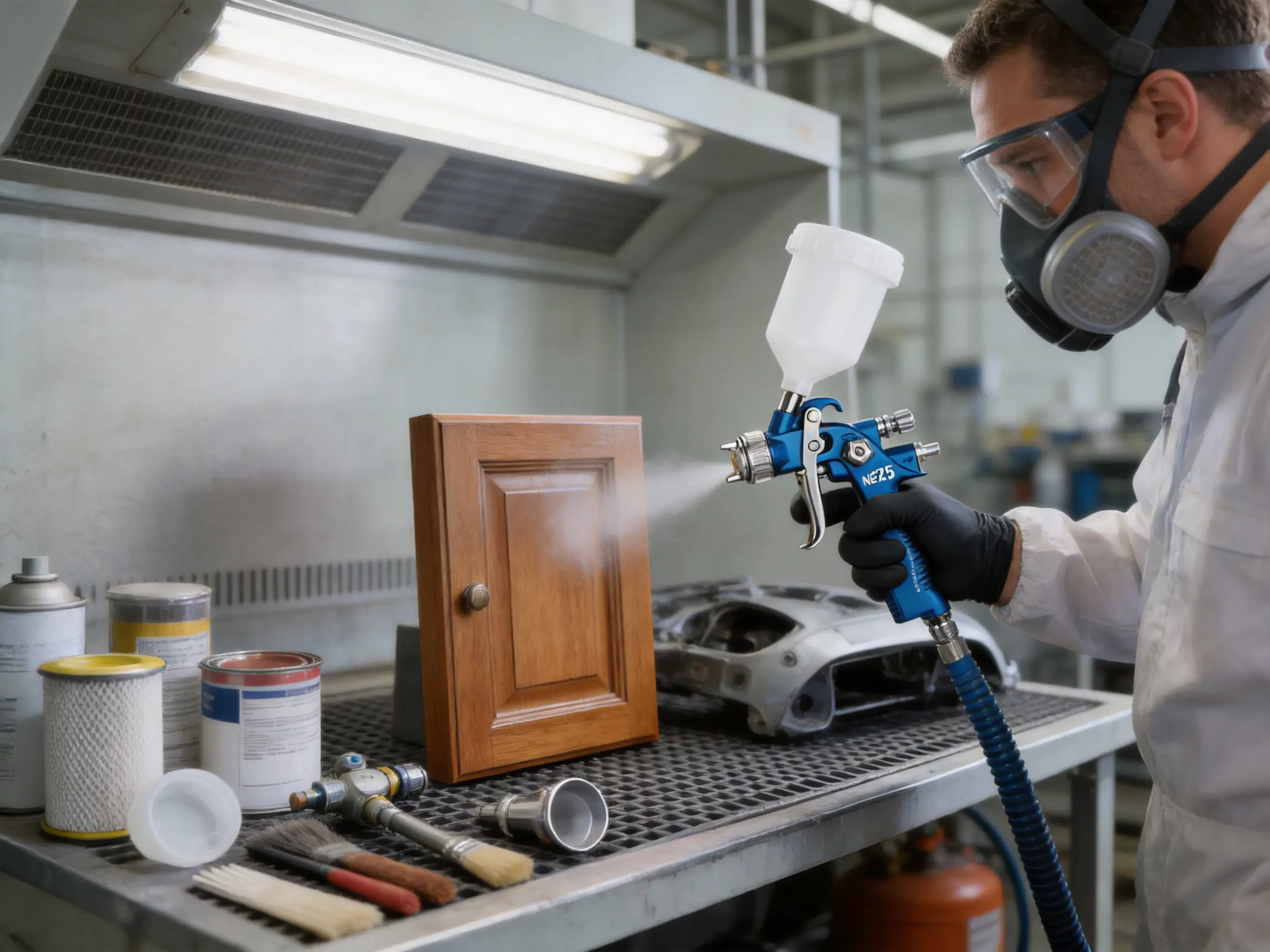
Choosing a spray gun is not simply a matter of selecting a nozzle size and connecting an air hose. The quality of the gun affects material transfer, surface finish, working speed, operator comfort, maintenance time, and the overall cost of a spraying operation. For users who need a compact gravity-feed tool for touch-up work, woodworking, light industrial finishing, detailing, and general maintenance, a well-designed HVLP spray gun can provide an effective balance between control, economy, and versatility.
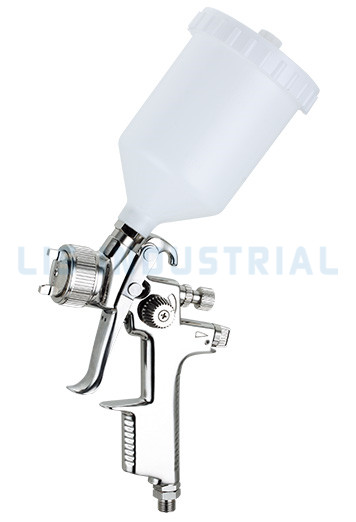
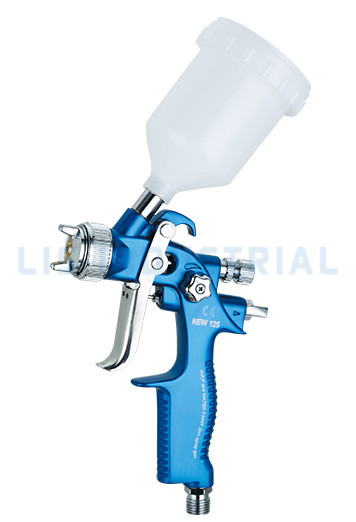
The N125 HVLP spray gun is designed around these practical requirements. It combines a compact 125 ml gravity-feed cup, interchangeable 0.5 mm, 0.8 mm, and 1.0 mm fluid nozzle options, a stated air pressure of 29 PSI, and a standard G1/4-inch air inlet. This configuration makes the gun suitable for small-area applications where accurate atomization and reduced overspray are more important than very high production volume.
Its compact format makes it particularly useful for repair shops, craft workshops, furniture touch-up, model finishing, equipment maintenance, and other applications in which a large spray gun would be unnecessarily difficult to control. At the same time, its interchangeable nozzle choices give users more flexibility than a fixed-orifice touch-up tool.
The product is manufactured by Ningbo Lis Industrial Co., Ltd., an established Chinese producer of spray guns, mini compressors, air tools, and related spraying equipment. The company’s long manufacturing history, broad product portfolio, quality-control systems, certification experience, research capability, and OEM and ODM services support the development of spraying tools for customers in different markets.
This article examines the design, operating characteristics, advantages, application range, maintenance requirements, and manufacturing strengths associated with the N125 HVLP spray gun. It also explains how the product compares with common alternatives and how buyers can evaluate whether its specifications match their particular needs.
1. Product Overview
The N125 is a high-volume, low-pressure gravity-feed spray gun intended for controlled application of paints, coatings, primers, stains, lacquers, and other compatible liquid materials. Its operating principle is straightforward: compressed air enters through the air inlet, the coating is supplied from the upper cup by gravity, and the air stream breaks the liquid into fine droplets as it leaves the nozzle.
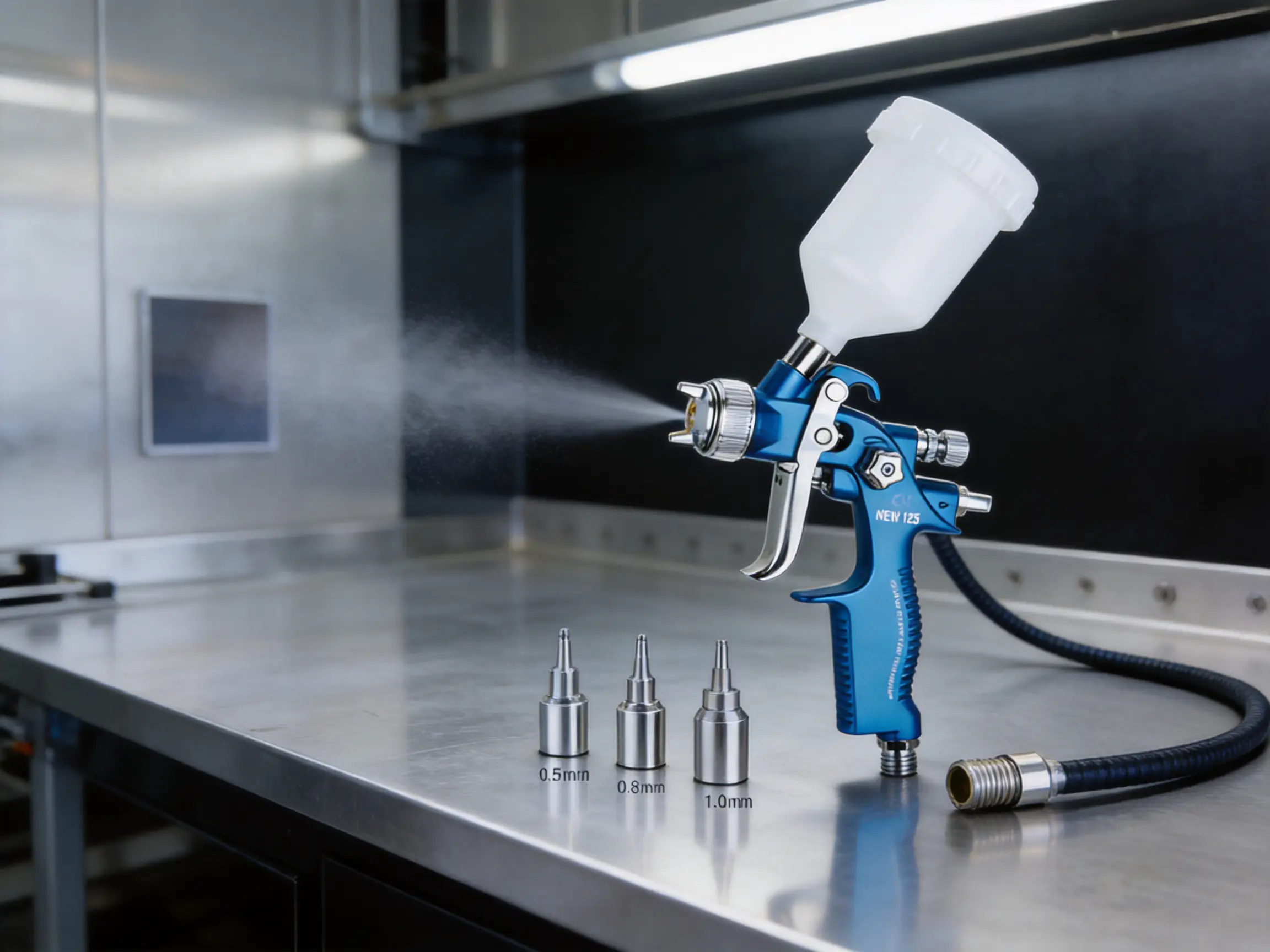
The gun is supplied with three listed fluid nozzle sizes: 0.5 mm, 0.8 mm, and 1.0 mm. These options allow the user to adapt the spray pattern and fluid delivery to different material viscosities and application requirements. The 125 ml cup is sized for short spraying tasks, localized repairs, and projects where frequent color or material changes are expected.
The principal specifications are summarized below.
| Specification | Product Detail | Practical Significance |
|---|---|---|
| Product type | HVLP gravity-feed spray gun | Suitable for controlled coating application with material supplied from an upper cup |
| Fluid nozzle options | 0.5 mm, 0.8 mm, and 1.0 mm | Supports fine detail work and light-to-medium coating applications |
| Air pressure | 29 PSI | Designed for low-pressure atomization and manageable overspray |
| Cup capacity | 125 ml | Appropriate for touch-up work and small-area projects |
| Feed type | Gravity | Helps support efficient fluid delivery with a relatively small quantity of material |
| Air inlet | G1/4 inch | Compatible with a widely used air-tool connection standard |
| Packaging information | 20 pieces per carton; carton size 53 × 28 × 39 cm | Useful for distributors, importers, and professional purchasing departments |
These specifications place the N125 between a fine-detail airbrush and a full-size production spray gun. It is larger and more capable than an airbrush for localized coating work, but more compact and economical than a conventional industrial gun intended for large panels or continuous high-volume spraying.
2. Why HVLP Technology Matters
HVLP stands for high volume, low pressure. Unlike a conventional high-pressure spray gun, an HVLP gun uses a larger volume of air at a comparatively lower pressure to atomize the coating. The objective is to create a usable spray pattern while limiting excessive air pressure that can contribute to overspray, bounce-back, and unnecessary material loss.
For many users, the most important benefit of HVLP technology is control. A lower-pressure spray stream can be easier to manage when working close to a surface or when applying a thin coating to a small component. It may also help reduce the aggressive disturbance of the wet film, particularly when the operator is learning how to balance fluid flow, fan width, gun distance, and travel speed.
HVLP technology does not eliminate overspray or guarantee perfect transfer efficiency under every condition. Results depend on the coating, viscosity, air supply, nozzle selection, spray distance, environmental conditions, and operator technique. However, a properly adjusted HVLP gun can provide a practical way to improve material control compared with many basic high-pressure alternatives.
The N125’s compact design makes these benefits especially relevant. A smaller gun is often easier to position accurately around edges, corners, recesses, trim pieces, and isolated repair areas. Users can work with less fatigue than they might experience when handling a larger gun for a small task, while the low-pressure format helps support a more controlled application process.
2.1 Reduced Material Waste
Material waste is a major concern in painting and finishing. Coatings represent a direct operating cost, and overspray can also create additional cleaning work, filtration requirements, and environmental concerns. By operating at a stated 29 PSI and using an HVLP air-cap concept, the N125 is intended to support a more measured application than many conventional high-pressure guns.
Actual savings depend on many variables. A skilled operator using the correct nozzle, suitable material viscosity, and stable air supply will normally achieve better results than an inexperienced operator using incorrect settings. Nevertheless, the gun’s low-pressure operating concept is favorable for users who want to improve transfer efficiency during small and medium touch-up jobs.
2.2 Improved Application Control
Control is particularly important when matching an existing finish or applying a coating to a visible surface. The 0.5 mm and 0.8 mm nozzle options can be used for finer application, while the 1.0 mm nozzle can provide a higher fluid delivery rate for somewhat heavier materials or broader coverage within the intended operating range.
The user should always confirm that the coating is compatible with the equipment and that the viscosity is appropriate for the selected nozzle. Thinning, if required, should follow the coating manufacturer’s instructions. Excessive thinning can reduce hiding power, alter gloss, increase runs, or affect curing, while insufficient thinning can produce poor atomization and an uneven finish.
3. Compact Gravity-Feed Design
The N125 uses a gravity-feed arrangement. The cup sits above the spray head, allowing the coating to move toward the fluid nozzle with assistance from gravity. This configuration is widely used for touch-up and finishing tools because it can operate effectively with a relatively small quantity of material.
A gravity-feed gun is often convenient when the user needs to change colors or coatings frequently. Instead of filling a large pot or connecting a remote pressure tank, the operator can prepare a limited quantity in the 125 ml cup. This reduces the amount of unused coating left in the system after a short job and makes cleaning more manageable.
The upper-cup design can also support efficient use of low volumes. Because the fluid path does not need to draw material upward from a large lower container, the gun can be practical for small batches and intermittent work. This is valuable in automotive touch-up, furniture repair, decorative work, hobby production, and maintenance operations.
The compact cup capacity should not be viewed as a limitation in every situation. For large panels, long production runs, or continuous industrial application, a larger cup, pressure pot, or automatic spray system may be more appropriate. The 125 ml capacity is instead aligned with the product’s intended role: precision, portability, and short-duration work.
3.1 Advantages for Touch-Up Work
Touch-up work often requires a tool that can be prepared quickly, controlled precisely, and cleaned without excessive downtime. A large spray gun may hold more coating than necessary and may produce a spray pattern that is difficult to manage on a small repair area. The N125 addresses this situation with a small cup and compact body.
For furniture edges, cabinet panels, small metal parts, equipment housings, motorcycle components, trim pieces, and localized automotive repairs, the gun can help the operator concentrate material where it is needed. Its nozzle options also allow users to adapt the tool instead of relying on one fixed configuration for every material.
4. Nozzle Selection and Application Flexibility
The inclusion of 0.5 mm, 0.8 mm, and 1.0 mm nozzle options is one of the product’s most useful practical features. No single nozzle can provide ideal performance for every coating. Thin materials generally benefit from a smaller fluid orifice, while thicker materials often require a larger passage to maintain a stable flow.
4.1 The 0.5 mm Nozzle
The 0.5 mm nozzle is the most suitable of the listed options for fine work within the gun’s intended application range. It may be useful for small details, thin coatings, narrow repair zones, model components, decorative work, and controlled finish application where a lower fluid output is preferred.
Because a small nozzle restricts fluid flow, it typically requires a material with suitable viscosity and careful adjustment. If the coating is too thick or contains particles that are too large, the nozzle may become more susceptible to blockage. Proper filtration and thorough cleaning are therefore especially important when using the smallest nozzle.
4.2 The 0.8 mm Nozzle
The 0.8 mm nozzle represents a flexible middle option. It can be suitable for many general touch-up coatings, stains, lacquers, and light finishing materials when properly prepared. Users who want one configuration for a variety of small jobs may find this size a useful starting point.
As with all nozzle sizes, the correct setting depends on fluid viscosity, desired film thickness, fan width, air supply, and spraying technique. The 0.8 mm option can provide a useful balance between detail and coverage, particularly when the operator does not require the smallest possible spray output or the highest possible material delivery.
4.3 The 1.0 mm Nozzle
The 1.0 mm nozzle allows a greater volume of material to pass through the fluid passage. It can be useful for somewhat heavier coatings, broader touch-up areas, primers within the gun’s capability, or applications where faster coverage is preferred.
It remains important to distinguish between a larger nozzle and a full-size production setup. A 1.0 mm nozzle increases flexibility, but the N125 is still a compact spray gun with a 125 ml cup. Users should evaluate the coating instructions and conduct a test spray before beginning the final application.
5. Advantages Over Common Alternatives
The N125 competes with several types of spraying equipment, including basic conventional spray guns, fixed-nozzle touch-up guns, disposable cup systems, airbrushes, and larger HVLP guns. Its advantages depend on the specific comparison, but several characteristics make it a practical option for users who need adaptability without moving to a more complex system.
5.1 Compared with Conventional High-Pressure Guns
Conventional high-pressure guns can provide strong atomization and may be effective for certain industrial coatings, but they can also generate more overspray and require greater control of the spray environment. The N125’s low-pressure operating approach is intended to provide a more manageable spray stream for small-area finishing.
For users working in limited spaces, repair stations, workshops, or areas where material conservation matters, an HVLP format may be more convenient. It can also be easier for less experienced operators to learn when the gun is correctly adjusted.
5.2 Compared with Fixed-Nozzle Touch-Up Guns
A fixed-nozzle gun can be inexpensive and simple, but it offers limited flexibility when the user changes materials or application requirements. The N125’s three listed nozzle options provide a broader working range and can reduce the need to purchase several separate guns for different tasks.
Interchangeability can also be valuable for distributors and service centers. A single product platform can support multiple application preferences, while replacement or additional nozzle configurations can be managed as part of a product family.
5.3 Compared with Airbrushes
Airbrushes are excellent for very fine detail, illustration, miniature work, and highly localized application. However, they may be too small or slow for many touch-up and furniture-finishing tasks. The N125 offers a larger fluid capacity and a more substantial spray capability while remaining compact enough for controlled work.
For users who need to cover a repair area efficiently rather than create extremely fine artistic detail, a small HVLP gun can be more practical than an airbrush.
5.4 Compared with Large HVLP Guns
Large HVLP guns are better suited to broad surfaces and longer production cycles, but they may consume more air and hold more coating than necessary for small projects. They can also be physically less convenient for close-up work.
The N125 offers a complementary solution. It is easier to prepare for a short task, more economical when only a small quantity of material is required, and potentially simpler to clean after localized work. Its compactness may also reduce operator fatigue during detailed applications.
6. Application Areas
The product category and specifications indicate a broad range of possible applications. Actual suitability depends on the coating manufacturer’s recommendations, but the N125 can be considered for the following types of work.
6.1 Automotive and Vehicle Touch-Up
Small automotive repairs often require controlled application rather than maximum output. The N125 may be used for localized refinishing, trim parts, motorcycle components, brackets, interior pieces, and other relatively small areas. The smaller nozzle options can support careful material placement, while the 1.0 mm option can provide more fluid flow for suitable preparatory or finishing materials.
Color matching and blending require more than the spray gun alone. Surface preparation, coating compatibility, mixing accuracy, flash-off time, environmental conditions, and final polishing all influence the result. Nevertheless, a compact HVLP tool can be an effective part of a professional or semi-professional repair process.
6.2 Furniture and Woodworking
Woodworking applications frequently involve stains, clear coats, lacquers, sealers, and paint applied to cabinet doors, trim, furniture components, decorative panels, and small assemblies. The gravity-feed cup allows the user to work with limited material quantities, which is useful when testing colors or finishing separate pieces.
The ability to change nozzle sizes can also help users adapt the gun to different coating types. Fine stains and thin clear finishes may require a different approach from heavier primers or pigmented topcoats. Operators should always test on scrap material to confirm spray pattern, fluid flow, and surface appearance.
6.3 Equipment and Industrial Maintenance
Maintenance departments often need to repair painted components, machinery covers, enclosures, brackets, tools, and other parts without setting up a large production line. A compact spray gun can be stored conveniently and prepared when required.
In such environments, portability and cleaning speed can be as important as output. The N125’s small cup and standard air inlet support a straightforward setup for intermittent maintenance work.
6.4 Decorative and Craft Projects
Craft users, sign makers, restoration specialists, and hobbyists may value the compact size and interchangeable nozzles. The tool can be used for controlled application on decorative objects, props, small furniture, models, and prepared surfaces where a brush or roller would leave an unsuitable texture.
As with all spray equipment, ventilation, respiratory protection, eye protection, and appropriate handling of flammable materials are essential. Users must follow the safety instructions for the coating being applied.
7. Manufacturing Strengths Behind the Product
A spray gun’s performance depends not only on its visible shape but also on the accuracy of its internal components, the consistency of assembly, the reliability of sealing surfaces, and the discipline of quality control. The manufacturer of the N125 has operated in the spraying-equipment industry since 1984 and has developed a broad production base for spray guns, mini compressors, and related air tools.
The company reports a facility covering more than 400,000 square feet, a workforce of more than 400 employees, and annual output valued at more than 40 million US dollars. These figures indicate the scale required to support product development, manufacturing, inspection, packaging, and international distribution across a broad product range.
Manufacturing scale alone does not guarantee quality. Its value comes from organized processes that convert capacity into repeatable performance. For a spray gun, these processes may include controlled material purchasing, incoming inspection, component machining or molding, surface treatment, assembly, air and fluid testing, appearance inspection, packaging verification, and traceable quality records.
7.1 Research and Development Capability
The manufacturer maintains a research and development team and supports both OEM and ODM cooperation. OEM production allows customers to order products according to approved drawings, samples, specifications, or branding requirements. ODM cooperation provides a broader development service in which the supplier contributes design and engineering capability according to the customer’s needs.
This capability is relevant to distributors and equipment brands that need more than a standard catalog item. They may require modified nozzle combinations, packaging changes, color and marking specifications, accessory bundles, or product adaptations for a particular market.
The company has also established a spraying machinery engineering technology center and has carried out technical cooperation with an American spraying-technology company. Such cooperation and dedicated engineering resources can support product improvement in areas such as atomization, ergonomic design, component durability, manufacturing efficiency, and application consistency.
7.2 Production Process Control
The manufacturer describes a quality system based on ISO9000 requirements. The stated control process extends from raw-material and incoming inspection through in-process quality control, 100 percent functional testing, and final inspection of finished products.
For a spray gun, these stages are particularly important. A defect in a seal, air passage, needle, nozzle, trigger mechanism, or cup connection can affect atomization and operating safety. In-process inspection helps identify problems before the product reaches final assembly, while functional testing provides an opportunity to verify that the completed gun performs as intended.
Not every quality characteristic can be judged by appearance. A gun may look acceptable while still having an air leak, unstable fluid delivery, poor needle seating, or an inconsistent spray pattern. Functional inspection is therefore a critical part of responsible manufacturing.
7.3 Certifications and Management Systems
The company reports certification and compliance experience that includes ISO9001 quality management, ISO14001 environmental management, OHSAS18001 occupational health and safety management, European CE certification, and German GS product certification for relevant products and systems.
Certifications should always be evaluated according to the exact product, model, market, and current certificate scope. Nevertheless, experience with international certification frameworks can be valuable for importers and distributors that need documentation, technical files, quality records, and consistent production procedures.
7.4 Production Capacity and Supply Support
The manufacturer states that production capacity can be increased by 30 percent within two months. For customers planning seasonal sales, promotional programs, new-market launches, or large procurement projects, scalable production can help reduce supply risk.
Capacity planning must still be confirmed for each order. Buyers should discuss forecast quantities, lead times, packaging requirements, inspection standards, spare parts, shipping schedules, and any required market documentation. A supplier’s ability to scale is most useful when supported by clear communication and structured order planning.
8. Quality Control Considerations
When purchasing a compact spray gun, buyers should assess more than the headline nozzle size. Important quality factors include trigger smoothness, thread accuracy, seal integrity, air-cap alignment, fluid-nozzle seating, cup connection strength, internal cleanliness, surface finish, and repeatability from one unit to the next.
The N125’s stated 100 percent functional-testing approach, as part of the manufacturer’s broader quality process, is a positive consideration. A distributor may also request additional inspection criteria, such as air-leak testing, sample spray-pattern evaluation, coating compatibility trials, packaging drop tests, or statistical process records.
For professional customers, spare parts and after-sales support are also important. Nozzle and needle sets, seals, cups, air caps, cleaning tools, and other wear components should be discussed before purchase. The availability of replacement parts can extend service life and reduce the total cost of ownership.
9. Operating Guidance
Correct preparation is essential for achieving the best possible result from any spray gun. Before spraying, inspect the gun, confirm that the nozzle and needle are correctly installed, check the cup and seals, and ensure that the air hose and fittings are secure.
9.1 Preparing the Coating
Prepare the coating according to its technical data sheet. Mix thoroughly, measure accurately, and filter the material when recommended. The correct viscosity depends on the product being sprayed and cannot be determined solely from the spray gun specification.
Overly thick material may produce poor atomization, an irregular pattern, or excessive fluid buildup. Overly thin material may cause runs, weak coverage, uneven color, or an altered final appearance. A small test batch can help confirm the correct preparation before the main application.
9.2 Setting the Spray Pattern
Begin with a test spray on cardboard, scrap material, or an inconspicuous area. Observe whether the pattern is evenly distributed and whether the coating is being delivered at a suitable rate. Adjust the fluid and air controls gradually rather than making large changes all at once.
The gun should generally be held at a consistent distance and kept perpendicular to the surface during each pass. Arcing the gun or changing distance during a stroke can create uneven film thickness. Overlap successive passes consistently to avoid striping and visible transition lines.
9.3 Managing Air Supply
The stated air pressure is 29 PSI, but the actual pressure at the gun can be affected by hose length, compressor capacity, fittings, regulators, and simultaneous use of other air tools. A stable and clean air supply is important for consistent atomization.
Moisture and oil contamination can damage the finish and may interfere with the operation of the spray gun. Appropriate filtration and regular compressor maintenance are recommended, especially when applying sensitive coatings or clear finishes.
10. Cleaning and Maintenance
Cleaning should begin immediately after spraying. Dried coating can obstruct the fluid nozzle, air cap, needle, and internal passages, making later cleaning more difficult and potentially reducing performance.
Empty unused material from the cup in accordance with local disposal requirements. Flush the fluid path with a compatible cleaning solution recommended for the coating. Do not assume that one solvent is safe for every seal, cup, coating, or gun finish.
Remove and clean the nozzle and air cap carefully. Use appropriate cleaning tools and avoid damaging precision openings with hard wire or sharp objects that could alter the nozzle geometry. Wipe the needle and inspect it for residue or damage before reassembly.
Periodically inspect seals, threads, cup connections, and adjustment components. Replace worn or damaged parts rather than compensating with excessive tightening. Proper maintenance not only protects the finish quality but also helps extend the usable life of the equipment.
11. Safety and Responsible Use
Spraying coatings can expose the operator to vapors, aerosols, solvents, and flammable materials. Always review the safety data sheet for the coating and cleaning products. Use suitable respiratory protection, gloves, eye protection, and protective clothing as required.
Provide effective ventilation and keep ignition sources away from flammable materials. Do not spray toward people, animals, electrical equipment, or unprotected surfaces. Compressed air can cause injury if directed at the body, and the spray gun should never be used for cleaning skin or clothing.
Disconnect the air supply before disassembly, nozzle replacement, or maintenance. Release pressure safely and keep the equipment away from unauthorized users. The product should be operated only within the pressure, material, and environmental conditions appropriate for the tool and coating.
12. Buyer and Distributor Considerations
For individual users, the main purchase questions are likely to involve nozzle flexibility, cup size, air requirements, application suitability, and cleaning convenience. For distributors, the evaluation is broader and may include packaging, order quantity, private labeling, spare parts, documentation, certification, quality inspection, and delivery capability.
The stated carton configuration is 20 pieces per carton, with carton dimensions of 53 × 28 × 39 cm. These details can help with warehouse planning, freight calculations, and retail packaging decisions. Buyers should confirm gross weight, net weight, inner packaging, carton strength, palletization, and shipping marks when preparing a commercial order.
The G1/4-inch air inlet is a practical feature for international markets because this size is widely used in air-tool systems. Even so, regional hose and fitting standards vary, so users should verify thread compatibility and use suitable adapters when necessary.
Customers requiring customized products can discuss OEM or ODM options with the manufacturer. Possible areas of cooperation may include logo placement, product color, instruction manuals, accessory kits, nozzle combinations, retail packaging, barcode labels, and regional compliance documentation. Any customization should be confirmed through approved samples and written technical specifications.
13. Overall Product Assessment
The N125 HVLP spray gun is best understood as a compact, adaptable tool for controlled low-volume spraying. Its 125 ml gravity cup supports short jobs and reduces the need to prepare large quantities of coating. Its three nozzle options provide greater flexibility than a single fixed-nozzle design. Its 29 PSI operating specification reflects an emphasis on low-pressure atomization and manageable application.
The product is not intended to replace every large industrial spray gun, automatic spray system, or airbrush. Instead, its value lies in occupying a useful middle ground. It offers more practical coverage and fluid capacity than a fine-detail airbrush, while remaining smaller and simpler than a full-size production HVLP gun.
Its advantages are strengthened by the manufacturer’s wider capabilities. A long operating history, dedicated research and development resources, international certification experience, structured quality control, functional testing, OEM and ODM services, and scalable production capacity can provide meaningful support to professional buyers and distribution partners.
For users who need a compact spray gun for woodworking, repair, detailing, maintenance, craft, or other small-area finishing tasks, the N125 presents a balanced combination of versatility, portability, and controlled application. Proper material preparation, air management, cleaning, and operator technique remain essential, but the underlying configuration is well aligned with the practical demands of precision touch-up work.
N125 HVLP Spray Gun 0.5/0.8/1.0mm Nozzle with 125ml Cup+
Frequently Asked Questions
1. What type of spray gun is the N125?
The N125 is an HVLP gravity-feed spray gun. It uses compressed air at comparatively low pressure to atomize coating material supplied from a 125 ml upper cup.
2. Which nozzle sizes are available?
The listed nozzle options are 0.5 mm, 0.8 mm, and 1.0 mm. The smaller nozzle is generally more suitable for fine application and lower fluid output, while the larger nozzle can support greater material delivery when the coating is compatible.
3. What is the stated operating air pressure?
The stated air pressure is 29 PSI. Actual operating conditions should be checked at the gun and adjusted according to the coating, compressor, hose, and application requirements.
4. Is the gun suitable for large painting projects?
The N125 is primarily suited to touch-up work, small components, localized repairs, craft projects, and other low-volume applications. Large panels or continuous production may be better served by a larger spray gun, pressure pot, or automatic spraying system.
5. What is the advantage of the 125 ml cup?
The 125 ml cup is convenient for small jobs because it reduces the amount of coating that must be prepared and can make color changes and cleaning easier. It is especially useful when only a limited quantity of material is needed.
6. What does gravity feed mean?
Gravity feed means that the coating is stored above the spray head and moves toward the nozzle with assistance from gravity. This arrangement is commonly used for touch-up guns because it can work efficiently with relatively small amounts of material.
7. What type of air connection does the gun use?
The N125 uses a G1/4-inch air inlet. Users should confirm that their hose, regulator, and fittings match this connection or use a suitable adapter.
8. Can the gun be used with every type of coating?
No. Compatibility depends on the coating formulation, viscosity, particle size, solvent system, and manufacturer instructions. Users should consult the coating technical data sheet and test the material before beginning production work.
9. Is the N125 suitable for woodworking?
It can be considered for woodworking applications such as stains, lacquers, clear finishes, sealers, and suitable paints applied to furniture parts, cabinets, trim, and small panels. A test spray is recommended for every new material.
10. How should the gun be cleaned?
Clean the gun immediately after use. Remove remaining coating, flush the fluid path with a compatible cleaning solution, clean the nozzle and air cap carefully, wipe the needle, and inspect seals and connections before reassembly.
11. Does the manufacturer offer customized products?
The manufacturer reports OEM and ODM capabilities. Customers may discuss approved drawings, samples, branding, packaging, accessory configurations, and other project-specific requirements with the supplier.
12. What quality systems are associated with the manufacturer?
The manufacturer describes quality control based on ISO9000 requirements, including incoming inspection, in-process control, 100 percent functional testing, and final inspection. The company also reports experience with ISO9001, ISO14001, OHSAS18001, CE, and GS certification frameworks for relevant products and systems.
13. Is the gun appropriate for beginners?
Its compact design and controlled format can make it approachable for beginners, but safe and effective spraying still requires practice. Beginners should start with test material, learn the correct gun distance and travel speed, and follow all coating and compressed-air safety instructions.
14. What should professional buyers confirm before ordering?
Professional buyers should confirm nozzle configuration, cup and accessory contents, packaging, carton weight, lead time, spare parts, inspection standards, certification documents, labeling, customization requirements, and after-sales support.
Conclusion
A compact HVLP spray gun can provide significant practical value when the job requires controlled application rather than maximum production output. The N125 combines a 125 ml gravity-feed cup, three nozzle choices, a 29 PSI air-pressure specification, and a standard G1/4-inch air inlet in a format suited to touch-up and small-area finishing.
Its main advantages include flexibility, manageable size, efficient preparation for short jobs, and compatibility with a broad range of potential applications when the coating is properly selected and prepared. Compared with fixed-nozzle tools, it offers more configuration choices. Compared with large spray guns, it is easier to handle for localized work. Compared with airbrushes, it provides greater practical coverage and material capacity.
The manufacturing background behind the product adds further value. Long-term industry experience, engineering resources, structured inspection, functional testing, international certification knowledge, OEM and ODM support, and scalable production can help customers build reliable supply programs around the product.
For repair professionals, woodworking users, maintenance departments, craft operators, and distributors seeking a versatile compact spray gun, the N125 is a practical solution worthy of technical evaluation and application testing.
References
1. Manufacturer-provided product specification for the N125 HVLP spray gun.
2. Manufacturer-provided company profile and manufacturing capability information.
3. General principles of high-volume, low-pressure spray application and gravity-feed coating equipment.
4. General guidance on spray-gun cleaning, coating preparation, compressed-air safety, and personal protective equipment.
5. General quality-management principles associated with ISO9001, ISO14001, and occupational health and safety management systems.