 Search

 English
 中文简体
 Deutsch
 Español
Content
- 1 Understanding the 2-QT Paint Tank
- 2 How a Pressure-Fed Paint System Works
- 3 Principal Advantages of the 2-QT Format
- 4 Construction Features That Influence Performance
- 5 Manufacturing Quality and Process Control
- 6 Advantages Over Alternative Material Supply Methods
- 7 Application Areas
- 8 Operating Procedure
- 9 Cleaning and Maintenance
- 10 Safety Considerations
- 11 Selection Guide for Buyers
- 12 Why Manufacturer Experience Matters
- 13 Performance Factors and Best Practices
- 14 Troubleshooting Common Problems
- 15 Environmental and Economic Considerations
- 16 Q&A
- 16.1 What does 2-QT mean?
- 16.2 What is the main purpose of a paint tank?
- 16.3 Can the 2-QT tank be used with every spray gun?
- 16.4 Is a pressure tank better than a gravity cup?
- 16.5 What coatings can be used in the tank?
- 16.6 How full should the tank be?
- 16.7 How should pressure be adjusted?
- 16.8 Why is a pressure relief device important?
- 16.9 How often should the tank be cleaned?
- 16.10 Can a tank be opened while pressurized?
- 16.11 What makes this type of tank suitable for professional use?
- 16.12 Can the tank be used for OEM or private-label programs?
- 17 Conclusion
- 18 References
- 19 Product: 2-QT
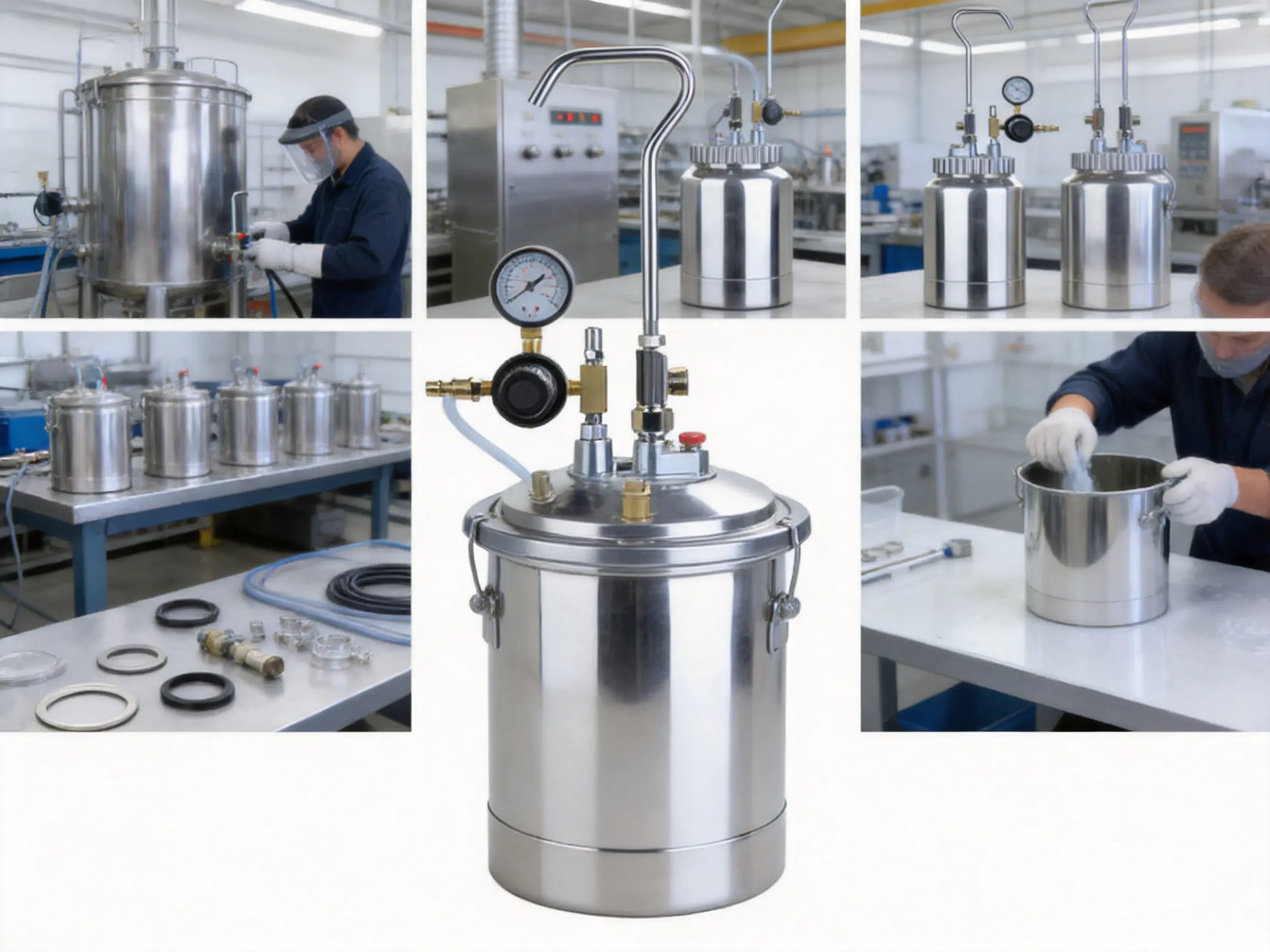
A 2-quart paint tank is a compact pressure-fed container designed to deliver coating materials from a sealed vessel to a spray gun. It is used in automotive refinishing, woodworking, metal finishing, equipment maintenance, industrial touch-up work, and many other applications where a spray gun must receive a continuous supply of paint. Compared with a conventional gravity-feed or suction-feed cup attached directly to the spray gun, a separate paint tank can improve working comfort, increase material capacity, and support a more consistent spraying routine.
The 2-QT model is especially suitable for users who need more capacity than a small gun-mounted cup but do not require a large industrial pressure pot. Its compact volume makes it practical for short and medium production runs, color changes, repair operations, furniture work, and mobile spraying tasks. The tank can be placed on a workbench, carried to a nearby work area, or integrated into a larger compressed-air spraying system.
Paint tanks are not simply storage containers. A properly designed tank is a pressure-rated delivery system. It must contain the coating material safely, maintain a stable internal pressure, provide reliable connections for air and fluid lines, and permit convenient filling, cleaning, inspection, and maintenance. The quality of its construction directly affects spray consistency, operator safety, material utilization, and the service life of the complete finishing system.
Understanding the 2-QT Paint Tank
The term “2-QT” indicates a nominal capacity of two U.S. quarts, equal to approximately 1.9 liters. In practical use, the tank should not normally be filled completely to the rim. A portion of the internal volume must remain available for air space, agitation or fluid movement, and safe pressure operation. The effective working capacity therefore depends on the coating type, filling practice, recommended operating procedure, and the instructions supplied with the individual unit.
The tank is connected to a compressed-air source and a compatible spray gun. Air pressure enters the tank through the air inlet and acts on the surface of the coating. This pressure pushes the material through the fluid outlet and along a fluid hose toward the spray gun. Separate atomizing air may also be supplied to the spray gun. At the gun, the coating is broken into fine droplets and applied to the workpiece.
This arrangement separates the material reservoir from the spray gun. The operator does not need to support a heavy cup directly beneath or above the gun, and the gun can remain relatively lightweight. The result is often improved balance, reduced wrist fatigue, and greater freedom of movement, particularly during extended spraying sessions or when the gun must be held at different angles.
A two-quart tank also offers a useful compromise between portability and productivity. A small cup may need frequent refilling, interrupting the spray pattern and creating additional opportunities for contamination. A very large tank may be unnecessarily heavy, difficult to clean, or excessive for a limited job. The 2-QT size can provide enough material for many short production tasks while remaining manageable for a single operator.
How a Pressure-Fed Paint System Works
A pressure-fed system contains several basic elements: the paint tank, compressed-air supply, regulator, pressure gauge, safety relief device, fluid hose, air hose, spray gun, and the fittings that connect these components. Each part contributes to system performance. The tank stores and pressurizes the material, the regulator controls pressure, the hoses carry air and fluid, and the spray gun controls atomization and application.
Before spraying begins, the coating is mixed and filtered according to its technical requirements. The material is placed into the tank, and the lid is secured. The air supply is opened gradually. The regulator is adjusted to establish an appropriate tank pressure, while the spray gun receives the air and fluid supply required for the selected nozzle and coating.
When the trigger is pulled, compressed air atomizes the material as it leaves the gun. The tank pressure provides the force necessary to move the coating through the fluid hose. Because the material is delivered under pressure rather than lifted by suction, the system can support a more stable fluid flow, especially when using longer fluid lines, thicker coatings, or larger fluid tips.
The operator must always follow the pressure limits and operating instructions specified for the tank, spray gun, hoses, and fittings. The safe operating pressure is determined by the complete system, not by one component alone. A pressure setting that is acceptable for one gun, hose, or coating may be unsuitable for another.
Principal Advantages of the 2-QT Format
Greater Capacity Than a Gun-Mounted Cup
A two-quart tank holds substantially more material than the small cup commonly mounted directly on a spray gun. This increased capacity reduces the number of interruptions required for refilling. Fewer refills can help maintain a continuous wet edge, reduce variation between spray passes, and improve productivity during repetitive work.
For furniture panels, vehicle sections, cabinets, doors, machinery components, and other medium-sized workpieces, a 2-QT tank can provide a convenient operating duration without creating the bulk associated with a larger production pot. The operator can prepare an appropriate amount of coating at the beginning of a job and concentrate on the application process.
Improved Gun Balance
When paint is stored in a separate tank, the spray gun itself can be lighter and easier to maneuver. The operator is not required to carry the full weight of the coating at the gun. This can be particularly valuable when spraying vertical surfaces, overhead areas, interior corners, or large panels that require repeated passes.
Reduced gun weight may also help the operator maintain a more consistent distance and angle from the surface. Consistency is important because excessive distance can produce dry spray and overspray, while insufficient distance can cause runs, sags, and uneven film thickness. A well-balanced gun can support better control throughout the work cycle.
More Stable Fluid Delivery
Pressure-fed delivery can provide a consistent flow of coating when the tank pressure, fluid adjustment, and atomizing air are properly balanced. Unlike a small suction cup, the system is less dependent on the gun being held at a particular angle. This is useful when the operator changes direction or sprays surfaces that cannot be reached from a single position.
Stable delivery is also helpful when applying materials with moderate viscosity. The exact suitability depends on the coating formulation, nozzle size, temperature, thinning procedure, and pressure setting. Users should always consult the coating supplier and spray-gun instructions before selecting operating parameters.
Flexible Hose Placement
Because the tank and gun are connected by hoses, the tank can remain in a convenient position while the operator moves the gun around the workpiece. The arrangement can improve access to large or irregular objects and reduce the need to carry a reservoir through the spray area.
Correct hose management remains essential. Hoses should be kept away from sharp edges, hot surfaces, moving machinery, and areas where they may become crushed or kinked. A properly routed hose protects the fluid supply, reduces pressure fluctuations, and helps prevent accidental damage.
Reduced Refill Interruptions
Every refill requires the operator to stop spraying, relieve pressure, open the tank, add material, and restore the system. These interruptions consume time and may introduce dust, moisture, or other contaminants. A 2-QT tank reduces the frequency of such interruptions while still allowing the operator to change colors or materials without managing an unnecessarily large vessel.
Suitability for Diverse Applications
The 2-QT format can support a broad range of finishing work. Typical applications include primer, topcoat, clearcoat, stains, lacquers, enamels, industrial coatings, wood finishes, and selected waterborne materials. Compatibility depends on the tank’s wetted materials, seals, hoses, and the chemical properties of the coating.
In automotive work, a pressure tank can support refinishing of panels and components. In woodworking, it can help apply stains, sealers, lacquer, and furniture coatings. In general manufacturing, it can deliver paint to spray guns used for metal parts, machinery housings, agricultural equipment, and fabricated assemblies. In maintenance work, it can be used for touch-up and protective coating applications where portability and controlled material supply are important.
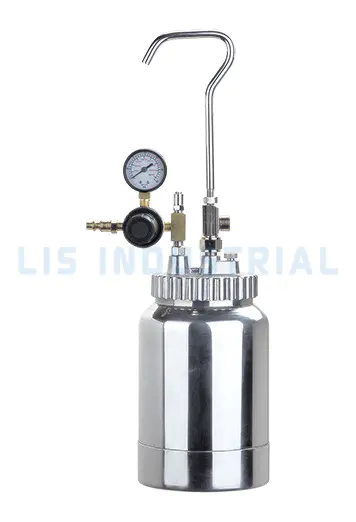
2-QT
Construction Features That Influence Performance
The performance of a paint tank depends on more than nominal capacity. The vessel body, lid, gasket, pressure regulator, gauge, fluid outlet, air inlet, safety device, and internal or external connections must work together as a reliable system. Careful attention to each feature helps improve safety, durability, and ease of use.
Pressure-Resistant Tank Body
The tank body must be manufactured from suitable material and formed to withstand the pressures specified by the design. A robust vessel resists deformation during normal operation and provides a stable foundation for the lid, fittings, and coating connections.
Metal construction is common in professional pressure tanks because it offers mechanical strength and resistance to impact. The internal surface should be suitable for contact with the intended coating materials, while the exterior finish should help protect the tank from corrosion and workshop wear. Surface preparation, coating quality, weld integrity, and final inspection all influence long-term reliability.
Secure Lid and Sealing System
The lid creates the closed chamber required for pressure delivery. A reliable lid should be easy to position, secure firmly, and remove without unnecessary effort after the pressure has been fully released. The sealing gasket must maintain contact around the lid perimeter and resist deterioration caused by the coatings and cleaning agents used in the application.
A damaged, hardened, swollen, or incorrectly positioned gasket can cause air leakage. Leakage may lead to unstable tank pressure, reduced material flow, wasted compressed air, and poor spray performance. Regular inspection of the gasket and lid sealing surface is therefore an important part of routine maintenance.
Pressure Regulation
A regulator allows the operator to control the pressure applied to the coating. Precise pressure adjustment is essential because excessive tank pressure may increase material flow, overspray, and solvent evaporation, while insufficient pressure may cause weak or inconsistent delivery.
The regulator should respond smoothly and remain stable during operation. It should be adjusted gradually rather than opened abruptly. Pressure readings should be observed while the system is operating because static pressure and working pressure may differ depending on airflow, hose length, coating viscosity, and gun settings.
Pressure Gauge
A clear gauge enables the operator to monitor tank pressure during setup and spraying. The gauge should be positioned so it can be read without placing the operator in an awkward or unsafe position. The scale should be appropriate for the intended pressure range, with markings that permit practical adjustment.
Gauges should be protected from impact, coating contamination, and excessive vibration. If the gauge reading becomes unstable, fails to return to zero, or appears inconsistent with system behavior, the equipment should be inspected before further use.
Safety Relief Device
A pressure relief device is an essential safety component. It is designed to release pressure if the system approaches an unsafe condition. It must never be blocked, removed, adjusted without authorization, or replaced with an unsuitable component.
Operators should understand that a relief device is not a substitute for correct regulation and inspection. The tank must still be operated within its specified limits, and all connected components must be rated for the same application. Safety procedures should be followed every time the tank is filled, pressurized, cleaned, or stored.
Fluid and Air Connections
The air inlet and fluid outlet should provide secure, leak-resistant connections. Fittings must match the hoses and accessories used in the spraying system. Incompatible threads, damaged sealing surfaces, loose couplings, and excessive use of sealing materials can create leaks or restrict flow.
Connections should be tightened correctly without over-tightening. Excessive force may damage threads, distort fittings, or make future service difficult. Before each use, the operator should check the hoses, couplers, fittings, and clamps for wear or damage.
Manufacturing Quality and Process Control
A high-quality paint tank is the result of controlled manufacturing rather than a single fabrication step. The process normally includes material selection, component forming, welding or joining, surface treatment, assembly, pressure-related inspection, functional testing, and final quality control.
Material Selection
Materials are selected according to mechanical strength, corrosion resistance, compatibility with coatings, manufacturability, and service requirements. The tank body, lid, fittings, gasket, and fluid path may require different materials or surface treatments.
Material consistency is important because variations in thickness, hardness, or surface condition can affect forming, welding, sealing, and durability. A disciplined incoming inspection process helps ensure that components meet the specifications established for production.
Precision Forming and Fabrication
The tank body must be formed accurately so that the lid, gasket, fittings, and support features align correctly. Poor dimensional control may cause uneven sealing, difficult assembly, or stress concentrations. Modern production methods can combine dedicated tooling, controlled forming operations, and inspection fixtures to maintain repeatability across large production quantities.
Where welded construction is used, weld quality is particularly important. Welds must be continuous and appropriately finished for the intended pressure service. Production personnel should control welding parameters, joint preparation, cleaning, and inspection. Defects such as pinholes, incomplete fusion, excessive spatter, or distortion can compromise performance.
Surface Treatment and Corrosion Protection
Surface preparation helps remove oil, scale, residue, and other contaminants before coating or finishing. A properly prepared exterior surface improves adhesion and appearance. Corrosion protection is valuable in workshops where the tank may encounter moisture, solvent vapors, cleaning chemicals, and airborne contaminants.
The internal surface also deserves attention. It should be smooth enough to support cleaning and should not contain unnecessary recesses where coating material can accumulate. Easy cleaning is more than a convenience; it helps prevent color contamination, material buildup, and blockages in the fluid path.
Controlled Assembly
Assembly procedures should ensure that regulators, gauges, relief devices, gaskets, fittings, and hoses are installed correctly. Components that appear similar may have different specifications, so traceable assembly instructions and trained personnel are important.
Sealing components should be installed without cuts, twisting, or excessive compression. Threads should be clean, and connection points should be checked for proper engagement. A controlled assembly process reduces the risk of leaks and improves consistency between units.
Functional and Pressure-Related Testing
Testing should verify that the tank performs as intended before shipment. Typical checks may include visual inspection, connection verification, leak testing, regulator operation, gauge response, relief-device installation, lid sealing, and fluid delivery evaluation.
Testing procedures should be based on recognized internal standards and applicable regulatory or customer requirements. The exact test method depends on the design and market. Records of inspection and testing can support traceability and help manufacturers identify process improvements.
Quality Management
A professional manufacturer benefits from an organized quality-management system that controls incoming materials, production operations, inspection points, nonconforming products, corrective actions, and final release. The supplied company information describes a long-established Ningbo manufacturer with extensive experience in spray guns, air tools, compressors, and related spraying equipment. Its reported quality approach includes raw-material inspection, process control, functional testing, and final inspection.
This type of integrated experience is valuable because a paint tank is part of a complete spraying solution. Knowledge of spray guns, air compressors, fittings, regulators, and fluid delivery allows the manufacturer to evaluate the tank in relation to the broader system rather than treating it as an isolated container.
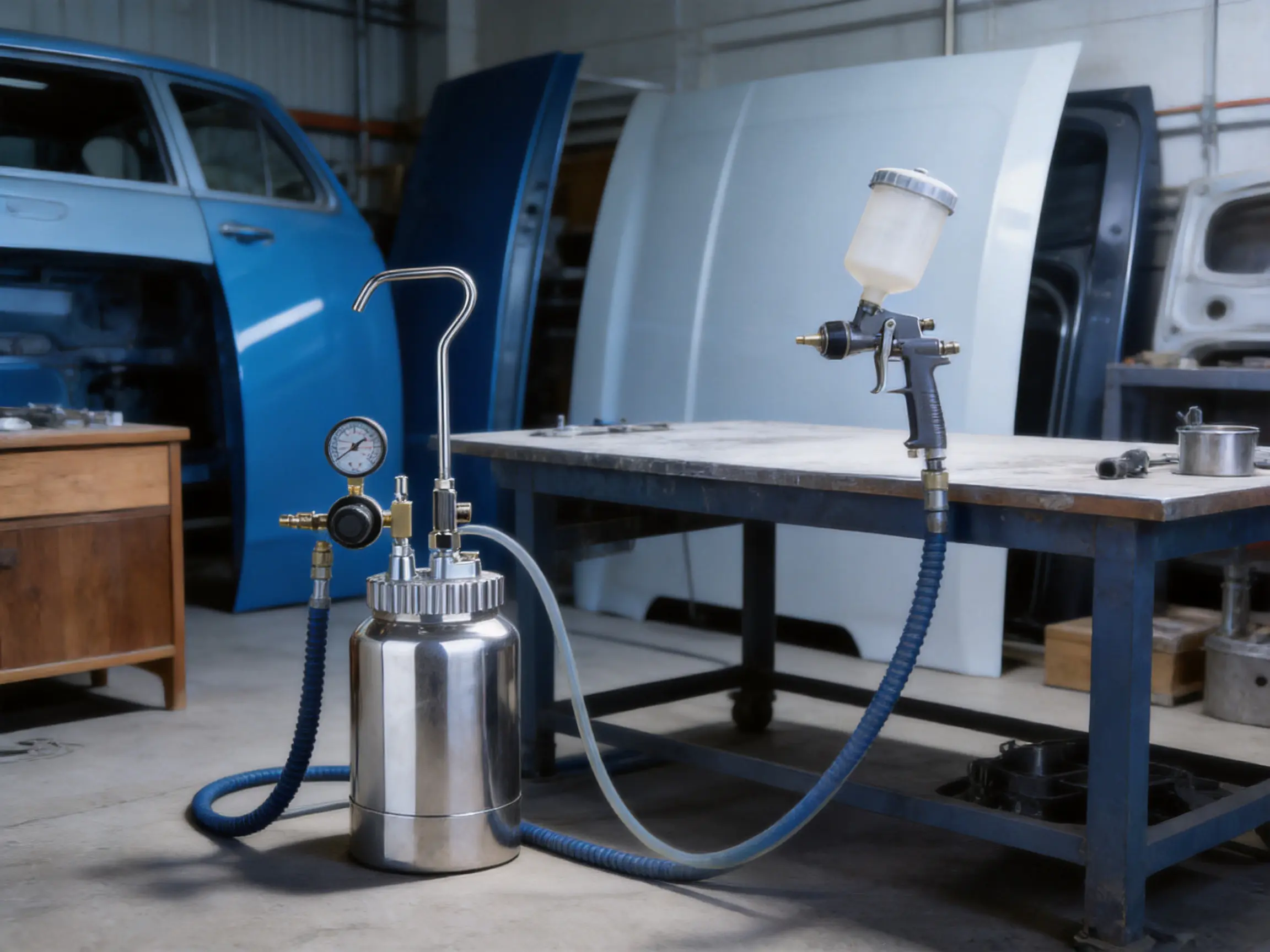
Advantages Over Alternative Material Supply Methods
Compared With Small Gravity Cups
A gravity-feed cup is convenient, simple, and useful for many small jobs. However, its capacity is limited, and the weight of the coating remains attached to the gun. As the cup empties, the balance changes. The operator may also need to stop frequently to refill the cup.
A 2-QT tank provides greater capacity and moves the reservoir away from the operator’s hand. It can therefore be preferable for longer application periods, larger surfaces, and situations where stable gun balance is important. The trade-off is that the tank system requires hoses, pressure regulation, cleaning, and more careful setup than a basic cup.
Compared With Suction-Feed Systems
Suction-feed guns draw material upward from a container beneath the gun. They can be practical and economical, but their performance may be influenced by the material level, gun angle, fluid viscosity, and suction capability. A pressure-fed tank pushes material to the gun, which may provide more consistent delivery under demanding conditions.
Pressure feeding can also support larger fluid tips and coatings that are difficult to draw efficiently through a suction arrangement. Nevertheless, the operator must choose the correct pressure and atomization settings to avoid excessive material flow or overspray.
Compared With Large Pressure Pots
Large pressure pots can support high-volume production, multiple spray guns, or extended operating periods. However, they occupy more space, require more material to charge, and may be less convenient for short jobs or frequent color changes. A two-quart model is easier to handle when the required coating quantity is moderate.
The smaller format may also reduce cleaning time and material waste after a job. For workshops that perform varied work rather than uninterrupted mass production, a compact tank can provide an efficient balance between capacity and flexibility.
Compared With Disposable Containers
Disposable liners and containers can simplify certain cleanup operations, but recurring consumable costs may be significant. A reusable pressure tank can provide long-term value when it is properly maintained. It also offers a durable, standardized platform for repeated use.
The most suitable choice depends on the coating, production volume, environmental policy, cleaning facilities, and total operating cost. The 2-QT tank is particularly attractive where operators value reusability, controlled pressure delivery, and compatibility with existing professional spray equipment.
Application Areas
Automotive Refinishing
In automotive refinishing, a pressure-fed tank can supply primer, color coat, clearcoat, and selected specialty materials to a spray gun. The separate tank can help the operator move smoothly around panels and reduce the physical burden of a full gun-mounted cup.
Automotive coatings often require careful mixing, filtration, and control of film thickness. The tank should be cleaned thoroughly between materials, especially when changing from a dark color to a light color or from a pigmented coating to a clear finish.
Woodworking and Furniture Finishing
Woodworking operations frequently involve repeated spraying of cabinets, furniture panels, doors, trim, and assembled components. A pressure tank can deliver stains, sealers, lacquer, enamel, and other compatible finishes while keeping the spray gun relatively light.
Wood finishes can contain solids that settle over time. The operator should follow the coating manufacturer’s instructions for agitation, periodic mixing, filtration, and viscosity adjustment. If the material settles in the tank, the spray pattern and color may change during the job.
Metal Fabrication
Fabricators may use pressure-fed systems for machinery parts, frames, brackets, enclosures, tools, and other metal products. The tank can support primers and protective coatings where a continuous supply is useful and where a gun-mounted cup would require frequent refilling.
Metal surfaces must be properly cleaned and prepared before coating. Oil, rust, moisture, and abrasive residue can affect adhesion and may also contaminate the tank or fluid line if preparation is incomplete.
Industrial Maintenance
Maintenance departments often perform varied, short-duration coating tasks. A compact two-quart tank can be stored conveniently and prepared for touch-up work, repair coating, or protective finishing. Its capacity is sufficient for many localized jobs without requiring a large production vessel.
Decorative and Specialty Work
Artists, sign makers, model builders, and specialty fabricators may use pressure-fed systems when they need greater material capacity than an airbrush cup or small spray gun reservoir. The appropriate nozzle, pressure, and coating preparation must be selected carefully to maintain detail and prevent excessive overspray.
Operating Procedure
Preparing the Material
Read the coating manufacturer’s technical information before preparing the material. Mix the coating thoroughly, add thinner or reducer only when permitted, and filter the material before placing it in the tank. Filtering helps remove skins, particles, unmixed solids, and other contaminants that could block the fluid passage or damage the spray pattern.
Do not fill the tank beyond the recommended level. Leave sufficient headspace and ensure that the material is suitable for the tank’s internal components, gasket, hoses, and fittings.
Inspecting the Tank
Before filling, inspect the tank body, lid, gasket, pressure gauge, relief device, air inlet, fluid outlet, hoses, and couplings. Confirm that the lid sealing surface is clean and that the gasket is correctly seated. Check that the fluid hose is not cracked, swollen, kinked, or contaminated with hardened coating.
Connecting the System
Connect the air supply and fluid hose according to the system configuration. Confirm that the connections are secure and that the spray gun is compatible with the fluid and air requirements. The compressed-air source should be clean and dry. Water or oil contamination in the air line can affect the coating finish and may damage regulators or other components.
Adjusting Pressure
Open the compressed-air supply gradually and adjust the tank regulator to a low initial setting. Test the gun on a suitable sample surface. Increase or decrease pressure in small steps while observing the spray pattern, material flow, atomization, and overspray.
The correct setting depends on the coating viscosity, nozzle size, hose length, gun design, temperature, and desired finish. More pressure is not automatically better. Excessive pressure can create a cloud of overspray, increase material waste, accelerate solvent evaporation, and produce a dry or rough finish.
Spraying the Workpiece
Hold the gun at a consistent distance and keep it perpendicular to the surface whenever possible. Begin moving the gun before pulling the trigger, and release the trigger before stopping the movement. Maintain a controlled overlap between passes as recommended for the coating.
Watch for changes in the spray pattern. A narrowing fan, pulsing flow, spitting, or sudden loss of material may indicate insufficient pressure, a blocked filter, an empty tank, a kinked hose, an obstructed nozzle, or a leak. Stop safely and investigate rather than compensating by making a large and uncontrolled pressure adjustment.
Relieving Pressure
When the job is complete, close the air supply and relieve pressure from the tank and fluid line according to the equipment instructions. Never remove the lid while the tank is pressurized. Pressure must be fully released before opening, cleaning, changing material, or servicing any component.
Cleaning and Maintenance
Cleaning should begin immediately after use, before the coating dries inside the tank or fluid hose. Delayed cleaning can create hardened deposits that are difficult to remove and may contaminate future work. The cleaning method must be compatible with the coating and the materials used in the tank.
Remove unused material according to local waste-handling requirements. Do not pour paint, solvent, or contaminated rinse fluid into drains unless specifically permitted by applicable regulations. Use appropriate containers and follow the safety information supplied with the coating and cleaning chemicals.
After the tank is depressurized, remove the lid and clean the interior using an approved method. Pay particular attention to the lid gasket, fluid outlet, pickup area if present, fittings, and hose connections. Flush the fluid line until the discharge is clean. Avoid using tools or practices that scratch sealing surfaces or damage internal components.
Inspect the gasket after cleaning. Wipe it carefully and store it in a condition recommended by the manufacturer. Replace it if it is cut, permanently compressed, swollen, hardened, or chemically damaged. Examine hoses for softening, cracking, blisters, or discoloration.
Keep the pressure gauge, regulator, and relief device free from paint and solvent contamination. Do not immerse components unless the equipment instructions specifically permit it. Protect open connections from dust during storage, but do not seal them in a way that traps moisture.
A maintenance schedule should include routine visual inspection, leak checks, cleaning after every use, periodic examination of pressure-control components, and replacement of wear parts. The frequency of detailed service depends on use, coating chemistry, operating environment, and manufacturer recommendations.
Safety Considerations
A pressure tank must be treated as pressurized equipment. Operators should receive practical training before use and should understand the function of every control and connection. The tank should never be modified, welded, drilled, over-pressurized, or fitted with unapproved parts.
Use only hoses and fittings suitable for the pressure, coating, and application. Inspect them regularly and replace damaged components immediately. A hose that appears acceptable externally may still have internal deterioration caused by solvents or incompatible materials.
Wear suitable personal protective equipment, including eye protection, gloves, protective clothing, and respiratory protection appropriate for the coating. Spraying should be performed in a properly ventilated area or approved spray booth. Many coatings and solvents are flammable, toxic, or harmful when inhaled.
Keep ignition sources away from flammable coatings and solvents. Grounding and bonding procedures should be followed where required. Static electricity, electrical equipment, hot surfaces, and open flames can create serious hazards in a spraying environment.
Do not point the spray gun at people or animals. Never attempt to locate a leak with bare hands while the system is pressurized. High-pressure fluid can cause serious injury even when the leak appears small. Stop the system, relieve pressure, and follow proper service procedures.
Store the tank clean, dry, and protected from impact. Keep it away from unauthorized users and conditions that may damage seals, hoses, gauges, or the tank finish.
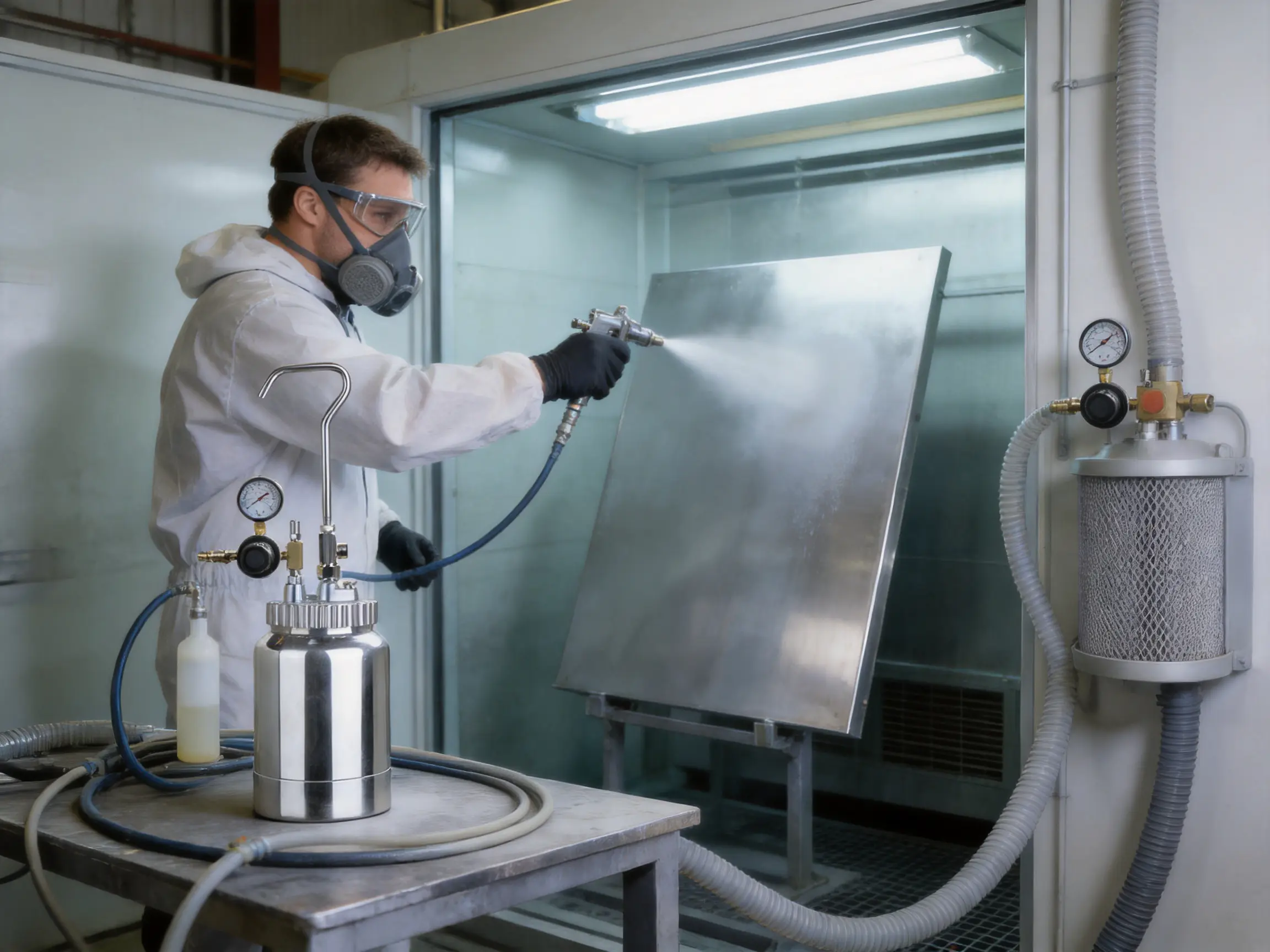
Selection Guide for Buyers
Before purchasing a 2-QT paint tank, buyers should evaluate more than capacity. The intended coating, pressure range, connection standard, spray-gun requirements, cleaning method, and service support all affect suitability.
| Selection Factor | Why It Matters | Recommended Consideration |
|---|---|---|
| Nominal capacity | Determines how much material can be prepared and delivered between refills. | Confirm the practical working capacity rather than filling to the maximum physical volume. |
| Coating compatibility | Solvents, waterborne materials, pigments, and additives can affect seals and internal surfaces. | Verify compatibility of the tank, gasket, hoses, fittings, and cleaning agents. |
| Pressure range | Controls material delivery and must remain within safe limits. | Match the tank rating with the regulator, spray gun, hose, and compressor. |
| Connection standard | Incorrect threads or couplings can cause leaks and installation problems. | Confirm the required regional or equipment-specific connection specification. |
| Gauge visibility | Allows pressure to be checked during setup and operation. | Choose a clear, readable gauge positioned for convenient monitoring. |
| Relief protection | Provides an additional safeguard against excessive pressure. | Ensure that an appropriate relief device is installed and kept unobstructed. |
| Cleaning access | Influences maintenance time and contamination control. | Look for a lid and internal arrangement that permit thorough cleaning. |
| Spare-part availability | Wear components eventually require replacement. | Confirm availability of gaskets, hoses, regulators, gauges, and fittings. |
| Application scale | Determines whether the compact tank is more practical than a larger pressure pot. | Use the 2-QT format for short and medium tasks where portability and flexibility matter. |
Why Manufacturer Experience Matters
A manufacturer with broad experience in spraying equipment can provide more than a basic pressure vessel. The supplied company information identifies Ningbo Lis Industrial Co., Ltd. as an established Chinese manufacturer involved in air painting spray guns, mini air compressors, air tools, paint tanks, fittings, and related products. Its long operating history, reported production scale, engineering resources, and international customer base indicate an ability to support products within a wider spraying ecosystem.
This integrated background can be valuable for product development. A paint tank must work with spray guns, air regulators, fluid hoses, couplers, compressors, and coating materials. A company that understands these components can better evaluate fluid delivery, air consumption, pressure stability, connection standards, and operator requirements.
The company also reports experience with OEM production based on customer drawings or samples and ODM development based on customer requirements. This can benefit distributors and industrial buyers that need private-label packaging, customized connections, application-specific configurations, or coordinated product sets. Any custom design should still be reviewed through proper engineering, testing, and regulatory processes.
Reported certifications and quality-system experience can also help support purchasing decisions. The supplied information mentions ISO9001 quality management, ISO14001 environmental management, OHSAS18001 occupational health and safety management, CE certification, and German GS product certification within the company’s broader operations. Certification relevance depends on the specific model, market, and documentation supplied with the product, so buyers should request current certificates and declarations for the exact item being purchased.
Production capacity is another consideration for distributors and professional users. The company states that its production capacity can be increased by 30 percent within two months. A scalable manufacturing base may help support repeat orders, seasonal demand, and programs requiring stable supply. Buyers should confirm lead times, minimum order quantities, packaging, inspection procedures, and delivery terms for each project.
Performance Factors and Best Practices
The tank alone does not determine the final coating result. A high-quality finish depends on the interaction of material preparation, surface preparation, spray-gun setup, air quality, pressure, operator technique, environmental conditions, and maintenance.
Use a clean and dry air supply. Install appropriate filtration and moisture separation where necessary. Contaminated air can cause fisheyes, blushing, uneven atomization, or corrosion in air components.
Keep the coating at a suitable temperature. Cold material generally becomes more viscous and may require different settings, while excessive heat can change evaporation behavior and shorten working time. Follow the coating supplier’s recommendations rather than relying only on pressure adjustments.
Use the correct nozzle and fluid setup. A small nozzle may restrict high-viscosity material, while a large nozzle may deliver excessive material for fine work. The spray gun manufacturer’s recommendations should be considered together with the coating supplier’s technical data.
Use test panels before coating the final workpiece. A test pattern can reveal whether the fan, flow, pressure, and viscosity are correctly balanced. It is more efficient to correct the setup on a sample than to repair an uneven finish on the finished product.
Troubleshooting Common Problems
Weak or Intermittent Material Flow
Possible causes include low tank pressure, an empty or nearly empty tank, blocked fluid passages, a kinked hose, an obstructed filter, excessive coating viscosity, or a loose connection. Depressurize the system before inspecting the fluid path. Confirm that the material has been mixed and filtered correctly.
Excessive Overspray
Overspray may result from excessive atomizing air, excessive tank pressure, an unsuitable nozzle, incorrect gun distance, or material that is too thin for the selected setup. Reduce pressure gradually, verify gun settings, and check the coating manufacturer’s recommendations.
Spitting or Pulsing
Spitting can be caused by an air leak, insufficient material supply, a blocked nozzle, a damaged fluid needle, loose fittings, or unstable pressure. Examine the tank gasket and connections after relieving pressure. If the problem remains, inspect the spray gun and fluid hose.
Leaking Around the Lid
A lid leak may indicate an incorrectly seated gasket, contaminated sealing surface, damaged gasket, loose lid clamps, or excessive pressure. Stop spraying, depressurize the tank, clean the sealing surfaces, and inspect the gasket. Do not continue operating a tank that cannot maintain a safe seal.
Uneven Finish
Uneven coating may result from inconsistent gun movement, incorrect overlap, unstable material flow, improper viscosity, poor air quality, or incorrect pressure. Use a test panel, verify the material preparation, and maintain a consistent gun distance and speed.
Environmental and Economic Considerations
A reusable 2-QT paint tank can contribute to efficient material handling by reducing refill interruptions and supporting controlled delivery. Stable fluid flow may help reduce defects and rework, while a separate reservoir can improve operator ergonomics during repeated spraying.
Material savings depend on the complete system and the operator’s technique. Excessive pressure, poor atomization, an incorrect spray distance, and unsuitable coating preparation can increase waste regardless of tank quality. Training and preventive maintenance are therefore important parts of an economical spraying program.
Durable construction can also reduce the frequency of equipment replacement. A tank that remains serviceable through repeated cleaning and use may offer a lower total cost of ownership than a lower-priced product with poor sealing, fragile fittings, or limited spare-part support.
Environmental responsibility includes proper storage, solvent handling, waste collection, ventilation, and disposal. Users should follow all applicable local requirements and the safety data provided for the coatings and cleaning chemicals.
Q&A
What does 2-QT mean?
2-QT refers to a nominal tank capacity of two U.S. quarts, or approximately 1.9 liters. The usable working volume may be lower because the tank should not normally be filled completely.
What is the main purpose of a paint tank?
A paint tank stores coating material under controlled pressure and delivers it through a fluid hose to a compatible spray gun. It separates the material reservoir from the gun and can provide greater capacity and improved gun balance.
Can the 2-QT tank be used with every spray gun?
No. Compatibility depends on the spray gun’s fluid and air requirements, connection standards, pressure range, nozzle configuration, and coating compatibility. Confirm the specifications of all components before connecting the system.
Is a pressure tank better than a gravity cup?
Neither system is universally better. A gravity cup is simple and convenient for small jobs, while a pressure tank offers greater capacity, reduced gun weight, and potentially more stable delivery for longer or more demanding applications.
What coatings can be used in the tank?
Many compatible primers, paints, stains, lacquers, enamels, clearcoats, and industrial coatings may be used. Compatibility must be confirmed for the specific coating, gasket, hoses, internal surfaces, and cleaning agents.
How full should the tank be?
Follow the equipment instructions and leave the required headspace. Do not fill the tank to the rim. Adequate free space is necessary for safe pressure operation and proper material handling.
How should pressure be adjusted?
Begin at a low setting and increase pressure gradually while testing the spray pattern. The correct pressure depends on the coating, viscosity, nozzle, hose arrangement, spray gun, and desired finish. Always remain within the specified safe operating range.
Why is a pressure relief device important?
The relief device provides protection if pressure rises beyond the intended level. It must remain unobstructed and should never be removed, disabled, or replaced with an unsuitable component.
How often should the tank be cleaned?
The tank, fluid hose, and spray gun should be cleaned after every use or whenever the coating is changed. Prompt cleaning helps prevent hardened deposits, color contamination, blockages, and damage to seals.
Can a tank be opened while pressurized?
No. The air supply must be closed and all pressure must be fully released before opening the lid, adding material, cleaning, or servicing the tank.
What makes this type of tank suitable for professional use?
Professional suitability depends on pressure-rated construction, reliable sealing, accurate regulation, readable pressure monitoring, safe connections, compatible materials, quality testing, available replacement parts, and consistent manufacturing. The complete system must also be used correctly.
Can the tank be used for OEM or private-label programs?
The supplied company information indicates experience with OEM production based on customer drawings or samples and ODM services based on customer needs. Buyers should discuss technical specifications, labeling, packaging, testing, documentation, minimum quantities, and approval procedures directly with the manufacturer.
Conclusion
The 2-QT paint tank is a practical pressure-fed solution for users who need more material capacity and a lighter spray gun without moving to a large industrial pressure pot. Its compact size supports short and medium production runs, automotive refinishing, woodworking, metal finishing, industrial maintenance, and specialty applications.
Its principal benefits include reduced refill interruptions, improved gun balance, flexible hose placement, stable pressure-fed delivery, and compatibility with a broad range of professional spraying tasks. These benefits are realized when the tank is correctly matched with the coating, spray gun, compressor, hoses, fittings, and operating procedure.
Manufacturing quality remains central to performance. Pressure-resistant construction, accurate forming, reliable welding or joining, effective surface treatment, durable seals, controlled assembly, functional testing, and final inspection all contribute to a dependable product. A manufacturer with experience across spray guns, compressors, fittings, and air tools can also provide valuable system-level knowledge.
For buyers, the best purchasing decision should consider capacity, coating compatibility, pressure limits, connection standards, safety devices, cleaning access, spare parts, certifications, manufacturing consistency, and after-sales support. When selected and maintained correctly, a two-quart paint tank can provide an efficient, ergonomic, and versatile material-delivery platform for professional coating work.
References
1. General principles of pressure-fed spray application and coating-material delivery.
2. Manufacturer technical information for the 2-QT paint tank product category.
3. Industrial spray-gun operating and maintenance practices.
4. Coating manufacturer guidance on viscosity, filtration, atomization, and pressure adjustment.
5. General workplace safety principles for compressed air, paints, solvents, and pressurized containers.
6. Quality-management principles for incoming inspection, process control, functional testing, and final product inspection.
7. General guidance concerning personal protective equipment, ventilation, flammable materials, and responsible waste handling.